What Is the Latest Technology in Automobiles Right Now?
The latest automotive technology buyers can use now is mostly software-driven, with features such as hands-free highway assist, over-the-air updates, driver monitoring, and EV thermal-management systems. The newest features still in limited rollout are higher-level autonomous driving and bidirectional charging, where available. Choose poorly, and you can pay for hardware that ages fast, needs subscriptions, or works only on certain roads. This guide ranks today’s newest car tech by what is available now, what is emerging, and what affects ownership cost and daily use.
What is the latest technology in automobiles right now?


What counts as new today
In broad terms, automotive technology covers powertrains, driver-assist systems, lighting, cabin software, battery systems, and connected services. The key question is not whether a feature sounds modern. It is whether you can buy it now, use it where you drive, and maintain it without surprise costs.
Current showroom tech includes driver-assistance systems, faster EV charging hardware, matrix LED lighting on some trims, over-the-air software updates, and voice-controlled cabin functions. Near-future items include wider V2X deployment, more capable AI copilots, solid-state batteries, and limited robotaxi-style features in tightly controlled areas.
Ranked by real-world usefulness
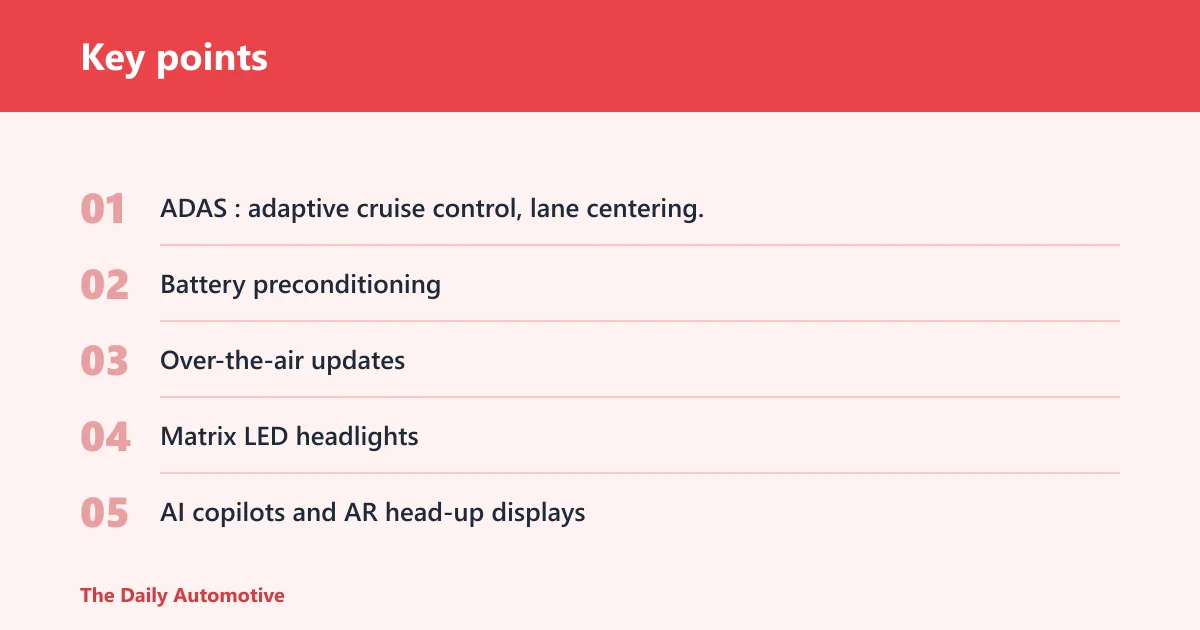
- ADAS: adaptive cruise control, lane centering, and automatic emergency braking are already useful on most roads.
- Battery preconditioning and 800-volt EV architecture: these matter a lot for EV road trips and cold-weather charging.
- Over-the-air updates: useful if the maker supports them for years and does not lock core functions behind fees.
- Matrix LED headlights: valuable at night, if legal in your market.
- AI copilots and AR head-up displays: helpful, but still limited and trim-dependent.
- V2X and solid-state batteries: important, but not mainstream for most buyers.
- Lidar-based sensing: strong on the engineering side, but often too expensive for the average buyer.
Why availability, regulation, and cost matter
Many of the newest features depend on local law, road marking quality, mapping coverage, or cellular service. Hands-free highway driving may be allowed in one region and blocked in another. Adaptive headlights may be legal in Europe but not enabled the same way in the United States. That changes the value of the option immediately.
Ownership cost matters too. Cameras and radar often need calibration after repairs. Lidar sensors can be expensive to replace. Connected features may require a subscription after a trial period. Those details matter as much as horsepower or screen size.
Simple buyer rule
Focus on features that improve daily driving without demanding perfect conditions. A commuter in heavy traffic gets real value from lane centering and adaptive cruise. A cold-climate EV shopper gets more value from preconditioning and fast-charging architecture than from flashy cabin graphics.
Which new car technologies are worth paying for today?

The best purchases today are the technologies you will use every week: strong ADAS, battery preconditioning in EVs, faster charging hardware, and a software policy that keeps updates coming. Skip options that depend on a narrow road type, a pricey subscription, or hardware that your market cannot legally use.
ADAS that deliver clear value now
Adaptive cruise control reduces fatigue in stop-and-go traffic. Lane centering helps on well-marked highways. Automatic emergency braking can reduce crash severity at low and moderate speeds. Those systems are already common on many trims, so the main question is how smooth and consistent the tuning is.
Hands-free highway systems deserve caution. They are generally not considered full autonomy. They still expect driver attention, and their operating domain is limited to approved roads, specific speeds, and supported map data. A system that works well on a divided interstate may refuse to engage on a curving state highway.
Battery preconditioning and 800-volt charging for EV shoppers
Battery preconditioning warms or cools the pack before a fast charge. That helps charging speed, especially in winter, and can cut the time spent waiting at a DC charger. It is most useful when the car ties it to navigation so the pack reaches the right temperature before arrival.
Eight-hundred-volt architecture is another real upgrade. A higher-voltage platform can support faster charging current with less heat and thinner cables than many 400-volt systems. In practice, it can replenish range faster on a compatible DC fast charger, but only if the charger and vehicle both support the same standard and power level.
Over-the-air updates and subscriptions: what to accept and what to question
Over-the-air updates are worth paying attention to because they can fix software bugs, add functions, and improve charging logic without a dealer visit. They are also a warning sign when a maker uses software to turn hardware into a recurring fee stream. Heated seats, remote start, and extra driver-assist features may be sold as subscriptions.
Security also matters. A connected car has more attack surface than a purely mechanical one. Buyers should look for clear update support periods, an easy way to see what data is collected, and a warranty policy that does not make every software issue a dealer-only event.
How have headlights and visibility tech changed?
The biggest current change in lighting is matrix LED headlights. They use software-controlled beam segments to shape light around traffic and reduce glare for other drivers. Augmented reality head-up displays are newer in the cabin, but they are not a lighting upgrade. They belong to the visibility and guidance category.
Matrix LED headlights and adaptive beam shaping
Matrix LED systems can keep more of the road lit while dimming specific zones around oncoming cars or vehicles ahead. That is more precise than a basic high beam cut-off. The benefit is strongest on dark rural roads and unlit highways.
Regional legality matters. Some markets allow adaptive beam patterns that U.S. regulations still limit or delay. Buyers should confirm that the exact headlight function on the trim is enabled in their country, not just listed in a brochure.
Glare reduction and software control
These systems are software-heavy, which means they can improve through updates but also depend on sensors staying clean and aligned. A dirty camera or miscalibrated module can reduce performance. After windshield replacement or front-end repair, recalibration may be required.
Where augmented reality head-up displays fit
An AR head-up display projects navigation prompts or lane guidance onto the windshield or a display surface near the driver’s line of sight. That can reduce the need to glance down. The risk is distraction if the graphics become busy or cluttered.
Suppose a driver enters a downtown one-way grid at night and the AR display keeps stacking turn arrows, speed warnings, and lane icons. The benefit drops fast if the information is poorly timed or visually crowded.
What is the latest technology in electric vehicles?
The latest EV technology is not one single battery breakthrough. It is a package: 800-volt architecture, battery preconditioning, faster DC charging curves, more efficient heat pumps, and software that manages charging and thermal control. Solid-state batteries matter, but they are not mainstream yet.
800-volt platforms and faster range replenishment
An 800-volt platform can reduce charging time when paired with a compatible fast charger. Many current EVs can add a meaningful amount of range in a short stop, but the exact result depends on battery state, temperature, charger power, and the car’s charge curve. Compatibility is the catch. Not every charger can deliver full benefit.
Battery preconditioning and cold-weather performance
Cold batteries charge more slowly. Preconditioning helps by bringing the pack into a better temperature range before charging begins. Navigation integration is the practical difference-maker, because the car can prepare automatically en route to a fast charger. Without it, the driver may need to trigger the feature manually.
Solid-state batteries: why they matter and why they are not mainstream yet
Solid-state batteries aim for higher energy density, faster charging potential, and better thermal stability than today’s common lithium-ion packs. Those are real advantages on paper. They could reduce fire risk and improve packaging efficiency if manufacturers solve cost, durability, and mass-production issues.
The commercialization timeline is still limited. Public announcements often point to pilot lines, small batches, or later-decade rollouts rather than full-volume showroom availability. Buyers should treat solid-state claims as future-facing unless the car is already on sale in meaningful numbers.
Two-column decision table: available now versus still emerging
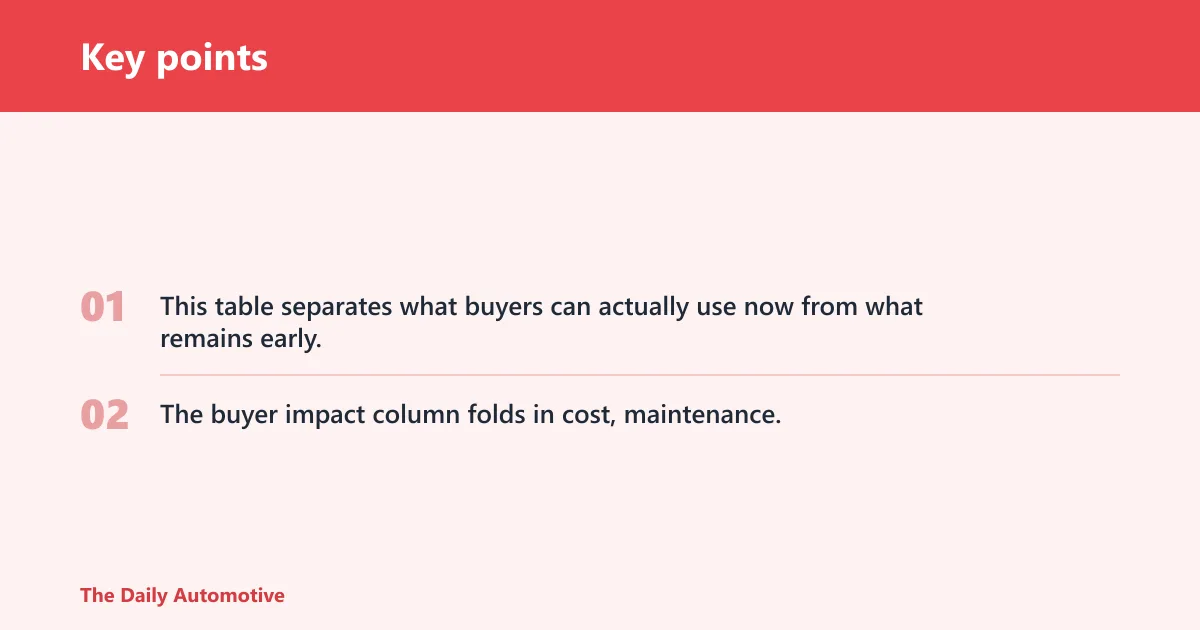
This table separates what buyers can actually use now from what remains early, restricted, or not yet widely deployed. The buyer impact column folds in cost, maintenance, and real-world usefulness so you can compare options without mixing marketing language with ownership reality.
| Technology | Status, buyer impact, and notes |
|---|---|
| ADAS | Available now. Adaptive cruise control, lane centering, and automatic emergency braking are common. Cost is often bundled into mid trims or packages. Maintenance can include camera and radar calibration after repairs. Real-world usefulness is high, but hands-free highway driving remains limited and not full autonomy. |
| Solid-state batteries | Still emerging. Promises higher energy density, faster charging, and better thermal stability. Cost should stay high at first. Maintenance is not yet well defined because volume production is limited. Real-world usefulness is future-facing, not a current buying reason. |
| 800-volt EV architecture | Available now. Supports faster DC fast-charging on compatible stations and can cut road-trip downtime. Cost is usually built into higher-end EVs. Maintenance is similar to other EVs, but charging gains depend on charger compatibility and battery temperature. |
| Matrix LED headlights | Available now in some markets. Adaptive beam shaping reduces glare and improves night visibility. Cost is usually a premium option. Repair bills can be higher because modules and cameras are expensive. Regional legality varies, so the feature may not be enabled everywhere. |
| Vehicle-to-everything (V2X) | Still emerging. Vehicle-to-vehicle and vehicle-to-infrastructure communication promise lower latency alerts, but deployment is uneven. Cost and infrastructure dependence remain major barriers. Daily usefulness is limited until more cars, roads, and agencies support the same standard. |
| Over-the-air updates | Available now. Useful for software patches and feature rollouts. Cost may be hidden in the purchase price or tied to subscriptions. Maintenance can improve if fixes arrive remotely, but security and data policies deserve close attention. |
| Automotive AI copilots | Available now, but uneven. Voice assistants can control navigation and some vehicle settings. Route planning can be useful. Cost is often built into infotainment packages. Privacy concerns matter because voice data and usage logs may be stored or processed offboard. |
| Augmented reality head-up displays | Available now on select trims. Navigation prompts can reduce eyes-off-road time, but clutter can distract. Cost is typically high. Repair and calibration can be expensive after windshield work. Real-world usefulness is good when the interface stays simple. |
| Lidar-based sensing | Still emerging for consumer cars. Strong object detection and sensor redundancy are attractive, but weather limits, dirt, and cost keep it rare. Replacement can be expensive. It may help advanced driver-assist systems, but it is not yet a mainstream ownership win. |
| Battery preconditioning | Available now on many EVs. Improves fast-charging speed and cold-weather charging behavior. Cost is usually part of the EV’s software and thermal package. Maintenance is modest, but value depends on navigation integration and whether the maker exposes the control clearly. |
What should you watch out for before you pay extra?
The main risks are not flashy. They are limits in roads, weather, regulation, and ownership cost. A feature can sound advanced and still be poor value if it depends on perfect lane markings, strong cellular service, or a subscription that starts after the first year.
Driver-assist limits
Hands-free highway systems are still supervised systems. Drivers must keep attention on the road and be ready to take over. A common first-timer mistake is assuming hands-free means no monitoring. It does not. If the car leaves its approved operating zone, the system may disengage or ask for intervention immediately.
Sensor dirt, weather limits, and lidar cost impact
Cameras, radar, and lidar all dislike dirt, ice, heavy snow, and road spray. Weather can reduce detection quality, especially for smaller objects or faded lane lines. If a front bumper sensor or roof-mounted lidar unit is damaged, replacement can be costly and may require calibration.
Privacy, software support, calibration, and repair bills
Ask how long software updates are promised, whether the maker charges for feature activation, and whether repair shops outside the dealer network can recalibrate sensors. Those questions matter more than the number of screens or menus. A feature that cannot be repaired affordably loses value quickly.
Say your EV shows a charging slowdown in January and the battery was never preconditioned. The fix may be simple if the route planner can trigger thermal prep before arrival. Without that function, the same charger can feel much slower than the sales brochure implied.
Frequently asked questions
What is the latest technology in car headlights?
Matrix LED headlights are the current high-end step forward. They use software-controlled light segments to shape the beam, reduce glare, and keep more of the road lit. Availability and legality vary by region, and repair costs can be higher than with simpler LED units.
What is the latest technology in car batteries?
For buyers, the biggest current battery-related advances are better thermal management, faster charging curves, and battery preconditioning. Solid-state batteries are the next major chemistry story, but they are not mainstream yet. Most shoppers should judge today’s battery tech by charging speed, cold-weather behavior, and warranty terms.
Which car technologies actually improve safety and convenience today?
Adaptive cruise control, lane centering, automatic emergency braking, matrix LED headlights, and over-the-air safety patches are the most practical upgrades today. They reduce fatigue and improve visibility or crash avoidance. Hands-free driving systems help in narrow use cases, but they still require attention and system awareness.
How does latest car technology affect maintenance and repair costs?
More sensors and software usually mean more calibration, more expensive replacements, and more dependency on dealer tools. Lidar and camera systems can raise repair bills after even minor damage. Subscription-based features can also add long-term cost, so the purchase price is only part of the total bill.
Products related to this article
Sponsored / affiliate links. As an Amazon Associate I earn from qualifying purchases. I may earn additional commission from eligible campaigns.