
What is the Quietest & Smoothest Riding Car: Essential Guide
The quietest and smoothest riding car focuses on advanced suspension and sound-deadening technology. Look for luxury sedans or EVs known for refined cabins, adaptive suspension systems, and generous sound insulation. These vehicles minimize road noise, engine vibrations, and impact harshness for a serene driving experience.
Driving can sometimes feel like a bumpy, noisy chore, right? Many of us dream of a car that glides down the road like a magic carpet – silent, smooth, and utterly relaxing. If you’re wondering “what is the quietest and smoothest riding car” and how to find one, you’re in the right place! It’s not just about fancy features; it’s about smart engineering that creates a peaceful sanctuary on wheels. We’ll break down what makes a car truly quiet and smooth, helping you make a choice that brings joy to your daily commute and long road trips.
Understanding Quiet and Smooth Ride Factors
So, what exactly do we mean by a quiet and smooth ride? It’s a combination of things that you feel and hear (or don’t hear!) when you’re driving. It’s about how the car handles bumps, how much engine noise reaches your ears, and how little vibration travels through the steering wheel or seats.
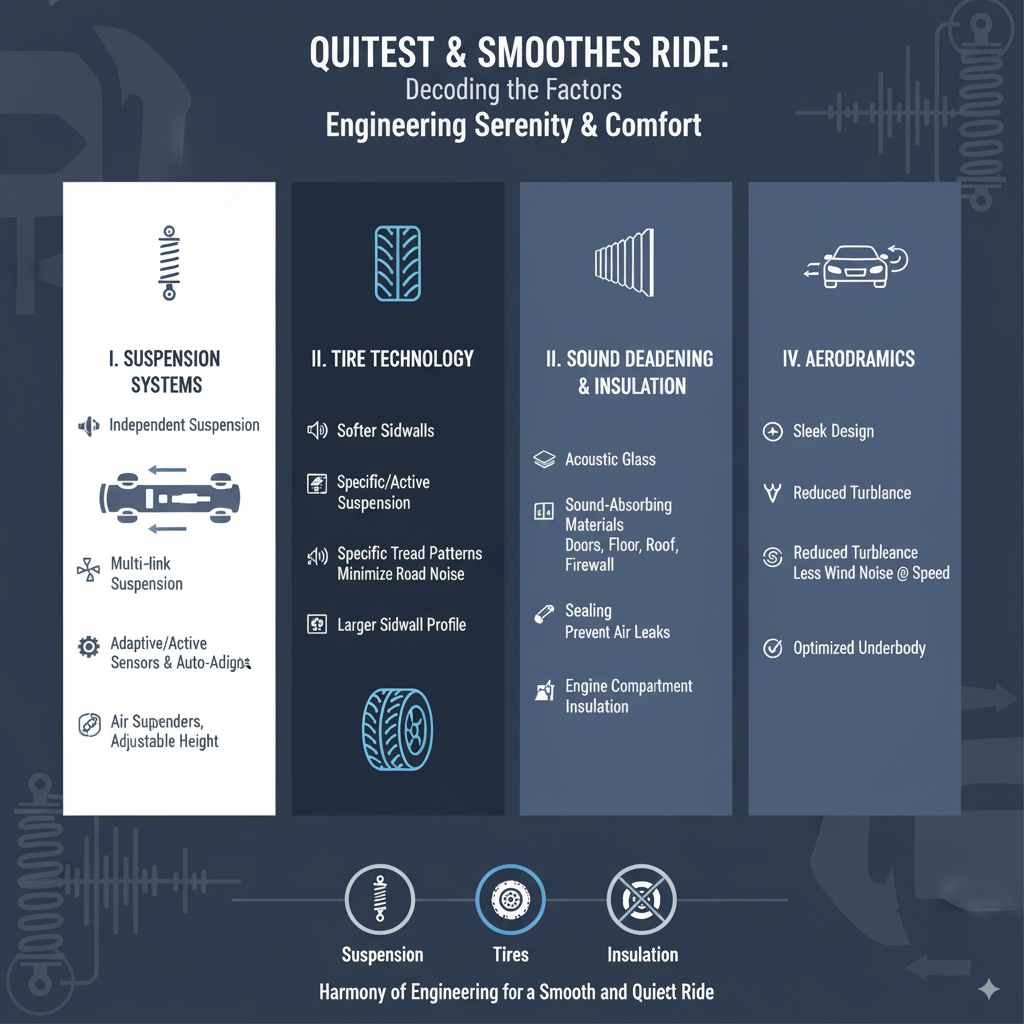
Suspension Systems: The Foundation of Smoothness
The suspension system is like the car’s legs and shock absorbers – it’s what handles bumps and keeps the ride comfortable. Different types of suspension work in different ways:
- Independent Suspension: Most modern cars use this. Each wheel can move up and down without affecting the others, absorbing shocks more effectively.
- Multi-link Suspension: A more complex type of independent suspension that uses several links to allow for very precise control of the wheel’s movement. This often leads to a smoother and more stable ride, especially around corners.
- Adaptive/Active Suspension: This is the high-tech stuff! Sensors detect road conditions and driver input, and the system automatically adjusts the stiffness of the shock absorbers on the fly. Think of it as the suspension constantly fine-tuning itself for the perfect comfort level. Major brands often offer this in their higher trims or luxury models.
- Air Suspension: Instead of traditional springs, this system uses air bladders. It’s incredibly versatile, allowing the car to lower itself for better aerodynamics on highways or raise itself to clear obstacles. Air suspension is a hallmark of many luxury vehicles known for their exceptional ride quality.
Tire Technology: Your First Line of Defense
The tires are your car’s only connection to the road, so they play a huge role in ride comfort. Quieter and smoother tires often have:
- Softer Sidewalls: These absorb minor road imperfections better than stiff sidewalls.
- Specific Tread Patterns: Some tread designs are engineered to minimize road noise and vibrations. Brands like Michelin, Bridgestone, and Continental often have specific “comfort” or “touring” tire lines designed for this.
- Larger Sidewall Profile: Think of a tire with a thicker bulge on the side. A higher aspect ratio (the height of the sidewall compared to its width) means more rubber and air to cushion impacts. This is often found on smaller wheel sizes; larger wheels tend to mean lower profile tires, which can lead to a firmer ride.
For the quietest ride, look for “low rolling resistance” or “quiet technology” tires specifically designed for comfort.
Sound Deadening and Insulation: Creating a Quiet Cabin
This is where the “quiet” part really comes in. Manufacturers use various techniques to block out unwanted noise from the engine, road, and wind:
- Acoustic Glass: Special laminated glass used in windshields and sometimes side windows acts as a barrier against sound waves.
- Sound-Absorbing Materials: Layers of foam, carpet, and special insulation are strategically placed in the doors, floor, roof, and firewall (the panel between the engine and the cabin).
- Sealing: Ensuring all doors, windows, and panels are perfectly sealed prevents wind noise and air leaks that can carry sound.
- Engine Compartment Insulation: Extra mats and covers in the engine bay reduce the amount of engine noise that can enter the cabin.
Aerodynamics: The Invisible Force
How air flows over and around a car significantly impacts wind noise at higher speeds. Sleek, aerodynamic designs reduce turbulence, leading to a quieter cabin on the highway. The shape of the mirrors, the roofline, and even the underbody panels are all considered.
What Makes a Car Quiet and Smooth: Key Features to Look For
When you’re shopping for a car that promises serenity on the road, keep an eye out for these specific features and characteristics. They are the building blocks of a truly comfortable driving experience.
1. Luxury Sedans and Flagships
Historically, luxury brands have made “quiet and smooth” a top priority. Think about cars designed for executive transport or long, comfortable journeys. They often feature:
- Advanced Independent Suspension: Often multi-link or with electronic dampers.
- Premium Tire Choices: Equipped with tires specifically chosen for comfort and low noise.
- Extensive Sound Insulation: Multiple layers of sound-deadening materials are standard.
- Double-Pane Acoustic Glass: A common feature for superior noise reduction.
Examples include models like the Mercedes-Benz S-Class, BMW 7 Series, Lexus LS, and Audi A8. These are often the benchmark for a refined ride.
2. Electric Vehicles (EVs)
Electric cars have a significant advantage: no internal combustion engine. This means:
- No Engine Noise: The complete absence of engine noise dramatically reduces a major source of cabin din.
- Smooth, Instant Torque: Acceleration is linear and smooth, without gear shifts interrupting the flow.
- Focus on Other Noises: Because engine noise is gone, manufacturers can focus even more on tire noise, wind noise, and road imperfections. Many EVs are engineered with exceptional sound insulation to make the most of their quiet powertrain.
Models like the Tesla Model S, Mercedes-Benz EQS, Lucid Air, and Porsche Taycan are known for their exceptionally quiet and smooth rides, often featuring air suspension and advanced acoustics.
3. Certain Crossover SUVs
While often perceived as less refined than sedans, many modern crossovers, especially larger luxury models, have made huge strides. Their higher ground clearance can mean more suspension travel to absorb bumps, and manufacturers are investing heavily in insulation.
- Sophisticated Suspension: Many offer adaptive damping or air suspension options.
- Comfort-Tuned Chassis: Designed to prioritize ride quality over sporty handling.
- Generous Cabin Insulation: To counteract potential road noise from their larger tires.
Consider vehicles like the Lexus RX, Volvo XC90, or Range Rover for surprisingly smooth experiences.
4. Vehicle Weight
Heavier cars often feel more planted and stable on the road. They tend to have more mass to absorb road imperfections, making them feel less unsettled by bumps and road changes. This is why many of the quietest and smoothest cars are larger luxury sedans or SUVs.
5. Wheel Size and Tire Profile
This is a crucial point. Smaller wheels with taller tires (higher aspect ratio) generally provide a smoother ride. Larger wheels with very low-profile tires look sportier but transmit more of the road’s harshness into the cabin. For instance, a 17-inch wheel with a 60-series tire will typically ride more smoothly than an 18-inch or 19-inch wheel with a 45-series tire.
Evaluating the Quietest & Smoothest Riding Cars: A Comparison Table
To give you a clearer picture, let’s look at some cars frequently cited for their exceptional quietness and smooth ride. Remember that specific trims, optional features (like air suspension), and tire choices can significantly impact the actual experience. This table highlights general strengths.
| Car Model | Typical Ride Quality | Key Contributing Factors | Consider for |
|---|---|---|---|
| Mercedes-Benz S-Class | Exceptional (Benchmark) | Standard air suspension, extensive sound deadening, acoustic glass, plush seating. | Ultimate luxury and serenity. |
| Lexus LS | Excellent | Sophisticated suspension tuning, quiet cabin insulation, focus on passenger comfort. | Reliable luxury with a smooth, quiet ride. |
| BMW 7 Series | Excellent | Adaptive M Suspension (optional), premium materials, acoustic glazing. | Refined driving dynamics with a comfortable feel. |
| Audi A8 | Excellent | Standard air suspension, advanced sound insulation, comfortable interior. | Sleek design combined with smooth, silent travel. |
| Tesla Model S | Very Good (for an EV) | No engine noise, good suspension tuning, often chosen with air suspension. | Cutting-edge EV tech with impressive refinement. |
| Porsche Taycan | Very Good (for a performance EV) | Optional two-speed transmission contributes to smooth acceleration, advanced chassis, excellent sound insulation. | Performance EV with a surprisingly comfortable ride. |
| Rolls-Royce Phantom / Ghost | Unparalleled (Ultimate Smoothness) | “Magic Carpet Ride” suspension, extreme soundproofing, bespoke engineering. | If budget is no object and absolute silence/smoothness is the only goal. |
| Volvo XC90 | Very Good (for an SUV) | Optional air suspension, comfortable seats, good cabin insulation. | Family-friendly SUV with a focus on comfort and safety. |
| Lexus RX | Good to Very Good | Comfort-tuned suspension, quiet cabin for its class. | Reliable and comfortable mid-size SUV. |
How to Test Drive for Quietness and Smoothness
Looking at specs is one thing, but experiencing it yourself is key! Here’s how to properly test drive a car to assess its quietness and smoothness:
1. Choose Your Route Wisely
Don’t just stick to the smooth dealership lot. Plan a route that includes:
- A variety of surfaces: Try smooth asphalt, rougher patches, concrete roads, and even some gentle gravel if possible.
- Bumpy roads: Look for areas with expansion cracks, potholes (carefully!), or speed bumps.
- Highway speeds: Test how quiet the car is when you’re cruising at 60-70 mph.
2. Pay Attention to Your Senses
Turn off the radio and try to isolate sounds and feelings:
- Listen for noise: Can you hear tire noise, wind noise, or engine noise? How loud are these sounds?
- Feel the road: Does the car transmit every little imperfection? Or does it absorb them?
- Check for jolts: When you hit a bump, does the car feel like it’s crashing, or does it smoothly absorb the impact?
- Observe body roll: While not directly about smoothness, excessive leaning in turns can feel less refined.
3. Engage Specific Features
If the car has adjustable suspension (like comfort, sport, or auto modes), try each setting. See how it changes the ride. If it has advanced driver-assistance systems that might make subtle steering corrections, ensure they are off during your initial smoothness assessment.
4. Compare Back-to-Back (If Possible)
If you’re serious about finding the quietest and smoothest car, try to test drive a few contenders on the same day. This makes it easier to compare the distinct feel and sound of each vehicle.
What About Ride Height and Ground Clearance?
While not the primary factor for smoothness, ride height and ground clearance can indirectly influence how a car handles road imperfections. Cars with higher ground clearance and longer suspension travel, like many SUVs and some sedans, often have an advantage in absorbing larger road impacts. This is partly because their suspension components have more room to move before hitting their limits.
For example, a vehicle with a generous suspension travel allows it to soak up a large pothole without the suspension bottoming out, which would otherwise result in a harsh jolt. This is why some drivers find that larger vehicles, when engineered for comfort, provide an exceptionally smooth ride on varied terrain. Resources from automotive engineering societies, such as SAE International, discuss the complex interplay of suspension geometry and vehicle design that leads to optimal ride comfort across different vehicle types.
Maintenance for Maintaining a Smooth and Quiet Ride
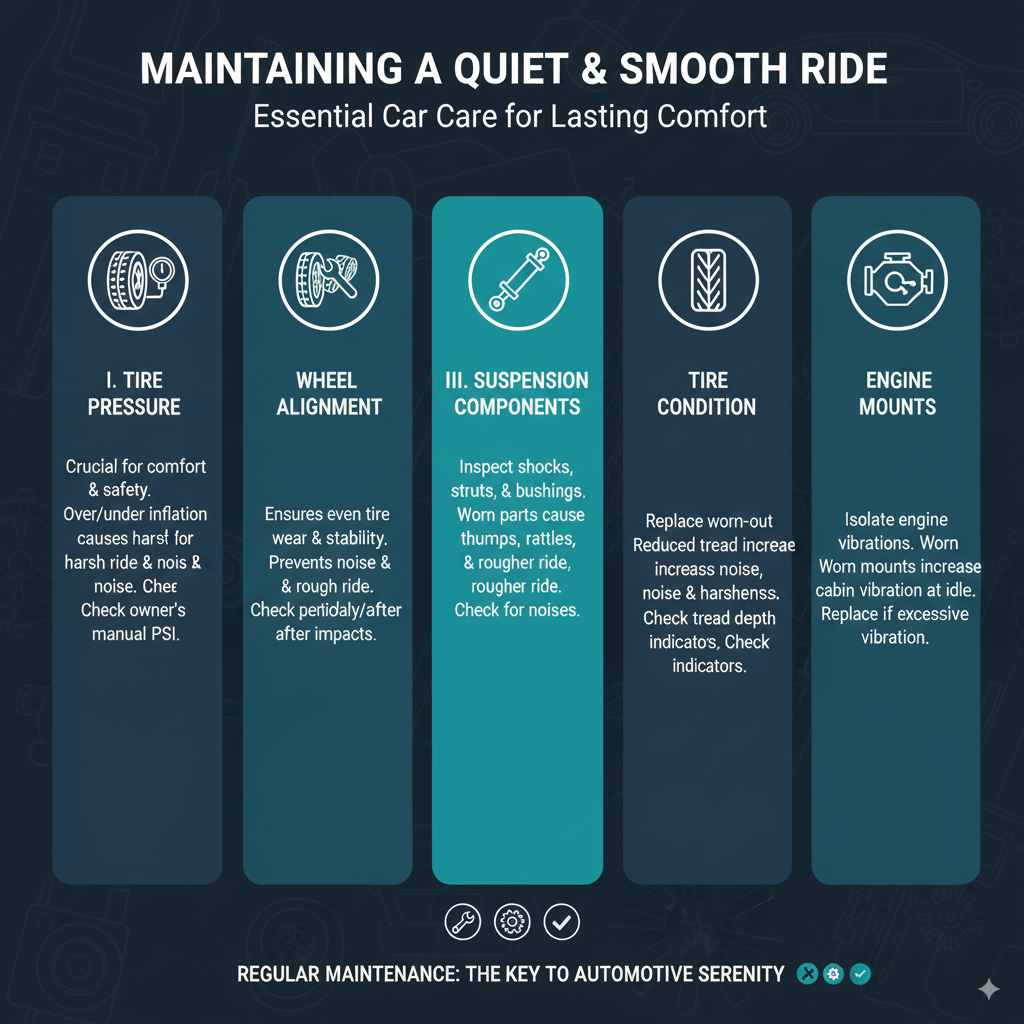
Even the best car can become less smooth and quiet if it’s not maintained. Here are some key maintenance items to keep in mind:
- Tire Pressure: Keeping tires properly inflated is crucial. Over- or under-inflated tires can lead to a harsher ride and increased road noise. Always check your owner’s manual for the recommended PSI.
- Wheel Alignment: Poor alignment can cause uneven tire wear, leading to increased noise and a less stable ride. It’s recommended to check alignment periodically, especially after hitting a significant pothole or curb.
- Suspension Components: Shocks, struts, bushings, and ball joints wear out over time. Worn components can lead to thumping noises, decreased stability, and a significantly rougher ride. Listen for clunks or rattles, and have them inspected if they appear.
- Tire Condition: Worn-out tires lose their ability to absorb road imperfections and can become noisy. Replace tires when the tread depth reaches the wear indicators.
- Engine Mounts: These rubber or hydraulic mounts isolate engine vibrations from the car’s chassis. If they wear out, you might feel more engine vibration in the cabin, especially at idle.
Regular visits to a qualified mechanic can help catch these issues before they significantly impact your driving experience. You can find great resources on general car maintenance from organizations like the National Highway Traffic Safety Administration (NHTSA).
Frequently Asked Questions (FAQs)
Q1: Are SUVs inherently less quiet and smooth than sedans?
Not necessarily anymore. While historically sedans had an advantage due to lower center of gravity and easier aerodynamic sculpting, many modern SUVs, especially luxury models, offer sophisticated suspension systems (like air suspension) and advanced sound deadening that rival or even surpass many sedans. Their taller stance can also contribute to absorbing larger bumps.
Q2: How do electric vehicles (EVs) compare to gasoline cars for quietness?
EVs are generally much quieter because they lack an internal combustion engine. The primary noise you might hear is from tire contact with the road and wind noise at higher speeds. Manufacturers often focus heavily on reducing these noises in EVs, making them exceptionally serene.
Q3: Does a car having more horsepower make it louder?
Not directly. Horsepower itself doesn’t dictate noise. What matters is how the engine noise is managed. A performance car with a powerful engine designed to sound aggressive will be louder than a luxury car with a powerful engine that’s heavily insulated. Engine speed (RPMs) and exhaust system design are bigger factors than raw horsepower.
Q4: Can I make my current car quieter and smoother?
Yes, to some extent. You can switch to high-quality touring tires known for quietness, ensure proper tire inflation, and have suspension components inspected and maintained. Adding sound-deadening material to doors or the floor can help, but it’s a significant undertaking and may not achieve the same results as factory insulation.
Q5: What’s the difference between a car that feels “soft” and one that feels “smooth”?
“Soft” often implies a suspension that is too floaty or lacks control, leading to excessive body roll and a disconnected feel, especially around corners. “Smooth” means the car effectively absorbs road imperfections without jarring occupants, maintaining composure and stability. A car can be both smooth and well-controlled, not just soft.
Q6: Are expensive cars always the quietest and smoothest?
Generally, yes, more expensive cars tend to offer better noise insulation, more advanced suspension technologies (like adaptive or air suspension), and better build quality, all of which contribute to a quieter and smoother ride. However, there are exceptions, and some mid-range or even budget cars with specific engineering priorities might surprise you.
Conclusion
Finding the quietest and smoothest riding car is a quest for serenity on the road. It’s about a thoughtful combination of sophisticated suspension engineering, advanced sound-deadening techniques, and carefully chosen tires.