Who Pays More Than CarMax? Find the Best Alternatives
Private buyers, specialty dealers, and some online instant-offer services can pay more than CarMax when the car has a clean title, strong retail demand, normal mileage, and enough condition to sell without heavy reconditioning. For older, rough, or high-mileage cars, CarMax often wins on certainty. Pick the wrong route, and you can give back money through reconditioning charges, title problems, or a deal that collapses before transfer. This guide compares the best CarMax alternatives by seller profile using speed, net proceeds, and sale risk.
CarMax vs alternatives at a glance
CarMax is often positioned in the middle of the market: generally faster and simpler than a private sale, often more predictable than a dealer search, and sometimes less exposed to post-offer surprises than some online buyers. The best alternative depends on whether you care most about cash speed, net proceeds after costs, or avoiding a deal that can unravel after inspection.
What each buyer pays
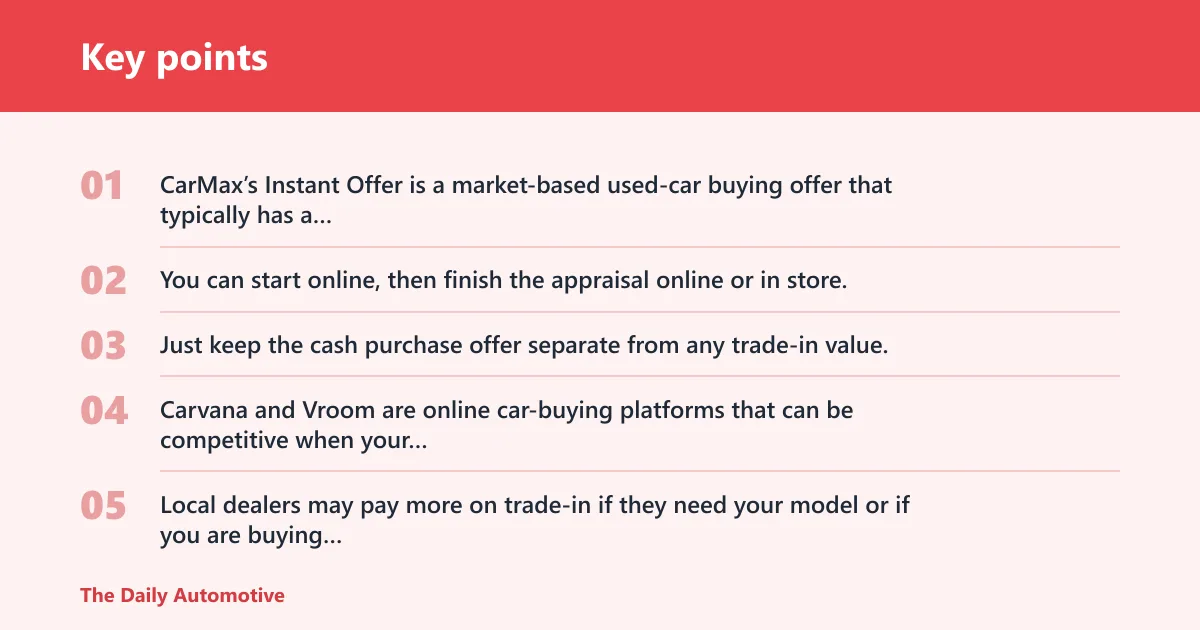
CarMax’s Instant Offer is a market-based used-car buying offer that typically has a limited validity window. You can start online, then finish the appraisal online or in store. Just keep the cash purchase offer separate from any trade-in value, because those numbers can differ.
Carvana and Vroom are online car-buying platforms that can be competitive when your vehicle matches their appetite. Local dealers may pay more on trade-in if they need your model or if you are buying another vehicle from them. A private sale can bring the highest gross price, but it also adds listing, screening, payment handling, and title transfer work.
Speed, effort, and net proceeds
Speed and convenience are where CarMax often looks strongest. Net proceeds are different. A dealer trade-in may reduce sales tax in some states, and a private sale may beat every instant buyer on gross price, yet still leave you with more hassle and more risk of a deal collapsing before title transfer.
Where the offer can change
Online quotes are often not final until the car is inspected or rechecked. Condition reports, mileage verification, accident history, cosmetic wear, and tire or brake condition can move the number. If there is a loan, lien payoff also affects what you actually pocket.
CarMax alternatives matrix
This table compares the main routes on the factors that matter most when you want more than a headline offer. Use it as a filter, not a promise.
| Option | Payout speed | Likely net price | Inspection and reconditioning risk | Paperwork and title burden | Best-fit seller profile |
|---|---|---|---|---|---|
| CarMax | Fast, often same day once appraised | Usually competitive, not always the highest | Moderate; final offer can change if details differ | Low to moderate | Seller who wants a quick, low-friction sale with a clear benchmark |
| Carvana | Fast if pickup or drop-off is available | Can beat CarMax on some cars | Moderate to high if condition or mileage differs from the quote | Low to moderate | Seller with a clean, accurately described car and flexibility on pickup logistics |
| Vroom | Fast quote, slower if reinspection is needed | Can be competitive, but quote changes matter | Moderate to high if the vehicle is rechecked | Low to moderate | Seller comfortable with online steps and possible value changes |
| Local dealership trade-in | Very fast when tied to a replacement purchase | Can beat CarMax after tax effects in some states | Moderate; dealer may adjust for inventory needs | Low if you are buying there | Buyer replacing a vehicle and wanting a simple one-stop transaction |
| Private sale | Slowest | Usually highest gross sale price | Low from a buyer platform, but higher fallout risk | High | Seller with time, a clean title, and a car that is easy to market |
Who pays more than CarMax?
Private buyers, some dealers, and a few online buyers can pay more than CarMax, but usually only under the right conditions. Clean title, normal mileage, decent cosmetics, and strong retail demand make the biggest difference. If the car has accident history, heavy wear, or a complicated payoff, CarMax often looks stronger on certainty.
When Carvana can beat CarMax
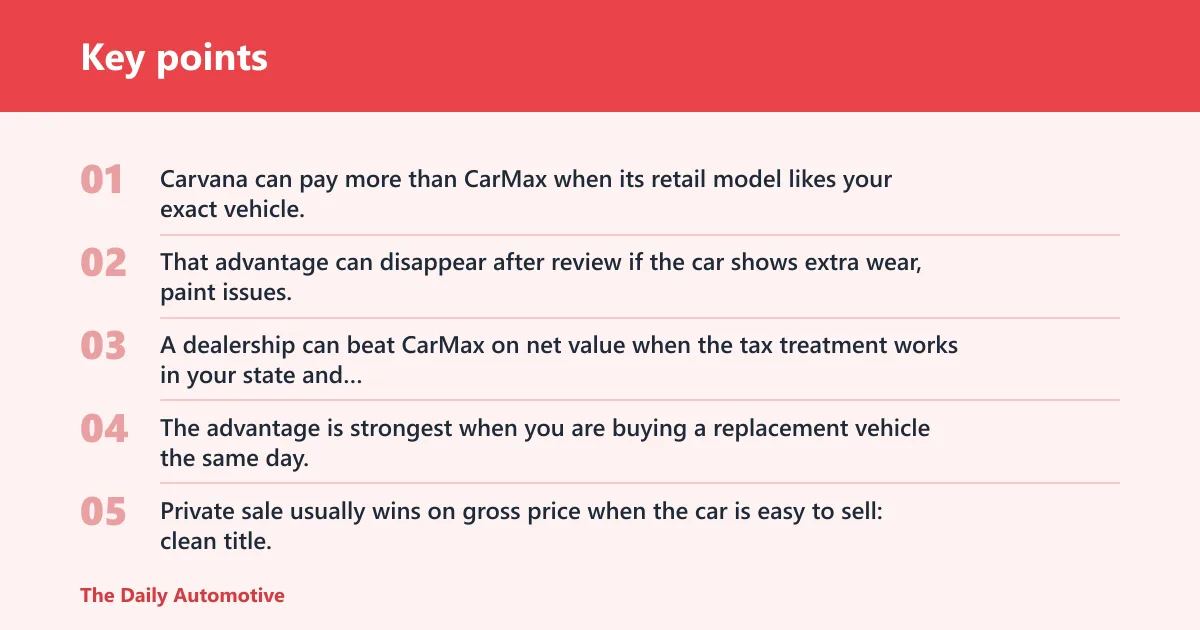
Carvana can pay more than CarMax when its retail model likes your exact vehicle, especially if mileage is reasonable and the condition report is clean. That advantage can disappear after review if the car shows extra wear, paint issues, warning lights, missing equipment, or a mileage mismatch from the online quote.
When a dealer trade-in can beat CarMax
A dealership can beat CarMax on net value when the tax treatment works in your state and the dealer wants your trade to move inventory. The advantage is strongest when you are buying a replacement vehicle the same day, because the trade-in can reduce the amount you finance or pay tax on.
When private sale can beat CarMax
Private sale usually wins on gross price when the car is easy to sell: clean title, popular trim, fair mileage, and no major cosmetic or mechanical problems. The trade-off is time. You have to advertise, screen buyers, handle payment safely, and complete title transfer without mistakes.
Say your 2019 compact SUV has 42,000 miles, clean service records, and no warning lights. A private buyer may pay more than CarMax because the car is easy to resell. Now change one variable: a minor accident on the vehicle history report. The private-sale gap can shrink fast if buyers worry about repainting or hidden damage.
Will Carvana pay more than CarMax?
Sometimes, yes. Carvana may outbid CarMax on vehicles that fit its current retail demand, but the first quote is not the final word. Expect condition checks, mileage verification, and possible adjustments after pickup or drop-off. The best-case spread tends to show up on clean, mainstream vehicles with few surprises.
Online quote versus final inspection
Carvana’s offer starts online, but it can change after review. If the vehicle arrives with damage, warning lights, missing keys, or extra wear that was not disclosed, the offer can drop. That means the headline number is useful, but it is not the same thing as final cash in hand.
Mileage and condition adjustments
Mileage is one of the biggest pricing factors. Lower mileage generally helps offers, and high mileage can cut value sharply. A vehicle condition report matters too: accident history, mechanical issues, paint damage, tire wear, and brake condition all feed into the final number.
Pickup or drop-off costs
Even when the pickup is free, the real cost is convenience versus flexibility. If the car needs a long handoff window, a second review, or extra paperwork, the higher offer may not be worth much more than CarMax’s lower-friction sale. Compare the net amount after any transport or time costs you would rather avoid.
Do dealers usually offer more than CarMax on trade-in?
Not usually across the board, but they can. A dealer may offer more than CarMax when it needs your vehicle for inventory, when your trade helps close a replacement sale, or when tax savings in your state improve the net math. The quote only makes sense if you compare the full deal, not the trade alone.
Tax treatment in some states
In some states, the trade-in value reduces the taxable amount on the replacement vehicle. That tax break can make a dealer’s offer look better than CarMax even if the raw trade number is close. Always compare the out-the-door price, not just the trade figure.
Why dealership inventory needs matter
Dealers pay more for vehicles they can retail quickly. A late-model truck, a fuel-efficient sedan, or a popular crossover can draw a better trade-in quote when the dealer wants that exact stock. If the lot already has several similar cars, the offer may sag.
Best case for a financed replacement
Trade-in is often strongest when you are financing another car at the same time. The dealer can handle lien payoff, title transfer steps, and the new purchase in one transaction. That convenience can outweigh a slightly higher private-sale number, especially if you do not want to juggle two separate deals.
Private sale versus dealer offer
Private sale usually brings the highest gross price, but that number is not the same as net proceeds. The real comparison is higher sale price against extra time, more buyer screening, payment risk, and the burden of completing title transfer correctly. Dealer trade-in is simpler and safer.
Payment safety and fraud risk
Private sellers have to manage counterfeit checks, failed transfers, and buyers who disappear after agreeing on a price. Cash is simpler, but even then the seller should verify the payment before handing over keys and title. Online payment apps can add their own limits and reversals.
Title transfer and lien payoff
Title transfer is state-specific, and a loan adds another layer. If there is a lien, the payoff has to be handled before ownership can move cleanly. Miss a step, and the buyer may not be able to register the car, which can delay or kill the sale.
How to use valuation guides
NADA and Kelley Blue Book are reference points, not final offers. They help you see where trade-in and private-party ranges may land before an actual buyer inspects the car. Use them to set expectations, then test the market with CarMax, an online buyer, and a dealer quote.
Mileage and condition change the range
Guide values move with mileage, trim, options, accident history, and general condition. A clean car with lower-than-average mileage can sit near the top of a range. A car with high mileage, worn tires, or cosmetic damage can fall to the bottom fast.
Why the guide price is not the final offer
Guides do not account for every local retail demand shift, transport cost, reconditioning need, or dealer inventory need. They also do not settle title issues. A quote becomes real only after the buyer verifies the vehicle and the paperwork is ready.
Suppose a sedan shows up with a guide value that looks strong on paper, but the tires are near replacement and the check engine light is on. The guide still helps frame the market, yet the actual buyer will price in reconditioning. That is why a vehicle condition report matters before you commit.
How to get the highest offer for your used car
The best offer usually comes from clean presentation and comparison shopping. That means checking the title status, gathering service records, disclosing condition honestly, and getting several quotes before you choose a buyer. The goal is higher net proceeds, not just a bigger headline number.
- Get a CarMax appraisal first so you have a market-based benchmark.
- Request at least one online offer and one dealer trade-in quote.
- Compare gross price and net proceeds, including taxes, payoff, and any transport or time costs.
- Check the title status and lien payoff amount before you accept an offer.
- Use the same condition facts everywhere: accident history, mileage, keys, tires, brakes, and cosmetic wear.
Choose CarMax if… / Choose alternatives if…
Choose CarMax if you want a fast, low-drama sale, need a benchmark before negotiating elsewhere, or have a car that may not bring much more from a private buyer. Choose alternatives if your car is clean, easy to market, and worth extra effort because the higher net price can justify more work.
Choose CarMax if…
Choose CarMax if you want a clear appraisal with no obligation, your car has average condition and mileage, or you want to avoid buyer screening and title hassle. It is also a strong option when the vehicle has wear that could trigger deductions elsewhere, because certainty can matter more than chasing a slightly higher quote.
Choose alternatives if…
Choose Carvana or Vroom if you want a quick online offer and your vehicle is likely to pass review without major adjustment. Choose a dealer trade-in if you are buying another car and want the tax and paperwork convenience. Choose private sale only if you can absorb the time, risk, and transfer steps.
Frequently asked questions
Who pays more than CarMax for my car?
Private buyers, some specialty dealers, and certain online instant-offer services can pay more than CarMax. The edge usually appears on clean-title cars with normal mileage, good cosmetics, and strong local demand. On older or rough vehicles, CarMax may still win because the offer is more predictable.
Is CarMax the best place to sell a car for cash?
CarMax is often one of the best places for fast cash when you value speed, paperwork simplicity, and a no-obligation appraisal. It is less likely to be the absolute highest bidder than a successful private sale, but it can be the best net choice when time and certainty matter.
What are the best alternatives to CarMax?
The best alternatives are Carvana, Vroom, a local dealership trade-in, and private sale. Carvana and Vroom can work well for clean vehicles with accurate condition details. Dealers can be strongest when you are replacing a car. Private sale is best when you want the highest gross price and can handle the work.
Will Carvana pay more than CarMax for my car?
Sometimes Carvana will pay more, especially if your vehicle fits its buying criteria and the condition report is clean. The quote can change after inspection, though. Mileage differences, cosmetic wear, missing equipment, or undisclosed damage can reduce the final payout.
When is private sale worth more than CarMax?
Private sale is worth more than CarMax when the car is easy to market, the title is clean, and the buyer pool is broad enough to support a higher retail price. If the car has heavy wear, a loan complication, or a slow market, the extra money may not justify the work.
Products related to this article
Sponsored / affiliate links. As an Amazon Associate I earn from qualifying purchases. I may earn additional commission from eligible campaigns.
 RVS Technology G6 Engine oil Treatment; For Gasoline Engines with a Motor oil capacity up to 6 quarts; Save fuel, Boost Power and Safely Restore and protect your Car, Truck, and all other engines
 Hail Protector Car Cover for Sedan(Length:Length:186"-203") + Gift Windshield Sunshade, Multi-Layered EVA Hail Proof Car Cover, Padded Car Hail Protector Blanket for Camry, Model 3, Accord, K5 etc.