When Do Cars Need Service? A Maintenance Timeline Guide
Many cars need service roughly every 5,000 to 7,500 miles or about once a year, but urgent warning lights, fluid leaks, brake problems, overheating, and tire damage should be checked right away. Miss the wrong interval, and a low-cost maintenance item can turn into a breakdown or a costly repair. This guide separates what needs action now, what to schedule by mileage or age, and what can wait for the next annual check.
Use the owner’s manual as the primary source
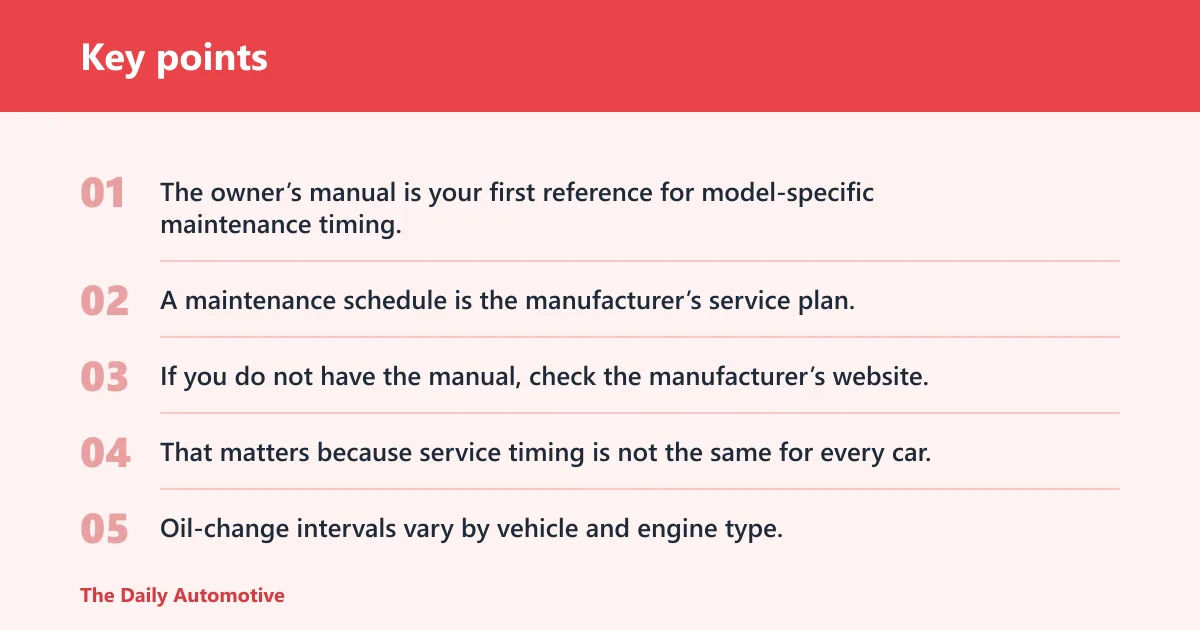


The owner’s manual is your first reference for model-specific maintenance timing. A maintenance schedule is the manufacturer’s service plan, with mileage or time as the trigger. If you do not have the manual, check the manufacturer’s website.
That matters because service timing is not the same for every car. Oil-change intervals vary by vehicle and engine type, tire rotation may not apply to every model, and some reminders are based on time rather than miles. A schedule that fits one car can be wrong for another.
Why mileage and age both matter
Cars need service because parts wear with distance, and because fluids, rubber, and batteries age even when the car sits. A low-mileage car can still need annual checks, while a high-mileage commuter may need service sooner than the calendar alone suggests.
What changes the timing: driving pattern, climate, and vehicle type
Short trips, stop-and-go traffic, extreme heat, and severe cold can shorten service intervals. Performance vehicles may need different maintenance, and some have different-sized front and rear tires that should not be rotated. High-mileage driving adds wear faster, while low-mileage ownership can hide age-related problems.
When does a car need service now?
A car needs service now when a warning light is on, the engine is overheating, a fluid is leaking, a tire is damaged, or braking feels unsafe. A steady check engine light should be checked as soon as you can, and a flashing check engine light may need immediate service.
Warning lights that need prompt inspection
Do not treat a warning light as a routine reminder until you know what it means. Some lights point to scheduled maintenance, while others signal a fault that can damage the engine, transmission, brakes, or emissions system. A tire-pressure warning can also point to low inflation, which affects handling and tire life.
Flashing check-engine light versus steady check-engine light
A steady check engine light usually means the car needs diagnosis soon. A flashing one is more urgent because it may signal a misfire or another issue that could damage the catalytic converter. If the light flashes, slow down and seek service right away instead of waiting for the next scheduled visit.
What a maintenance-required message usually means
A maintenance-required or service-reminder message usually means the car is due for routine work based on mileage or time. It is not the same as a true immediate warning light. You should still book service on schedule, but the message usually does not mean the car must stop driving right this minute.
Say your sedan shows “maintenance required” at 5,000 miles and otherwise drives normally. That message usually points to an oil change, inspection, or another scheduled item, not a roadside emergency. If the check engine light is flashing at the same time, treat that as a separate and more urgent problem.
What should you service at the first mileage milestones?
At the first mileage milestones, focus on the core items the manual calls for: oil changes, fluid checks, tire pressure, and a basic inspection of brakes, lights, and wipers. Many owners also see the first tire rotation window around this time, but the exact timing depends on the manufacturer and vehicle type.
Around 5,000 miles or the first routine check
Around this point, many cars may need an oil and filter change, a tire pressure check, and a quick look at tread wear. Some schedules call for more, some less. The manual decides that, so use the mileage as a checkpoint rather than a universal rule.
Around 10,000 to 15,000 miles
This is a common window for a fuller inspection. Tire rotation may be recommended once a year or every 10,000 miles, and most manufacturers specify the timing in the owner’s manual. Some vehicles do not require it at all. Brake wear, cabin and engine filters, and fluid levels also belong on the list.
How to treat the first year of ownership
Even if mileage stays low, the first year should end with a service review. Fluids age, batteries weaken, and wiper rubber hardens. For cars driven only a few thousand miles a year, the calendar can matter more than distance.
What should you service by age, even if mileage is low?
Cars should still be inspected by age, even if the odometer is low. Annual service often catches battery weakness, degraded fluids, cracked wipers, and brake issues that mileage alone may miss. Short-trip driving can also age parts faster because the engine and exhaust may not fully warm up.
Annual inspections for low-mileage cars
If the car has spent a year doing mostly short errands, it is a good idea to schedule an annual check. The vehicle may have little mileage, but condensation, moisture, and repeated cold starts can still stress oil, exhaust parts, and the battery. Time matters.
Fluids, battery health, wipers, and brake checks
At least once a year, check engine oil, coolant, brake fluid, washer fluid, battery condition, wiper blades, and brake pad wear. Some of these items are easy to inspect quickly; others need a technician. The point is to catch decline before it becomes failure.
Why short-trip driving can age parts faster
Short trips often mean repeated cold starts, more fuel dilution in the oil, and less chance for moisture to evaporate. A car used this way can need service sooner than a highway commuter at the same mileage. That is why calendar-based checks matter.
Service timing by mileage and age: use this table
This table gives a practical decision flow. Use it to separate “schedule soon” from “check now,” and use the owner’s manual to confirm the exact work for your model.
| Mileage or age trigger | Likely service items | Urgency level | Special note for vehicles with non-rotatable tires |
|---|---|---|---|
| Immediately: flashing check engine light, constant misfire, overheating, tire damage, brake warning, visible fluid leak | Diagnostic scan, engine or cooling-system check, brake inspection, tire repair or replacement | Immediate | If tires are different sizes front and rear, do not rotate them; inspect tread and pressure instead. |
| 5,000 miles or first routine service window | Oil change if due, tire pressure check, tire wear inspection, lights, wipers, fluid top-off | Soon | Rotation may be skipped if the manual does not call for it or if the vehicle is not built for it. |
| 10,000 miles or about 1 year | Tire rotation if specified, oil change if due, brake inspection, battery check, cabin or engine filter check | Schedule | Performance vehicles with different-sized front and rear tires should not be rotated. |
| 12 months or annual check, even with low mileage | Full fluid review, battery test, wipers, lights, tire tread, brake wear, hoses, belts | Schedule | Some vehicles do not require tire rotation, so use the manual before assuming it is due. |
| Higher mileage intervals listed in the manual | Filters, spark plugs, brake fluid, coolant, transmission service, belt and hose inspection | Schedule by manual | Follow the manual closely; non-rotatable tires still need tread and pressure checks. |
What basic checks can you do between services?
Between service visits, you can check oil level, tire pressure, tread wear, exterior lights, and wipers. These checks take little time and can catch problems early. They do not replace scheduled maintenance, but they help you avoid driving on low oil, low tire pressure, or worn rubber.
Check engine oil with the dipstick
To check oil level, use the dipstick: remove it, wipe it clean, reinsert it fully, then pull it out again and read the level. Engine oil should be changed at intervals suggested in the owner’s manual, but the level should be checked between changes. Low oil can damage the engine quickly.
Read tire pressure in PSI and compare it with the door-jamb label
New cars often have tire-pressure monitoring systems, which can show tire pressures in real time or trigger a warning light for low tires on some vehicles. The driver-side door jamb label lists the manufacturer’s recommended tire pressure in PSI. Compare the actual reading to that label, not the number on the tire sidewall.
Look for tread wear, lights out, and worn wipers
Scan the tires for uneven wear, bulges, or embedded debris. Check that headlights, brake lights, turn signals, and reverse lights work. Replace wiper blades if they streak or chatter, because poor visibility is a safety issue, not a cosmetic one.
How often should tires, oil, and other wear items be serviced?
Oil, tires, brakes, belts, hoses, and batteries all wear on different clocks. Oil change intervals belong to the owner’s manual and vary by vehicle and engine type. Tire rotation often lands around once a year or every 10,000 miles, but some cars do not need it and some should never have it done.
Oil change intervals and why they vary
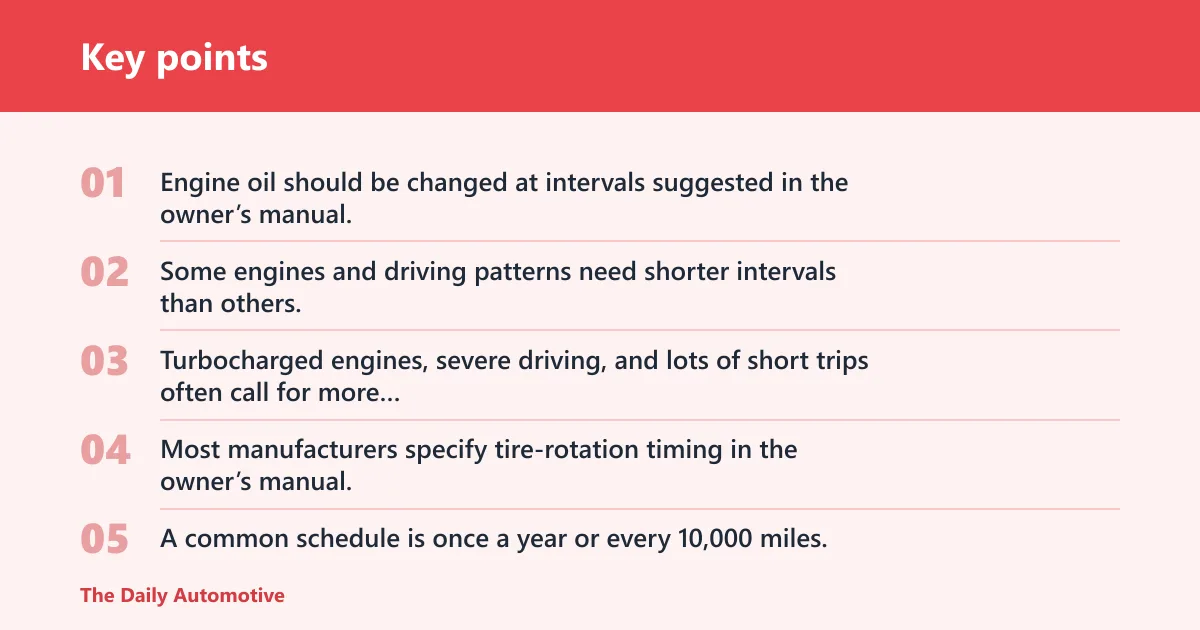
Engine oil should be changed at intervals suggested in the owner’s manual. Some engines and driving patterns need shorter intervals than others. Turbocharged engines, severe driving, and lots of short trips often call for more attention than gentle highway use.
Tire rotation timing and when it may be skipped
Most manufacturers specify tire-rotation timing in the owner’s manual. A common schedule is once a year or every 10,000 miles, but that does not apply to every vehicle. Performance cars with different-sized front and rear tires should not be rotated, and some vehicles do not require rotation at all. (caranddriver.com)
Brakes, belts, hoses, battery, and filters
Brake pads and rotors need periodic inspection because wear can be hard to spot from the driver’s seat. Belts and hoses should be checked for cracks, swelling, or fraying. Batteries weaken with age, and filters clog with use, so they belong on the routine inspection list even when the car seems fine.
Cleaning and general upkeep
Cleaning is not a substitute for maintenance, but it helps you spot trouble early. A clean engine bay makes leaks easier to see. A clean windshield and clear camera lenses improve visibility and driver-assistance performance. Wash road salt from the body and undercarriage when winter ends.
Frequently asked questions
when does a car need a service
A car needs service when the owner’s manual says it is due by mileage or age, and it needs immediate attention for warning lights, overheating, leaks, tire damage, or brake problems. A maintenance reminder usually means routine work is due soon, while a flashing check engine light points to urgent diagnosis.
when should cars be serviced
Cars should be serviced at the intervals listed in the owner’s manual, using mileage and time as the main triggers. For many drivers, that means periodic oil changes, tire checks, and annual inspections. Heavy city driving, short trips, or severe weather can move the schedule earlier.
how often do cars need servicing
Many cars need routine service roughly every 5,000 to 7,500 miles or about once a year, though this varies by vehicle. The correct interval depends on the vehicle, engine, and driving pattern. Oil changes, tire rotation, and inspections may fall on different schedules within the same car.
when should you service a car
You should service a car when the manual calls for it, when a dashboard reminder appears, or when a warning symptom shows up. Oil level, tire pressure, tread, lights, wipers, brakes, belts, and hoses should also be checked during routine ownership, not only when something feels wrong.
how often to do car maintenance
Car maintenance happens on two clocks: mileage and age. Some tasks come up every few thousand miles, while others are annual. The best approach is to follow the manual, then add monthly checks for oil level, tire pressure, and obvious wear so small problems do not grow.
when does my vehicle need a service
Your vehicle needs service when it reaches the manufacturer’s mileage or age benchmark, or when a symptom demands attention. If you do not have the manual, check the manufacturer’s website for the schedule. Do not wait for a breakdown if a light, leak, or noise appears.
when should a vehicle be serviced
A vehicle should be serviced when the manual says so, not by a one-size-fits-all mileage number. Routine maintenance can include oil changes, tire pressure checks, rotation where appropriate, and inspections of brakes, battery, lights, belts, and hoses. Urgent warning lights always come first.
how often should you service a vehicle
Service frequency depends on mileage, age, and use. A vehicle driven daily in city traffic may need attention sooner than a garage-kept car that barely moves. Use the owner’s manual as the baseline, then shorten the interval if the car sees hard use, short trips, or severe weather.
when does my car need servicing
Your car needs servicing when a scheduled interval arrives, when a reminder appears, or when a warning sign appears. The safest rule is simple: routine maintenance follows the manual, and urgent problems get checked right away. That split keeps routine care separate from true emergencies.
Products related to this article
Sponsored / affiliate links. As an Amazon Associate I earn from qualifying purchases. I may earn additional commission from eligible campaigns.