Why I Check My Car Seat’s Expiry Date
Check the label and manual: most child car seats expire 6 to 10 years after manufacture, and any seat with missing history, visible damage, or a past crash should be retired. A seat past its date can protect less in a crash. This quick checklist helps you decide in under five minutes whether your seat is safe, borderline, or done.
Expiry checklist table


| Check | Where to look | Action |
|---|---|---|
| Manufacture date | Label, sticker, shell, base, or molded into the plastic | Use it to calculate age if no expiry date is printed. |
| Printed expiry date | Bottom, back, base, or a side label | If the current date is past that date, replace the seat. |
| Hidden molded date | Underside of the shell or base, sometimes near the serial number | Read the molded code carefully; do not guess from worn text. |
| Manual confirmation | Owner’s manual or the manufacturer website | Confirm the model-specific useful life if the seat lacks a clear expiry label. |
| Recall status | Manufacturer registration records and recall notices | Stop using the seat until the recall issue is fixed. |
| Crash history | Seller disclosure, previous owner records, or your own history | If the crash history is unknown or there was a crash, retire the seat. |
| Visible damage | Shell, straps, buckle, latch parts, foam, and labels | Replace the seat if plastic is cracked, straps are frayed, or the buckle sticks. |
| Seat type | Infant seat, convertible seat, or booster seat model name | Check the model rules; useful life varies by seat type and brand. |
| Keep or replace | Use the results above | Keep only if the date is valid, history is clear, and the seat shows no damage. |
Where is the expiration date?
The expiration date is usually on the seat itself or in the manual. Transport Canada says to look for the manufacture and expiration date on a label or in the instruction manual, and Healthline says the date is usually on the bottom or back of the seat. If you cannot find it, use the model number to confirm it on the manufacturer website.
Find the date fast
- Check the bottom of the seat first.
- Look on the back, base, and underside labels.
- Search for molded plastic date codes, not just stickers.
- Open the manual and look for useful-life language.
- Confirm the exact model on the brand website if the label is worn.
A common first-timer mistake is reading only the outer cover and missing the hard shell underneath. The useful date is often on the shell, base, or a small label hidden under the seat pad.
What the manufacture date tells you
If the seat only shows a manufacture date, that date is your starting point for expiration. Healthline says most car seats expire 6 to 10 years after manufacture, and CARAMAZE gives the same range. The exact limit is model-specific, so use the brand’s stated useful life instead of guessing from the seat type alone.
How to calculate the date
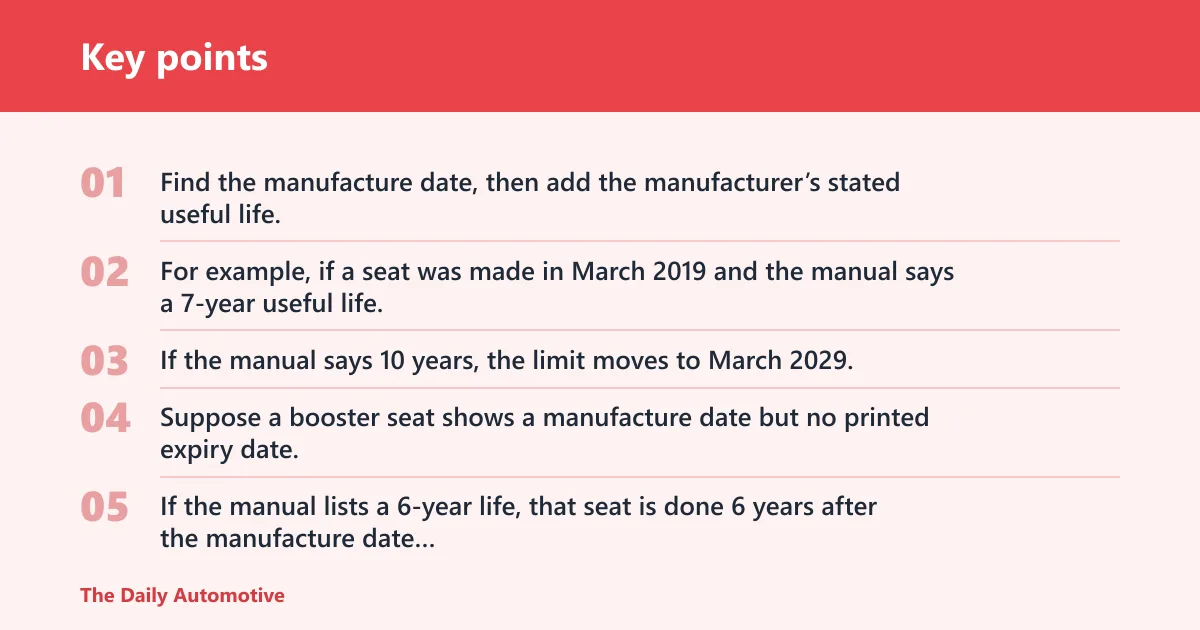
Find the manufacture date, then add the manufacturer’s stated useful life. For example, if a seat was made in March 2019 and the manual says a 7-year useful life, the seat would expire in March 2026. If the manual says 10 years, the limit moves to March 2029. The brand decides the exact cutoff.
Suppose a booster seat shows a manufacture date but no printed expiry date. If the manual lists a 6-year life, that seat is done 6 years after the manufacture date even if it still looks clean. Appearance does not reset the clock.
Why the same brand can differ by model
Graco, Britax, and Chicco all publish model-specific information, and the limits vary by seat. CARAMAZE says Graco car seats often expire 7 to 10 years from manufacture, while Chicco seats are around 6 years. That is why the exact model name matters more than the logo on the cover.
When a seat should retire early
Visible damage is a stop sign even if the date has not arrived. Heat, sunlight, spills, cleaning, and daily use can age plastics, foam, straps, and buckles before the printed limit. If the straps are frayed, the buckle sticks, or the shell is cracked, replace the seat.
Why do car seats expire?
Car seats expire because materials age, safety rules change, and recall coverage is never perfect. The same source says expiration dates reflect wear, changing safety standards, recalls, and testing limits. Over time, plastic, foam, webbing, and buckles can lose strength or function less predictably, even if the seat still looks usable.
Wear that shortens practical life
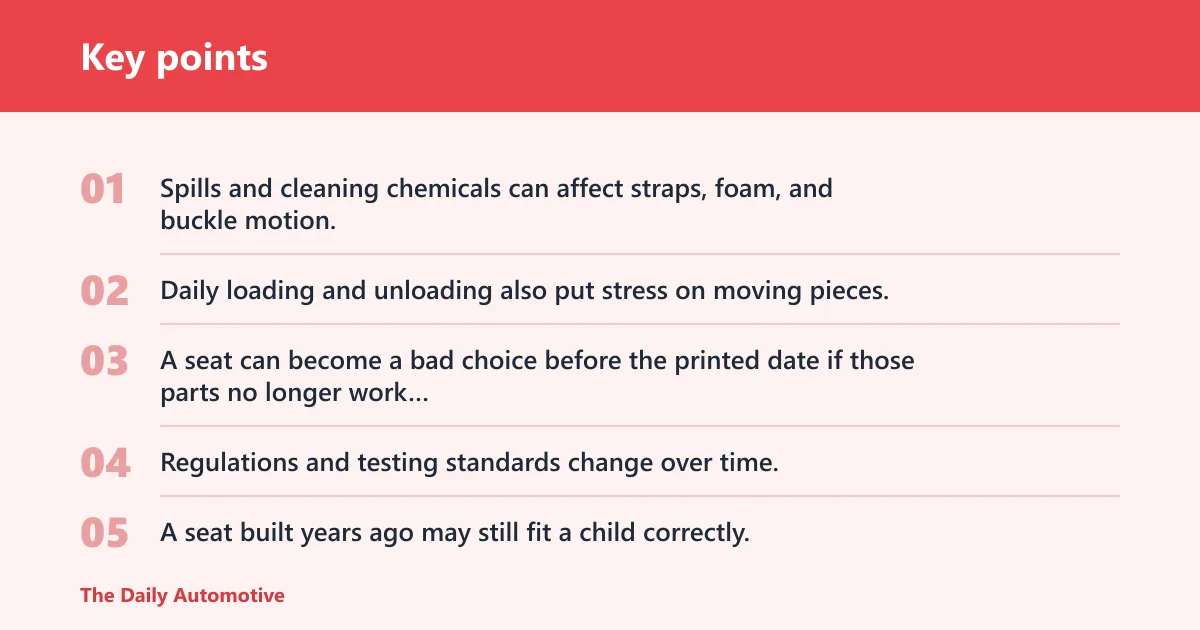
Sun exposure can dry out plastics. Heat can weaken some parts and adhesives. Spills and cleaning chemicals can affect straps, foam, and buckle motion. Daily loading and unloading also put stress on moving pieces. A seat can become a bad choice before the printed date if those parts no longer work properly.
Why standards and recalls matter
Regulations and testing standards change over time, so older seats may not reflect current best practice. A seat built years ago may still fit a child correctly, but it may not meet the newer expectations that manufacturers use now. Expiration also helps reduce the chance that a missed recall notice leaves an unsafe seat in service.
Is a used seat worth keeping?
A used car seat is only worth keeping when its history is complete. The same source says a used car seat or booster is generally not recommended unless accident history is certain. If the manufacture date, expiry limit, recall status, and crash history cannot all be verified, replace it.
What proof you need
- The exact model name and model number.
- The manufacture date.
- The current expiry or useful-life limit from the manual or brand website.
- Confirmation that there is no unresolved recall.
- A clear statement that the seat has never been in a crash.
- No cracks, missing parts, frayed straps, or damaged buckle pieces.
When to refuse a second-hand seat
Do not keep a used seat if the seller cannot confirm its history. Do not keep it if the registration is missing and no recall status can be checked. Do not keep it if the shell has been dropped hard enough to crack, even if the damage is small. Unclear history is reason enough to walk away.
Picture a convertible seat with a clean cover, but the buckle catches halfway and the back label is peeled off. That seat is borderline at best. Without a readable date, a clear model number, and proof of no crash, it belongs in the replacement pile.
Brand-specific expiration notes
Brand rules are model-specific, so the logo alone does not tell you the date. The same source says Britax and Graco publish expiration information on their websites, which makes the model number especially useful. The same source says Graco car seats often expire 7 to 10 years from manufacture, Chicco seats are around 6 years, and infant seats often expire sooner than some convertible or booster seats.
Graco
Graco expiration varies by model, and CARAMAZE says many Graco car seats often expire 7 to 10 years from manufacture. Check the exact model number and manual, then confirm the date on the brand website. Do not assume every Graco infant, convertible, or booster seat shares the same limit.
Britax
Britax publishes expiration information online, but the date still depends on the exact model. The sticker may be on the base or the shell, and the manual may spell out the useful-life period. If the seat is second-hand, verify that the model matches the manual before you trust the date.
Chicco
The same source says Chicco seats are around 6 years, but the model still decides the exact limit. Check the shell, base, and manual, then match the model number to the brand’s instructions. If the seat is older and the label is worn, treat it as suspect until the date is confirmed.
How long before a car seat expires?
Most child car seats and booster seats sold in Canada have an expiry date or useful life date, and the common range is 6 to 10 years after manufacture. That range is only a starting point. The exact limit depends on the brand, model, and seat type, so the manual or website decides the real cutoff.
Seat type changes the answer
Infant seats often have a shorter useful life than some convertible or booster seats. The same source says infant car seats expire after around 6 years from the manufacturer date, while convertible and booster seats can last around 7 to 10 years. That difference is why the seat type belongs on the checklist.
Frequently asked questions
Why car seat expiration dates matter
Expiration dates matter because the seat can age out before it breaks in obvious ways. The same source says the date reflects wear, changing safety standards, recalls, and testing limits. That means an unexpired seat can still be a poor choice if it has damage, missing parts, or unknown crash history.
When is a car seat expired?
A car seat is expired when the current date is past the printed expiry date or past the manufacturer’s stated useful life. If only a manufacture date is shown, count forward by the model’s limit, which is commonly 6 to 10 years. A seat with visible damage, recalled parts, or unknown history should be retired sooner.
Is my car seat expired?
It is expired if the label date has passed, the manual says the useful life is over, or the manufacturer website confirms the model is out of date. It may also be unsafe even before that point if there is crash history, a recall issue, or damage to the straps, shell, or buckle. If any of those are true, replace it.
What makes a car seat expire
Car seats expire because plastics, foam, straps, and buckles wear down, and because safety rules change over time. Heat, sunlight, spills, and cleaning can speed that wear. Expiration also helps cover recalls and older testing limits, so a seat is not judged only by how clean it looks.
Products related to this article
Sponsored / affiliate links. As an Amazon Associate I earn from qualifying purchases. I may earn additional commission from eligible campaigns.