Where to Buy Car Navigation Systems in Beijing
In Beijing, a car navigation system can be purchased from a brand’s 4S dealer, a local auto-electronics market with installation, or an OEM-verified online store if a model-specific unit is needed. Buy the wrong unit, and you can lose CAN-bus support, steering controls, map quality, or the savings once installation is added. This guide compares Beijing purchase channels, fitment checks, installation options, and warranty terms so you can separate real sellers from generic listings.
Where can you buy one in Beijing?
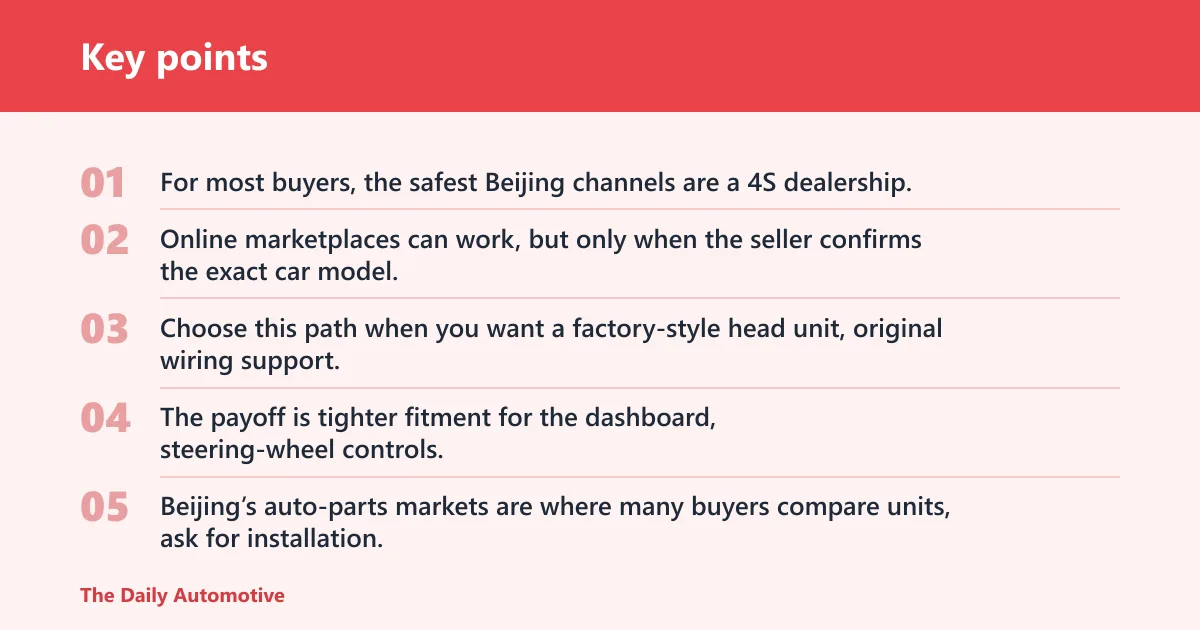


For most buyers, the safest Beijing channels are a 4S dealership, a known auto-parts market with installation bays, or an installer shop that sells and fits the unit together. Online marketplaces can work, but only when the seller confirms the exact car model, screen size, and wiring standard before shipping or pickup.
4S dealerships and brand-authorized parts counters
Choose this path when you want a factory-style head unit, original wiring support, and a straightforward warranty claim process. It usually costs more. The payoff is tighter fitment for the dashboard, steering-wheel controls, and vehicle electronics, especially on newer Chinese-market cars with closer CAN-bus integration.
Auto-parts markets and installer shops
Beijing’s auto-parts markets are where many buyers compare units, ask for installation, and check screen sizes in person. Common districts include the West Fourth Ring area around Jinwei Automobile Parts City, the South Fourth Ring area near large wholesale auto clusters, and the Yongdingmen and Jinsong auto service zones where electronics installers are common. Expect a mix of retail counters and wholesale sellers; some will bundle fitting, camera integration, and map setup.
Retail counters suit one-car buyers who want advice. Wholesale stalls can be cheaper, but they often assume you know your exact trim, connector type, and dash opening size. Ask whether the seller gives a written installation warranty, because that is separate from the product warranty.
Online marketplaces with Beijing pickup
Online listings are useful when you already know the part number or head-unit family. Favor seller-backed stores that state the car model, screen size, Android version, and whether the package includes a CAN-bus decoder. Beijing pickup lets you inspect the unit before payment, but pickup alone does not make a generic listing vehicle-specific.
Navigation buying matrix
This matrix compares the main Beijing purchase channels by cost, installation, warranty, map support, and best use case. Treat it as a buying filter, not a price promise, because model fit and trim level can change the total bill.
| Purchase channel | Typical price range | Installation included? | Warranty length | Chinese map support | Best use case |
|---|---|---|---|---|---|
| 4S dealership | High; often the most expensive path | Usually yes, or quoted as a bundle | Commonly tied to vehicle or dealer terms | Usually preloaded and model-matched | Newer cars, factory look, lowest fitment risk |
| Auto-parts market | Mid to low, depending on brand and screen size | Often optional, usually extra | Varies by seller; confirm both unit and labor | Often supported, but verify map app and updates | Budget-conscious buyers who want in-person comparison |
| Installer shop | Mid-range total cost | Yes, commonly bundled | Often one year on labor, separate for hardware | Usually supported if the shop sells China-market units | Owners who want a one-stop fitment and wiring job |
| Online marketplace | Lowest sticker price, but check extras | Rarely included | Depends on seller and platform policy | Varies widely; confirm local maps and voice pack | Exact-model shoppers who can verify compatibility first |
For Beijing, the real cost is hardware plus fitment. A cheaper head unit that needs a separate frame, decoder, camera adapter, and labor can end up costing more than a dealer bundle. Ask for the total landed cost before you commit.
Should I choose a built-in or portable car navigation system?
Built-in systems fit the dashboard and usually offer cleaner integration with the car’s screen, steering controls, and reverse camera. Portable units cost less and move between cars, but they look aftermarket and can be easier to steal. For Beijing buyers, the right choice depends on car value, dash shape, and how often you change vehicles.
Factory head units
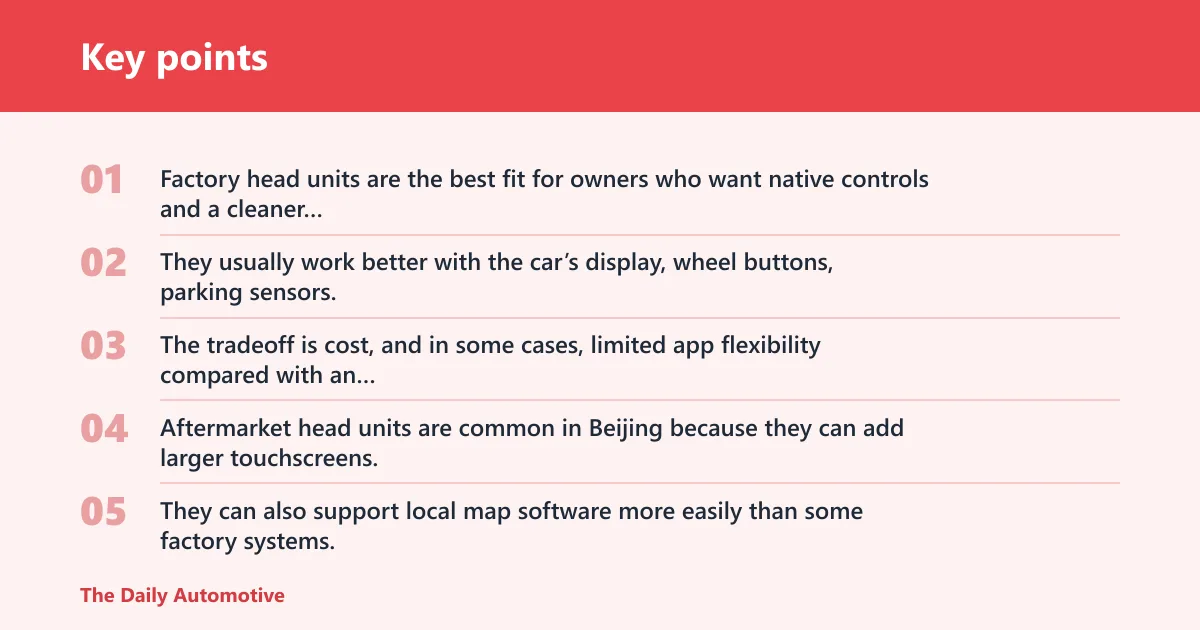
Factory head units are the best fit for owners who want native controls and a cleaner install. They usually work better with the car’s display, wheel buttons, parking sensors, and rear camera. The tradeoff is cost, and in some cases, limited app flexibility compared with an Android-based aftermarket unit.
Aftermarket infotainment head units
Aftermarket head units are common in Beijing because they can add larger touchscreens, CarPlay, Android Auto, and richer map apps. They can also support local map software more easily than some factory systems. The main risks are CAN-bus mismatch, weaker screen fitment, and poorer button translation if the installer cuts corners.
Portable GPS units and phone-based options
Portable units suit older cars, temporary use, or drivers who want a lower upfront spend. Phone-based navigation can work well in Beijing traffic, especially for congestion-aware routing, but it depends on data service, mounting, and safe voice operation. For a daily commuter, a fixed head unit is usually less cluttered.
Say your car is a five-year-old sedan with a plain dash and no factory touchscreen. A portable unit may solve navigation quickly, but a proper head unit with a frame kit and camera input usually gives a cleaner result if you plan to keep the car for years.
What features matter most in a car GPS for Beijing traffic?
For Beijing, the most important features are Chinese map coverage, lane guidance, live traffic, restricted-road awareness, and reliable voice prompts. A system that only gives basic turn-by-turn directions can miss toll-road choices, odd-even restrictions, and route changes during peak congestion.
Chinese map coverage and lane guidance
Look for maps that cover Beijing at street level, support Chinese place names, and include lane guidance at complex interchanges. That matters near ring roads, airport express routes, and dense junctions where late lane changes are hard. Good lane prompts reduce last-second weaving.
Real-time congestion, tolls, and restricted roads
Beijing route data should account for live congestion, toll routes, and roads that may be restricted by zone or time. The map app should reroute quickly during peak hours. For many buyers, traffic updates matter more than extra screen size, because the city’s route choice changes fast.
Offline maps and voice guidance
Offline maps help when data reception drops in garages, tunnels, or dense blocks. Voice guidance should support clear Chinese prompts, not awkward machine translations. If you rely on passenger directions, the screen can be smaller; if you drive alone, stronger voice guidance is worth paying for.
Picture a driver leaving the Third Ring during heavy evening traffic. A unit with live congestion and restricted-road alerts can move from a slow main road to a cleaner side route, while a basic GPS can keep pointing at the first route it loaded.
How do you check compatibility first?
Start with the car, not the screen. The unit must match the dash opening, connector type, CAN-bus logic, camera setup, and the operating system features you want. If the seller cannot name your exact model year and trim, keep shopping.
CAN bus support and dash fitment?
CAN-bus support matters because many modern cars use it to handle steering buttons, ignition behavior, parking data, and screen warnings. If the unit does not match the car’s bus protocol, buttons may fail or the screen may not wake correctly. Dash fitment should be checked against the bezel shape and depth.
Screen size, wiring, and reverse camera integration
Measure the opening before you buy. Common aftermarket screens are often about 7 to 12 inches, but size alone does not guarantee fit. Ask whether the seller provides a matching wiring harness, antenna adapter, and reverse camera input. A proper install should keep the rear camera image stable and the parking lines aligned.
CarPlay, Android Auto, and firmware updates
Many buyers want CarPlay or Android Auto because they simplify phone integration and voice use. Confirm whether the feature is wired or wireless, and whether it works with the exact unit sold in China. Firmware updates matter too, because map apps, voice packs, and Bluetooth stability often improve after update support.
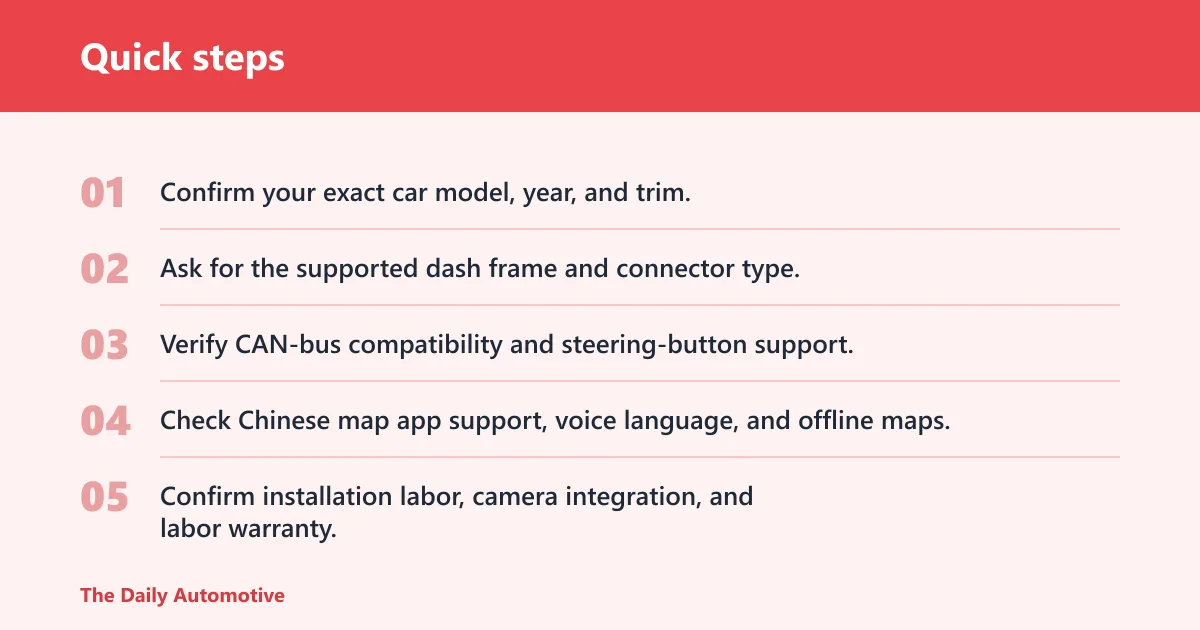
- Confirm your exact car model, year, and trim.
- Ask for the supported dash frame and connector type.
- Verify CAN-bus compatibility and steering-button support.
- Check Chinese map app support, voice language, and offline maps.
- Confirm installation labor, camera integration, and labor warranty.
- Get the total price before paying a deposit.
Beijing purchase channels and support
Beijing buyers should separate product purchase from installation support. A seller can have a low sticker price and still be a poor choice if they cannot fit the unit cleanly, update the firmware, or stand behind the labor. The best channel is the one that matches your car and your tolerance for risk.
4S dealership buying path
This is the most conservative option for late-model cars and owners who want the least guesswork. Expect higher pricing and less flexibility on screen size or app choice. Ask whether the quoted package includes firmware updates, map activation, and camera integration, not just the head unit.
Auto-parts market buying path
This is the best place to compare several units in one trip. Ask the counter to power up the screen, show the Chinese map interface, and confirm Chinese voice prompts. If the seller cannot explain the installation harness, move on.
Installer shop buying path
An installer shop is the strongest choice when you want one point of contact for sales and labor. Good shops will explain dash fitment, reverse camera input, and what happens if the unit needs a firmware patch after installation. Ask for the labor warranty in writing.
Online-to-install path
This works when you already know what fits and want to control the purchase price. Buy from a seller that lists the exact car model and the package contents. Then line up a Beijing installer before delivery so the unit does not sit unopened while you search for labor.
Frequently asked questions
Where can I buy a car navigation system in Beijing?
You can buy from a brand 4S dealer, an auto-parts market with electronics counters, a dedicated installer shop, or an OEM-verified online store with Beijing pickup. The best channel depends on whether you need model-specific fitment, installation, or the lowest total cost after labor.
How do I check if a navigation system supports Chinese maps and voice guidance?
Ask the seller which map app is preinstalled, whether it supports Chinese place names, and whether the voice pack is in simplified Chinese. Also confirm offline map support and update access. If possible, ask for a photo of the actual map screen, not a catalog image.
What’s the difference between car navigation systems and vehicle GPS systems?
In buying terms, a car navigation system usually means the whole head unit or device with screen, maps, and car integration. Vehicle GPS can refer to the positioning component inside that system. For Beijing buyers, the useful question is whether the full unit supports maps, traffic data, and the car’s electronics.
Can I buy car navigation systems online and pick up in Beijing?
Yes, but only if the seller confirms the exact model fit, harness type, and included parts before pickup. Beijing pickup is useful for inspection, yet it does not fix a generic listing. If the seller cannot name your car trim and dash size, treat the listing cautiously.
Which car navigation system is best for city driving in Beijing?
For most city drivers, the best choice is a model-specific head unit with Chinese maps, live traffic, voice guidance, and CAN-bus support. It should integrate cleanly with the dash and rear camera. If your car is older or temporary, a well-mounted portable unit can still be practical.
Products related to this article
Sponsored / affiliate links. As an Amazon Associate I earn from qualifying purchases. I may earn additional commission from eligible campaigns.