Which Car Service Is Best for You?
The best car service matches your vehicle and route: open carrier for most cars, enclosed transport for high-value or low-clearance vehicles, and expedited shipping only when timing matters. Pick the wrong type and you can invite damage, delays, or extra protection you do not need. This guide compares service types and providers by budget, distance, vehicle value, urgency, and coverage.
Key trade-offs and booking options


The main trade-off
Price, protection, speed, and convenience rarely peak together. Open transport usually costs less and fits common sedans, while enclosed transport costs more and adds shielding from road debris. Door-to-door service is easier for most owners, but tight streets, HOA rules, or truck restrictions can force a nearby meeting point instead.
For longer routes, quotes often move with distance, season, vehicle size, and how easy the car is to load. A pickup truck can cost more than a compact sedan because it takes more trailer space. A motorcycle may need special tie-down handling. A classic car may need enclosed transport even if the route is short.
When a broker, carrier, or marketplace fits best
An auto transport broker fits when you want one company to gather quotes, assign a carrier, and manage dispatch. A direct carrier fits when you already know the carrier and want a narrower, more direct arrangement. A comparison marketplace fits when speed matters in the quote stage and you want to compare multiple carriers before booking.
Service type matters as much as brand. A broker can offer door-to-door shipping with either open or enclosed trailers, but actual carrier availability still depends on route and vehicle type. A marketplace can surface options fast, yet the final experience depends on the carrier that accepts the job.
Car service decision matrix
Use this matrix as a first filter, not a final verdict. Higher scores mean a better fit for that factor. The strongest choice depends on how much you value price, convenience, speed, protection, and transparency for your route and vehicle.
| Service type | Price | Convenience | Speed | Protection | Transparency | Best fit |
|---|---|---|---|---|---|---|
| Auto transport broker | 4/5 | 5/5 | 4/5 | 4/5 | 3/5 | Most owners who want full-service quoting and dispatch help |
| Direct carrier | 3/5 | 3/5 | 3/5 | 4/5 | 4/5 | Repeat shippers and routes with known carrier availability |
| Comparison marketplace | 5/5 | 4/5 | 4/5 | 3/5 | 5/5 | Budget shoppers who want to compare carriers fast |
Price score
Price is usually lowest when the route is common, the vehicle is ordinary, and the carrier can fill a trailer efficiently. Open transport is typically cheaper than enclosed transport because the carrier can move more vehicles at once and does not need the extra equipment that enclosed hauling requires.
Convenience score
Brokers score well because they can coordinate quotes, carrier assignment, and basic communication in one place. Door-to-door shipping also cuts friction. If you do not want to call several carriers, compare availability, and manage handoff details, a broker usually fits better than calling carriers one by one.
Speed score
Speed depends on route density and how fast a carrier accepts the shipment. For a popular lane, both brokers and marketplaces can move quickly. For an unusual pickup or a remote destination, the fastest path is often the one with the widest carrier network rather than the lowest quoted price.
Protection score
Enclosed transport earns the strongest protection score because the vehicle is shielded from more road exposure. That matters for classic cars, luxury cars, and low-clearance vehicles. Open transport can still be appropriate for daily drivers, but it leaves the car exposed to weather and road debris during transit.
Transparency score
Marketplaces tend to score well because they show multiple offers side by side. Direct carriers can be clear too, especially when they publish straightforward service terms. Brokers vary more because the final carrier, tracking method, and route acceptance can shift after the initial quote.
How each car service type works

Each model solves a different part of the shipping problem. The right choice depends on whether you want one point of contact, the simplest price comparison, or a direct arrangement with the company that physically moves the car.
Auto transport broker
An auto transport broker arranges the shipment by matching your job with a carrier. This works well for door-to-door shipping, open or enclosed trailers, and broad state coverage, including all 50 states when carriers are available on the route. Quotes vary by route and vehicle type, so the same broker may price two similar trips very differently.
Tracking often comes by phone or email updates, and some brokers require you to contact them for status if the carrier does not offer live tracking. That is not a flaw by itself. It is a reminder to ask who provides updates before you pay a deposit.
Direct carrier
A direct carrier owns or operates the trailer and handles the move itself. This can help when you want a direct line to the company moving the vehicle, especially on repeat routes. The trade-off is narrower availability, because one carrier may not serve every lane or every vehicle type.
Comparison marketplace
A comparison marketplace collects offers from multiple transporters, which can be useful when you need a fast look at price spreads. uShip is positioned as best for comparing auto transporters, with a 3.5 rating from 297 reviews and a sample quote of $1,625. Availability varies by carrier, so the cheapest visible offer is not always the one you can actually book.
Say your sedan is moving 1,100 miles from Atlanta to Dallas. A marketplace may surface several open-carrier options in minutes, while a single carrier may have only one slot next week. The marketplace can help you compare, but you still need to verify insurance, cancellation terms, and the carrier’s communication style.
Open vs enclosed transport
Open transport is the standard choice for many cars, pickup trucks, and budget moves. Enclosed transport costs more, but it gives more protection from weather, dust, and road debris. If the vehicle is valuable, low-clearance, or difficult to replace, enclosed transport is often the safer fit.
Price implications
Open trailers usually cost less because carriers can move more vehicles and keep operating costs lower. Enclosed trailers raise the price because capacity is tighter and equipment costs more. That premium makes the most sense when the car’s value or finish matters more than the shipping bill.
Vehicle protection tradeoff
Open transport exposes the car to the road environment. Enclosed transport reduces that exposure. Neither option removes all risk, so insurance terms still matter. Ask whether the quoted coverage is carrier insurance, broker assistance, or a separate gap protection option that may fill a shortfall.
Best fit by vehicle value
Open shipping is usually fine for a daily driver with ordinary mileage and wear. Enclosed shipping is better for classic cars, luxury cars, and some motorcycles. Pickup trucks can ship either way, but trailer dimensions and weight can affect both price and carrier availability.
Which service does your vehicle need?
Your vehicle type, route length, and tolerance for exposure should guide the choice. Daily drivers usually do not need premium protection. Classics, low-clearance vehicles, and motorcycles often do. Long routes raise the value of good communication, clear cancellation terms, and dependable carrier assignment.
Daily driver and budget shipping
For a daily driver, the main goal is a workable price with reliable pickup and drop-off. Open transport is usually the first place to start. A broker or marketplace can help you compare several quotes quickly, which matters when you care more about savings than premium protection.
Classic car and luxury car shipping
Classic cars and luxury cars usually fit enclosed transport better because the vehicle value makes added protection worth the premium. Sherpa Auto Transport is named best for classic and luxury cars and has a 4.8 rating with 5,450 reviews. Its sample quote is $1,350, which should be read as an example, not a fixed offer.
Motorcycles and pickup trucks
Motorcycles need secure tie-downs and carrier experience, which is why RoadRunner Auto Transport is the best pick for motorcycle shipping. It has a 4.4 rating with 1,207 reviews and a sample quote of $1,075. Pickup trucks can fit open or enclosed options, but size and weight can push the quote higher.
Long-distance moves
Long-distance transport puts more weight on route coverage, dispatch reliability, and communication. Montway Auto Transport is the best pick for long-distance transport with a 4.6 rating from 5,397 reviews. Its sample quote is $1,219. Distance usually expands the range of carriers available, but it can also widen the price spread.
What to check before you book
Before paying a deposit, verify the rating, the review volume, the refund terms, and how updates are delivered. A low price can hide weak communication or tough cancellation rules. A higher quote may be justified if it includes better tracking, a clearer refund policy, or stronger support for your route.
Customer review score and verification signals
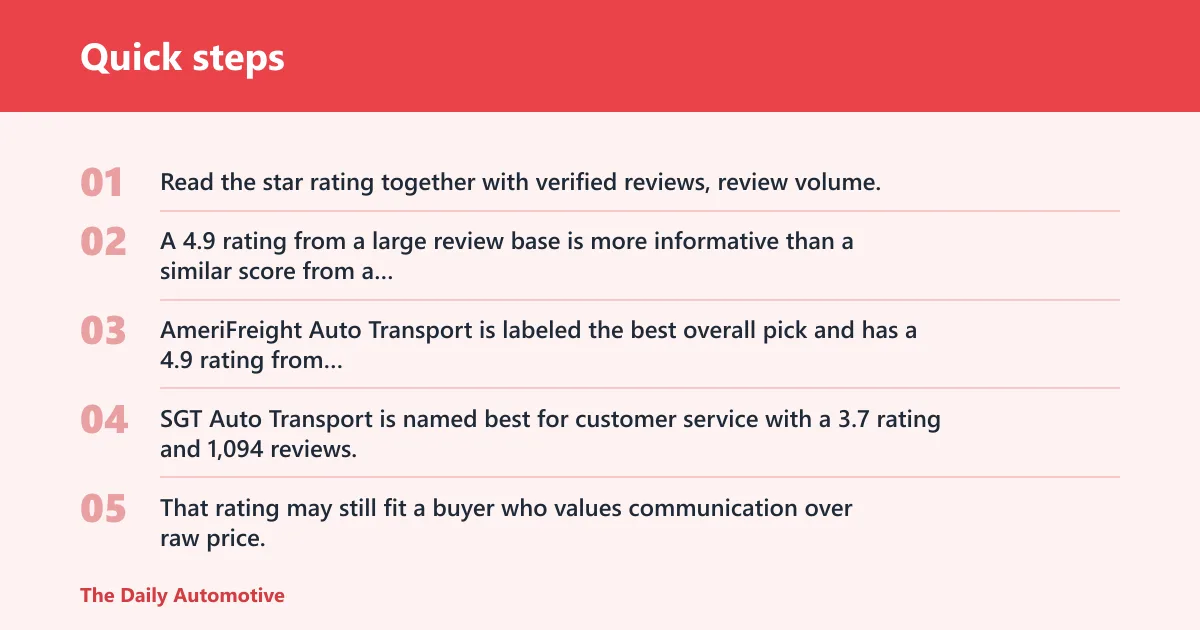
Read the star rating together with verified reviews, review volume, and response rate methodology if the platform publishes it. A 4.9 rating from a large review base is more informative than a similar score from a handful of reviews. AmeriFreight Auto Transport is labeled the best overall pick and has a 4.9 rating from 4,802 reviews.
SGT Auto Transport is named best for customer service with a 3.7 rating and 1,094 reviews. That rating may still fit a buyer who values communication over raw price, but the number should be weighed against route fit and the details of the quote.
Sample quote details
Sample prices help you compare, but they are only examples. AmeriFreight’s sample quote is $969. SGT’s is $1,192. Navi Auto Transport’s sample quote is $1,112 and it is named the best value pick with a 3.9 rating and 451 reviews. Quotes change with route length, season, vehicle size, and trailer type.
A common mistake is choosing the cheapest service without checking whether it includes pickup, mileage limits, or waiting time. Suppose two open-carrier quotes differ by $140. If the lower one requires a larger deposit, offers weaker insurance, and has slower updates, the “cheaper” offer may cost more in stress and delays.
Refund policy and cancellation terms
Refund policy can make or break the booking. Some companies may keep part of the deposit if you cancel late, while others may offer a total refund under narrower conditions. Always ask whether cancellation means loss of deposit, a partial refund, or a full refund, and get the policy in writing before you book.
Tracking and communication
Tracking is not always live. Some companies send phone or email updates, while others require you to contact them for status. Carrier-based tracking can help, but it depends on the actual truck assigned to your shipment. If you need frequent updates, ask how often the company will communicate and who answers after dispatch.
Choose broker if… / Choose marketplace if…
Choose a broker if you want full-service quoting and dispatch help, need door-to-door shipping, or want help finding open or enclosed transport on a specific route. Choose a marketplace if you want to compare multiple carriers fast, are price-sensitive, and are willing to verify the final carrier’s policy yourself.
Choose a broker if you want…
Choose a broker if you want one company to manage the search, especially on long-distance moves or when you are shipping a higher-value vehicle. Brokers can be helpful when you need a balance of convenience and coordination, and when you would rather not negotiate with several carriers at once.
Choose a marketplace if you want…
Choose a marketplace if your main question is price discovery. It is useful when you want to compare several offers quickly for a daily driver, a budget shipment, or a route with enough carrier traffic that multiple bids are likely. Just check the final carrier, not only the platform.
How to decide in five steps
- Match the vehicle to the trailer. Daily drivers usually fit open transport; classic cars, luxury cars, and low-clearance vehicles often fit enclosed transport better.
- Measure the route. Long-distance moves and less common lanes need broader carrier coverage and more flexible timing.
- Read the quote details. Check deposit amount, cancellation terms, insurance or gap protection, and whether tracking is carrier-based or manual.
- Check reputation the right way. Read the star rating together with verified reviews, review volume, and response patterns.
- Compare the service model. Use a broker for hands-off coordination, a carrier for direct booking, or a marketplace for fast comparison shopping.
Which car buying service is the best?
The best car buying service depends on whether you want the lowest price, the broadest inventory, or the most help narrowing choices. For transport, the same rule applies: pick the service that matches your route, vehicle value, and tolerance for risk rather than chasing one universal winner.
Which service does my car need?
Your car needs the service that fits its value, clearance, and route. Most ordinary cars fit open transport. High-value, classic, and low-clearance vehicles often fit enclosed transport. If you need door-to-door shipping, confirm that the carrier can reach your pickup and delivery addresses before paying.
Which is a better vehicle for low-maintenance ownership?
For low-maintenance ownership, the better vehicle is usually the simpler one with widely available parts, a common service schedule, and fewer specialized systems. That question is separate from shipping, but the same logic helps here: ordinary vehicles are easier and cheaper to move because carriers can load them more efficiently.
What car is the cheapest to maintain?
The cheapest car to maintain is usually a common, non-luxury model with broad parts availability and straightforward repairs. In shipping terms, those same vehicles often cost less to transport than specialty models because they are easier to place on open carriers and do not require enclosed protection.
What’s a good beginner car?
A good beginner car is one that is easy to drive, easy to park, and easy to repair. For transport, beginner-friendly cars also tend to be ordinary sedans or compact crossovers, which usually fit open shipping and draw more standard quotes than specialty or oversized vehicles.
Which car service company is best for customer service?
SGT Auto Transport is named best for customer service, with a 3.7 rating and 1,094 reviews. That answer only holds if the communication style and routing fit your shipment. A lower rating does not always mean a bad experience, but it does mean you should inspect policies carefully before booking.
Which car service is best for long-distance transport?
Montway Auto Transport is the best pick for long-distance transport, with a 4.6 rating and 5,397 reviews. Long routes benefit from broad carrier access, clear updates, and a quote that reflects actual distance, vehicle size, and trailer type. The best long-distance fit is the one that can cover the route reliably.
Which car service is best for value?
Navi Auto Transport is the best value pick, with a 3.9 rating and 451 reviews. Value means more than the lowest number on the page. Check whether the price includes the service level you want, whether the deposit is reasonable, and whether the cancellation terms leave you room to change plans.
Products related to this article
Sponsored / affiliate links. As an Amazon Associate I earn from qualifying purchases. I may earn additional commission from eligible campaigns.