Who Makes GTO Cars: The Essential Genius Answer
The Pontiac division of General Motors (GM) is the original and most famous maker of the GTO, launching it in 1964 and creating the American muscle car era. While Ferrari and Mitsubishi also produced cars named GTO, the iconic “Goat” that enthusiasts know and love is a classic Pontiac.
Have you ever heard someone mention a “GTO” and wondered what they were talking about? It’s a legendary name in the car world, but it can be confusing. You might have seen the name on a classic American muscle car, a sleek Italian racer, or even a high-tech Japanese sports car. It’s a common question, and you’re not alone in asking it!
Don’t worry, we’re going to clear everything up. Think of me as your friendly guide to the world of the GTO. I’ll break down exactly who made this iconic car, what the name means, and why there are different versions. By the end of this article, you’ll be able to talk about the GTO with confidence. Let’s dive in and solve this mystery together.
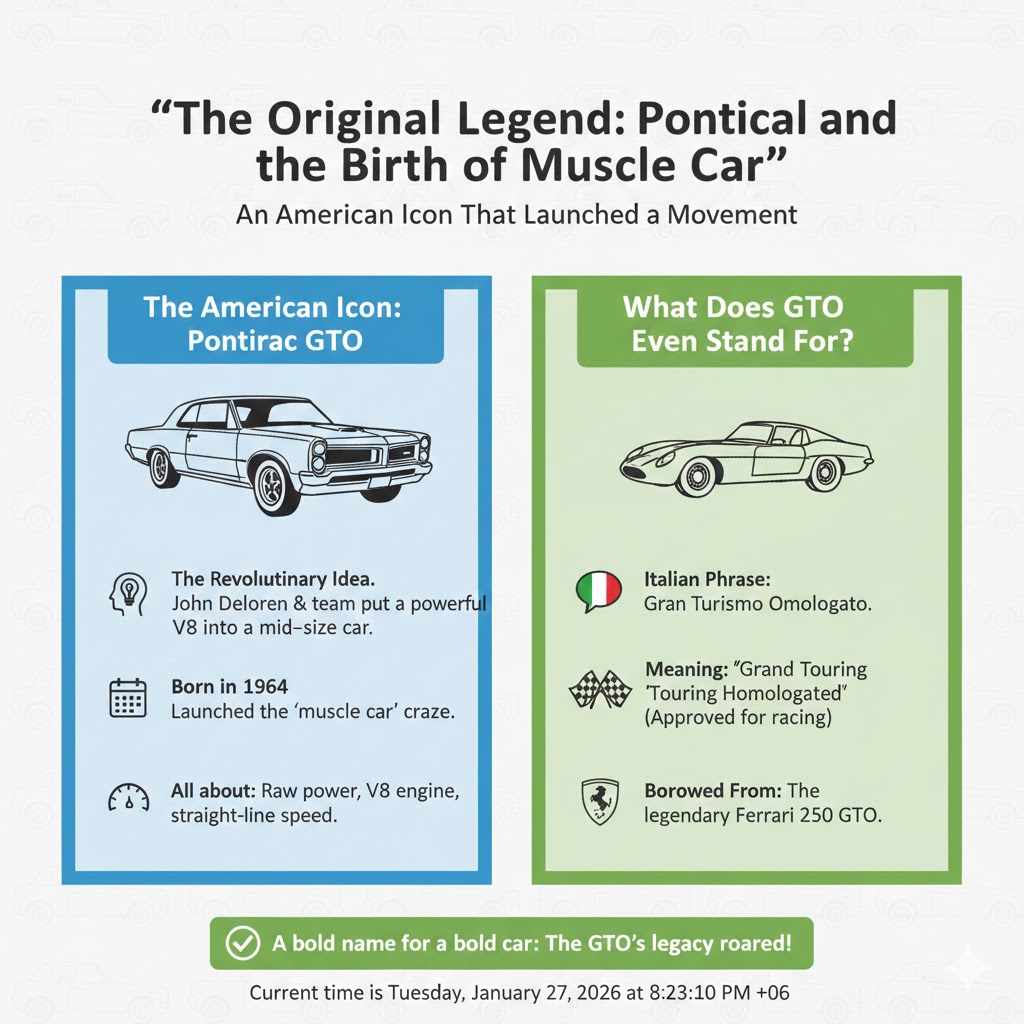
The Original Legend: Pontiac and the Birth of the Muscle Car
When most people say “GTO,” they are talking about the car made by Pontiac. Pontiac was a brand of General Motors (GM), and in the early 1960s, a team of brilliant engineers and marketers, including the famous John DeLorean, had a revolutionary idea. They decided to take a powerful engine from a full-size car and stuff it into a smaller, lighter mid-size car. The result was the 1964 Pontiac GTO, and it changed the automotive world forever.
This car wasn’t just fast; it was a statement. It was affordable power for the people, and it kicked off the “muscle car” craze that defined a generation. The GTO was all about straight-line speed, a roaring V8 engine, and an attitude that other cars just couldn’t match.
What Does GTO Even Stand For?
This is where the story gets interesting and connects to the other cars. GTO stands for Gran Turismo Omologato. It’s an Italian phrase that means “Grand Touring Homologated.” In simple terms, “homologated” means a car has been officially approved for a certain class of racing.
The Pontiac team, especially John DeLorean, borrowed this name from a famous Italian race car, the Ferrari 250 GTO. It was a bold and slightly cheeky move to name their American street brawler after a sophisticated European racer, but it worked. The name sounded powerful and exotic, and it perfectly captured the car’s high-performance spirit.
The Generations of the Pontiac GTO
The Pontiac GTO had a long and celebrated life, evolving over several distinct generations. Each one has its own unique style and place in automotive history. Let’s walk through them one by one.
First Generation (1964–1967): The Trendsetter
This is where it all began. The first GTO wasn’t its own model but an option package for the Pontiac LeMans. For just a few hundred dollars, you could upgrade to a 389 cubic inch V8 engine, a sport-tuned suspension, and of course, the GTO badges. It was a massive hit.
- 1964: The birth year. It came with the powerful 389 V8 engine, and its instant popularity caught GM by surprise.
- 1965: The styling was updated with stacked headlights, making it look even more aggressive. Power increased, and sales skyrocketed.
- 1966: The GTO became its own separate model, no longer just an option package. It featured a beautiful new “Coke bottle” body shape that became iconic.
- 1967: Safety and performance upgrades were introduced, including a new 400 cubic inch V8 engine and an optional automatic transmission. This is considered by many to be one of the best years for the GTO.
Second Generation (1968–1973): The Peak of Muscle
The GTO was completely redesigned for 1968 with a curvier, more muscular body. This era represents the peak of the muscle car wars, and the GTO was at the forefront of the battle.
A key feature of this generation was the “Endura” front bumper. This body-colored, rubber-like bumper could withstand minor impacts without damage—a revolutionary idea at the time. It gave the GTO a clean, streamlined look that was unlike anything else on the road.
Enter “The Judge”
In 1969, Pontiac introduced one of the most famous special editions in car history: “The Judge.” Initially conceived as a lower-cost, stripped-down competitor to the Plymouth Road Runner, it became a high-performance icon. The Judge package included:
- A powerful Ram Air III engine as standard.
- Wild “The Judge” decals and stripes.
- A distinctive rear spoiler.
- Bright, eye-catching colors like Carousel Red (which was really an orange).
The Judge was loud, proud, and incredibly fast. It perfectly captured the over-the-top spirit of the late ’60s muscle car era. As the ’70s began, however, things started to change due to new government regulations for emissions and rising insurance costs for high-performance cars.
Later Generations and the Modern Revival
The muscle car era began to fade in the early 1970s, and the GTO changed with the times.
- 1973: The GTO returned to being an option package, this time for the LeMans. While still a good-looking car, its performance was hampered by new emissions controls.
- 1974: For its final year of the classic era, the GTO was based on the smaller Pontiac Ventura. It was a good handling car with a 350 V8, but it was a shadow of its former self and sold in small numbers.
The Comeback Kid (2004–2006)
After a 30-year absence, Pontiac brought back the GTO nameplate in 2004. This new GTO was very different from the originals. It was actually a rebadged version of an Australian car called the Holden Monaro. GM owned Holden, and importing the car was an easy way to bring a powerful, rear-wheel-drive coupe back to the US market.
This modern GTO featured:
- A modern Corvette-derived LS1 V8 engine (later upgraded to the LS2).
- A comfortable, well-equipped interior.
- Independent rear suspension for much better handling than the classic models.
While it was incredibly fast and a great performance car, its conservative styling didn’t scream “GTO” to many old-school fans. Sales were lower than expected, and Pontiac discontinued it after the 2006 model year.
| Pontiac GTO Generation | Years | Key Features |
|---|---|---|
| First Generation | 1964-1967 | Birth of the muscle car, 389 & 400 V8 engines, classic styling. |
| Second Generation | 1968-1973 | Curvy “Coke bottle” body, Endura bumper, “The Judge” package. |
| Third Generation | 1973 | Option package on the LeMans, performance limited by regulations. |
| Fourth Generation | 1974 | Based on the compact Pontiac Ventura. |
| Fifth Generation | 2004-2006 | Modern revival based on the Australian Holden Monaro, LS V8 power. |
The Other GTOs: Ferrari and Mitsubishi
Now that we’ve covered the legendary Pontiac, let’s clear up the confusion about the other cars that share the GTO name. Remember, GTO stands for Gran Turismo Omologato, an Italian term for a race-certified car. This is why other manufacturers, especially one from Italy, have used it.
Ferrari GTO: The Racing Pedigree
Ferrari is the original source of the GTO name. They produced two of the most legendary cars ever to wear the badge.
Ferrari 250 GTO (1962–1964)
This is one of the most famous and valuable cars in the entire world. The Ferrari 250 GTO was built purely for racing. The “O” in GTO—Omologato—was critical here. Ferrari had to build a certain number of these cars for it to be “homologated” or approved for GT-class racing. It was a masterpiece of engineering and design, dominating racetracks across Europe. Today, these cars can sell for over $50 million. To learn more about its history, you can explore resources from institutions like the Revs Institute, which documents automotive history.
Ferrari 288 GTO (1984–1987)
In the 1980s, Ferrari revived the GTO name for another race-bred supercar. The 288 GTO was built to compete in the wild “Group B” rally circuit. It was a twin-turbocharged V8 monster and the first in a line of Ferrari supercars that would later include the F40, F50, and Enzo. While the racing series it was built for was canceled, the 288 GTO remains a highly sought-after collector’s car.
Mitsubishi GTO: The Japanese Technophile
In the 1990s, a third GTO appeared, this time from Japan. The Mitsubishi GTO was a high-tech sports car designed to showcase the company’s engineering skills.
In most parts of the world, including the United States, this car was sold as the Mitsubishi 3000GT. In its home market of Japan, however, it was called the GTO. This car was the complete opposite of the Pontiac GTO’s simple, brutish power. The Mitsubishi GTO/3000GT was packed with advanced technology:
- A twin-turbocharged V6 engine.
- All-wheel drive.
- Four-wheel steering.
- Active aerodynamics with spoilers that adjusted automatically.
It was a fast and capable car, representing the pinnacle of Japanese automotive technology in the ’90s. But it had no connection to the Pontiac or Ferrari other than sharing the three famous letters in its name.
A Simple Comparison
To make it even clearer, let’s break down the key differences in a simple table.
| Feature | Pontiac GTO | Ferrari GTO | Mitsubishi GTO |
|---|---|---|---|
| Country of Origin | USA | Italy | Japan |
| Primary Era | 1960s-70s (Classic), 2000s (Modern) | 1960s & 1980s | 1990s |
| Engine Type | Large V8 | V12 (250 GTO), Twin-Turbo V8 (288 GTO) | Twin-Turbo V6 |
| Core Philosophy | Affordable straight-line speed (Muscle Car) | Purebred racing performance (Race Car) | Advanced technology and handling (Sports Car) |
| Nickname | “The Goat,” “The Judge” | (None) | 3000GT (in the US) |
Why Did Pontiac, the Original GTO Maker, Disappear?
You might be wondering, if Pontiac created such an amazing car, where are they today? It’s a sad chapter in automotive history. Pontiac was a successful and exciting brand for decades, known for performance and style. However, during the major financial crisis of 2008, its parent company, General Motors, had to make some very tough decisions to survive.
As part of a massive restructuring plan, which was influenced by a government-backed bailout, GM decided to shut down several of its brands to focus on its most profitable ones. Unfortunately, Pontiac was one of the brands that was discontinued. The last Pontiac vehicle was built in 2010, and the brand was officially closed. The news archives from that time explain the difficult circumstances surrounding the decision. While the brand is gone, the legacy of its incredible cars, especially the GTO, lives on with enthusiasts and collectors around the world.
The Lasting Legacy of the GTO
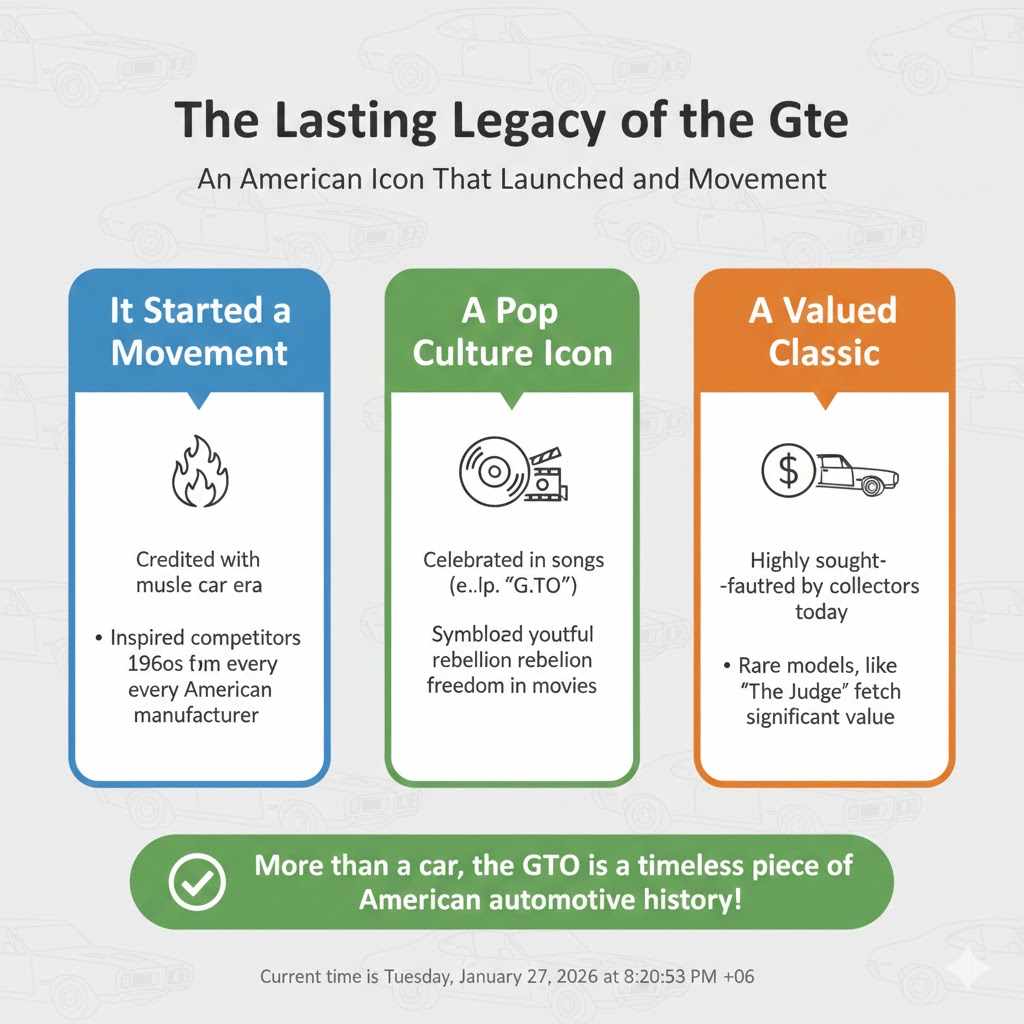
The Pontiac GTO wasn’t just another car. It was a cultural icon that defined an era. It represented freedom, power, and a uniquely American approach to performance. Its impact is still felt today:
- It Started a Movement: The GTO is widely credited as the car that launched the muscle car wars of the 1960s. After its success, every other American manufacturer scrambled to release their own competitor.
- A Pop Culture Icon: The GTO was celebrated in songs (like “G.T.O.” by Ronny & the Daytonas), featured in movies, and became a symbol of youthful rebellion.
- A Valued Classic: Today, classic Pontiac GTOs are highly sought-after by collectors. Pristine examples, especially rare models like “The Judge,” can be worth a significant amount of money. Their value reflects their importance in automotive history.
Frequently Asked Questions (FAQ)
1. What does GTO stand for?
GTO stands for Gran Turismo Omologato, an Italian phrase meaning “Grand Touring Homologated.” This term signifies that a car has met the requirements to be certified for a specific class of racing.
2. Was the Pontiac GTO the first muscle car?
While some earlier cars had big engines, the 1964 Pontiac GTO is almost universally considered the car that created the muscle car formula and kicked off the entire trend. Its combination of a mid-size body, a large V8 engine, and an affordable price defined the genre.
3. Why did Pontiac stop making the GTO?
The classic GTO was stopped in 1974 due to changing market demands, rising insurance costs, and new emissions regulations that reduced performance. The modern GTO (2004-2006) was discontinued due to slower-than-expected sales, and the entire Pontiac brand was shut down by GM in 2010.
4. Is a Mitsubishi GTO a “real” GTO?
While the Mitsubishi GTO (sold as the 3000GT in the US) is a fantastic high-tech sports car from the 1990s, it has no historical or mechanical connection to the Pontiac or Ferrari GTOs. It simply used the same name, likely to suggest high performance.
5. How much is a classic Pontiac GTO worth today?
The value varies widely based on the year, condition, and specific model. A 1970s GTO in driver condition might be found for under $20,000, while a perfectly restored, rare 1969 GTO “Judge” convertible could be worth hundreds of thousands of dollars.
6. Who was John DeLorean?
John DeLorean was a brilliant engineer and executive at Pontiac who is often called the “father of the GTO.” He championed the project within GM and was a key figure in its development. He later left GM to start his own car company, which produced the famous DeLorean DMC-12 sports car.
7. Are Pontiac GTOs good cars to own today?
For enthusiasts, they are wonderful cars to own. Classic GTOs are relatively simple to work on, have strong parts availability, and are a blast to drive. Modern GTOs (2004-2006) offer excellent performance and more comfort but have their own unique maintenance needs. Like any classic car, they require regular care and attention.
Conclusion: The One True “Goat”
So, who makes GTO cars? The answer is a bit more complex than a single name, but the conclusion is simple. Ferrari created the name for its ultra-exclusive race cars. Mitsubishi borrowed it for a high-tech sports car. But the heart and soul of the GTO legend belongs to Pontiac.
The Pontiac GTO wasn’t just a car; it was a phenomenon. It was the “Great One,” the “Goat,” the car that brought incredible power to the average person and started a revolution on the streets of America. From the raw energy of the 1964 original to the wild style of “The Judge,” the Pontiac GTO defined the muscle car era.
Now, the next time you hear someone mention a GTO, you’ll know the whole story. You can confidently separate the American muscle legend from the Italian racer and the Japanese tech wizard. You understand the legacy, the generations, and why this one car holds such a special place in the hearts of car lovers everywhere.