Will A Bad O2 Sensor Cause Car Not To Start: Key Warning
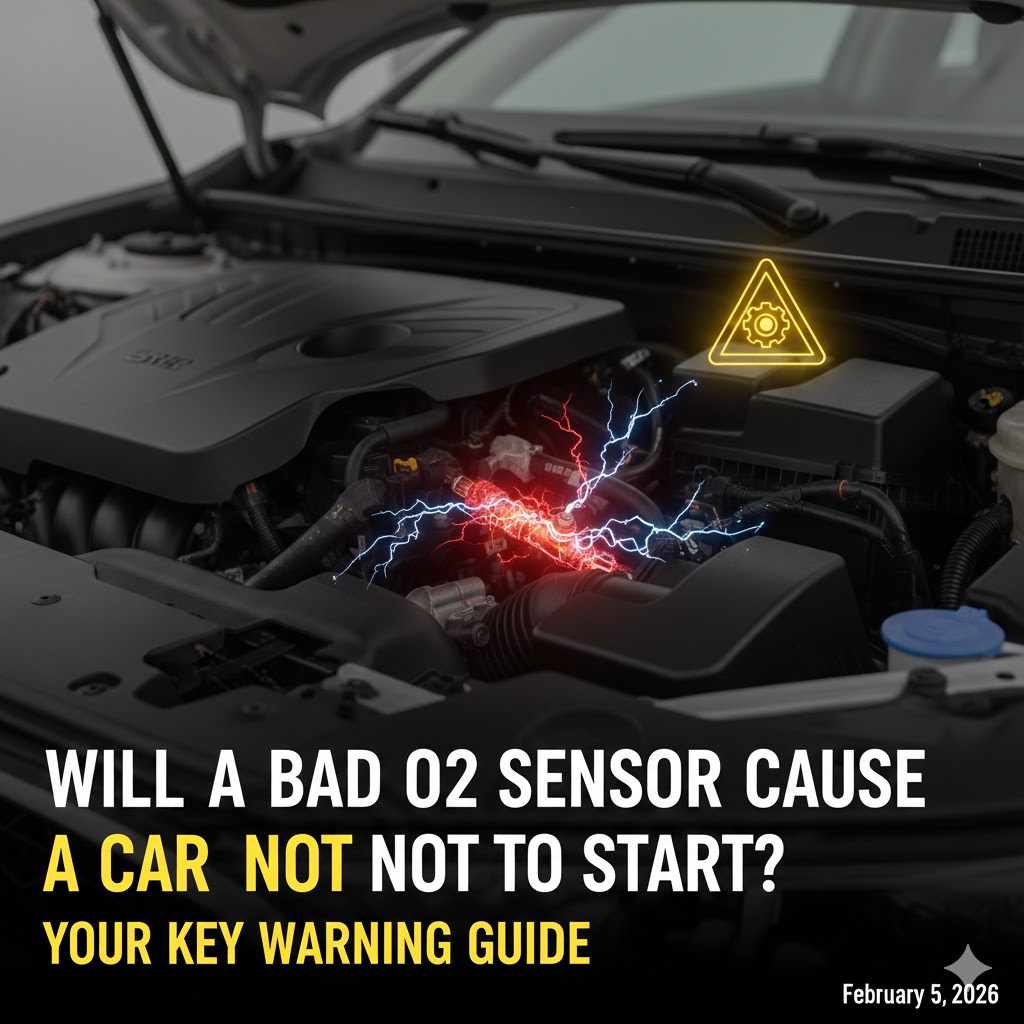
A bad O2 sensor will almost never cause a car not to start. While it plays a key role in fuel efficiency and emissions, a complete failure that prevents ignition is extremely rare. Your no-start problem is far more likely caused by a dead battery, a bad starter, or a fuel system issue.
You turn the key, and… nothing. Or maybe just a sad clicking sound. Your mind races through all the expensive things that could be wrong. You might have heard about something called an O2 sensor, and now you’re wondering if that little part could be the culprit behind your car’s refusal to start. It’s a frustrating situation, and a confusing one, too.
Don’t worry. You’ve come to the right place for clear, simple answers. I’m Md Meraj, and I’m here to help you understand what’s going on with your car without all the confusing mechanic jargon. We’ll figure this out together. In this guide, we’ll explore what an O2 sensor does, the real signs it’s failing, and what is most likely causing your no-start problem.
What Is an O2 Sensor and Why Does Your Car Need It?
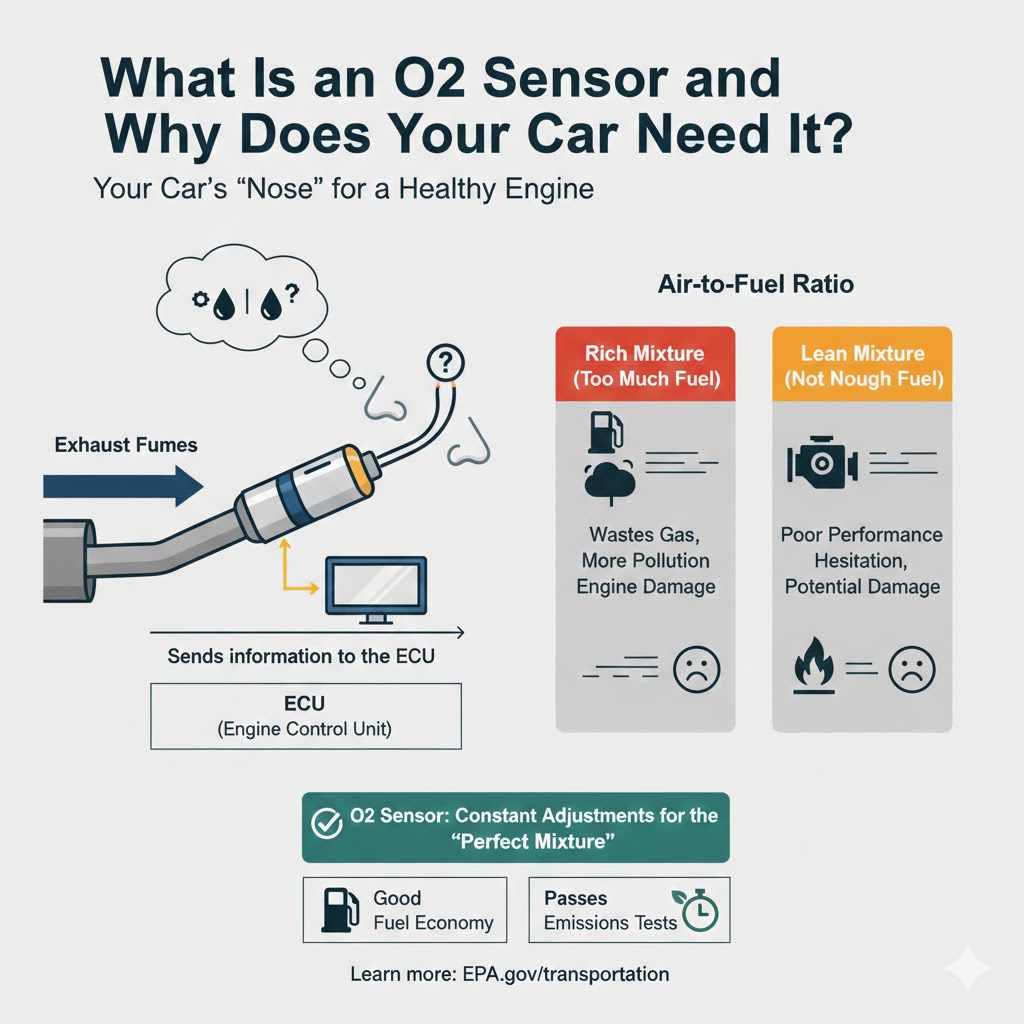
Think of the O2 sensor (or oxygen sensor) as your car’s “nose.” It sits in the exhaust system and its main job is to “smell” the unburned oxygen in the exhaust fumes coming out of your engine. It then sends this information to your car’s main computer, the Engine Control Unit (ECU).
Why does the computer need this info? It uses it to fine-tune the air-to-fuel ratio. For your engine to run smoothly, efficiently, and cleanly, it needs the perfect mixture of air and gasoline.
- Too much fuel (a “rich” mixture): Wastes gas, creates more pollution, and can damage other parts over time.
- Not enough fuel (a “lean” mixture): Can cause poor performance, engine hesitation, and potential engine damage.
The O2 sensor helps the computer make constant, tiny adjustments to keep that mixture just right. This simple part is crucial for good fuel economy and for passing emissions tests. To learn more about how vehicle components impact air quality, you can visit the Environmental Protection Agency (EPA) website on transportation and pollution.
The Big Question: Can a Faulty O2 Sensor Prevent Your Car From Starting?
Let’s get straight to the point: it is extremely unlikely.
In 99.9% of cases, a bad O2 sensor will not be the direct reason your car won’t start. Your car’s engine is designed to start and run even with a faulty sensor. When the computer gets bad information (or no information) from the O2 sensor, it switches to a default, pre-programmed mode. This “limp mode” or “open-loop” mode uses a fixed, rich fuel mixture to ensure the engine can run safely, even if it’s not efficient.
So, your car will almost certainly start. It just won’t run very well.
The Extremely Rare Exception
Is there a scenario where it could cause a no-start? Yes, but it’s a long shot and happens over time. If an O2 sensor fails completely and causes the engine to run extremely rich for a very long time (we’re talking weeks or months of ignoring a check engine light), it could theoretically cause a secondary problem.
This prolonged rich condition can create excess carbon buildup, which can eventually foul the spark plugs. If the spark plugs become too coated with soot and carbon, they can’t create the spark needed to ignite the fuel. In this indirect, roundabout way, a long-neglected O2 sensor could contribute to a no-start condition. However, you would have experienced many other warning signs long before this ever happened.
Key Warning Signs Your O2 Sensor Is Actually Failing
Instead of causing a no-start issue, a failing O2 sensor gives you plenty of other, more common warnings. If you’re experiencing any of these, it’s time to pay attention to your O2 sensor.
- The Check Engine Light Comes On: This is the most common sign of all. The O2 sensor is one of the top reasons the check engine light illuminates.
- Terrible Gas Mileage: Are you suddenly visiting the gas station more often? A bad sensor can cause your engine to use more fuel than it needs, leading to a noticeable drop in miles per gallon (MPG).
- Rough Idle or Engine Stalling: Your car might shake, sputter, or feel unsteady when you’re stopped at a light. In some cases, it might even stall.
- Poor Engine Performance: Does your car feel sluggish or slow to accelerate? A bad sensor can mess with the engine’s timing and fuel mixture, making it feel weak.
- Failed Emissions Test: The O2 sensor is a core part of the emissions control system. If it fails, your car will release more pollutants, and you will almost certainly fail an emissions test.
- A “Rotten Egg” Smell: A very rich fuel mixture can overheat the catalytic converter, producing a distinct sulfur or rotten egg smell from your exhaust. This is a serious sign that needs immediate attention.
Understanding Check Engine Light Codes for O2 Sensors
When your check engine light comes on, it means the car’s computer has stored a “trouble code.” You can read these codes with an inexpensive tool called an OBD-II scanner. If the O2 sensor is the problem, you’ll likely see codes in these ranges:
- P0130 to P0167: This range of codes points to general O2 sensor circuit malfunctions, heater circuit issues, or slow response times.
For example, a common code like P0135 means there’s a problem with the “Heater Circuit” for “Bank 1, Sensor 1.” Don’t worry about what that means just yet. The key is that the code directly tells you (or your mechanic) that the O2 sensor is the place to start looking.
If Not the O2 Sensor, What’s Keeping Your Car From Starting?
Since the O2 sensor is off the hook, let’s look at the usual suspects for a car that won’t start. It’s helpful to know if your car is “cranking” or not. “Cranking” is that “ruh-ruh-ruh” sound the engine makes when you turn the key. It’s the sound of the engine trying to start.
Here’s a breakdown of the most common causes:
| Common Cause | Symptoms | Is it Cranking? |
|---|---|---|
| Dead Battery | A single click or no sound at all. Dim or no dashboard lights. | No |
| Bad Alternator | Car might start with a jump but dies shortly after. Battery warning light is often on while driving. | No (once the battery is fully drained) |
| Bad Starter Motor | A loud, single click or a grinding noise when you turn the key. Dashboard lights work fine. | No |
| Fuel Pump Failure | Engine cranks normally (“ruh-ruh-ruh”) but never catches and starts. You might not hear the faint hum from the gas tank when you turn the key to the “on” position. | Yes |
| Clogged Fuel Filter | Similar to a bad fuel pump. Engine cranks but won’t start, or it may start and then quickly die. | Yes |
| Ignition System Problem | Engine cranks but won’t start. This could be bad spark plugs, ignition coils, or a crankshaft position sensor. | Yes |
As you can see, these issues present much clearer “no-start” symptoms than a faulty O2 sensor.
How to Diagnose a Potential O2 Sensor Problem: A Simple Guide
Let’s say your car is starting, but you’re experiencing some of the warning signs we talked about, like bad gas mileage or a rough idle. Here’s a simple, beginner-friendly process to investigate if your O2 sensor is the culprit.
- Confirm the Symptoms: Take note of how your car is behaving. Is the check engine light on? Are you filling up the tank more often? Does the engine sound or feel different? Write down what you observe.
- Get an OBD-II Scanner: This is the most empowering tool a car owner can have. You can buy one online or at an auto parts store for a very reasonable price. Some auto parts stores will even scan your codes for free.
- Plug in the Scanner and Read the Codes: The diagnostic port is usually located under the dashboard on the driver’s side. Plug the scanner in, turn your key to the “on” position (without starting the engine), and follow the scanner’s instructions to read the diagnostic trouble codes (DTCs).
- Look Up the Codes: If you get a code like P0135, a quick online search for “P0135 trouble code” will tell you it’s related to an O2 sensor heater circuit. This confirms your suspicion.
- Perform a Visual Inspection: If you feel comfortable, take a look at the O2 sensor’s wiring. The sensors are located on the exhaust pipe. You might see frayed, melted, or disconnected wires, which could be the source of the problem.
- Decide on Your Next Step: With a trouble code in hand, you have a choice. You can either try replacing the sensor yourself if you’re feeling adventurous, or you can take it to a trusted mechanic with specific information, which saves them diagnostic time and saves you money.
The Cost of Replacing an O2 Sensor
The cost to replace an O2 sensor can vary quite a bit depending on your car’s make and model and whether you do it yourself or hire a professional. Most modern cars have between two and four O2 sensors.
Here’s a general cost breakdown:
| Item / Service | Estimated Cost Range | Notes |
|---|---|---|
| DIY: The Part Only | $30 – $100 per sensor | Prices depend on the brand and your vehicle type. You will also need a special O2 sensor socket tool (~$10-$20). |
| Professional Replacement: Parts & Labor | $150 – $450 per sensor | Labor costs typically range from $80 to $150 per hour. Some sensors are very difficult to access, increasing labor time. |
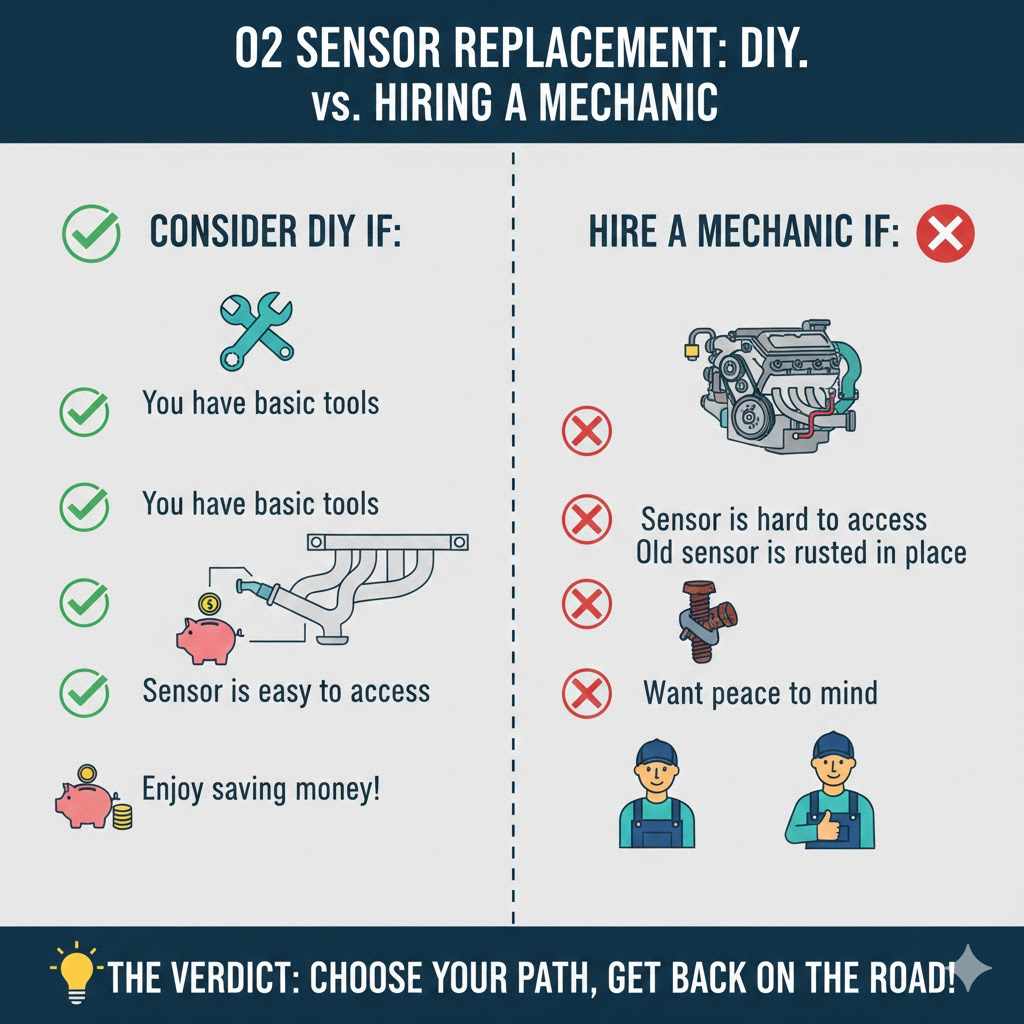
DIY vs. Hiring a Mechanic: What’s Right for You?
Deciding whether to tackle this job yourself comes down to your comfort level, tools, and time.
Consider DIY if:
- You have basic tools and are willing to buy an O2 sensor socket.
- The sensor is easy to access. (Some are right on the front of the exhaust manifold).
- You enjoy learning about your car and saving money.
Hire a Mechanic if:
- The sensor is in a hard-to-reach spot, like up against the firewall or on top of the transmission.
- The old sensor is rusted in place and won’t budge. This is very common.
- You’re not comfortable working under your car or dealing with potentially hot exhaust components.
- You want the peace of mind that the job is done right and comes with a warranty.
Frequently Asked Questions (FAQ)
1. Can I drive my car with a bad O2 sensor?
Yes, you can usually drive with a bad O2 sensor, but it’s not recommended for long. Your car will run inefficiently, wasting fuel and producing more pollution. Over time, it can lead to more expensive damage, particularly to your catalytic converter, which can cost thousands to replace.
2. How many O2 sensors does my car have?
Most cars made since 1996 have at least two O2 sensors. Many V6 or V8 engines have four. There is typically one sensor “upstream” (before the catalytic converter) and one “downstream” (after the catalytic converter) for each bank of cylinders.
3. Where is the O2 sensor located?
O2 sensors are always screwed into the exhaust system. You will find them on the exhaust manifold (the pipe coming directly off the engine) or further down the exhaust pipe near the catalytic converter.
4. How long do O2 sensors last?
Modern O2 sensors are designed to last a long time, often between 60,000 and 100,000 miles. However, they can fail sooner due to contamination from things like an oil or coolant leak.
5. Can a bad O2 sensor damage my engine?
While it won’t cause immediate, catastrophic engine failure, driving for an extended period with a bad sensor can cause issues. A constant rich fuel mixture can foul spark plugs, and a lean mixture can lead to higher engine temperatures, which is not good for your engine’s health in the long run.
6. What happens if I just ignore the check engine light for an O2 sensor?
Ignoring it means you’ll continue to get poor fuel economy. More importantly, you risk damaging your catalytic converter due to the incorrect fuel mixture. Replacing a catalytic converter is a far more expensive repair than replacing an O2 sensor.
7. Is it hard to replace an O2 sensor myself?
The difficulty ranges from very easy to very difficult. If the sensor is easily accessible and not rusted in place, it’s a simple job that involves unplugging a wire and unscrewing the sensor with a special socket. If it’s in a tight spot or seized by rust, it can be a frustrating job even for experienced mechanics.
Your Next Steps: Putting It All Together
So, let’s bring it all home. Will a bad O2 sensor cause your car not to start? The answer is a clear and confident “almost certainly not.” Your no-start issue is pointing you toward the big three: your battery, your starter, or your fuel delivery system.
However, that doesn’t mean you should ignore the signs of a failing O2 sensor. That check engine light is your car’s way of asking for help. Listening to it promptly by checking the codes will save you money at the pump, help your car run better, and prevent much more costly repairs down the road.
You have the knowledge now to face that dashboard light without panic. You know the real symptoms to watch for, and you understand that a simple OBD-II scanner can be your best friend. Whether you decide to tackle the repair yourself or head to a mechanic, you can now do so with confidence. You’ve got this!