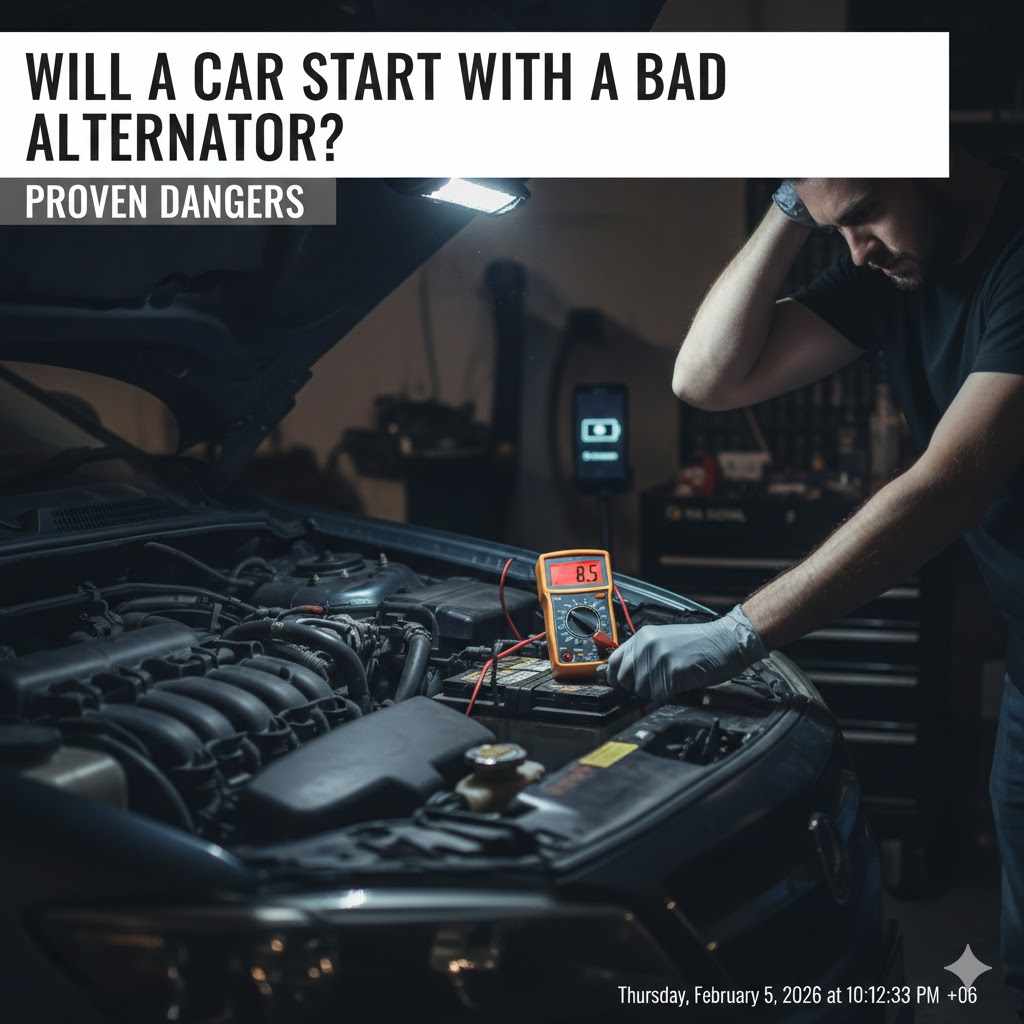
Will a Car Start With a Bad Alternator? Proven Dangers
Yes, a car can start with a bad alternator, but it won’t run for long. The car starts using power from the battery, but the alternator’s job is to recharge the battery and power the electronics while the engine is running. Without it, the battery will drain quickly, and the car will stall.
Hello there, I’m Md Meraj. I know how stressful it is when your car acts up. One minute you’re driving along, and the next, a strange light pops up on your dashboard. Or maybe your car starts fine one day and is completely dead the next. One of the most common culprits behind these electrical mysteries is the alternator.
It’s a small part with a huge job, and when it fails, it can cause a lot of confusion and worry. But don’t stress! I’m here to clear things up. We’re going to walk through this together, step by step, so you can understand what’s happening, spot the warning signs, and know exactly what to do. Let’s get you back on the road with confidence.
What Does an Alternator Do Anyway?
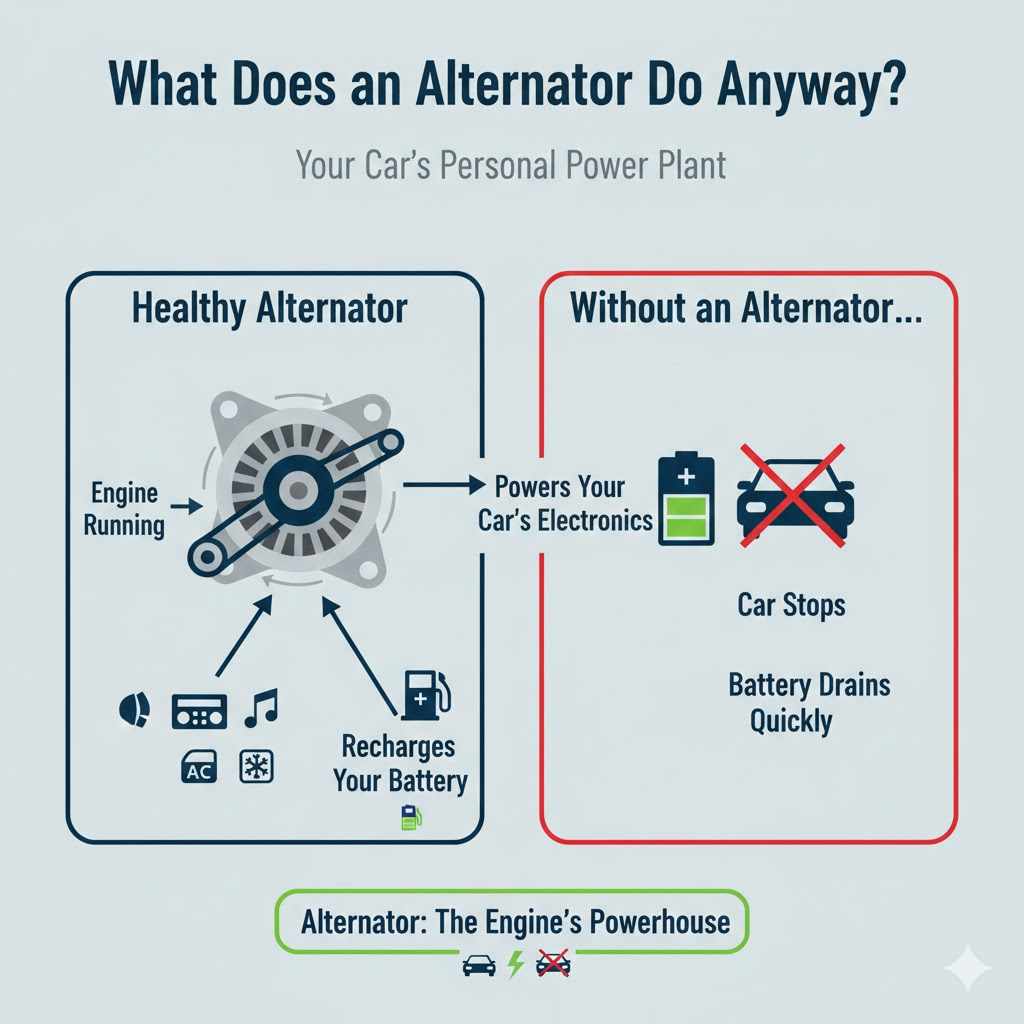
Before we dive into the problems, let’s talk about what a healthy alternator does. Think of it as your car’s own personal power plant. When your engine is running, the alternator creates electricity. This electricity does two very important things:
- Powers Your Car’s Electronics: It runs everything from your headlights and radio to your power windows and air conditioning.
- Recharges Your Battery: It keeps your battery topped up so it has enough juice to start your car next time.
Your battery is great for one big burst of power to get the engine started, but it’s not designed to run the whole car by itself. That’s the alternator’s job. Without it, the battery quickly runs out of power, and your car comes to a grinding halt.
So, Your Car Started. Now What?
You turned the key, and the engine roared to life. You might think everything is okay, but if the alternator is bad, you’re driving on borrowed time. The car is running entirely on the battery’s stored power. Every electrical component you use—the lights, the wipers, the GPS—is draining that battery faster and faster.
A fully charged, healthy battery might give you anywhere from 15 to 30 minutes of driving time before it’s completely drained. This window gets even smaller at night when you need your headlights, or if you’re running the A/C. Once the battery is empty, the engine will shut down completely.
Top Signs of a Failing Alternator
Your car is pretty good at telling you when something is wrong. You just have to know what to look (and listen) for. Here are the most common warning signs of a bad alternator. If you notice any of these, it’s time to pay attention.
- The Dashboard Warning Light: This is the most obvious sign. You’ll see a light shaped like a battery, or it might say “ALT” or “GEN.” This light is a direct signal from your car’s computer that there’s a problem in the charging system. Don’t ignore it!
- Dim or Flickering Headlights: Is your dashboard lighting looking a bit weak? Are your headlights pulsing from dim to bright? This happens because the alternator isn’t producing a steady stream of electricity, causing your electrical systems to struggle.
- Strange Noises: A failing alternator often makes unusual sounds. You might hear a whining or grinding noise that gets louder as you accelerate. This is often caused by a worn-out bearing inside the alternator or a misaligned belt.
- Electrical Gremlins: When the alternator can’t supply enough power, your car’s computer has to decide what gets electricity and what doesn’t. You might notice your power windows moving slowly, your radio acting up, or your speedometer suddenly dropping to zero.
- The Smell of Burning Rubber or Wires: A hot, burning smell can be a serious red flag. It could mean the alternator’s drive belt is slipping and creating friction, or the alternator itself is overheating and burning its internal wiring. Pull over immediately if you smell this.
- A Dead Battery (Repeatedly): If you find yourself with a dead battery more than once, the battery itself might not be the problem. A bad alternator can’t recharge the battery, so even a brand-new battery will go dead quickly. Jump-starting the car will only be a temporary fix.
The Proven Dangers of Ignoring a Bad Alternator
Trying to “limp home” with a failing alternator isn’t just inconvenient—it’s dangerous. The risks go far beyond simply getting stranded. Understanding these dangers will help you see why it’s so important to address the problem right away.
1. Sudden Stalling in Traffic
This is the biggest risk. When the battery finally dies, your engine will shut off immediately. It doesn’t matter if you’re going 5 miles per hour in a parking lot or 65 miles per hour on the highway. Losing all engine power unexpectedly can lead to a serious accident, especially in heavy traffic. You’ll lose the ability to accelerate, and other drivers may not react in time.
2. Loss of Power Steering and Brakes
Modern cars rely on engine power for more than just moving forward. Your power steering and power brakes are assisted by systems that run off the engine. When the engine stalls:
- Your steering wheel will become extremely difficult to turn.
- Your brake pedal will become very hard to press down.
You can still steer and brake, but it will require a lot more physical effort. In a panic situation, this can make it incredibly difficult to control your vehicle and pull over safely. The National Highway Traffic Safety Administration (NHTSA) emphasizes how critical responsive steering is for avoiding crashes.
3. Damage to Other Expensive Components
A failing alternator can send erratic voltage through your car’s electrical system. These power surges and drops can fry sensitive and expensive electronics, including:
- The battery itself (a bad alternator can overcharge and “cook” a new battery)
- The onboard computer (ECU or PCM)
- The stereo and navigation systems
- Various sensors and modules
What started as a few hundred dollars for an alternator replacement can quickly turn into thousands of dollars in widespread electrical repairs.
Alternator vs. Battery: How to Tell the Difference
It’s very easy to confuse a bad alternator with a dead battery because the main symptom—a car that won’t start—is the same. Here’s a simple table to help you diagnose the problem.
| Symptom | Likely a Bad Alternator If… | Likely a Bad Battery If… |
|---|---|---|
| Car Won’t Start | The car started fine yesterday, but is dead today. After a jump-start, it dies again soon after the cables are removed. | The car makes a clicking sound but won’t turn over. After a jump-start, it stays running and starts again later. |
| Warning Lights | The “ALT,” “GEN,” or battery-shaped light is on while you are driving. | No warning lights were on before the car failed to start. The battery light may come on, but only when you try to crank the engine. |
| Headlights & Electronics | Lights are dim or flickering while the engine is running. They may brighten when you rev the engine. | Lights are very dim or won’t turn on at all, even before you try to start the car. |
| After a Jump-Start | The car starts but dies within a few minutes. | The car starts and continues to run fine. |
A Super-Simple Test You Can Do at Home
Want to check your alternator yourself? You can perform a very basic test with no tools required. It’s not a 100% foolproof diagnostic, but it can give you a strong clue.
- Start your car. If you need to jump-start it, that’s okay. Leave the engine running.
- Turn on your headlights. Make sure they are on a normal setting, not auto.
- Observe the brightness. Are they bright and steady, or are they dim and weak?
- Rev the engine gently. While watching the headlights, press the gas pedal slightly to bring the engine RPM up to around 2,000. You don’t need to floor it!
What to look for:
- If the headlights get significantly brighter as you rev the engine, it’s a classic sign of a failing alternator. It means the alternator is only producing enough electricity when it’s spinning faster.
- If the headlights stay dim and don’t change, the alternator is likely not producing any charge at all.
- If the headlights are bright and stay consistently bright, your alternator is probably working correctly.
What to Do if Your Alternator Fails While Driving
Realizing your alternator is dying while you’re on the road can be frightening. The key is to stay calm and act quickly to get yourself to safety.
- Turn Off Everything You Don’t Need. To save every last drop of battery power, immediately turn off the radio, air conditioning or heat, heated seats, and unplug any phone chargers. This might buy you a few extra minutes.
- Don’t Turn Off the Car. Resist the urge to pull over and restart the car to “see if it’s fixed.” If the alternator is bad, the car will not start again once you turn it off. Keep it running until you are safely parked.
- Find a Safe Place to Pull Over. Put your turn signal on and start looking for a safe spot to get off the road. An exit ramp, a well-lit parking lot, or a wide shoulder are ideal. Avoid stopping in a lane of traffic or on a blind curve.
- Call for Help. Once you are safely parked, turn the car off and call for roadside assistance or a tow truck. Driving any further is a gamble you don’t want to take.
How Much Does It Cost to Replace an Alternator?
The cost can vary a lot depending on your car’s make and model, as well as where you live. Some alternators are easy to access, while others are buried deep in the engine bay, which increases labor time. Here is a general breakdown of what you can expect.
| Cost Component | Average DIY Cost | Average Professional Repair Cost |
|---|---|---|
| Alternator Part (Remanufactured) | $150 – $350 | $200 – $450 (includes shop markup) |
| Labor Costs | $0 (your time and effort) | $150 – $500 (1 to 4 hours of labor) |
| Total Estimated Cost | $150 – $350 | $350 – $950+ |
For an accurate price on parts, you can check reputable online stores like AutoZone or NAPA Auto Parts. Remember that luxury or European cars will often have higher part and labor costs.
Can You Replace an Alternator Yourself?
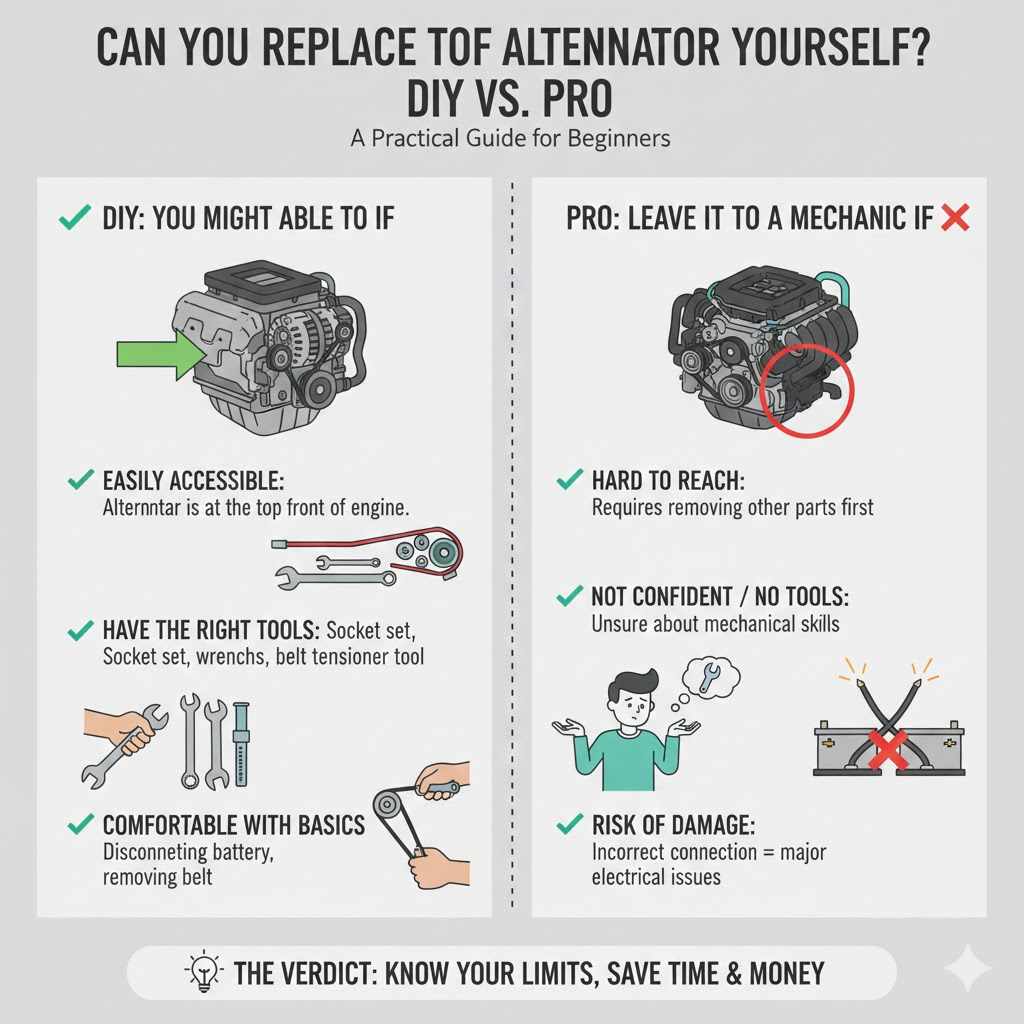
For a motivated beginner with the right tools, replacing an alternator is an achievable DIY project on many common vehicles. However, it’s not as simple as changing your oil.
You might be able to do it yourself if:
- The alternator is easily accessible at the top front of your engine.
- You have a good set of mechanic’s tools (socket set, wrenches, belt tensioner tool).
- You are comfortable disconnecting the battery and removing the serpentine belt.
You should probably leave it to a professional if:
- The alternator is hard to reach, requiring other parts to be removed first.
- You are not confident in your mechanical skills.
- You don’t have the proper tools.
Making a mistake, like connecting the battery incorrectly, can cause major electrical damage. When in doubt, it’s always safer and often cheaper in the long run to have a trusted mechanic do the job.
Frequently Asked Questions (FAQ)
1. How long can a car run with a bad alternator?
A car can run for about 15 to 30 minutes on a fully charged battery with a bad alternator. This time decreases significantly if you use headlights, A/C, or other electronics.
2. Can a bad alternator ruin a new battery?
Absolutely. A failing alternator can either undercharge or overcharge a battery. Undercharging will cause it to die repeatedly, while overcharging can “boil” the liquid inside, permanently damaging the battery’s cells and drastically shortening its life.
3. What sound does a bad alternator make?
The most common sounds are a high-pitched whining that changes with engine speed, or a grinding/rumbling noise. These sounds are typically caused by worn-out internal bearings.
4. Is it okay to jump-start a car with a bad alternator?
You can jump-start it to get the engine running, but it’s only a temporary solution. The car will die again as soon as the battery drains, usually within minutes. It’s useful for diagnosing the problem or moving the car a very short distance to a safe spot.
5. Will a bad alternator drain my battery when the car is off?
Yes, it can. A faulty diode inside the alternator can create a “parasitic draw,” meaning it continues to pull power from the battery even when the car is shut down. This can leave you with a dead battery overnight.
6. How much does it cost to have an alternator tested?
Most auto parts stores will test your alternator for free. They have a machine that can tell you if it’s functioning correctly. A mechanic will typically include the test as part of their diagnostic fee, which could be around $50 to $150.
Your Next Steps for a Healthy Car
Dealing with a bad alternator can feel overwhelming, but now you have the knowledge to face it head-on. You know that while a car might start with a failing alternator, it’s a ticking clock before it stalls. More importantly, you understand the serious safety risks of continuing to drive.
Remember the key signs: a warning light, dimming headlights, strange noises, and electrical issues. If you suspect your alternator is the problem, use the simple tests we discussed or take it to an auto parts store for a free check. Don’t let a small issue turn into a dangerous situation or a much more expensive repair.
Taking care of your car is about more than just mechanics; it’s about keeping yourself and others safe on the road. By tackling this issue now, you’re not just fixing a part—you’re ensuring your car remains a reliable and safe partner for all your journeys ahead. You’ve got this!
Products related to this article
Sponsored / affiliate links. As an Amazon Associate I earn from qualifying purchases. I may earn additional commission from eligible campaigns.