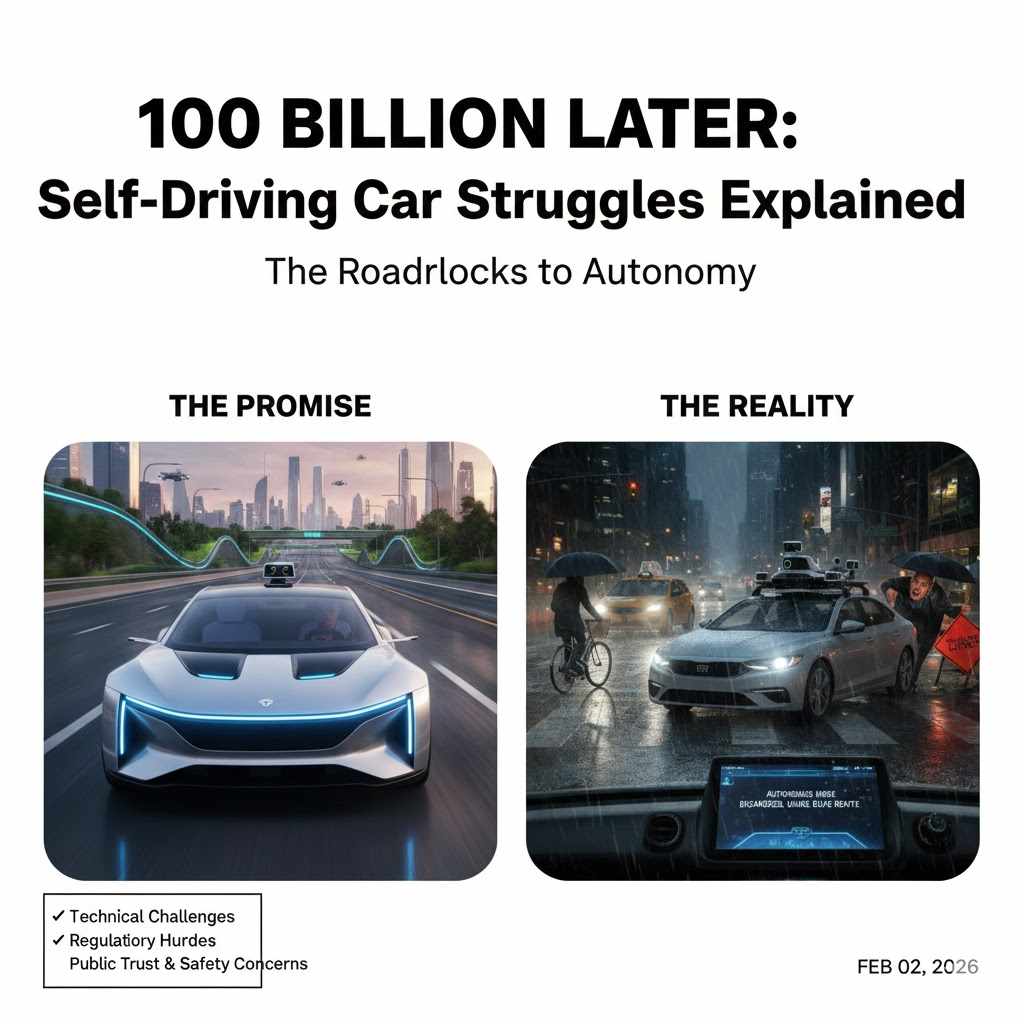
$100 Billion Later: Self-Driving Car Struggles Explained
It’s easy to get lost when thinking about $100 Billion Later: Why Self-Driving Cars Are Stuck. It sounds super complicated, right? Don’t worry, you’re not alone! Many folks find this topic a bit tricky at first. But we’re going to break it down step-by-step so it’s super simple. You’ll soon see why self-driving cars haven’t taken over the roads, despite all the money spent. Next, we’ll examine the key obstacles.
The Roadblocks to Autonomous Vehicles
The quest for self-driving cars has been a massive undertaking, costing billions and taking years. But what’s holding these amazing machines back? The biggest problems aren’t about building the cars; they’re about dealing with the real world. Think about it: roads aren’t always perfect, weather changes constantly, and other drivers can be unpredictable. This section will explore the main challenges that the industry faces, from technical hurdles to public acceptance, and all the stuff in between. We’ll explore the main issues behind why autonomous vehicles are not on every road.
Technical Challenges in Self-Driving Systems
Building a car that can drive itself is a massive technical feat. It’s not just about steering and braking; it’s about seeing, thinking, and making decisions. This means the cars need super-smart computers and super-accurate sensors. Developing the software and hardware requires tons of time and money, and it is a challenging process. We need to explore the specific technical issues and discover what’s holding everything back.
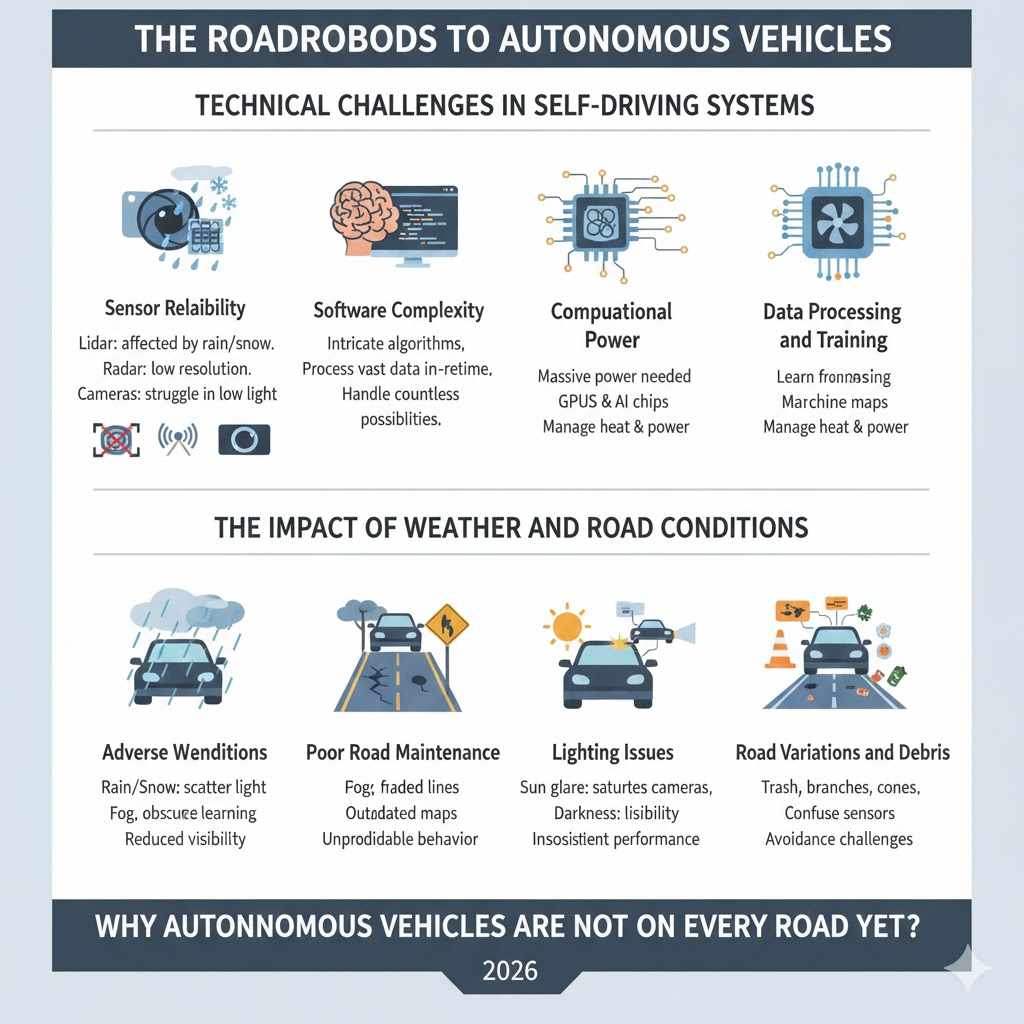
Sensor Reliability: Self-driving cars rely on sensors (like cameras, radar, and lidar) to “see” the world. These sensors have to work perfectly, even in tough conditions. Imagine trying to drive with foggy glasses or in a snowstorm.
Sensors are the eyes and ears of a self-driving car. They must accurately and reliably detect objects, distances, and road conditions in real-time. This involves lidar, radar, and cameras, each with advantages and disadvantages.
Lidar provides highly detailed 3D maps but can be affected by rain and snow. Radar can penetrate adverse weather but has lower resolution. Cameras offer high-resolution imagery but struggle in low-light conditions. The challenge is in integrating these sensors seamlessly and ensuring their output is accurate. The processing of sensor data needs to be incredibly precise, as a mistake could be dangerous.
Software Complexity: The software that tells the car what to do is unbelievably complex. It has to process all the sensor data, make decisions in a split second, and control the car’s movements. Think of it as a super-smart brain that must be able to handle countless possibilities.
The software inside self-driving cars manages everything, from detecting objects to planning routes. This software uses intricate algorithms that must process vast amounts of data in real-time. It faces a huge challenge – the ability to handle various situations, from simple lane changes to complex city traffic. Writing and testing these algorithms is a tough job. Developers need to account for everything.
Computational Power: The computers in these cars need a ton of power to process all the information. They have to be fast enough to make quick decisions, which makes them expensive to produce. It’s like having a super-powerful gaming computer in your car, but even faster.
Self-driving cars require massive computational power to process the data from their sensors and make real-time decisions. This is done with powerful processors, including GPUs (Graphics Processing Units) and specialized AI chips. The computers must handle huge amounts of data. This means that designing these systems is tricky, from managing heat and power consumption to ensuring the systems remain functional under high stress.
Data Processing and Training: Self-driving cars “learn” by being fed massive amounts of data. This includes real-world driving data, which is then used to train the car’s AI. This process is time-consuming and requires lots of processing power.
Self-driving cars learn and improve from experience, similar to people. They are trained with tons of driving data – from simple roads to complex city environments. This process involves machine learning algorithms that teach the cars to recognize objects, anticipate actions, and make driving decisions. The AI models require continuous training and refinement to deal with different situations. The more data the cars process, the more accurate and reliable they become.
The Impact of Weather and Road Conditions
Weather and road conditions play a huge role in the performance of self-driving cars. Rain, snow, fog, and even bright sunlight can confuse the sensors. Meanwhile, potholes, lane markings fading, or unclear road signs cause serious problems. Let’s explore how these environmental factors make it hard for self-driving cars to navigate safely.
Adverse Weather Conditions: Rain, snow, and fog can make it difficult for sensors to “see” clearly. Sensors are usually affected by weather. Raindrops can scatter light, snow can block the view, and fog can obscure objects, which is a big deal for sensors.
Adverse weather conditions are a significant challenge for self-driving vehicles. Rain, snow, and fog can severely affect the performance of the sensors. Raindrops can scatter light, and snow can block the sensors, leading to inaccurate readings. Fog reduces visibility, making it challenging for the car’s systems to detect objects at a distance. As a result, the car’s ability to drive safely is reduced.
Poor Road Maintenance: Damaged roads, faded lane markings, and unclear road signs can all throw off self-driving cars. This can lead to the car making incorrect decisions or failing to understand the road.
Poor road maintenance is also a major problem. Potholes, cracks, and uneven road surfaces can confuse the sensors, leading to the car behaving unpredictably. Faded or missing lane markings make it difficult for the car to stay in its lane. The car’s mapping systems might also be confused if the information is out of date. All of this can make autonomous driving difficult, especially in areas with poor infrastructure.
Lighting Issues: Glare from the sun or dark areas can make it hard for cameras to “see.” This can lead to the car having trouble understanding the road environment.
Light also impacts autonomous systems. Glare from the sun can saturate the cameras, making it difficult to recognize objects. Driving in the dark introduces different issues. Self-driving cars rely on headlights and other sensors, but the effectiveness of these can vary based on the specific conditions. The challenge is in developing systems that perform consistently under various lighting conditions.
Road Variations and Debris: Debris on the road, such as construction cones or fallen objects, can also confuse the sensors. It can affect how the car perceives its surroundings.
The road isn’t always clear and simple. Debris on the road, such as trash, branches, or construction cones, can confuse the car’s sensors. These objects can be mistaken for other cars or obstacles. The car’s programming must be able to understand what is safe to drive over and what needs to be avoided. This is a big challenge.
The Ethical and Legal Issues
Self-driving cars bring up some big questions about ethics and the law. Who is responsible when a self-driving car gets into an accident? How do we decide which choices are best if a crash is unavoidable? Exploring these questions is essential, because these are issues that matter to everyone.
Liability and Accountability
One of the biggest questions is about who is responsible when an autonomous vehicle is involved in a crash. Is it the car manufacturer, the software developer, the owner, or someone else? Figuring out the answers will be critical before self-driving cars become widespread. Let’s break down liability and accountability.
Determining Fault: Figuring out who’s at fault when a self-driving car crashes is complex. It could be the manufacturer if a system failure caused the accident. It could also be the owner or operator if they were negligent.
Figuring out who’s at fault is not easy. When a self-driving car gets into a crash, it’s not clear who is responsible. It could be the manufacturer if a system failure caused the accident. It could be the owner if they were not paying attention. The challenge is collecting and analyzing all the data. We need to define legal standards to determine who’s at fault.
Insurance and Regulations: Insurance companies and governments are working on new rules to cover self-driving cars. These will need to address how liability is assigned and what safety standards are required.
Insurance companies and governments are trying to create new laws for self-driving cars. These laws need to figure out who is responsible if there is a crash. There must also be safety standards. The rules must keep up with technology to make sure everything is safe. The rules need to protect drivers and the public.
Data Privacy: Self-driving cars collect a lot of data about how they’re driven. This data could be used to determine who’s at fault in a crash. It also raises questions about privacy.
Self-driving cars collect a lot of data. This data includes how the car is driven and the road conditions. This data is valuable for figuring out what happened in a crash. It raises questions about privacy. Who gets to see the data? The laws need to protect data and ensure the privacy of people.
Ethical Dilemmas in Self-Driving Systems
Self-driving cars may have to make tough decisions in emergency situations. For example, if a crash is unavoidable, should the car try to protect its passengers or swerve to avoid hitting a pedestrian? These dilemmas can become extremely hard to solve. Let’s explore these difficult scenarios.
The Trolley Problem: This is a famous thought experiment where you must choose between two bad outcomes. For example, should the car protect its passengers or swerve to avoid hitting a pedestrian?
The trolley problem is a classic ethical dilemma. Imagine a self-driving car is in a situation where a crash is unavoidable. Should the car prioritize the safety of its passengers by staying on course? Or should it swerve to protect pedestrians, even if it endangers its passengers? This has no easy answer. This is something the system must be prepared for.
Programming Moral Choices: How do you program a car to make these kinds of ethical decisions? This requires defining ethical principles and then translating them into code.
The main challenge is deciding how to program a car to make moral decisions. This means defining ethical principles and translating them into computer code. The car must be taught to consider the value of lives and make choices that minimize harm. The programming must cover different situations, which can be a very hard thing to do.
Bias in Algorithms: Algorithms can be biased. For example, if a self-driving car is trained on data that does not include all types of people, it could make unfair decisions.
The data used to train self-driving car algorithms can introduce bias. Algorithms may make choices based on things like race, gender, or age, which is a serious issue. We must ensure that the training data represents all members of society fairly. We need to implement fairness and ethical consideration during development.
Public Acceptance and Trust
Even if self-driving cars become technically perfect, people must trust them. If people do not trust self-driving cars, they won’t use them. This section will explore the importance of public perception and the steps needed to build trust, from increasing awareness to handling the social aspects of this new technology.
Building Public Trust in Autonomous Vehicles
Trust is an essential factor for the success of self-driving cars. People must feel safe and confident that these vehicles are capable. Building trust is an important part of the process, and we should discuss some of the most essential methods.
Transparency and Education: It is vital to show how self-driving cars work. This helps people understand how they operate and what safety features are in place.
Transparency and education are key. People must understand how self-driving cars operate. Explaining the technology behind the sensors, the decision-making process, and the safety features, can reduce anxiety. We can create materials and educate the public on the ways they can trust self-driving cars.
Demonstrations and Testing: Demonstrating self-driving cars in real-world scenarios, and the results of various tests, can build confidence. These demos should showcase the cars’ capabilities.
Showcasing the cars’ capabilities through demonstrations and testing can build confidence. We need to run tests in various environments and driving situations. The results can be shared with the public to demonstrate the vehicles’ performance and safety. Transparency in testing is essential.
Addressing Concerns: Responding to public concerns about self-driving cars, such as safety, job loss, and data privacy, is important. We can do so by providing information and addressing common worries.
Addressing the worries is important, too. Public concerns can range from safety to jobs, and data privacy. Listening to and addressing those concerns builds trust. We need open discussions. Sharing clear and honest information about the benefits of self-driving cars can help reduce fear and make people comfortable.
Social and Economic Impacts
Self-driving cars have the potential to change our lives. The way people move around, to job markets, and to the environment will be affected. It is essential to discuss these influences to prepare for the future.
Job Displacement: Self-driving vehicles may replace drivers of trucks, taxis, and delivery vehicles. This could lead to job losses in the transportation sector.
The introduction of self-driving cars might cause job displacement in the transportation sector. Professional drivers, such as truck drivers, taxi drivers, and delivery drivers, could face job losses. This requires planning and policies, such as retraining programs. The goal is to make sure people can adapt to new job roles.
Accessibility and Mobility: Self-driving cars could increase mobility for people who can’t drive, such as the elderly or people with disabilities. This is positive.
Self-driving cars could help increase mobility for people who cannot drive, such as the elderly or disabled persons. This can make them independent and improve their quality of life. Self-driving cars could give these people freedom, but accessibility must be a priority.
Urban Planning and Development: Self-driving cars could change how cities are designed. Fewer parking spaces could be needed, and new types of transportation infrastructure might be created.
Self-driving cars could influence urban planning and development. Because these vehicles might not need parking spaces, this could impact the design of cities. We could see the creation of new transportation infrastructure. We must have plans to make sure that these technologies are useful and that everyone benefits.
$100 Billion Later: A Deeper Look
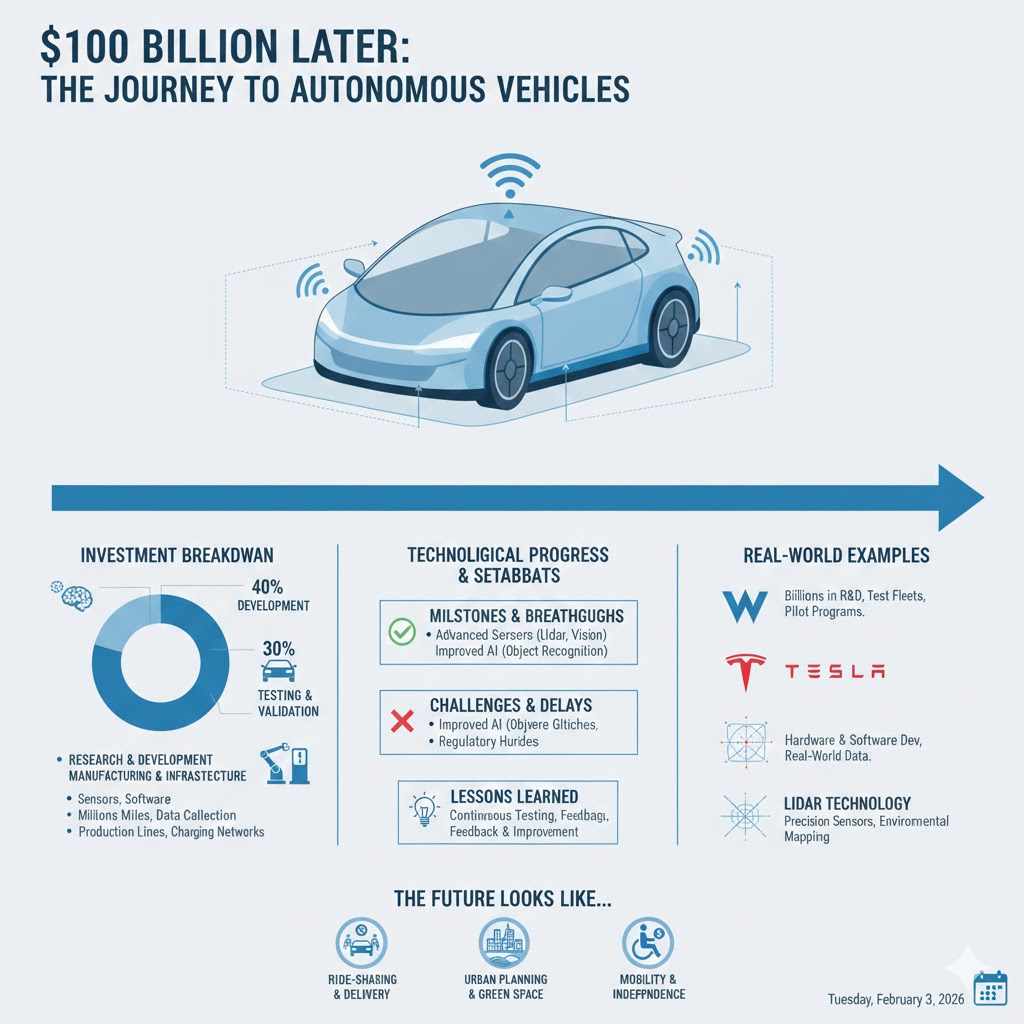
Let’s take a look at the journey to autonomous vehicles. Over the years, billions of dollars have been spent. Companies and governments have put a lot of money into this technology. Now it is important to understand where the money has gone, and why the progress has been so slow. This deep dive will explore the key investments, the technology’s progress, and the impact of these investments.
Investment Breakdown
The money spent on self-driving cars comes from various sources, and the spending is huge. Knowing where all the money goes helps us understand the challenges. Let’s look at the areas where funds are being allocated.
Research and Development: A huge part of the funding goes into research and development. This includes the development of sensors, software, and AI algorithms. Companies often invest to push innovation.
A big portion of the investment goes into research and development (R&D). This includes the development of sensors, software, and AI algorithms. Companies are investing in R&D to push the boundaries of what is possible. They’re constantly trying to create more advanced and reliable systems. The goal is to make self-driving cars safer and more capable.
Testing and Validation: Testing is a costly part of the process. Companies need to test self-driving cars in various conditions and for millions of miles. Data is essential for building these technologies.
Testing and validation are essential parts of the self-driving car process. Companies must test their cars in different conditions and log millions of miles to check their performance. They collect data to improve their systems and make sure they meet safety standards. The validation process is costly.
Manufacturing and Infrastructure: Once self-driving cars are ready for the market, money goes into manufacturing and building the infrastructure needed to support them, such as charging stations.
A part of the money invested goes to the manufacturing of self-driving cars and the infrastructure to support them, such as charging stations. This includes setting up production lines, purchasing parts, and building the necessary support systems. This can be costly, and the scale of production is essential for creating infrastructure.
Technological Progress and Setbacks
The progress in self-driving cars is not linear. There are moments of great improvement and times when things get delayed. Reviewing the successes and the issues helps us to understand the bigger picture.
Milestones and Breakthroughs: We’ve seen amazing progress, from the invention of more reliable sensors to advances in AI. These improvements are milestones.
There have been many breakthroughs in self-driving car technology. There have been advancements in sensors, with better resolution and performance, and in AI algorithms. We’ve seen improved object recognition and decision-making capabilities. These advancements are essential for getting autonomous vehicles on the road.
Challenges and Delays: We’ve also had setbacks, like unexpected accidents and problems with the software. These can be expensive and slow the process down.
The journey to self-driving cars has faced challenges and delays. Problems with software, hardware, and unexpected accidents can slow the development and deployment of these vehicles. These delays highlight the many issues.
Lessons Learned: Each challenge teaches us something new. Companies and researchers are constantly learning to improve the technology.
From every challenge, we learn something new. Companies and researchers are always working to improve self-driving car technology. They’re using lessons from past mistakes to improve. The learning process involves continuous testing, feedback, and improvement to make these systems safer.
Here are some examples of what the $100 Billion has bought.
Waymo, one of the leaders in the field, has spent billions developing its technology. This includes a fleet of test vehicles and sophisticated software. Their investment is visible in their pilot programs, which operate in controlled environments.
Waymo has invested a massive amount into self-driving technology. They spent billions on R&D, sensor development, and software. They also tested their systems over millions of miles in various conditions. This huge investment allows them to test their tech. The data helps them improve their technology.
Tesla, known for its advanced driver-assistance systems, has invested heavily in developing its hardware and software. Elon Musk has invested heavily in creating the hardware and software for self-driving cars.
Tesla has invested in creating and testing hardware and software. They have improved their technology by getting real-world data and making updates. Tesla’s approach focuses on a particular method and integration that helps their systems improve. This also helps them find ways to improve safety and performance.
The development of lidar technology, which is essential for self-driving cars to “see” the environment, involved massive investments. This includes the development and manufacturing of lidar units and improving the software for processing the data.
The evolution of lidar technology required investments. Lidar is a key part of self-driving cars. Investments help improve the precision and reliability of lidar sensors. Improved sensor performance contributes to better object detection and mapping of the environment, which is all essential for self-driving cars to be successful.
Here are some examples of what the future could look like.
Self-driving cars could be used for ride-sharing and delivery services. They could provide transportation to people.
Self-driving cars will be used for ride-sharing. People can request a self-driving car to take them to their destination. Self-driving cars will also be used for deliveries, which can improve logistics. This could provide better transport options.
Self-driving cars will change the way cities are planned. Less space will be needed for parking, creating space for parks.
Self-driving cars can transform how cities are designed. When these cars are common, it will reduce the need for parking spaces. This can create more green spaces. Self-driving cars will help cities become more livable and sustainable.
Self-driving cars can improve the lives of people who have disabilities or difficulty with mobility. People with mobility issues will be able to travel more easily.
Self-driving cars can improve people’s lives. Self-driving cars can help people who have trouble moving around by providing transportation. This will increase their independence. This will increase people’s quality of life.
Frequently Asked Questions
Question: Why is it taking so long for self-driving cars to be widely available?
Answer: Self-driving cars are complex, and many technical and ethical issues need to be resolved. This takes a lot of time.
Question: Are self-driving cars safe?
Answer: Self-driving cars are constantly improving, but they are not perfect. It is important to remember that all technology involves risk.
Question: Who is responsible if a self-driving car causes an accident?
Answer: Determining responsibility can be complex and depends on the circumstances of the accident and the laws in place.
Question: How will self-driving cars affect jobs?
Answer: Self-driving cars could change job roles in the transportation industry, with possible displacement in some areas and opportunities in others.
Question: When will self-driving cars be everywhere?
Answer: This is hard to say for sure! It depends on solving many technical, legal, and social challenges. Progress is happening all the time!
Final Thoughts
The journey of self-driving cars, despite the huge sums of money spent, shows how complex this technology is. $100 Billion Later: Why Self-Driving Cars Are Stuck highlights the difficulties of the challenges ahead. It is a reminder that innovation is often challenging, involving tests, and setbacks.
While the path to widespread adoption is not straightforward, the effort is still important. From sensor improvements to solving ethical dilemmas, every step provides a better understanding of autonomous systems. If you’re excited by the idea of self-driving cars, the best thing you can do is to remain informed. Learning about the different developments will help you understand the future.