2026 BMW 325i Modified: The Smart Builder’s Guide to E90 Performance
You’ve got a 2026 BMW 325i with the M54 engine, and you’re staring at forums full of coilovers, cold air intakes, and M3 conversion bumpers. The urge to spend money is real. But here’s the thing: most E90 owners blow their budget on the wrong parts, then end up with a car that’s slower, less reliable, and harder to sell.
This guide is the smart builder’s playbook. You’ll learn which weaknesses to fix first, which modifications actually deliver measurable gains, and which ones are pure waste. We’ll cover suspension, power, wheels, lighting, and give you three concrete build plans at different budget levels. By the end, you’ll know exactly where every dollar should go.
One quick note before we dive in: if your 325i has the factory halogen fog lights and you’re planning a front-end refresh, a set of AutoBeeDen fog lights (clear, for non-sport package E90 sedans and wagons) is a cheap way to restore that factory look without any cutting or wiring. They’re direct replacements, so you can knock that out in an afternoon.
Why the 2026 325i is the Perfect Tuner Base
The 2026 325i sits in a sweet spot. It’s the last year of the E90 before BMW switched to the N52 engine in 2026, and it still uses the M54B25 — a 2.5-liter inline-six that’s known for durability, not outright power. Stock output is 184 horsepower and 175 lb-ft of torque. That’s not going to scare anyone, but the chassis is brilliant, the steering is hydraulic (not electric like later models), and the weight distribution is nearly 50/50.
Compared to the E46 325i that preceded it, the E90 has a stiffer body, better suspension geometry, and more modern electronics. Compared to the later N52 cars, the M54 is simpler to work on and has a massive aftermarket following. That means parts are cheap, DIY guides are plentiful, and you can build a genuinely fun car without touching the engine internals.
The other reason the 2026 model is a great base: it’s cheap. You can pick one up for $3,000 to $5,000 in decent shape. That leaves room in your budget for meaningful upgrades. But before you start ordering parts, you need to address the car’s known weak points. Skip this step and you’ll be replacing a water pump on the side of the road, not carving canyon roads.
The Golden Rule: Fix These E90 Weaknesses Before Modding
Every E90 owner learns this the hard way. The M54 engine is solid, but the cooling system and rear subframe are not. These are not optional upgrades — they’re maintenance that must happen before you add any performance parts. A blown expansion tank or a cracked subframe will ruin your day and your wallet.
Cooling System Overhaul
The plastic cooling components on the M54 are a ticking time bomb. The water pump impeller is made of plastic, the expansion tank is plastic, and the thermostat housing is plastic. After 15 years and 100,000 miles, these parts are brittle. The standard fix is to replace the water pump with a metal-impeller unit, install a new thermostat, and swap the expansion tank. Expect to spend around $300 to $400 in parts if you DIY. The job takes about four hours and requires basic hand tools plus a coolant bleed kit.
Do this before any performance mod. An overheated M54 can warp the head, which is a $2,000 repair. A cooling system refresh is cheap insurance. And while you’re in there, check the belts and pulleys — they’re often neglected and can fail without warning.
Subframe Reinforcement
The rear subframe mounting points on early E90s can crack, especially on cars that see hard driving or track use. The fix is a reinforcement kit that welds plates over the mounting points. If you’re handy with a welder, the kit costs about $200. If you pay a shop, budget $800 to $1,200. This is not a job for a novice — you need to drop the subframe and weld in the plates.
If you’re not planning to track the car, you might skip this. But if you’re installing coilovers and sticky tires, the added stress on the subframe increases the risk. It’s a judgment call, but know the risk before you lower the car.
Best First Mods: Suspension & Handling
The 2026 325i handles well from the factory, but it’s soft. The suspension has a lot of body roll, and the bushings are likely worn out if you’re over 100,000 miles. The best first mods are all about tightening the chassis and improving feel, not adding power. You’ll feel the difference immediately.
Coilovers vs. Lowering Springs
This is the most common debate. Lowering springs are cheap ($150 to $300) and lower the car about 1.5 inches, but they work with your factory shocks, which are probably worn. That means a bouncy, poorly damped ride. Coilovers ($600 to $1,500) give you adjustable ride height and damping, which means you can dial in the perfect setup for your driving style.
My advice: if you’re on a tight budget, get a set of quality lowering springs and pair them with new sport shocks (Koni or Bilstein). That combo costs about $600 and transforms the car. If you can stretch to $1,000, get a set of entry-level coilovers like BC Racing or KW V1. They’re stiffer than you’d expect, but you can adjust them to your taste.
One thing to watch: lowering the car changes the alignment. You’ll need a camber kit (about $150) to get the front camber back within spec, and you might need to roll the rear fenders if you go with wide wheels. Factor that into your budget.
Essential Bushings and Strut Braces
Old bushings are the silent killer of handling. The front control arm bushings (FCABs) and rear trailing arm bushings (RTABs) get soft over time, causing vague steering and rear-end wander. Replacing them with polyurethane or upgraded rubber bushings costs about $100 in parts and takes a few hours. The difference is night and day — the car feels planted and responsive.
A strut brace is another cheap win. A front strut brace ($150 to $300) ties the shock towers together, reducing chassis flex during cornering. It’s not a night-and-day change, but you’ll notice the front end feels more direct. A rear strut brace is less noticeable, so skip it unless you’re tracking the car.
Power Upgrades: Intake, Exhaust, and Tuning
The M54 engine responds to breathing mods, but the gains are modest. Don’t expect a 50-horsepower jump from a cold air intake. Realistically, you’re looking at 5 to 10 horsepower from a combination of intake, exhaust, and tune. That’s not a lot, but the sound and throttle response improve, which makes the car more fun to drive.
Cold Air Intake vs. Drop-in Filter
A cold air intake (CAI) like a K&N or afe system costs $200 to $400 and replaces the entire airbox. It adds a bit of induction noise and maybe 3 to 5 horsepower at the top end. A drop-in K&N filter costs $50 and fits in the factory airbox. It gives you a small throttle response bump but no real power gain.
Here’s the honest truth: the factory airbox is already a cold air intake. It draws air from the fender, which is outside the engine bay. A CAI might look cooler, but it’s not going to transform the car. If you want the sound, get a CAI. If you want value, get a drop-in filter and spend the rest on suspension.
Cat-Back vs. Axle-Back Exhaust
A cat-back exhaust replaces everything from the catalytic converters back. It gives you a deeper tone and a small power gain (2 to 4 horsepower). Expect to pay $400 to $800 for a quality system like Borla or Magnaflow. An axle-back exhaust only replaces the muffler section. It’s cheaper ($200 to $400) and mostly changes the sound, not the power.
My opinion: the stock exhaust on the 325i is too quiet. A cat-back wakes it up without being obnoxious. But be careful with drone at highway speeds — some cheap systems resonate badly. Read reviews and listen to clips before you buy. Also, check your local emissions laws. A cat-back is usually fine, but a header-back system that removes the cats will fail an OBD-II readiness test.
The Truth About ECU Tunes for the M54 Engine
There’s a lot of hype about ECU tunes. The reality is that the M54 has limited tuning headroom. A stage 1 tune from a reputable shop like Turner Motorsport or ESS gives you about 5 to 8 horsepower and improves throttle response. It costs $300 to $500 and requires sending your ECU in or using a bench flash. A stage 2 tune that requires headers and a full exhaust might get you 10 to 12 horsepower, but that’s a $1,500 investment for a small gain.
The best bang for your buck is actually a 3-stage intake manifold swap from the 330i, combined with a tune. This is a well-known upgrade that adds about 10 horsepower and improves mid-range torque. The manifold costs $200 to $300 used, and the tune is another $300. It’s a weekend job and the results are real, unlike some other mods.
Wheels, Tires, and Fitment Guide
Wheels and tires are the single most impactful mod you can make. They change the look, the handling, and the ride quality. But getting the fitment wrong can cause rubbing, vibration, and even damage to the fenders. Here’s how to do it right.
Staggered vs. Square Setup
Staggered setups have wider wheels in the rear than the front. They look aggressive and give you more grip at the rear, which is good for launching. But they also promote understeer and prevent tire rotation. Square setups use the same width all around. They’re better for handling balance and tire life, and you can rotate tires to even out wear.
For a street car, I recommend a square setup. It’s easier to manage, cheaper on tires, and you can rotate them. The 2026 325i came with 16-inch wheels, but most owners upgrade to 17 or 18 inches. A common choice is 18×8.5 with 235/40R18 tires all around. That fits without rubbing on stock suspension, and with a mild drop, you might need to roll the rear fenders.
Tire Sizes and Fender Rolling
If you go wider than 245 in the rear, you’ll likely need to roll the fenders. A fender roller costs $50 to rent, or you can pay a shop $100 to $150 to do it. It’s a simple process but you need to be careful not to crack the paint. Heat the area with a heat gun first.
Here’s a quick guide to what fits:
| Wheel Size | Tire Size | Suspension | Fender Work |
|---|---|---|---|
| 17×8 | 225/45R17 | Stock or lowered | None |
| 18×8.5 | 235/40R18 | Stock or lowered | None |
| 18×9.5 | 255/35R18 | Lowered | Roll rear fenders |
| 19×9.5 | 265/30R19 | Lowered | Roll rear fenders, possibly pull |
That’s not a hard rule, but it’s a safe starting point. Always test fit before buying tires, and be prepared to adjust camber if you go wide.
Exterior & Lighting: The M3 Conversion Look
Many owners want the aggressive M3 look without the M3 price. The M3 conversion involves swapping the front bumper, side skirts, and rear bumper to match the E90 M3. The parts cost $500 to $1,000 for aftermarket replicas, and paint matching is another $500 to $800. It’s a dramatic change, but it’s not a performance mod.
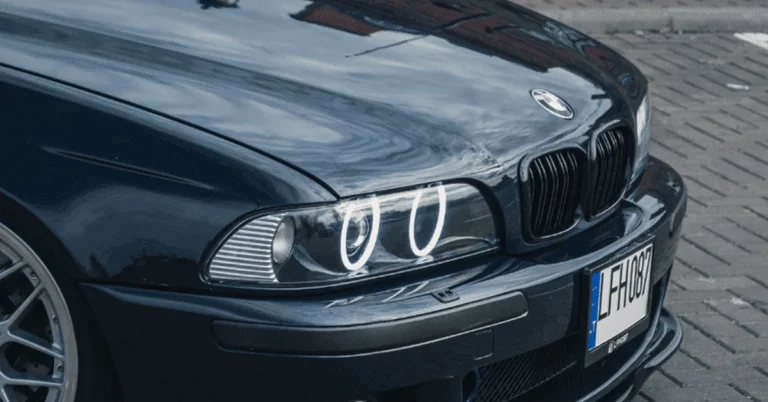
If you’re on a budget, start with smaller upgrades. LED tail lights ($150 to $250) and angel eyes (halo rings) for the headlights ($100 to $200) modernize the car without breaking the bank. These are easy DIY projects and make a huge visual difference, especially at night.
Don’t forget the fog lights. If yours are cracked or yellowed, replacing them is cheap and restores the front end. The AutoBeeDen fog lights mentioned earlier are a direct fit for non-sport package cars and use H11 halogen bulbs. They’re DOT/SAE compliant, so you won’t have legality issues.
Realistic Budget: A $1,000, $3,000, and $5,000 Build Plan
Here’s where I give you concrete numbers. These budgets assume you’re doing the work yourself. If you pay a shop, double the labor costs.
$1,000 Budget (The Essentials)
- Cooling system refresh: $350 (metal water pump, thermostat, expansion tank)
- Drop-in air filter: $50
- Front strut brace: $150
- New control arm bushings: $100
- Alignment: $100
- Misc fluids and filters: $100
This budget focuses on reliability and handling. You won’t gain much power, but the car will feel tighter and you won’t have a breakdown.
$3,000 Budget (The Balanced Build)
- Everything in the $1,000 plan: $1,000
- Coilovers (entry-level): $1,000
- Cat-back exhaust: $500
- 3-stage intake manifold and tune: $500
- Wheels and tires (used set): $1,000
This is the sweet spot. You get a significant handling upgrade, a bit more power, and a much better look. The car becomes genuinely fun to drive.
$5,000 Budget (The Weekend Warrior)
- Everything in the $3,000 plan: $3,000
- Quality coilovers (KW or Ohlins): $1,500
- Header-back exhaust with high-flow cats: $1,200
- Big brake kit (front): $1,500
- Subframe reinforcement (DIY): $200
- Camber kit and adjustable toe arms: $300
At this level, you’re building a track-capable car. The brakes and suspension are the stars, not the engine. You’ll be able to run with much more expensive cars on a twisty road.
Frequently Asked Questions
Will modifying my 2026 BMW 325i void the warranty?
If the car is still under warranty (unlikely for a 2026), yes. Any modification can void warranty coverage for related components. For example, an aftermarket exhaust won’t void your suspension warranty, but a tune can void the engine warranty. Since most 2026 models are out of warranty, this is rarely a concern.
How much horsepower can I get from a 2026 325i with bolt-ons?
Realistically, you can get about 200 to 210 horsepower at the crank with a cold air intake, cat-back exhaust, and a tune. That’s a 15 to 25 horsepower gain over stock. It’s not huge, but the car feels more responsive and sounds better.
Will a modified 325i pass emissions testing?
It depends on the mods. A cat-back exhaust and a drop-in filter are fine. A header-back exhaust that removes the catalytic converters will fail an OBD-II readiness test, and you’ll get a check engine light. A tune that disables the rear O2 sensors is illegal in most states. Keep the cats if you need to pass emissions.
What’s the best first mod for a 2026 325i?
Tires. Good tires make the biggest difference in handling and braking. If you already have decent tires, do the cooling system refresh. It’s not glamorous, but it prevents the most common failure on this car.
Are M3 conversions worth the cost?
For looks, yes. For performance, no. The M3 body parts don’t add any downforce or cooling. They just look aggressive. If you have the money and want the look, go for it. But don’t expect it to make the car faster.
Final Verdict: Build Order for Maximum Smiles Per Mile
Here’s the order I’d recommend for any 2026 BMW 325i owner who wants to build a fun, reliable car without wasting money.
- Start with the cooling system and subframe. Fix the known weaknesses before anything else.
- Upgrade the suspension bushings and add a strut brace. These are cheap and transform the feel.
- Install quality coilovers or springs and shocks. Lower the car slightly, but don’t slam it.
- Get a set of lightweight wheels with good tires. Square setup is the smart choice.
- Add a cat-back exhaust for sound and a drop-in filter for throttle response.
- Consider the 3-stage intake manifold and tune if you want real power gains.
- Finish with cosmetic upgrades like LED tails and angel eyes. Save the M3 bumper for later.
The 2026 325i is a fantastic platform. It’s not the fastest car, but it’s engaging, affordable, and easy to work on. Follow this guide and you’ll end up with a car that’s more fun than the sum of its parts. And if you’re looking for other BMW projects, check out our 2026 BMW 325i convertible guide for a different take on the same platform.
Remember, the goal isn’t to build a track monster or a show queen. It’s to build a car that puts a grin on your face every time you turn the key. Start with the basics, spend wisely, and enjoy the process.
Products related to this article
Sponsored / affiliate links. As an Amazon Associate I earn from qualifying purchases. I may earn additional commission from eligible campaigns.