5W30 vs 5W20 in Honda Big Mistake Safe
Choosing the right oil for your Honda can feel a bit confusing, especially when you see different numbers like 5W30 and 5W20. Many car owners wonder if using the wrong one, like asking if 5W30 vs 5W20 in Honda: Big Mistake or Safe? is a real worry. Don’t sweat it!
This guide will break it down simply. We’ll walk through exactly what these numbers mean and help you pick the perfect oil for your car. Get ready for clear answers and a simple plan to keep your Honda running smoothly.
Understanding Honda Oil Viscosity 5W30 vs 5W20
This section helps you figure out the difference between 5W30 and 5W20 oils. It’s important to know what these numbers mean for your Honda’s engine. We will cover how the viscosity numbers affect how your car performs and stays protected.
This knowledge is key to making sure your engine lasts a long time and runs its best.
What Do the Oil Viscosity Numbers Mean
The numbers on your car’s oil container, like 5W30 or 5W20, tell you about its thickness. This thickness is called viscosity. It’s super important for how well the oil protects your engine, especially in different temperatures.
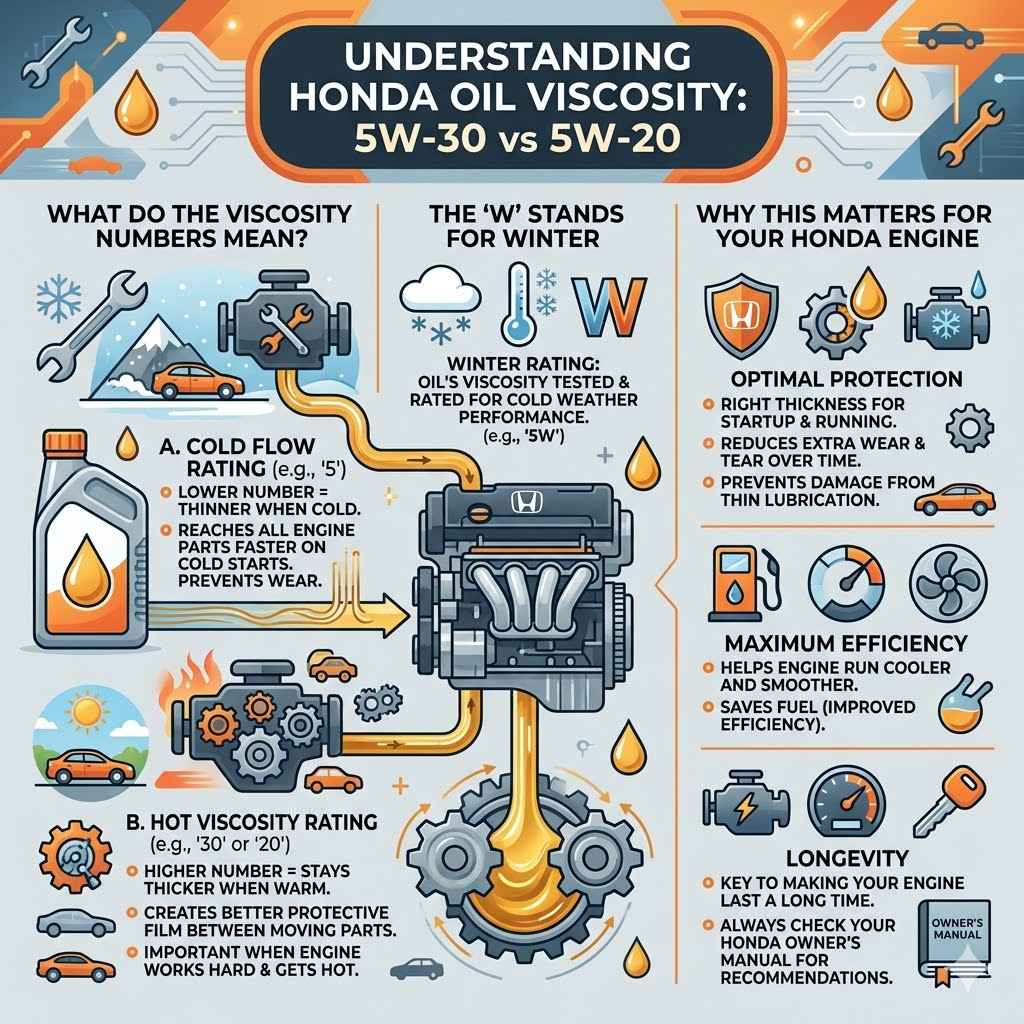
The first number, like the ‘5’ in 5W30 or 5W20, tells you how the oil flows when it’s cold. A lower number means the oil is thinner when it’s cold. This is good because a thinner oil can reach all parts of your engine faster when you start your car on a chilly morning.
This quick reach helps prevent wear.
The second number, like the ’30’ or ’20’ in 5W30 or 5W20, tells you how thick the oil is when the engine is hot. A higher number means the oil stays thicker when the engine is warm. This thicker oil creates a better protective film between moving parts, which is important when the engine is working hard and gets hot.
Think of it like honey. Cold honey is very thick and hard to pour. Warm honey is much thinner and flows easily.
Car oil works similarly, but in a much more controlled way.
The ‘W’ Stands for Winter
You often see a ‘W’ between the two numbers, like in 5W30. This ‘W’ simply stands for ‘Winter.’ It indicates that the oil’s viscosity has been tested and rated for cold weather performance. So, 5W30 oil is rated for its performance in cold temperatures (the ‘5W’ part) and its viscosity at normal engine operating temperatures (the ’30’ part).
When you see an oil label, it’s giving you two key pieces of information about its flow. The ‘W’ tells you that the first number is about how it acts when it’s cold. The second number is about how it acts when the engine is hot.
This rating system helps car owners pick the right oil for where they live and how they use their car. Different climates and driving conditions need different oil types.
Why This Matters for Your Honda Engine
Using the correct oil viscosity is like giving your Honda’s engine the right fuel. If the oil is too thick when cold, it won’t flow quickly enough to protect parts right away when you start the car. This can cause extra wear and tear over time.
On the other hand, if the oil is too thin when the engine is hot, it might not provide enough lubrication. This can lead to parts rubbing together, causing damage and reducing efficiency. Your Honda is designed with specific tolerances for oil thickness to ensure optimal performance and longevity.
The right oil helps your engine run cooler and smoother. It also helps save fuel. Your owner’s manual has the exact recommendation for your specific Honda model.
Always check it first.
5W30 vs 5W20 in Honda Big Mistake or Safe For Your Car
This section tackles the core question: 5W30 vs 5W20 in Honda: Big Mistake or Safe? We’ll look at what Honda recommends and what happens if you choose one over the other. You’ll get clear guidance on whether a mix-up is a major problem or a minor issue for your vehicle’s health.
Honda’s Official Recommendations
Honda is very specific about the type of oil your car needs. They test their engines thoroughly to find the best oil viscosity for protection and performance. For many Honda models, especially newer ones, the recommendation is often for 0W-20 synthetic oil.
However, some older models or specific engines might call for 5W-30.
Your Honda owner’s manual is the ultimate guide. It will clearly state the recommended oil viscosity. It might also list alternative oils that are acceptable if the primary recommendation is unavailable, but it’s always best to stick to what the manufacturer suggests.
Using the exact oil specified in your manual ensures that your engine’s warranty stays valid. It also guarantees that your car will perform as intended by Honda’s engineers.
What Happens If You Use the Wrong Oil
Using an oil with the wrong viscosity can have consequences for your Honda. If your car calls for 5W-20 and you use 5W-30, the oil will be a bit thicker when the engine is hot. This could slightly reduce fuel economy and potentially strain the oil pump.
Conversely, if your car needs 5W-30 and you use 5W-20, the oil will be thinner when hot. This might not provide enough protection for engine parts, especially under heavy load or in hot weather, leading to increased wear over time.
While a single instance of using the wrong oil might not cause immediate catastrophic failure, consistently using an incorrect viscosity can shorten your engine’s lifespan. It could also lead to parts wearing out faster than they should.
Is It Always a Big Mistake
Whether using the wrong oil is a “big mistake” depends on a few things. The main factor is how different the viscosities are and how your car is used. For most modern Hondas designed for 0W-20, using 5W-30 might be considered more problematic than using 5W-20 in a car designed for it.
The difference between 5W-20 and 5W-30 is not huge, especially in mild conditions. If you accidentally used 5W-30 in a car that recommends 5W-20 for one oil change, and then you switch back to the correct oil, the damage is likely minimal. However, it’s still not ideal.
If your Honda explicitly states 5W-30 is required, using 5W-20 could be more concerning, especially in hot climates or during hard driving. The thinner oil might not protect as well. It’s always best to follow the owner’s manual to avoid any potential issues.
Factors Affecting the Choice
Several factors influence which oil is best. The primary one is your Honda’s engine design, which is detailed in the owner’s manual. This tells you the manufacturer’s preferred viscosity.
Your local climate also plays a role. In very cold regions, an oil that flows well at low temperatures is crucial. In very hot regions, an oil that maintains its thickness at high temperatures is vital for protection.
Your driving habits matter too. If you frequently tow heavy loads, drive in stop-and-go traffic, or push your car hard, your engine works harder and gets hotter. This might make the higher viscosity oil (like 30) a better choice for more protection, provided it’s within the manufacturer’s acceptable range.
Real-Life Example A Car Owner’s Experience
Sarah drives a 2015 Honda Civic that specifically calls for 0W-20 oil. One day, during an oil change at a quick-lube shop, she noticed they used 5W-30. She was worried because she knew her car needed a specific type of oil.
She contacted her Honda dealership. They assured her that while 0W-20 is optimal, 5W-30 wouldn’t cause immediate, severe damage if it was only for one oil change and she switched back. However, they emphasized that for long-term engine health and fuel efficiency, sticking to 0W-20 was the best course of action.
Sarah decided to have the oil professionally changed to 0W-20 as soon as possible to be safe.
This example shows that while a slight variation might not be an immediate disaster, it’s always best to follow the manufacturer’s exact recommendation. The focus should always be on optimal performance and engine protection.
Benefits of Using the Correct Honda Oil Viscosity
Choosing the right oil for your Honda brings many advantages. This section details why sticking to the recommended viscosity, whether it’s 5W30 or 5W20 (or another type), is so important for your car’s health. You’ll learn about improved performance, fuel savings, and longer engine life.
Optimal Engine Performance
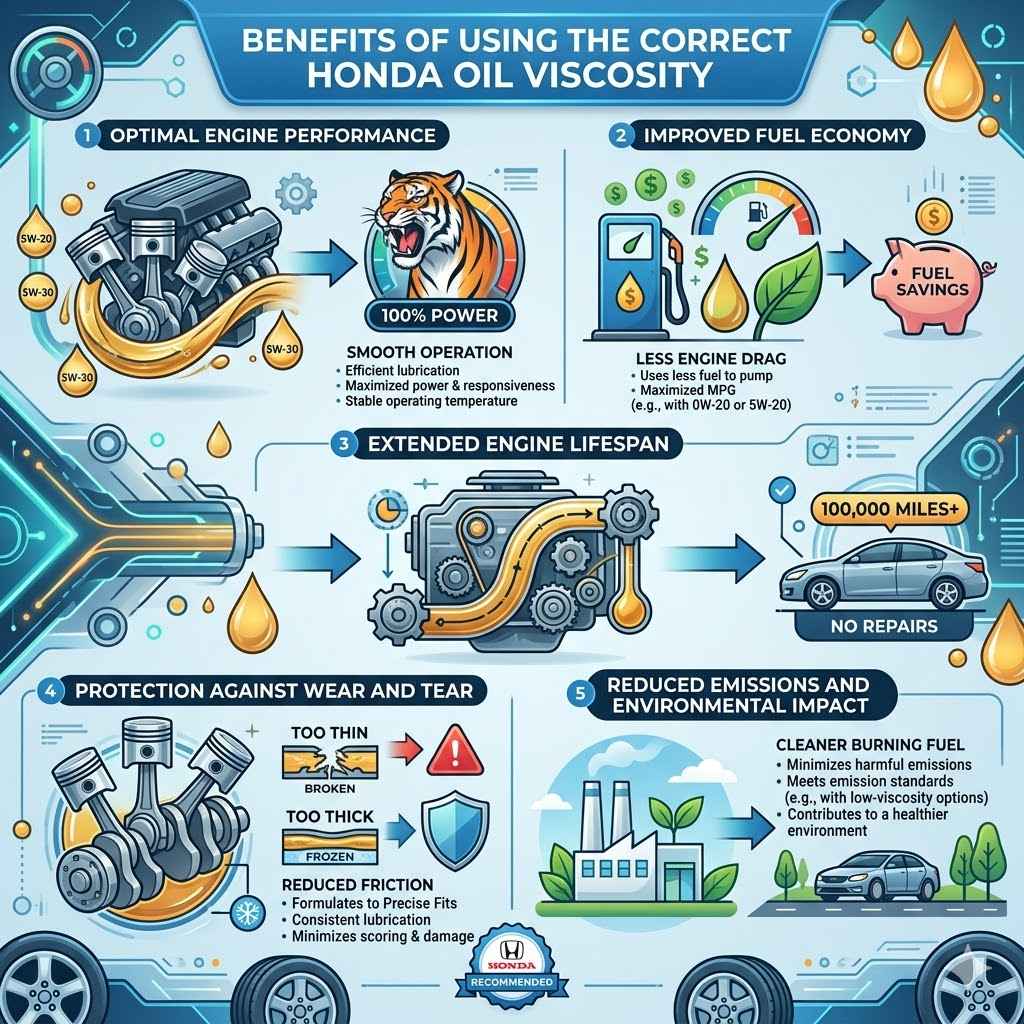
When you use the correct oil viscosity, your Honda’s engine operates at its peak performance. The oil circulates efficiently, lubricating all moving parts without hindrance. This means the engine runs smoothly, without unnecessary friction.
A perfectly lubricated engine responds better to acceleration. It also maintains a stable operating temperature, which is crucial for consistent power delivery. Honda engineers design engines with precise clearances, and the recommended oil viscosity is formulated to perfectly fill these gaps.
This precise fit ensures that critical components are always protected, no matter the driving conditions. It leads to a more enjoyable and reliable driving experience.
Improved Fuel Economy
Using the right oil can also help you save money on gas. Thinner oils generally require less energy for the engine to pump them around. This means the engine works less hard, using up less fuel in the process.
For instance, if your Honda is designed for a 0W-20 or 5W-20 oil, using a thicker oil like 5W-30 can create more drag. This increased drag forces the engine to use more fuel to overcome it, leading to slightly worse fuel economy.
While the difference might seem small per trip, it can add up significantly over the lifetime of your car. Maximizing your MPG is a great perk of using the recommended oil.
Extended Engine Lifespan
The most significant benefit of using the correct oil is the protection it offers your engine, leading to a longer lifespan. Proper lubrication prevents metal-on-metal contact, which is the primary cause of wear and tear.
When the oil is the right thickness, it forms a protective film that withstands high pressures and temperatures. This film separates moving parts, preventing scoring and damage. Over years of use, this consistent protection means fewer repairs and a more durable engine.
A well-lubricated engine is less likely to suffer from premature component failure. This saves you money on costly repairs and keeps your Honda running reliably for many more miles.
Protection Against Wear and Tear
Engine components like pistons, crankshafts, and camshafts move at very high speeds. They require a constant, high-quality oil film to prevent them from grinding against each other. The correct viscosity ensures this film is consistently present and effective.
When the oil is too thin at high temperatures, the protective film can break down. This allows parts to come into direct contact, causing friction and wear. For example, in a hot climate, a 5W-20 oil might not be thick enough to maintain protection in an engine designed for 5W-30.
Conversely, if the oil is too thick in cold weather, it can’t flow fast enough to coat parts during startup. This ‘dry start’ period is when a lot of engine wear occurs. Using the recommended viscosity minimizes these risks.
Reduced Emissions and Environmental Impact
A well-maintained engine that runs efficiently also produces fewer emissions. When your engine is properly lubricated and performs optimally, it burns fuel more cleanly. This means less harmful stuff is released into the air.
Using the manufacturer-recommended oil, which often includes fuel-efficient low-viscosity options like 0W-20, helps your Honda meet its emission standards. It also contributes to a healthier environment.
Furthermore, engines that last longer mean fewer cars are disposed of prematurely. This reduces waste and the environmental impact associated with manufacturing new vehicles.
Frequently Asked Questions About Honda Oil
Question: Can I mix 5W30 and 5W20 oil in my Honda?
Answer: It is generally not recommended to mix different oil viscosities. While it might not cause immediate catastrophic damage in a pinch, mixing can alter the overall viscosity of the oil. This could compromise the lubrication properties and potentially lead to increased engine wear over time.
It’s best to stick to one type or consult your owner’s manual for specific advice on mixing.
Question: What happens if I use 5W30 in a Honda that requires 5W20?
Answer: If your Honda requires 5W20 and you use 5W30, the oil will be slightly thicker when the engine is hot. This could lead to a slight decrease in fuel efficiency and potentially put more strain on the oil pump. For occasional use and if switched back to the correct oil promptly, the long-term impact might be minimal, but it’s not ideal for optimal engine performance and protection.
Question: How often should I change the oil in my Honda?
Answer: The oil change interval for your Honda depends on the model, the type of oil used (synthetic vs. conventional), and your driving habits. Most modern Hondas with synthetic oil can go between 7,500 to 10,000 miles between changes.
Always refer to your Honda owner’s manual for the most accurate recommended oil change schedule.
Question: Does my Honda’s warranty require a specific oil type?
Answer: Yes, your Honda’s warranty typically requires you to use oil that meets the manufacturer’s specifications as outlined in your owner’s manual. Using the wrong type of oil, including an incorrect viscosity, could potentially void certain parts of your warranty if an engine problem arises that is attributed to the improper lubrication.
Question: Is 0W-20 oil always better for my Honda than 5W-30?
Answer: 0W-20 oil is often recommended for newer Hondas because it provides excellent flow at cold temperatures, leading to better fuel economy and reduced wear during startup. However, whether it’s “better” than 5W-30 depends on your specific Honda model and its design. Always follow the viscosity recommended in your owner’s manual, as that is what the engineers determined is best for that particular engine.
Conclusion
Choosing between 5W30 and 5W20 for your Honda is about more than just numbers. It’s about protecting your engine, saving fuel, and ensuring your car runs its best. Always check your owner’s manual.
It has the exact oil your Honda needs. Using the right oil is a simple step that makes a big difference for your car’s long life and performance.