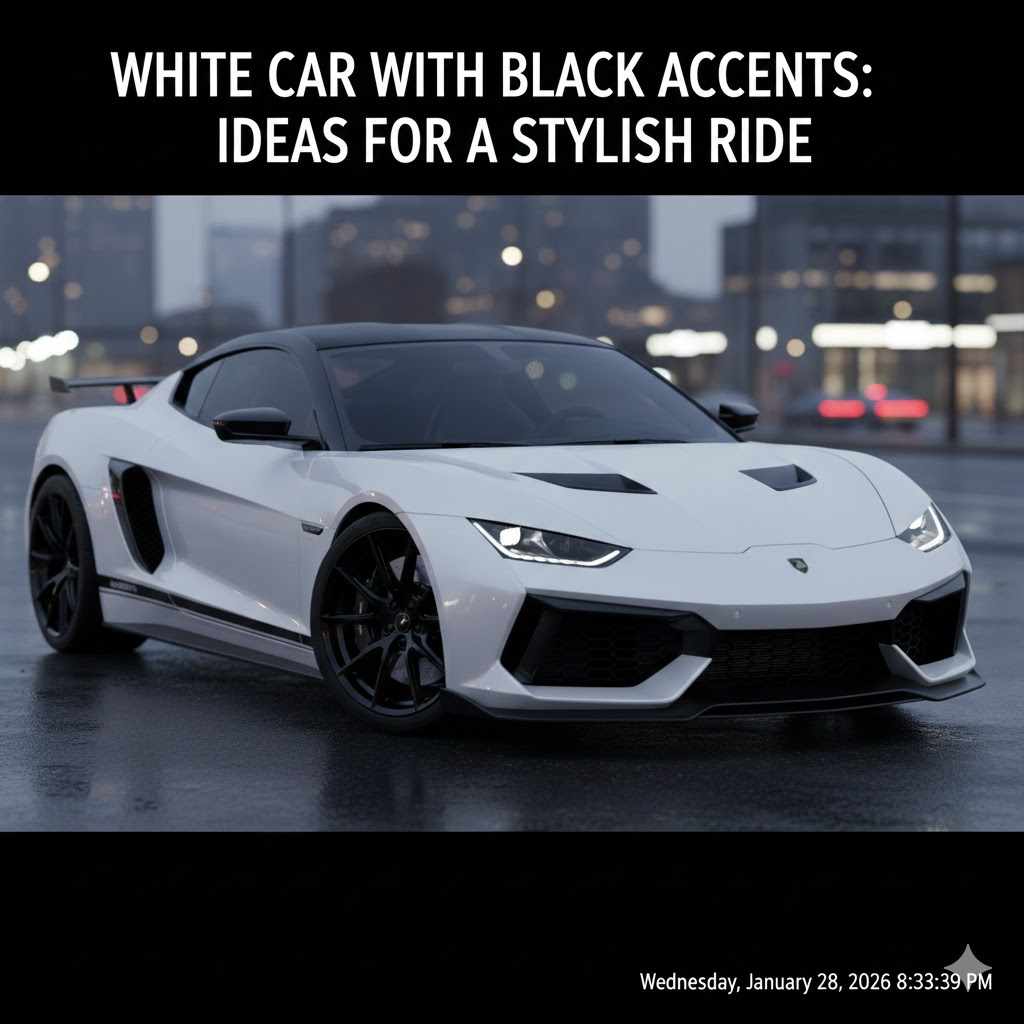
White Car With Black Accents: Ideas for a Stylish Ride
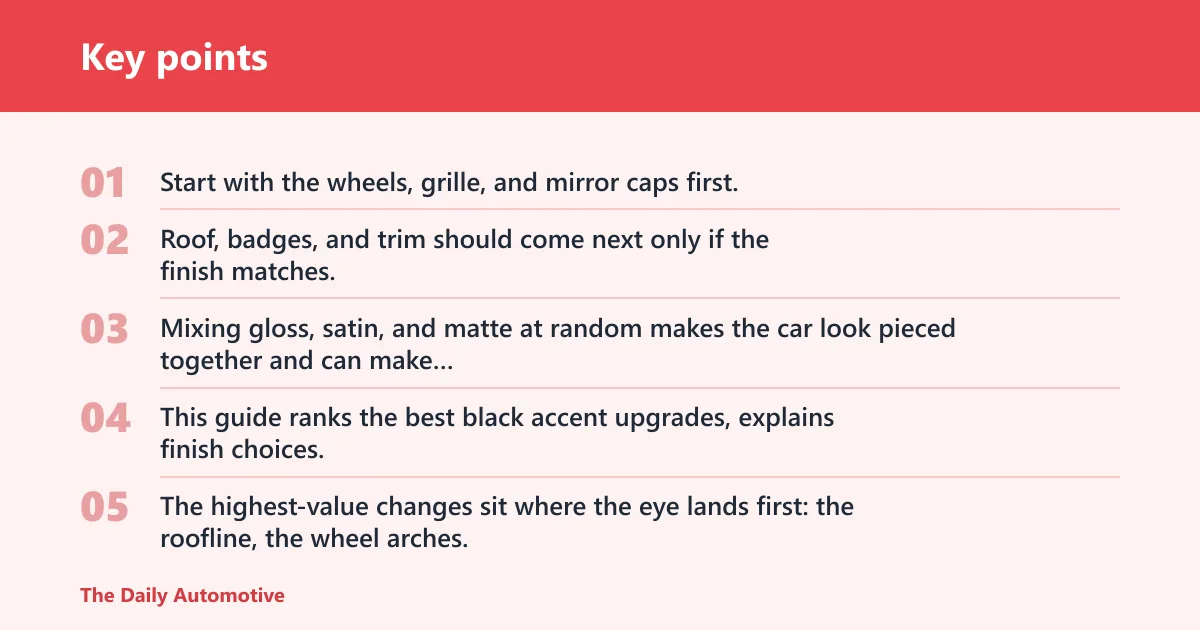
Start with the wheels, grille, and mirror caps first; those three black accents change a white car the fastest. Roof, badges, and trim should come next only if the finish matches. Mixing gloss, satin, and matte at random makes the car look pieced together and can make pricey parts look cheap. This guide ranks the best black accent upgrades, explains finish choices, and shows how to keep the build clean instead of overdone.
The highest-value changes sit where the eye lands first: the roofline, the wheel arches, and the front fascia. Black wheels create a strong contrast on a white car, while a black roof changes the whole silhouette instead of adding small details one by one.
What black accents work best?


Choose accents that follow the body shape, not every open surface. A white sedan with a black roof and black wheels can look intentional; a white hatchback with black roof, black mirrors, black trim, and black calipers can start to feel busy if every part uses a different sheen.
A common first-timer mistake is adding small black pieces before the big ones. A black badge, black calipers, and dark mirror caps will not pull a car together if the wheels still read bright and the chrome trim still breaks the side glass line.
Why finish order matters
Black on white works because the contrast is strong and easy to read from across a parking lot. But that contrast only looks clean when the same finish family carries across the major accents. Gloss black trim works best for mirror caps, roof, grille, and side skirts when the goal is a high-contrast OEM-plus look, while matte black reads more subdued and often fits roofs, spoilers, and lower trim.
White car black accent priority matrix
This matrix ranks the most common black accent parts by visual impact, practical cost, reversibility, maintenance, and risk of looking overdone. Use impact first, then check whether the part can be removed later without hurting resale or leaving a mismatch.
| Part | Visual impact | Cost level | Reversibility | Maintenance | Risk of looking overdone |
|---|---|---|---|---|---|
| Roof | 5 | Medium | High if wrapped; low if painted | Medium | 3 |
| Wheels | 5 | High | Medium if powder coated; high if swapped | High | 2 |
| Mirror caps | 3 | Low | High | Low | 2 |
| Grille surround | 4 | Low to medium | Medium | Medium | 3 |
| Window trim | 4 | Medium | High if wrapped | Medium | 2 |
| Spoiler | 3 | Low to medium | High if added as a part | Low | 2 |
| Side skirts | 4 | Medium | Medium | Medium | 3 |
| Brake calipers | 2 | Low to medium | Low if painted, high if left alone | High | 4 |
How to read the matrix
A score of 5 means the part changes the car’s look from several angles, not just up close. A roof and wheels can transform the side profile and stance; calipers cannot. Cost level matters because some parts are cheap to wrap but expensive to replace, and some are cheap to paint but harder to return to stock.
Reversibility matters for resale and for taste changes later. Factory black accents usually age better than a heavy aftermarket mix, while wraps and trim pieces can be removed or replaced more easily. That difference is worth separating before you spend on the wrong part.
What the rankings mean for your build
For the cleanest result, start with one anchor change and one supporting change. A black roof plus black wheels gives the strongest base. Mirror caps, grille surround, and window trim should support that base, not compete with it. Brake calipers belong near the end because they are small and easy to overdo.
Suppose a white midsize sedan gets gloss black wheels, a gloss black roof wrap, and gloss black mirror caps. The look reads deliberate because the large surfaces match. If the same car adds matte calipers, satin trim, and metallic grille pieces, the eye keeps stopping on the finish changes instead of the body lines.
Should I choose black wheels or a black roof on a white car?
Choose black wheels if you want the fastest visual change at street level and a stronger stance, especially on a car with smaller wheels or visible brake dust. Choose a black roof if you want the side profile to feel longer, lower, and more cohesive. On many white cars, wheels are the more immediate change, while the roof is the more dramatic one.
When a black roof fits best
A black roof works best on sedans, SUVs, and hatchbacks with a clean roofline. It adds contrast without crowding the front or rear of the car, and a white car with a black Roof is often described as a mix of elegance and modern style. The black roof can also make the silhouette look more dynamic.
Factory-applied black roofs tend to age better than a rushed wrap, but a wrap is useful if you want to test the look first. White paint is heat-reflective and helps keep interiors cooler, so changing only the roof can preserve some of that benefit while still adding contrast.
When black wheels make more sense
Black wheels are the safer starting point when the car already has a strong roof color or when the body sides are plain. Black wheels create a strong contrast on a white car, and black rims can help hide dirt, brake dust, and minor scuffs. That makes them practical as well as visual.
Wheel size and spoke design change the result more than many owners expect. Larger wheels and open spoke patterns make black read more aggressively; smaller wheels or dense spokes can make the car feel visually heavy. Bronze wheels are a luxury-oriented alternative to black on white paint, and gunmetal gray wheels are a sleek, understated option if pure black feels too dark.
How wheel size and spoke style change the look
Thin spokes reveal more brake hardware and reduce the blocky effect of black. Thick spokes and deep-dish designs create more shadow, which can make a white car look lower and more serious. If the car already has black trim, a wheel with some machined or metallic detail can keep the side view from turning into one large dark mass.
Which black finishes work best?
Gloss black gives the sharpest OEM-plus result, matte black looks lower-glare and more subdued, and satin sits in the middle. The best finish is the one that matches the rest of the black accents on the car. A mixed-finish build can look accidental unless the contrast is deliberate and limited to small parts.
Gloss black for a sharper OEM-plus look
Gloss black is the best fit for mirror caps, roof wraps, grille surrounds, and some side skirts when you want the car to look like a higher-spec factory build. It is also common in chrome delete work, where black trim replaces brightwork for a stealth look. Gloss reflects light more clearly, so fingerprints and wash marks show faster.
Use gloss sparingly on a white car with a lot of bright sunlight. Too much shine on too many pieces can make the body look chopped into separate zones instead of one shape.
Matte black for a lower-glare, sportier look
Matte black is more subdued than gloss and often suits roofs, spoilers, and lower trim. It reduces glare and can make the car feel more serious, especially on a sedan or hatchback with compact proportions. Matte can hide some visual noise, but it also makes dust and rub marks more noticeable in some lighting.
A matte roof on a white car is a common choice when the goal is a sportier, less polished look. The tradeoff is that the finish can clash with glossy wheels or mirror caps if those parts are not matched carefully.
Satin and metallic black as middle-ground choices
Satin black softens reflections without turning the car flat black. Metallic black adds depth in daylight and can look better on larger panels such as a roof or wheel. These finishes help if pure gloss feels too bright and matte feels too dull.
The key is consistency across major accents. If the roof is satin and the wheels are gloss, the car can look like two different styling plans were used. Match the sheen across the biggest parts first, then let smaller items vary only if needed.
How do you keep it from looking busy?
Keep one finish family, one main anchor, and a limited number of accent points. Chrome delete, black wheels, and a black roof can work well together, but only if each part looks like it belongs to the same build. Too many black details on a white car can make the design feel busy or unfinished.
Use chrome delete with a clear plan
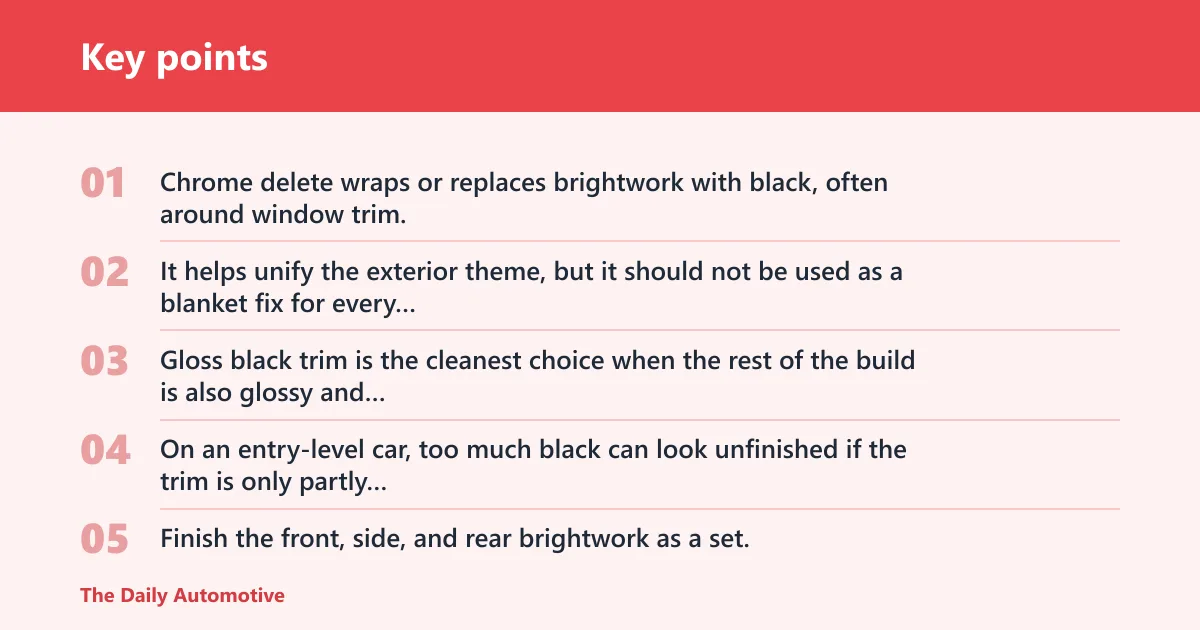
Chrome delete wraps or replaces brightwork with black, often around window trim, grille surround, and badges. It helps unify the exterior theme, but it should not be used as a blanket fix for every shiny piece. Gloss black trim is the cleanest choice when the rest of the build is also glossy and restrained.
On an entry-level car, too much black can look unfinished if the trim is only partly deleted. Finish the front, side, and rear brightwork as a set, or leave the car stock and add just a few parts. Halfway chrome delete is where a lot of builds fall apart.
Match mirror caps, grille surround, and window trim
Mirror caps are a good small accent because they sit near eye level and are easy to match with the roof or grille. Window trim should usually follow the same sheen as the grille surround. If one is gloss, the others should not be matte unless the rest of the car has a deliberate two-finish plan.
Side skirts can help a white car sit lower visually, especially when the body has a tall greenhouse. A partial wrap on the hood, roof, mirror caps, side skirts, or spoiler is a lower-cost way to test the look before committing. Accent wraps are also used to trace body lines and give a vehicle a more custom, aggressive look.
Keep brake calipers subtle unless the wheels call for more contrast
Brake caliper color is a small accent area, so it should support the wheel design rather than compete with it. Red is the familiar sporty choice, but black can work for stealth styling when the wheels already carry the visual weight. Keep calipers minimal if the car already has a black roof and black wheels.
Picture a white coupe with 19-inch gloss black wheels and a black roof. Bright red calipers would become the loudest detail on the car, even though they are the smallest part. Black calipers would disappear more cleanly and keep the focus on the larger surfaces.
Watch for the top-heavy effect on smaller cars
Small cars can look top-heavy with a black roof if the side glass and pillars are already dark. In that case, black wheels and a darker grille surround may work better than a full roof wrap. Trucks often need more restraint too, because a large black roof on a tall cab can read heavy unless the lower body is tied in with matching trim.
Best black accents for white cars
The best parts to black out are the ones that shape the car’s outline: roof, wheels, grille surround, window trim, and mirror caps. Those pieces frame the vehicle from a distance and make the paint color feel cleaner. Lower-cost items such as a spoiler or partial wrap are best used as support, not as the main event.
Roof and spoiler choices
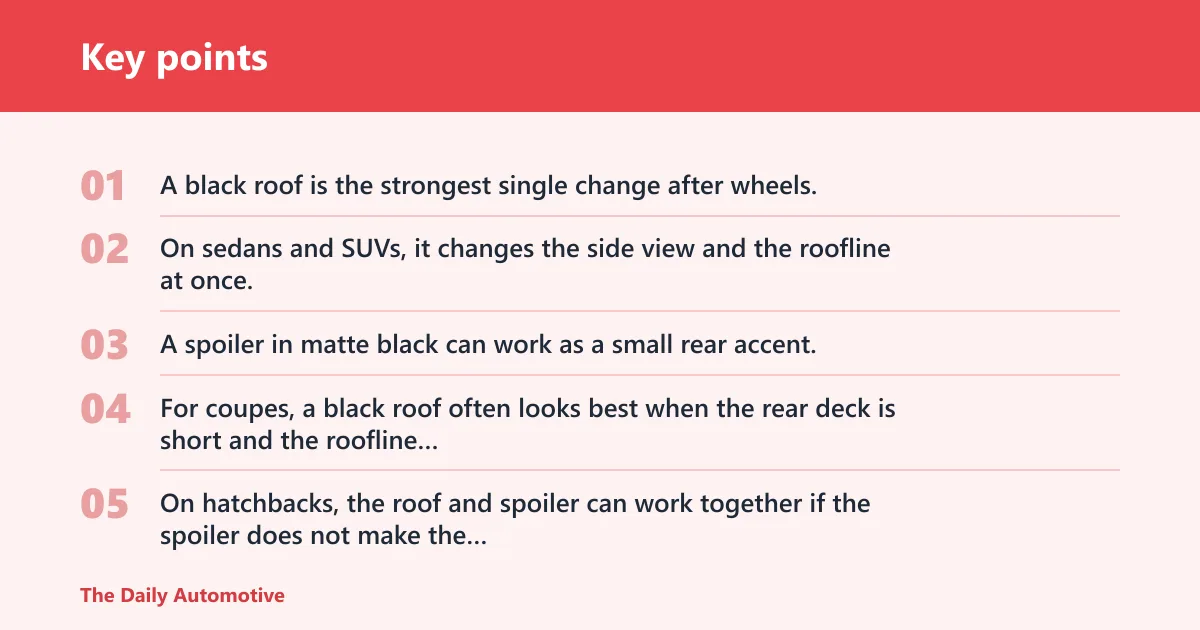
A black roof is the strongest single change after wheels. On sedans and SUVs, it changes the side view and the roofline at once. A spoiler in matte black can work as a small rear accent, especially when the rest of the car already has a darker theme.
For coupes, a black roof often looks best when the rear deck is short and the roofline flows into the trunk. On hatchbacks, the roof and spoiler can work together if the spoiler does not make the rear end look too heavy.
Mirror caps and grille accents
Mirror caps are one of the easiest black accent upgrades because they are small, visible, and easy to match with other parts. The grille surround changes the front face fast, especially when the car still has chrome or silver trim. These are good early upgrades if you want visible change without committing to larger body work.
Use caution with badges and lower grille details. Black badges can help the theme, but only if the grille and window trim already follow the same sheen. Otherwise the front can look disconnected.
Side skirts, trim, and partial wrap options
Side skirts work best when they align with the body lines and do not hang visually below the car without support elsewhere. Partial wrap is useful for testing a black hood, roof, mirror caps, or lower trim before paying for a larger change. It is also the simplest way to see whether the black theme fits the body style.
Factory parts, wrap, paint, and powder coat all have different tradeoffs. Factory black trim usually gives the cleanest match and durability. Wrap is reversible and good for testing. Paint can look right if the panel prep is done well. Powder coat is strong for wheels and some metal parts, but it is less flexible if you later want to return to stock.
What black accents look best on a white car?
The best black accents on a white car are the roof, wheels, grille surround, mirror caps, and window trim. Those parts have the most visual reach and the least chance of looking like random add-ons. If you want a premium result, keep the finish family consistent and avoid scattering small black details across every surface.
Frequently asked questions
Which black finishes work best with white paint: gloss, matte, or satin?
Gloss black gives the crispest contrast and works well for mirror caps, grille surrounds, and chrome delete. Matte black is better when you want less glare and a more subdued look. Satin is the safest middle ground if you want depth without the full shine of gloss.
How do I keep black accents from looking too busy on a white car?
Limit the number of black parts, and keep the finish consistent across the biggest surfaces. Start with wheels or a roof, then match mirror caps and trim only if they belong to the same sheen. Too many mixed finishes make the build look accidental.
What parts of a white car are best to wrap in black?
Roof, mirror caps, hood sections, side skirts, and spoilers are the best wrap candidates because they are visible and often easier to reverse later. Window trim and grille surround also work well if the wrap is clean. Partial wrap is a good way to test the style before committing.
Do black accents make a white car look sportier or more luxurious?
They can do either, depending on the part and finish. Gloss black trim and black wheels often read more premium and factory-like, while matte black roofs, spoilers, and lower trim lean sportier. Bronze or gunmetal wheels can shift the look toward restrained luxury if pure black feels too common.
How do I match black accents with wheels, mirrors, and trim?
Match the sheen first, then match the placement. If the wheels are gloss black, keep the mirror caps, grille surround, and roof in the same family or very close to it. If the wheels are matte or satin, avoid bright gloss trim that breaks the theme in the middle of the car.
Products related to this article
Sponsored / affiliate links. As an Amazon Associate I earn from qualifying purchases. I may earn additional commission from eligible campaigns.