Best Oil Drain Pans for Cars (2026): Based on Specs and Reviews
The best oil drain pan for most DIY drivers is the Dorman 95-1371 because its 15-quart capacity and universal fit cover a wide range of cars and fluid-change jobs without forcing a one-size-fits-all pick. Match clearance first, though: use a low-profile pan for lowered vehicles, and choose a more specialized pan for ATVs, lawn mowers, or motorcycles.
Quick comparison
| Product | Badge | Best for | Price | ||
|---|---|---|---|---|---|
 |
Low Profile 12V Oil Drain Pan, 15-Gallon Metal Oil ChangeGAOMON | Our pick | 15-Gallon · 180W · Low Profile | $106.99
Price as of 16 Oct 2026
|
View |
 |
Hlimior 6 Pack Large Auto Oil Drain Pan – 22′ Plastic OilHlimior | Budget pick | 22-inch · 6-Pack · Plastic | $44.99
Price as of 16 Oct 2026
|
View |
 |
MaxWorks 15-Gallon Portable Oil Drain Pan with Wheels,MaxWorks | Also great | 15-Gallon · HDPE · Portable | $139.99
Price as of 16 Oct 2026
|
View |
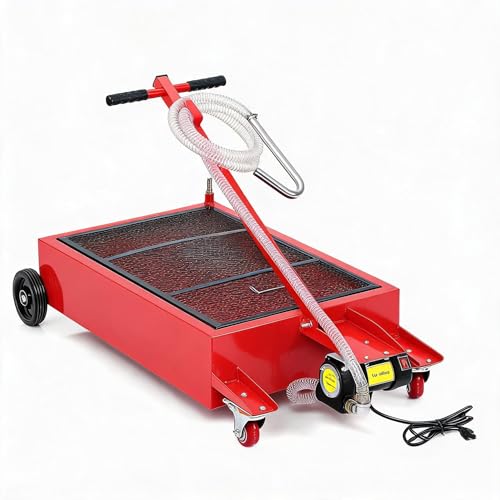 |
ElfinAura 20 Gal Electric Low Profile Oil Drain Pan,110VElfinAura | Also great | 20-Gallon · 110V · Heavy-Duty | $145.99
Price as of 16 Oct 2026
|
View |
Capacity matters, but a pan only works if it clears the drain plug and contains the stream without sloshing oil onto the floor. Use this section to compare fit, shape, and storage trade-offs before you choose a size.
The usual failure points are plain: the pan sits too high under the vehicle, holds too little oil, or is awkward to pour from when shelf space is tight.
How we chose
We compared each option on four practical points: clearance under the vehicle, capacity against common oil-change volumes, splash and pour control, and how much space the pan needs in storage. We also weighed material choice, because lightweight plastic helps handling while thicker metal and HDPE-style builds usually hold up better under repeated use.
Quick picks
| Best for | Pick | Why it stands out | Key trade-off |
|---|---|---|---|
| Most vehicles | Dorman 95-1371 | 15-quart capacity, universal fit, lightweight plastic | Larger footprint than a compact pan |
| Low-clearance vehicles | Chapin 78005 | 12-quart low-profile container made with recycled materials | Less reserve than a 15-quart pan |
| Spill control | NEIKO 20762A | 2-gallon capacity with anti-splash design | Smaller volume for larger oil drains |
| Garage collection cart | GAOMON low profile oil drain pan cart | 15-gallon metal cart with pump, hose, and debris screen | Bulky and unnecessary for simple passenger-car changes |
| Large-duty workshop use | MaxWorks 51266 | 15-gallon HDPE pan with wheels and controlled outlet | More storage space needed than a hand-carried pan |
| High-capacity, low-profile shop setup | ElfinAura electric low profile oil drain pan | 20-gallon cart with pump and folding handle | Too large for small-garage storage |
Which size oil drain pan do you need?
The right size depends on the vehicle’s oil-change volume. A 2-gallon pan works for small jobs, a 12-quart pan gives broader coverage for many cars and small engines, and a 15-quart pan is the safer all-purpose choice for multi-vehicle use and extra spill margin.
2 gallons or 8L for smaller oil changes
A 2-gallon pan, such as the NEIKO 20762A, fits smaller oil changes where you want a compact container that is easy to position and empty. Its anti-splash design helps control drips, and its 1.25-pound weight makes it easy to move, but the smaller capacity leaves less room for mistakes when the drain stream starts fast.
That size makes sense for drivers with one compact car and limited storage. It becomes a poor fit when you service larger engines, vehicles that drain more oil, or any job where the pan sits off-center under a drain plug.
12 quarts or 11.4 liters for broader coverage
A 12-quart pan gives more room for the oil volume common in passenger cars and many small utility machines. The Chapin 78005 fits this middle ground well because it is a low-profile container, it fits ATVs, tractors, lawn mowers, and motorcycles, and it is made with recycled materials.
This size is useful when you want better clearance without jumping to a bulky workshop cart. The trade-off is clear: you get less reserve than a 15-quart pan, so it should not be treated as a catch-all for every vehicle in the driveway.
15 quarts for multi-vehicle use
A 15-quart pan is the practical ceiling for many home garages because it handles wider oil-change volumes and still works for fluid changes beyond a single car. The Dorman 95-1371 is a universal fit, plastic pan that is described as lightweight, which helps if you need one pan for more than one vehicle type.
Its bigger footprint can be the problem. If your storage shelf is shallow or your garage is already crowded, a larger pan can become the thing you start stepping around instead of using easily.
Universal-fit drain pan: best for most cars
If you service several cars or only want one pan for general maintenance, a 15-quart universal-fit design is the most forgiving choice. It gives you extra room under the stream, more margin against splash, and enough capacity for many routine fluid changes without forcing you to own a separate pan for every job.
Why 15 quarts helps with variety
The Dorman 95-1371’s 15-quart capacity is useful because it leaves space for both oil volume and imperfect aiming. The universal-fit label matters too: one pan can cover more than one vehicle, which is useful for households that rotate between a compact car, a crossover, and light maintenance jobs.
Plastic construction keeps it lighter, and “lightweight” matters more than it sounds when the pan is full. A pan that is easy to carry is less likely to be tipped by hand while you are walking it to a drain container.
When a bigger footprint becomes a problem
Big pans store badly if your garage is small. They can also snag on floor clutter, sit awkwardly on a narrow shelf, or make pour-back harder if the lip and handle are not shaped for controlled emptying.
A common first-timer mistake is buying the largest pan available, then discovering it blocks access under a low bumper or is too wide to stow near the wall. Capacity only helps when the pan still fits the workspace.
Who should skip it?
Skip the 15-quart universal pan if your main jobs are lowered cars, motorcycles, or small engines where low height matters more than reserve capacity. In those cases, a low-profile shape or a purpose-built container with better side clearance usually works better.
It is also a weaker choice if storage is extremely tight and the garage already holds jacks, ramps, and fluid containers. Space is part of fit.
Low-profile drain container: best for low-clearance vehicles
Low-profile pans are better for lowered vehicles because they fit under the drain point before the first drop hits the floor. The Chapin 78005 is the clearest example here: it is a low-profile container with 12-quart capacity, and its shape suits ATVs, tractors, lawn mowers, and motorcycles as well as low cars.
Why lowered cars need lower pans
On lowered cars, the drain plug and surrounding underbody parts can leave little vertical room. A taller pan may fit in theory and still miss the oil stream in practice, especially if the stream starts at an angle or the vehicle sits on slight floor slope.
Low-profile designs reduce that risk. They also help when you cannot raise the car much, which is common in home garages that rely on basic ramps or modest jack clearance.
Use with ATVs, tractors, lawn mowers, and motorcycles
The Chapin 78005 is built for exactly these mixed-use jobs. That matters because these vehicles often have low drain points, tight frames, or awkward service access that make a tall pan annoying to position.
For motorcycles, the issue is often stability and spillage rather than sheer volume. For lawn mowers and tractors, the pan has to sit flat while you maneuver around blades, decks, or axle clearance, so a low container is usually easier to live with.
Where tipping and splash control matter most
Low-profile pans can tip if the floor is uneven or if you drag them while full. They also give you less room to recover from a hard start to the drain stream, so splash control matters more than it does with a deeper catch pan.
If your floor slopes toward a drain, use a pan with a broad base and pour-back edge, and keep the vehicle stable before you open the plug. That reduces the chance of oil walking sideways across the pan rim.
Are plastic drain pans durable enough?
Plastic drain pans are durable enough for regular maintenance when the plastic is thick and the pan is used for routine oil changes, not abuse. They are lightweight and portable, but they are generally less durable than metal, so rough handling, hot fluid, or repeated impacts can shorten their useful life.
Lightweight and portable benefits
Plastic is easier to carry from vehicle to shelf, especially when you are managing a full pan by yourself. That matters for home mechanics who do not want a heavy steel pan adding weight before the oil is even inside it.
The Dorman 95-1371 is a good example of the trade-off: lightweight and plastic, but designed for broad use. The point is convenience, not indestructibility.
How regular maintenance affects wear
Repeated use wears plastic in the places that matter most: the lip, the pour spout, the handle area, and the base where the pan sits on concrete. Scratches are normal; deformation, warping, or hairline cracks are the signs that the pan should be retired.
Storage also affects longevity. If a pan is stacked under heavy tools or squeezed into a shelf that bends it, the material is more likely to lose shape over time.
When metal may be the safer choice
Metal is the safer bet when the pan will live in a shop, see frequent use, or need better resistance to dents and rough handling. The GAOMON cart and the ElfinAura cart both lean in that direction because they are built as larger, heavier-duty collection systems rather than simple hand-carried pans.
If you change fluids on larger vehicles, roll the pan around a garage, or need a debris screen and splatter guard, metal starts to make more sense than a basic plastic catch pan.
Oil drain pan decision matrix
This matrix ties vehicle type, clearance, oil volume, and storage space to the style that fits best. Use it as the filter before you compare brands, because the wrong shape will fail even if the capacity looks generous on paper.
| Vehicle type | Ground clearance | Oil-change volume | Storage space | Best fit recommendation | Avoid if |
|---|---|---|---|---|---|
| Compact and midsize cars | Standard to moderate | Up to about 12 quarts | Small garage or limited shelf space | 12-quart low-profile or 15-quart universal pan | The pan is too tall to slide under the drain point |
| Lowered cars | Very low | Moderate | Compact storage | Low-profile drain container, such as Chapin 78005 | You need a tall sidewall more than low entry height |
| ATVs | Low and uneven | Usually modest | Moderate | Low-profile container with broad base | The pan rocks on a sloped or uneven floor |
| Tractors | Low to moderate | Moderate to higher | Workshop storage available | Low-profile 12-quart pan or larger collection cart | You only have a shallow pan and a high-volume drain |
| Lawn mowers | Low | Small to moderate | Tight | Low-profile pan with easy carry handle | The pan footprint blocks deck or wheel access |
| Motorcycles | Low with narrow access | Small to moderate | Very limited | Low-profile pan with controlled pour-back edge | The pan lacks a stable base and drips are hard to control |
| Mixed household fleet | Varies | Varies | Moderate | 15-quart universal-fit pan | You need the lowest possible profile or the smallest footprint |
GAOMON low profile oil drain pan cart: best for workshop collection
The GAOMON cart fits users who want a heavy-duty collection system rather than a simple catch pan. Based on the listed specs, its 15-gallon capacity, 180W electric pump, 8-foot hose, full-width debris screen, and splatter guard make it better suited to garages handling larger vehicles, multiple drains, or repeated service jobs.
Its strength is also its drawback. This is more machine than pan, so it needs storage room and makes little sense if you only change a compact car’s oil a few times a year. The steel build and motorized evacuation system add complexity that a small garage may not need.
Hlimior 6 pack large auto oil drain pan: best for backup use
The Hlimior six-pack is the budget-minded answer for drivers who want backup pans, distributed use in more than one spot, or a low-cost solution for multiple machines. The 22-inch size and high-lip edge design help contain fluid, and the reinforced thick plastic is a useful signal for regular maintenance use.
The drawback is that you are buying quantity, not a specialized fit story. A six-pack can be handy in a shop or shared garage, but it does not solve low-clearance access as neatly as a dedicated low-profile container, and each pan still needs enough room to store.
MaxWorks 51266 portable oil drain pan: best for garage mobility
The MaxWorks 51266 is aimed at users who want one large-capacity pan that can move when loaded. Its 15-gallon capacity, HDPE construction, built-in drain outlet, and two heavy-duty wheels make it a practical garage or workshop tool for people who handle larger maintenance jobs and want controlled emptying.
The trade-off is footprint. Wheels help with movement, but the pan still needs floor space, turning room, and a place to store it when it is not in use. It is a poor match for tiny garages where every inch has to earn its keep.
ElfinAura electric low profile oil drain pan: best for heavy-duty low clearance
The ElfinAura cart is aimed at larger vehicles and heavier-duty use where low clearance and high capacity matter at the same time. Its 20-gallon capacity, 110V high-flow pump, 8-foot hose, folding T-handle, and rolling cart design make it a serious collection tool for trucks, RVs, and SUVs.
The main downside is size. It is hard to justify for simple passenger-car oil changes, and a small garage may not have space for the cart, hose, and movement needed to use it comfortably. It is also far more pan than many DIY drivers need.
How to choose
Start with clearance, then capacity, then spill control. If the pan cannot fit under the drain point, the rest does not matter.
- Match the height to the vehicle. Low-clearance cars, motorcycles, and many ATVs need a low-profile container. Standard cars can use a taller universal pan if clearance is adequate.
- Match capacity to the oil volume. Use 2 gallons for smaller oil changes, 12 quarts for broader coverage, and 15 quarts if you service more than one vehicle or want extra margin.
- Look at the spout or pour-back edge. A controlled outlet matters when you empty the pan into a larger waste container. A sloppy lip turns the second half of the job into a cleanup problem.
- Check anti-splash features. Anti-splash design reduces mess and helps control drips when the stream starts hard or shifts in the pan.
- Judge the footprint honestly. A pan that stores badly becomes annoying fast, especially in a small garage. Larger dimensions matter as much as the advertised capacity.
- Choose material by use, not hype. Plastic is light and portable. Metal and cart-style systems are better when you want more durability or more controlled collection for repeated service.
Say your garage only has one low shelf and a compact sedan with a shallow drain plug. A 15-quart universal pan may seem efficient, but the storage problem and clearance issue make a low-profile 12-quart design the more realistic buy.
Suppose you change oil on a motorcycle and a lawn mower in the same month. A low-profile container with a stable base is the better choice, because it keeps the drain point low, controls splash, and still fits the limited floor space beside the bike stand or mower deck.
Frequently asked questions
What size oil drain pan do I need for my car?
For most cars, a 12-quart pan is a safe middle ground, and a 15-quart pan gives more margin for larger oil volumes or imperfect alignment under the drain plug. Smaller cars with tight storage needs can use 2 gallons, but the less capacity you have, the less spill reserve you keep.
Is a low-profile oil drain pan better for lowered vehicles?
Yes. Lowered vehicles need the pan to fit under the drain point before the oil starts flowing, and tall pans often create avoidable problems. A low-profile container reduces the chance of missing the stream, especially when the car cannot be raised very high.
What is the best oil drain pan for ATVs and lawn mowers?
A low-profile drain container is usually the best fit because ATVs and lawn mowers often have limited clearance and awkward drain access. The Chapin 78005 is a strong match here because it is low-profile, holds 12 quarts, and is built for ATVs, tractors, lawn mowers, and motorcycles.
How many quarts should an oil drain pan hold?
Choose a pan that exceeds the vehicle’s oil-change volume, not one that merely matches it. For smaller changes, 2 gallons can be enough; 12 quarts covers many cars and compact machines; 15 quarts is better when you want room for splash control and multi-vehicle use.
Are plastic oil drain pans durable enough for regular use?
Yes, if the plastic is thick and the pan is used normally. Plastic is lightweight and portable, which makes routine maintenance easier, but it is usually less durable than metal. If the pan will see frequent heavy use, rough handling, or shop-level abuse, metal is the safer long-term choice.
What is an anti-splash oil drain pan?
An anti-splash design is built to reduce mess and help control drips when oil hits the pan. That matters most when the drain stream starts fast or the pan has to sit at a slight angle. It does not remove spill risk, but it lowers the odds of a floor cleanup.
Which oil drain pan fits most vehicles?
A 15-quart universal-fit pan is the broadest pick for mixed garages. It gives enough capacity for many passenger cars and enough flexibility for different fluid-change jobs, but it is not the best choice if you need very low clearance or if your storage space is tight.
Should I choose a recycled-material oil drain pan?
Choose recycled materials if you want an eco-friendly angle without giving up basic function. The Chapin 78005 is the clearest example here. Fit, clearance, and capacity should decide the purchase first; recycled content should be a tie-breaker, not the main criterion.
Products related to this article
Sponsored / affiliate links. As an Amazon Associate I earn from qualifying purchases. I may earn additional commission from eligible campaigns.