Best Car Seat Gap Fillers for Cars (2026): We Compared
The best car seat gap filler comes down to fit and use: pick a slim foam blocker if you want the tightest hold and the least movement, or a rigid gap organizer if you want drop protection plus small-item storage. Leave the gap alone, and phones, keys, cards, and coins can slip where you cannot reach them. Below, this guide compares two real styles by fit, retention, daily use, and the failure modes that matter most.
Quick comparison
| Product | Badge | Best for | Price | ||
|---|---|---|---|---|---|
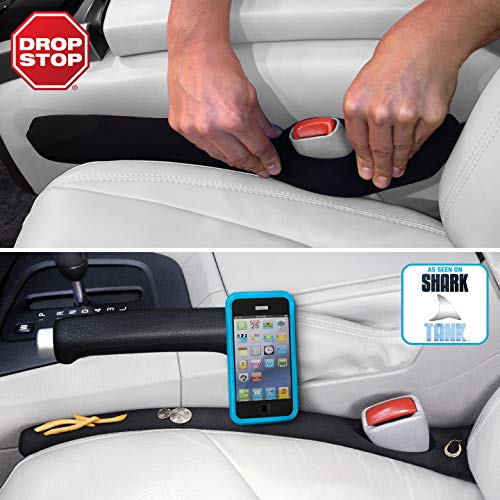 |
Drop Stop – 2 Original Car Seat Gap Fillers (Shark Tank) +Drop Stop | Our pick | 2-pack · Neoprene · Universal fit | $24.99
Price as of 16 Oct 2026
|
View |
 |
Universal Fit Premium Leather Car Seat Gap FillerOwntow | Also great | 2-pack · Leather · Organizer style | $39.90
Price as of 16 Oct 2026
|
View |
The trade-off is plain. The slimmer wedge works better when space is tight or the buckle sits close to the console, while the pocketed style is better when you want storage and fast access to small items.
How we chose
These two picks cover the main ways gap fillers fail or help. The comparison centers on gap width, seat-belt buckle clearance, movement resistance, cleaning, and how much extra bulk each style adds in real cabin layouts.
That matters because “universal” does not mean the same fit in every car, truck, or SUV. Seat shape, console curvature, armrest height, and seat-track motion can all change whether a filler sits flat, stays put, or gets in the way.
| Fit factor | Drop Stop-style wedge | Gap filler with organizer pocket | Safer choice when… |
|---|---|---|---|
| Gap width | Best for narrow gaps and tighter openings | Needs more room because the pocket adds bulk | The opening is close to 0.2 to 1.2 inches and space is tight |
| Seat-belt buckle clearance | Usually better if the buckle sits close to the seat edge | Higher risk of crowding the buckle or cover edge | You need clear buckle access every time you drive |
| Console shape | Handles curved consoles and seat bolsters more easily | Works best with a flatter, less contoured console side | The console curve leaves little side room |
| Daily use | Best for stop-loss protection with minimal clutter | Best for phone, coin, and card storage | You want storage within reach more than the slimmest fit |
| Cleaning | Usually simpler because there is less fabric and fewer pockets | More surfaces to wipe, and pockets can trap crumbs | You want the easiest cleanup and least snag risk |
| Movement risk | Often more resistant if compressed firmly between seat and console | Pocket bulk can shift if the fit is loose | The seat slides often or the opening changes with seat position |
Drop Stop-style gap filler: best for tight fit
The Drop Stop-style wedge is the better pick for drivers who want the tightest fit and the least clutter beside the seat. Based on the manufacturer’s specs and buyer feedback, its single-piece wedge design, seat-belt slot cutout, and neoprene casing are aimed at covering the gap without adding much bulk.
This style suits narrow gaps, curved consoles, and cabins where buckle clearance is already limited. The seat-belt slot cutout matters because it can leave the buckle accessible while the wedge fills the drop zone along the console side.
The drawback is also its strength: it is mainly a blocker, not a storage part. If you want a place for coins, a phone, or cards, this design gives up that convenience in exchange for a lower-profile fit.
A common first-time mistake is assuming a “universal” wedge will act the same in every cabin. Power seats, sloped bolsters, and tall armrests can change how firmly the filler compresses, which affects movement resistance when the seat slides forward and back.
Single-piece wedge design
The wedge shape works best when the seat edge and console leave a continuous seam that needs to be sealed. Foam or EVA tends to compress and rebound well, while silicone can grip surfaces more aggressively; leatherette looks cleaner on some interiors, but it can add stiffness and cleaning steps.
Seat-belt slot cutout
The cutout is the key safety-sensitive detail. If the slot is too small, too high, or angled badly, the buckle can become harder to reach, especially on cars with short buckle stalks or seat bases that slope inward toward the console.
Installation and movement resistance
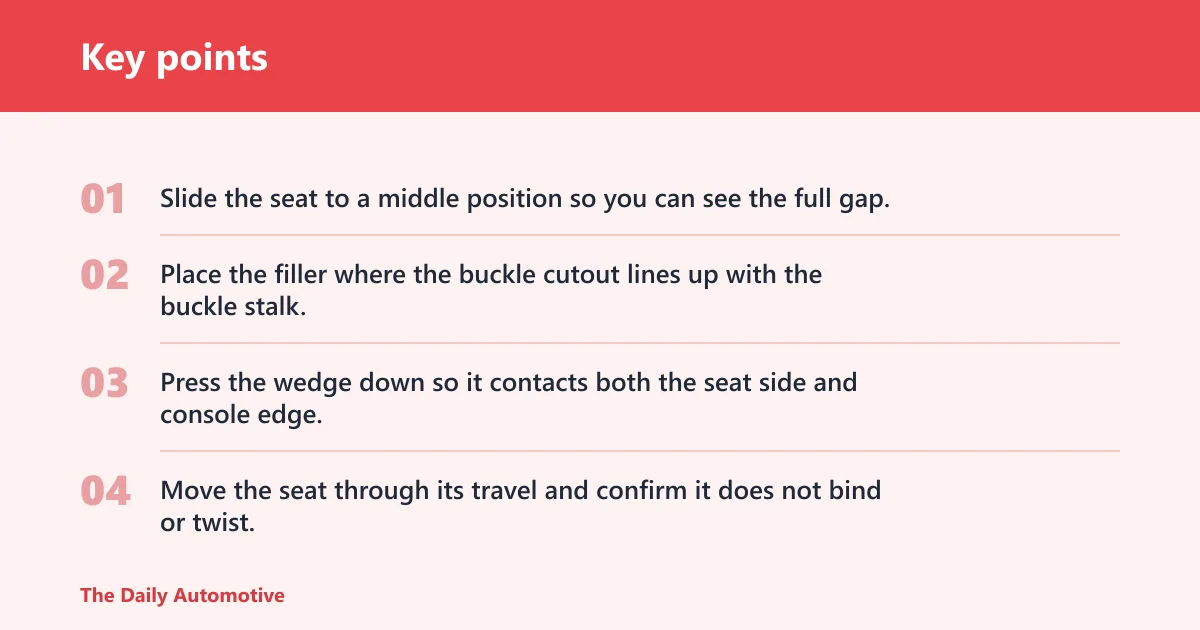
- Slide the seat to a middle position so you can see the full gap.
- Place the filler where the buckle cutout lines up with the buckle stalk.
- Press the wedge down so it contacts both the seat side and console edge.
- Move the seat through its travel and confirm it does not bind or twist.
Movement resistance depends on compression, rebound, and cabin geometry. A firm filler can stay planted better in a narrow channel, but if the console side is curved or the seat track is exposed, repeated seat movement can work it loose.
Gap filler with organizer pocket: best for storage
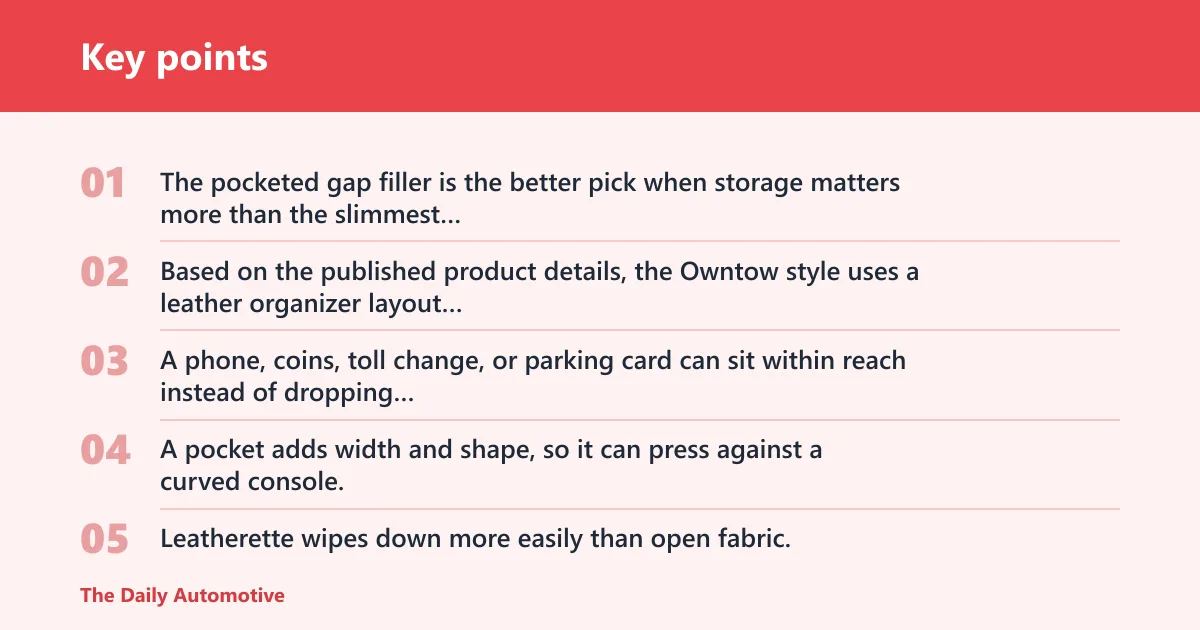
The pocketed gap filler is the better pick when storage matters more than the slimmest possible profile. Based on the published product details, the Owntow style uses a leather organizer layout with card slots and a stated compatibility range of 0.2 to 1.2 inches, which fits drivers who want quick access to small items.
Its main advantage is convenience. A phone, coins, toll change, or parking card can sit within reach instead of dropping under the seat, and the pocket can reduce the number of loose items in the console area.
The tradeoff is bulk. A pocket adds width and shape, so it can press against a curved console, crowd the buckle, or create snag points if the seat moves often.
Cleanability also matters. Leatherette wipes down more easily than open fabric, but pockets still collect crumbs and small debris, so a storage-first filler usually needs more regular cleanup than a plain wedge.
Pocket size and item retention
A useful pocket holds a phone or coins without letting them rattle out during normal driving. That said, deeper pockets can become catch-alls, and a pocket that is too shallow may spill smaller items when the seat shifts or the cabin turns sharply.
Access while driving
This style makes sense for drivers who reach for parking tickets, cards, or coins often. It is less useful if your cabin already feels tight, because the added depth can make the console side harder to clear when entering, exiting, or adjusting the seat.
Bulk versus usability
The main question is whether the storage is worth the added volume. In a wider gap, the extra structure is easy to live with; in a narrow tunnel or a car with tall armrests, that same structure can become the reason the filler shifts or rubs.
What gap width do you have?
Gap width is the first fit check, and it should be measured before you buy. Measure the opening in inches or millimeters at the seat position you actually drive in, because sliding the seat forward or back can widen or shrink the gap.
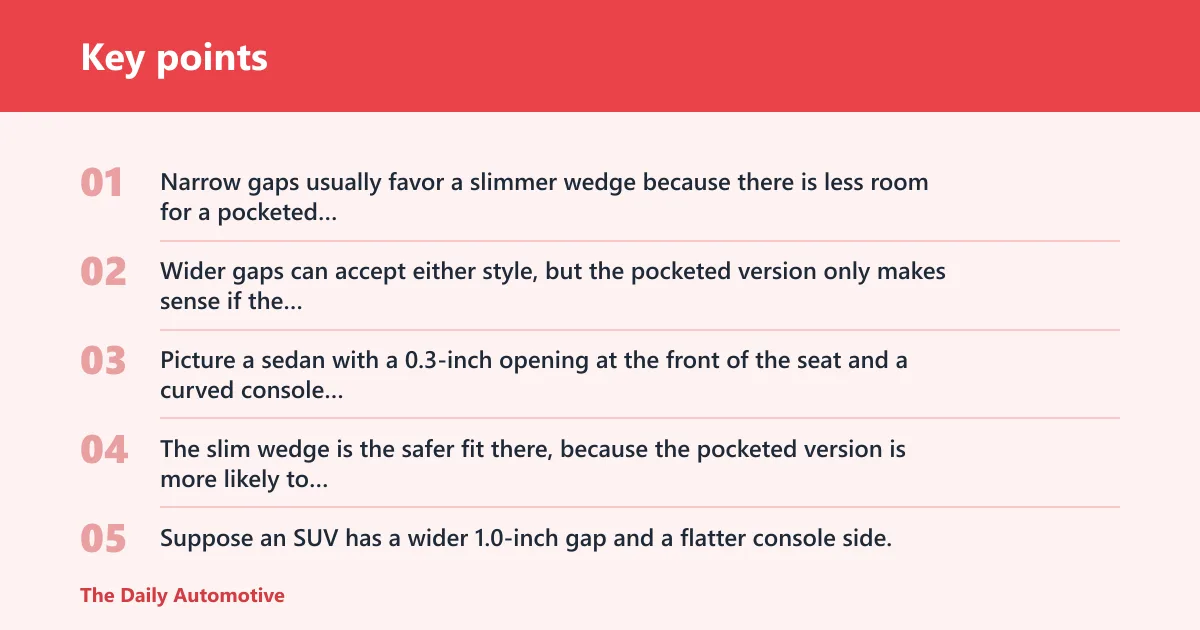
Narrow gaps usually favor a slimmer wedge because there is less room for a pocketed design to compress. Wider gaps can accept either style, but the pocketed version only makes sense if the console shape leaves enough side room for the added bulk.
Picture a sedan with a 0.3-inch opening at the front of the seat and a curved console that pinches tighter near the armrest. The slim wedge is the safer fit there, because the pocketed version is more likely to sit crooked or crowd the buckle.
Suppose an SUV has a wider 1.0-inch gap and a flatter console side. That layout gives the pocketed filler more room to sit square, which makes storage more practical and reduces the chance of the organizer folding into the opening.
Narrow-gap fit
For gaps near the low end of the usual range, a low-profile filler is the better starting point. Too much thickness can push the filler upward, reduce buckle access, and make the seat feel like it is fighting the insert every time it slides.
Wide-gap fit
Wider gaps are more forgiving, but they also expose more of the console side and seat-track area. If the opening is broad and the seat base is tall, the filler should still sit low enough that it does not block access to the buckle or snag on trim.
How seat position changes the opening
Seat position changes the fit more than many buyers expect. Power seats with long travel can pinch the filler at one end of the rail and loosen it at the other, while manual seats may hold a more repeatable position but still change the angle of the gap as they slide.
Will it block your seat belt buckle?
It can, if the slot shape or placement is wrong. The buckle needs clear access, because a filler that hides the buckle, presses on the stalk, or tilts into the latch path turns a convenience item into a daily nuisance.
The risk is highest when the buckle sits close to the console, the console curves inward, or the seat bolster slopes toward the buckle zone. In those layouts, the wedge with a dedicated cutout is usually the safer starting point.
Buckle slot shape
A good slot should align with the buckle stalk and leave enough room for fingers to reach the latch. A narrow slot can trap the buckle edge, while a poorly placed slot can force the filler upward and create a gap that still drops items.
Interference risk by console shape
Flat consoles are easier to work with than deeply curved ones. When the console wall bows outward or the armrest sits low, a pocketed filler can jut into the buckle area more than a plain wedge would.
Positioning tips before you buy
- Measure the gap at your normal driving seat position.
- Check how much room the buckle stalk has beside the seat base.
- Look at the console side from above and from the front.
- Make sure the filler shape matches the buckle path, not just the gap width.
Which one should you buy?
Choose the wedge if your priority is stop-loss protection with the least movement. It is the better fit for narrow openings, close-set buckles, and cabins where the console side curves or the seat slides frequently.
Choose the pocketed version if you want storage and quick access for small items. It works best when the gap is wider, the console side is fairly straight, and you actually want the added bulk to hold a phone, coins, or cards.
Choose neither if your seat base is so close to the console that the buckle already feels crowded, or if the seat track and bolster shape leave almost no stable mounting area. In that case, a filler can become more trouble than it solves.
For tall drivers, the key issue is often seat travel. If the seat moves far enough that the opening changes shape during daily use, a slim blocker is usually the more forgiving choice because it has less material to catch on trim.
Choose Drop Stop if… / Choose Owntow if…
Choose the Drop Stop-style wedge if your gap is narrow, your buckle sits close to the seat, or your console side is curved. Choose the Owntow pocketed organizer if your gap is wider, your console side is flatter, and you want a pocket for phones, coins, or cards.
Choose the wedge if you care most about low bulk, easier cleanup, and better movement resistance with frequent seat sliding. Choose the pocketed style if you are willing to trade some clearance for easier access to small items during everyday driving.
Choose the wedge if the seat-belt buckle must stay easy to reach at all times. Choose the pocketed version only if you have confirmed that the extra depth will not crowd the latch or rub the console edge.
Are seat gap fillers worth it?
Yes, if the gap regularly eats phones, keys, cards, or coins and the filler matches your cabin shape. The value drops quickly when the fit is wrong, because a loose or bulky insert can create a different annoyance even if it stops some items from falling through.
Frequently asked questions
What is the best car seat gap filler for my car?
The best choice depends on your gap width, buckle clearance, and console shape. If the cabin is tight or the seat moves a lot, a slim wedge is usually safer; if you want storage and have room beside the seat, a pocketed organizer can make more sense.
Do car seat gap fillers fit all vehicles?
No universal design fits every vehicle equally well. Most claims are broad because the same filler can work in many cars, trucks, and SUVs, but power-seat tracks, sloped bolsters, and curved consoles can change how well it sits and how much it shifts.
Will a car seat gap filler block my seat belt buckle?
It can if the slot is too small, too high, or aimed at the wrong angle. The safest choice is a filler that leaves the buckle stalk clear and does not require you to dig beside the seat every time you buckle in.
How wide should the gap be for a seat gap filler to work?
There is no single perfect number, but the opening should match the filler’s stated range and leave room for compression. A common practical range is about 0.2 to 1.2 inches for many universal organizers, though the seat position can change that fit.
Do seat gap fillers move when the seat slides?
They can, especially if the fit is loose or the console shape is curved. A firmer foam or EVA wedge usually resists movement better than a bulkier pocketed design, but repeated seat travel can still shift any insert if the cabin geometry does not support it.
Which car seat gap filler is better for phones and coins?
The pocketed style is better for phones and coins because it gives you a place to keep them within reach. The tradeoff is extra bulk, more cleaning, and a higher chance of snagging or crowding the buckle in tight cabins.
Products related to this article
Sponsored / affiliate links. As an Amazon Associate I earn from qualifying purchases. I may earn additional commission from eligible campaigns.
 Coverado Car Seat Covers, Front Covers for Cars, Car Seat Cover Front Seats, Automotive Seat Cover, Waterproof, Leather Car Seat Cushion, Universal Interior Covers Seat Protectors for Most Cars
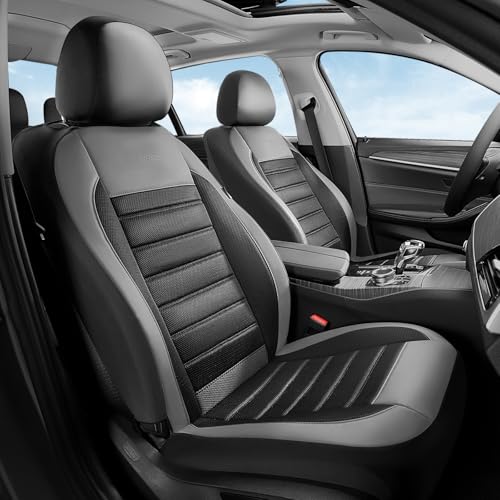 Coverado Car Seat Covers Front Seats, Luxury Leather Car Seat Covers, Automotive Mesh Seat Covers 2 Pack, Airbag-Compatible, Black Gray Seat Covers for SUV Sedan Truck