Are Burnouts Bad For An Automatic Car? Damage Guide
Yes. Burnouts can hurt an automatic car by overheating the transmission, loading the differential, and cooking tires and brakes. A short slip is far less risky than repeated holds or brake-torque launches. Ignore warning signs, and you can turn a smoke show into a repair bill for tires, fluid, seals, or driveline parts. This guide explains what burnouts do, which automatic-car parts are most exposed, and how to inspect for damage afterward.
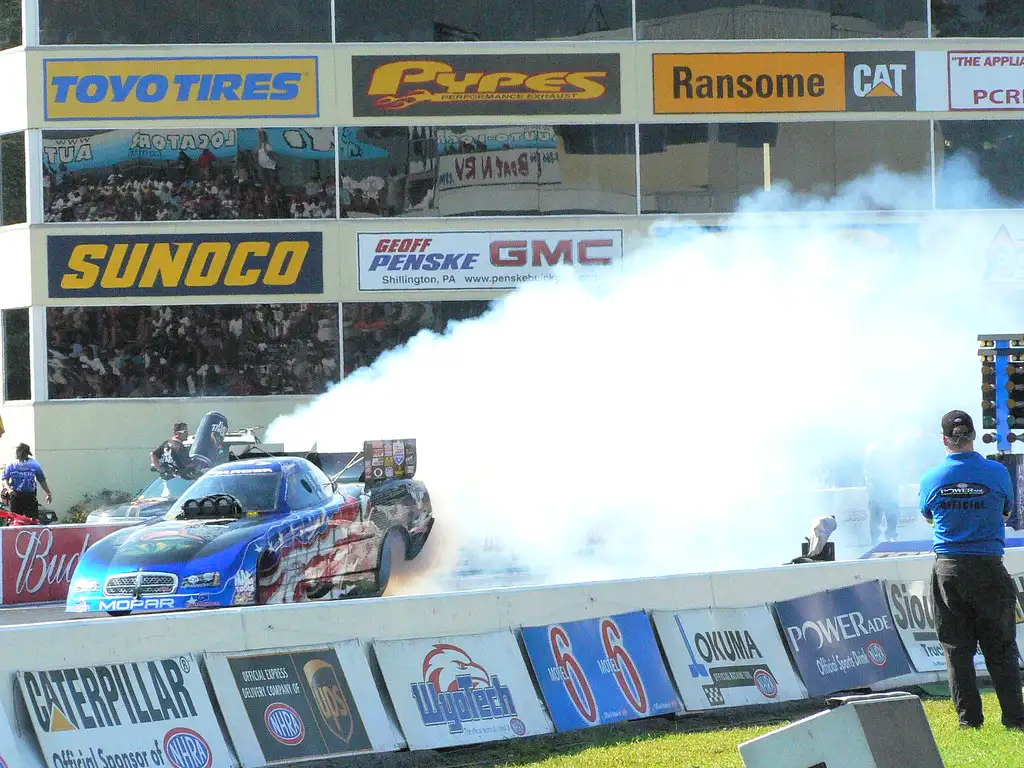
The key difference is between a brief tire spin and a burnout that holds the car stationary against throttle and brake pressure. The first can end quickly. The second can load the torque converter, raise ATF temperature, and pound the drivetrain when grip returns.
Are burnouts bad for an automatic car?


Why the risk depends on how the burnout is done
A quick slip with little brake input is not the same as holding the car in place while the engine stays on the throttle. The second setup makes heat the main problem. Automatic transmissions are sensitive to heat because ATF serves as both a lubricant and hydraulic fluid, so higher temperatures can shorten clutch and seal life and hurt shift quality.
Repeated abuse usually does more damage than one short event. That applies to the transmission, and to the tires, brakes, axles, and differential too.
Can a burnout damage an automatic transmission?
Yes. A burnout can damage an automatic transmission by loading the torque converter, building heat in the ATF, and increasing wear on clutch and band materials compared with normal street use. A brief tire spin may leave no immediate symptoms, but a brake-torque burnout can push the transmission much closer to the edge.
Torque converter loading and heat buildup
The torque converter helps because it multiplies engine torque at low speed, but that same slip turns energy into heat when the car is held still against throttle. The longer the hold, the hotter the fluid gets. Heat is the main enemy of ATF, seals, and friction materials inside the transmission.
Clutch and band wear, fluid condition, and shift behavior after abuse
If the fluid overheats, clutch packs and bands can lose holding power. That can show up later as delayed engagement, slipping, or shift flare. Burnt-smelling ATF and dark color are common warning signs. A transmission that starts shifting differently after a burnout should be checked before the next hard drive.
Why a brake-torque burnout is harder on the transmission
A brake-torque burnout is harder because the engine is making torque while the brakes hold the car in place, which can keep the drivetrain loaded and raise heat. That loads the converter longer, drives up transmission heat, and also works the brake system at the same time. It is harsher than a short wheelspin that ends quickly on its own.
What parts get damaged from burnouts in an automatic car?
The first parts to suffer are usually the tires, then the transmission fluid and converter, then the driveline parts that take the shock when traction returns. Which component gives up first depends on drivetrain layout, tire grip, engine torque, cooling capacity, and whether the car has factory launch-control hardware.
Axles, CV joints, and driveshafts
When spinning tires suddenly hook, the shock load moves through axles, CV joints, and, in rear-drive cars, the driveshaft. That can expose worn joints or crack already-stressed parts. Clicking on turns, new vibration under throttle, or grease flung around a CV boot can point to burnout-related damage.
Differential stress and traction shock loads
The differential takes a sharp hit when traction returns. Open differentials, limited-slip units, and wheel bearings all see the load spike. Rear-wheel-drive cars often put the most strain on the rear differential first. Front-wheel-drive cars put more of the stress through the front CV axles and transaxle. All-wheel-drive cars can spread the load, but they also spread the risk.
Why the weak point changes by layout
In a front-wheel-drive automatic, the transaxle, front CV joints, and front tires work hardest. In a rear-wheel-drive automatic, the driveshaft, rear differential, and rear tires take more of the abuse. In an all-wheel-drive car, the center coupling, transfer case, and all four tires can be part of the damage path.
Do burnouts wear out tires faster?
Yes. Burnouts wear out tires faster because they abrade the tread at high speed, generate heat, and can cause delamination if the tire is overheated. Rear-drive cars usually burn the rear pair first, while front-drive cars punish the front pair. In AWD cars, all four tires may see abnormal wear or heat damage.
Rapid tread loss and heat damage
The tread disappears quickly during a burnout, and heat can harden the rubber. A tire that looks fine from ten feet away may still be damaged inside. Check for missing chunks, cords, bubbles, blueing, and uneven wear. If cords are exposed, the tire is not safe for normal driving.
Delamination risk and balance symptoms
Delamination means the internal layers begin to separate, often after overheating. One clue is a new vibration or balance problem after the event. Consumer Reports recommends having tire balance checked when you feel a vibration, and notes that ignored tire balancing can prematurely wear wheel bearings and other suspension parts.
Rear-wheel drive, front-wheel drive, and all-wheel drive differences
Rear-wheel-drive cars usually leave their evidence on the rear tires first. Front-wheel-drive cars often show quicker damage at the front because those tires steer and drive at the same time. AWD cars can hide the smoke show, but the strain is shared across more parts, including couplings and transfer hardware.
Say your front-wheel-drive sedan spins one front tire for several seconds in a parking lot. The tire may smell hot, the tread may feel greasy, and the steering wheel may shake on the next drive. That does not guarantee transmission failure, but it does justify a careful inspection before any longer trip.
Can one burnout cause permanent damage?

Yes, one burnout can cause permanent damage if it overheats a weak transmission, separates a tire, or shocks a worn axle or differential. It does not happen every time. A short event may leave no lasting issue, but one severe brake-torque hold can create a repair problem that shows up immediately or after a few drives.
Why damage may not show immediately
Some wear is hidden at first. Fluid can darken after the event, seals can begin leaking later, and a marginal clutch pack may not slip until the next hard acceleration. That is why the owner’s manual baseline and a post-event inspection matter. Waiting for symptoms can turn a smaller repair into a larger one.
A common first-timer mistake is assuming smoke means the tires were the only part stressed
Smoke only proves the tires were hot. It does not tell you how much heat reached the converter, fluid, axle seals, or brake rotors. If the car smelled burnt after the burnout, that smell may be coming from ATF, brake pads, or overheated rubber, and each one points to a different inspection path.
Is it worse to do a brake-torque burnout in an automatic?
Yes. A brake-torque burnout is usually worse because the transmission stays loaded while the brakes hold the car back. That increases torque converter loading, raises ATF temperature, and adds brake wear. It is the kind of event that can stress multiple systems at once, not just the tires.
Extra transmission heat and brake wear
The converter slips while the car is stationary, which makes heat fast. At the same time, the brake pads and rotors are absorbing energy. Consumer Reports lists brake pads and rotors as typically lasting 25,000 to 50,000 miles, but abuse can shorten that interval sharply. A hot, faded pedal after a burnout deserves attention. (consumerreports.org)
Modern performance automatics versus ordinary commuter cars
Performance automatics often have stronger cooling, heavier internal parts, and sometimes factory launch-control logic. That does not make them immune. A commuter automatic with modest cooling and older ATF is more likely to complain sooner. Vehicle-specific hardware changes the margin, not the basic physics of heat and shock load.
How can you tell if a burnout hurt your transmission?
Look for burnt-smelling ATF, dark fluid, delayed shifts, shudder, slipping, or warning lights. A transmission that takes longer to engage, shifts harshly, or feels inconsistent after the event may have suffered heat-related wear. New vibration or a flare between gears is worth checking before the next drive.
Burnt ATF smell and dark coloration
Fresh ATF is usually red or amber, depending on the fluid. Dark brown or black fluid, especially if it has a burnt odor, can suggest overheating. That does not prove internal failure, but it is a warning that the fluid has been pushed beyond a healthy temperature and may no longer protect as intended.
Delayed shifts, shudder, or slipping
Delayed engagement into Drive or Reverse can point to pressure loss, wear, or fluid problems. Shudder on takeoff may suggest converter trouble. Slipping under load is more serious because it means the transmission is no longer holding torque cleanly. Any of these symptoms should be treated as a reason to stop repeating the abuse.
New vibration, noise, or warning lights
Noise and vibration can come from the driveline as well as the transmission. A clunk on takeoff may be a mount or differential issue. A warning light may flag a transmission control problem or a wheel-speed sensor fault after a hard event. Symptoms matter most when they were not there before the burnout.
What should you inspect after doing a burnout?
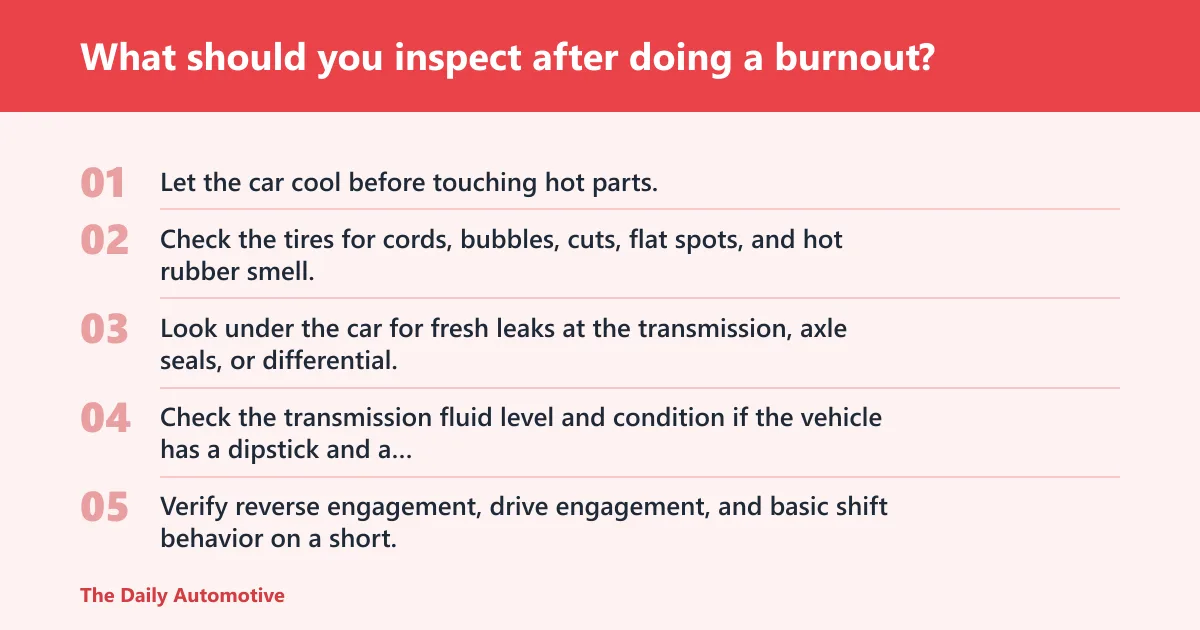
Start with what you can check safely at home: tires, fluid leaks, visible axle and brake damage, and obvious new noises. Move to a shop if you find burnt fluid, slipping shifts, a vibration that was not there before, or any sign of tire belt damage. Do not treat repeated testing as a diagnosis.
Post-burnout inspection checklist
- Let the car cool before touching hot parts.
- Check the tires for cords, bubbles, cuts, flat spots, and hot rubber smell.
- Look under the car for fresh leaks at the transmission, axle seals, or differential.
- Check the transmission fluid level and condition if the vehicle has a dipstick and a manufacturer-approved check procedure.
- Verify reverse engagement, drive engagement, and basic shift behavior on a short, gentle drive.
- Listen for clunks, whines, clicks, or vibration under light acceleration and while turning.
- Inspect brake feel for fade, a soft pedal, or a burning odor near the wheels.
What is safe to check at home versus what needs a technician
You can safely look for visible tire damage, fluid leaks, odor, and obvious shift changes. A technician should handle deeper diagnosis, including pressure checks, scan-tool data, and inspection of internal transmission parts. If the car has AWD hardware, the center coupling or transfer case deserves professional attention sooner rather than later.
| Symptom | Likely damaged part | Urgency | Safe to drive to a shop? |
|---|---|---|---|
| Burnt ATF smell | Transmission fluid, torque converter, clutch packs | High | Usually yes, if shifts are normal and no slipping is present |
| Dark or brown ATF | Transmission fluid, seals, clutch material | High | Yes for a short trip; avoid hard driving |
| Delayed Drive or Reverse engagement | Transmission hydraulics, fluid condition | High | Yes, if engagement is still predictable |
| Shudder on takeoff | Torque converter, transmission mounts, driveline | High | Maybe; keep speeds low and avoid load |
| Clicking on turns | CV joint or axle shaft | Medium | Usually yes, but avoid long trips |
| Vibration after the event | Tire balance, bent wheel, damaged tire, wheel bearing | Medium to high | Yes if mild; no if the tire is visibly damaged |
| Soft brake pedal or burning brake smell | Brake pads, rotors, brake fluid | High | No if pedal feel is poor or stopping power changed |
| Fluid at axle seal or transmission case | Seal damage | High | Short drive only if leak is minor; otherwise tow |
What changes the damage risk?
Damage risk changes with drivetrain layout, torque output, transmission design, cooling capacity, tire compound, and whether the car has factory launch-control hardware. Two cars can both spin the tires, but the one with more torque, weaker cooling, or a tighter driveline margin is more likely to show symptoms afterward.
Drivetrain layout and torque output
High-torque rear-wheel-drive cars often load the rear differential and tires harder. Front-wheel-drive cars can put more stress into the transaxle and front axles. AWD systems may distribute the force, but that also means more components can be affected when the grip returns suddenly.
Factory cooling and launch-control hardware
A performance transmission cooler gives the fluid more margin against heat. Factory launch control can also manage spin in a controlled way, but it is designed for brief launches, not repeated abuse. Ordinary commuter automatics usually have less thermal headroom than performance models.
Tire compound and transmission design
Sticky tires can reduce wheelspin, which changes how the shock load arrives when grip finally breaks or returns. Tire compound matters because it changes the amount of slip and heat. Transmission design matters because some units handle heat better than others, and CVTs are generally poor candidates for this kind of load.
Frequently asked questions
Are burnouts bad for an automatic car?
Yes. Burnouts add heat and shock load to parts that were not designed for repeated abuse, especially the transmission, torque converter, tires, brakes, and differential. A brief spin is less risky than a long brake-torque hold, but repeated events raise the odds of fluid damage, seal wear, and driveline failure.
Can a burnout damage an automatic transmission?
Yes. The main risks are torque converter loading, heat buildup in the ATF, and wear to clutches and bands. If the fluid smells burnt, shifts change, or engagement becomes slow after the event, the transmission should be inspected before more hard driving.
What parts get damaged from burnouts in an automatic car?
The first parts to suffer are usually tires, then transmission fluid and converter components, followed by axles, CV joints, driveshafts, differential parts, and brakes. The exact weak point depends on whether the car is FWD, RWD, or AWD, plus torque output and cooling capacity.
Do burnouts wear out tires faster?
Yes. Burnouts remove tread quickly, overheat the rubber, and can cause delamination if the tire gets too hot. Rear-drive cars usually hit the rear tires first, front-drive cars wear the fronts, and AWD cars can still suffer abnormal wear across multiple tires and driveline parts.
Is it worse to do a brake-torque burnout in an automatic?
Yes. Holding the car with the brakes while the engine applies throttle loads the torque converter longer, builds more transmission heat, and adds brake wear at the same time. That makes brake-torque burnouts more severe than a short, brief wheelspin that ends on its own.
What should you inspect after doing a burnout?
Check the tires for cords, bubbles, and heat damage; look for fluid leaks; inspect ATF condition if the car allows it; and watch for delayed shifts, shudder, vibration, or warning lights. If the car smells burnt, shifts oddly, or shows tire or brake damage, get a technician involved.
Consumer Reports notes tire rotation is typically needed every 5,000 to 7,500 miles, brake pads and rotors often last 25,000 to 50,000 miles, spark plugs usually last around 100,000 miles, many timing belts need replacement at 60,000 to 120,000 miles, coolant flush intervals can be up to 100,000 miles, and oil changes commonly occur at 5,000, 7,500, or 10,000 miles. Those intervals are not burnout rules, but they are useful reminders that hidden wear rarely helps you after abuse.
Products related to this article
Sponsored / affiliate links. As an Amazon Associate I earn from qualifying purchases. I may earn additional commission from eligible campaigns.