Are Formula E Cars All the Same? Chassis vs. Powertrain
Formula E cars generally share the same chassis, battery, tires, and many control systems, but manufacturers control the powertrain hardware and software, so they may look alike while running very different pace. Miss that split and you miss where lap time comes from, because setup, efficiency, and energy use decide who qualifies well and who fades late. This guide breaks down the spec parts, the team-built parts, and why identical-looking Formula E cars still race differently.
| Decision factor | Are Formula E Cars All the Same? Chassis | Powertrain Explained | Winner |
|---|---|---|---|
| What it covers | Spec parts: the shared car base, battery, and tires. | The parts teams can tune or design around: motor, inverter, gearbox, rear suspension, software, and energy strategy. | Powertrain Explained |
| Helps explain lap-time gaps | Only partly. It shows what is fixed across the grid. | Yes. It explains why two cars with the same tub can still be quicker or slower. | Powertrain Explained |
| Best for understanding “same car or not?” | Best if you want the short answer: the visible chassis is shared. | Best if you want the deeper answer: the performance difference comes from the manufacturer package. | Tie |
| Best for comparing teams | Less useful, because the chassis is nearly identical by design. | More useful, because it is where manufacturers separate themselves. | Powertrain Explained |
Are all Formula E cars the same?
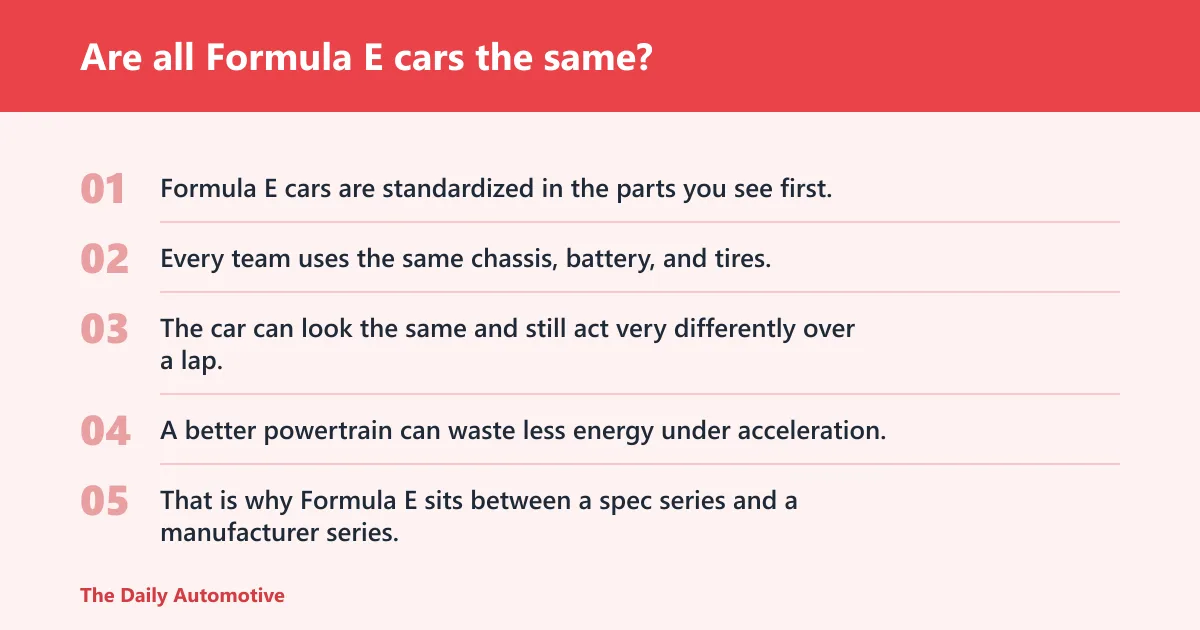
No. Formula E cars are standardized in the parts you see first, but they are not identical in the parts that shape performance. Every team uses the same chassis, battery, and tires, while manufacturers control the powertrain and the software that decides how efficiently the car uses energy.
Why identical-looking cars can still produce different lap times
The car can look the same and still act very differently over a lap. A better powertrain can waste less energy under acceleration, recover more cleanly under braking, and deliver power in a way that helps a driver carry speed without draining the battery too early.
That is why Formula E sits between a spec series and a manufacturer series. The body, battery, and tires keep the grid closely matched, but the freedom left in the powertrain is enough to separate strong programs from average ones.
📊 Seven manufacturers build their own powertrains in the Gen3 era. Source: Are Formula E Cars All the Same? Chassis vs. Powertrain Explained.
What parts of a Formula E car are standardised?
The standard parts are the base of the series. Formula E uses a Spark Racing Technology chassis, a single-source battery for the Gen3 era, and Michelin tires across the grid, so the teams start from the same basic package before the powertrain differences begin.
Spark Racing Technology chassis
Formula E uses a Spark Racing Technology chassis, which is FIA-homologated. In plain terms, that means every team races with the same carbon-fiber tub and the same structural base, which keeps the cars closely aligned in size, packaging, and crash structure.
Battery and tires: what every team receives from the same supplier chain
The battery is standardized across the grid. Williams Advanced Engineering supplied the battery through the Gen3 era, and Podium Advanced Technologies is set to take over the battery contract for Gen4. Michelin is the sole tire supplier, and every team runs the same all-weather compound.
That matters because it narrows the ways teams can win. If everyone starts with the same battery and tires, performance shifts toward how efficiently the powertrain uses them.
What do Formula E teams actually build themselves?
Teams and manufacturers do not build a completely different car from the ground up. They build the powertrain package: the electric motor, inverter, gearbox, rear suspension, and the race software that controls deployment, regeneration, and energy use during a stint.
Motor, inverter, gearbox, rear suspension, and control software
These are the parts that change the car’s personality. A motor and inverter can deliver power more efficiently, a gearbox can suit the torque curve better, and rear suspension packaging can affect how the car puts power down and how stable it is over kerbs and braking zones.
Software is part of the performance story too. It decides how aggressively the car deploys energy, how it manages regen, and how much of the battery is left when the driver needs a push lap or a late-race defense.
How race strategy and energy deployment become part of the car package
In Formula E, the car and the strategy are tightly linked. A well-tuned powertrain can make the same energy budget travel farther, which lets a driver push harder without paying for it later in the race.
Suppose two drivers start with the same chassis and the same tire set. One team’s software may recover energy more cleanly into the braking zones, while the other burns more of the battery on the exits. The lap-time gap can come from that difference alone.
Which manufacturers make Formula E powertrains?
Seven manufacturers currently register their own powertrains in the Gen3 era: Porsche, Jaguar, Maserati, Nissan, DS Automobiles, Mahindra Racing, and NIO 333. The names matter because they are the groups chasing efficiency and software gains inside the same spec framework.
Why manufacturer names matter even when the chassis is identical
The chassis tells you the car’s base shape, but the manufacturer name tells you who designed the performance-critical electrical and control package. That is why two Formula E cars can look almost identical in the pit lane and still qualify several places apart.
A common mistake is to think identical bodywork and tires mean every Formula E team gets the same performance. In Formula E, the shared chassis is only the starting point.
Formula E sameness map
| Subsystem | Spec or manufacturer-controlled? | Plain-English impact on lap time or energy use |
|---|---|---|
| Chassis | Spec | Sets the same structural base for every team, so differences do not come from body architecture. |
| Battery | Spec | Gives every team the same energy store, so efficiency matters more than extra capacity. |
| Tires | Spec | Creates the same grip window across the grid, which keeps tire choice from becoming a performance separator. |
| Electric motor | Manufacturer-controlled | Affects how efficiently the car turns battery energy into speed. |
| Inverter | Manufacturer-controlled | Shapes how smoothly and efficiently electrical power reaches the motor. |
| Gearbox | Manufacturer-controlled | Changes how the powertrain delivers torque and how well it suits the circuit. |
| Rear suspension | Manufacturer-controlled | Influences traction, stability, and how well the car puts power down out of corners. |
| Race software | Manufacturer-controlled | Controls deployment, regeneration, and energy management, which can decide whether a car is quick early or late. |
| Energy strategy | Manufacturer-controlled | Determines how a team spends and recovers energy over the lap and the full race. |
How much freedom do teams get in Gen3 Evo?
Gen3 Evo keeps the series tightly controlled, but the power and regen ceilings still leave room for meaningful manufacturer differences. The car can produce up to 350 kW in qualifying, race power is capped at 300 kW, regenerative braking can reach up to 600 kW, and the minimum weight is 840 kg including the driver.
Why software and efficiency matter more when raw hardware is tightly controlled
When the headline figures are bounded, efficiency becomes the separator. A car that turns less of its battery into heat, wastes less energy under braking, and deploys power more cleanly can translate the same spec hardware into a better lap.
That is why Formula E is not a pure spec series, even though it uses a spec base. The freedom left in calibration and hardware design is small compared with Formula 1, but it is large enough to matter.
How is Formula E different from Formula 1?
Formula E is much more standardized than Formula 1. F1 gives teams broader freedom in chassis architecture, aerodynamics, and power unit development, while Formula E keeps the car base fixed and lets manufacturer differences show up mainly in the powertrain and software.
What that means for car sameness, budget, and visible technical variety
Formula E looks more uniform because it is designed that way. The trade-off is that the series pushes competition toward efficiency and energy management instead of toward many different car shapes and aero concepts.
For readers, that makes Formula E easier to read from the outside once you know where the differences live. The chassis is shared, the battery is shared, the tires are shared, and the manufacturer edge sits in the powertrain package.
What changes with the Formula E Gen4 car?
Gen4 is described as arriving for the 2026-27 season, with permanent all-wheel drive and roughly double the power. That points to a stronger manufacturer role, because more of the performance picture will come from how each brand manages traction, energy, and control logic.
What Gen4 suggests about the balance between spec parts and manufacturer input
Gen4 does not erase the spec model, but it shifts the emphasis. A permanent all-wheel-drive layout changes how cars deploy traction and how manufacturers tune control systems, so software and powertrain design should matter even more.
The battery supplier also changes for Gen4, with Podium Advanced Technologies set to take over. That means the shared base remains, but the technical conversation moves forward rather than backward.
Choose the chassis explanation if…
Choose the chassis explanation if you want the simplest answer to whether Formula E cars are all the same. It is the right frame if you care most about the spec base: the Spark Racing Technology tub, the shared battery, and the Michelin tire package that every team receives.
Choose the powertrain explanation if…
Choose the powertrain explanation if you want to understand why the same-looking cars do not run the same pace. It is the right frame if you care about the parts teams build themselves, the seven manufacturer programs, and the software choices that decide how much speed a car can turn from the same energy.
Frequently asked questions
What parts of a Formula E car are spec?
The spec parts are the chassis, battery, and tires. Formula E uses a Spark Racing Technology chassis, Williams Advanced Engineering supplied the Gen3 battery, Michelin is the sole tire supplier, and those parts are shared across the grid.
Products related to this article
Sponsored / affiliate links. As an Amazon Associate I earn from qualifying purchases. I may earn additional commission from eligible campaigns.