Remote Car Starter Installation Cost / Price / How Much
Remote car starter installation usually costs about $300 to $600 for a basic aftermarket system, while vehicle-specific or OEM-style setups often land around $700 to $1,200+ installed. Cheap fitment can bring wiring faults, security issues, and a starter that won’t work in cold weather. This guide breaks down what changes the quote, which features raise the price, and when a higher-tier system is worth it.
Cost breakdown by vehicle type and components
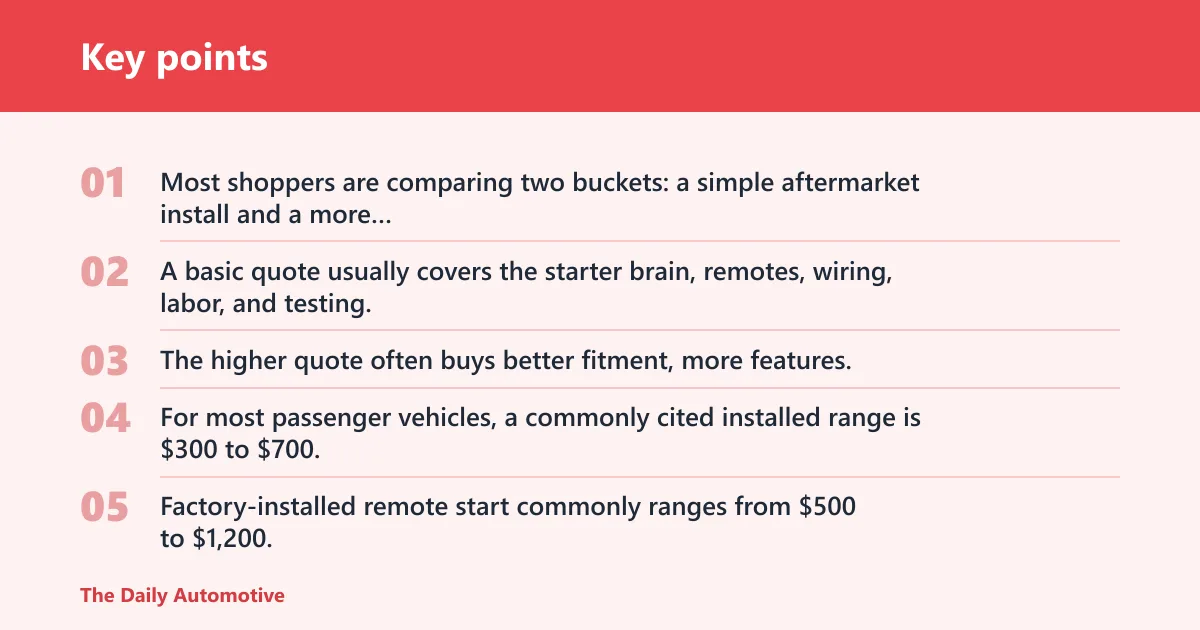


Most shoppers are comparing two buckets: a simple aftermarket install and a more vehicle-specific setup that needs extra modules, programming, or factory-style integration. A basic quote usually covers the starter brain, remotes, wiring, labor, and testing. The higher quote often buys better fitment, more features, or fewer compatibility problems.
Typical installed price bands by vehicle type
For most passenger vehicles, a commonly cited installed range is $300 to $700. Factory-installed remote start commonly ranges from $500 to $1,200, which is why dealer quotes often look higher at first glance. The difference is usually less about the remote itself and more about integration, programming, and what the vehicle needs to recognize the command.
Older key-start cars usually sit at the lower end if the vehicle does not need a complex bypass module. Push-button start vehicles and models with more factory security hardware tend to move upward because the shop has to preserve immobilizer behavior and smart-key functions. Luxury models can cost more still when the install requires extra interface parts and longer programming time.
What parts usually sit inside the quote
A quote should usually separate the starter system, the interface module, labor, and any programming or testing fees. Remote starter systems can include factory key-fob control, extended-range remotes, two-way confirmation, and smartphone control. Not every vehicle can use every format, so compatibility verification matters before price shopping.
Factory-key remote start works through the original key fob on compatible vehicles. Extended-range remotes can reach beyond many factory systems, which helps in large lots or outside offices. Two-way remotes send a command and receive confirmation back. Smartphone control adds app-based access, but it requires compatible installed equipment and an active service plan.
Where basic, mid-range, and premium systems diverge
Basic systems usually focus on remote start only. Mid-range setups often add better range or a cleaner vehicle-specific module. Premium systems can add two-way feedback, app control, and tighter integration with lock, unlock, and vehicle status features.
For many drivers, the price jump only makes sense if the extra function fixes a real problem. If you start the car from a nearby parking space, a long-range or two-way unit may be unnecessary. If you park far from the building or want confirmation that the command worked, paying more can be justified.
Why remote starter quotes vary so much
Remote starter quotes vary because the installer is not pricing the same job every time. Vehicle year, make, model, trim, and factory security equipment all change the hardware and labor required. The same system may fit one car cleanly and need add-on parts on another.
Vehicle age and key type
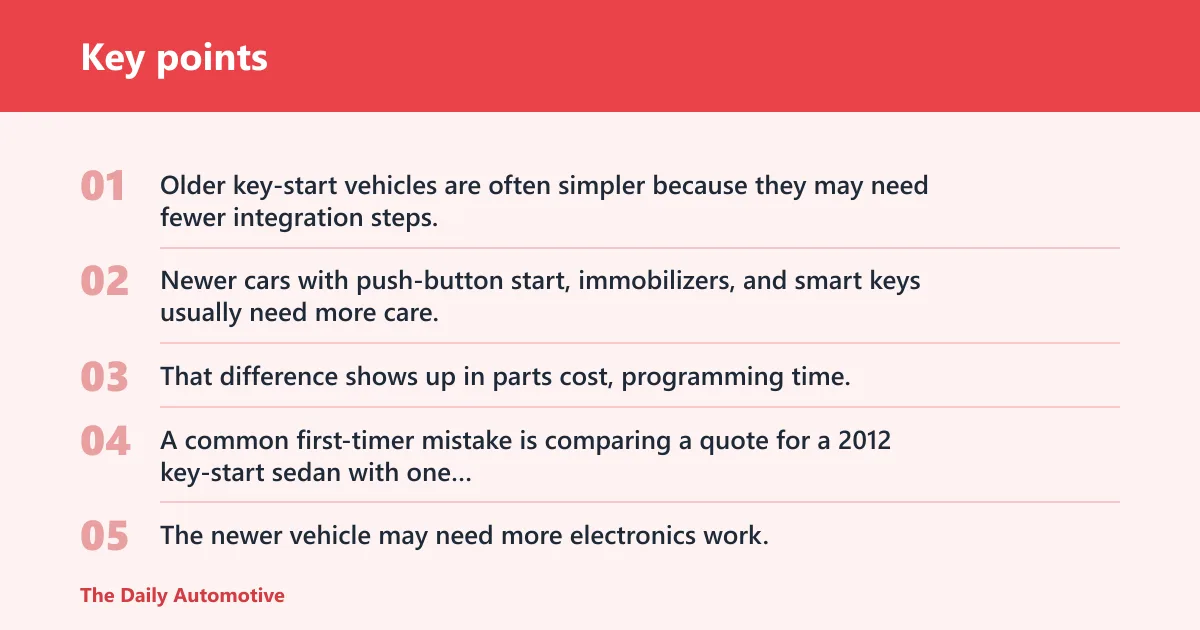
Older key-start vehicles are often simpler because they may need fewer integration steps. Newer cars with push-button start, immobilizers, and smart keys usually need more care. That difference shows up in parts cost, programming time, and the chance that a vehicle-specific module is required.
A common first-timer mistake is comparing a quote for a 2012 key-start sedan with one for a 2022 push-button SUV and assuming the prices should match. They should not. The newer vehicle may need more electronics work, and that extra work is part of what the quote buys.
Push-button start, immobilizers, and smart-key systems
Vehicle immobilizer and security systems can complicate the install because the remote starter has to work without defeating factory theft protection. Push-button start compatibility and smart-key integration often require more exact matching and more programming. If the bypass plan is wrong, the quote may look cheap but fail after installation.
Manual transmissions are harder and may cost more. They need additional safeguards and a shop willing to handle the job carefully, which is one reason not every installer quotes the same car the same way.
Regional labor rates and shop policy
Labor costs usually depend on hourly rate and local market conditions. The price article says labor rates usually range from $75 to $150 per hour, and installation time typically ranges from 2 to 5 hours. That means labor alone can move the quote a lot before parts are even counted.
Some shops include programming and testing in the labor line. Others itemize them. Ask which approach the quote uses, because a low base price can become expensive if the add-ons are missing.
Aftermarket vs. dealer-installed pricing
Aftermarket installation usually costs less than dealer-installed remote start, especially when you are comparing a basic system to a factory-style option. Dealer pricing can be higher because it often includes tighter factory integration and OEM-style fitment. The better choice depends on whether you want the lowest installed cost or the cleanest factory-like package.
When aftermarket usually costs less
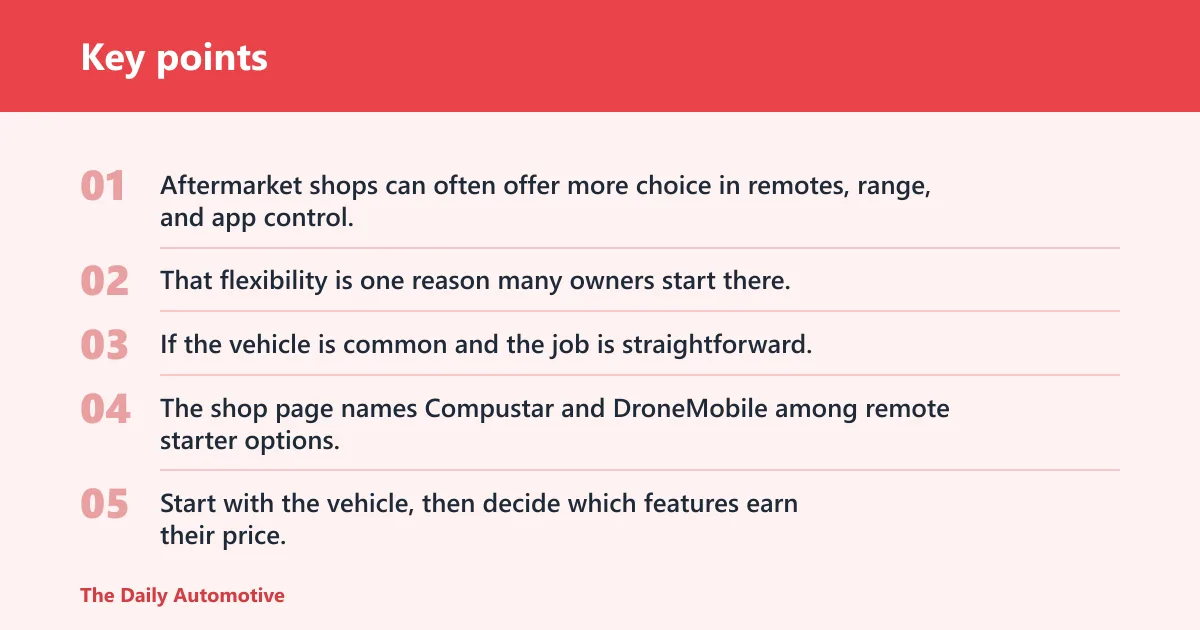
Aftermarket shops can often offer more choice in remotes, range, and app control. That flexibility is one reason many owners start there. If the vehicle is common and the job is straightforward, aftermarket pricing can stay well below dealer pricing while still delivering dependable operation.
The shop page names Compustar and DroneMobile among remote starter options, and it explicitly recommends matching system level to budget, vehicle, and distance needs. That is the right comparison method. Start with the vehicle, then decide which features earn their price.
When factory integration can be worth the premium
Factory-style or dealer-installed pricing can make sense when you want the system to blend closely with the original vehicle controls or when the vehicle’s electronics are easier to support through dealer channels. Some buyers also prefer one-stop warranty handling, even if the initial price is higher.
If the dealer quote is only modestly higher and it includes verified compatibility, complete integration, and a clear warranty path, the premium may be worth it. If the price gap is large, ask exactly what the dealer is adding beyond a standard aftermarket package.
What to ask before you compare dealer and shop quotes
Ask whether the quote includes the module, programming, testing, and any security bypass hardware. Ask whether the vehicle needs a data interface or a special cable. Ask whether the quoted system supports the original key fob, extended-range remotes, two-way feedback, or smartphone control.
Also ask whether the price includes removal of interior trim, calibration, and post-install verification. A quote that leaves those out is not a complete comparison.
How much does a two-way system cost installed?
A two-way remote starter usually costs more than a one-way system because it adds confirmation feedback hardware and often sits in a higher feature tier. Installed pricing commonly rises when you add better range or app control, and the premium is most defensible when you need to know that the car actually received the command.
What confirmation feedback adds to the price
Two-way remotes send a command and receive confirmation back. That extra communication path helps when you cannot see the vehicle from where you are standing. The price increase is tied to the remote hardware, not just the sticker on the box.
If a basic one-way remote already covers your parking routine, the added cost may not be necessary. If you park several rows away or in a lot where visual confirmation is impossible, two-way feedback can be worth paying for.
When longer range matters
Extended-range remotes can reach beyond many factory systems, which is useful in large lots or outside offices. That matters most when the vehicle sits far from the building, behind obstacles, or in a place where a short-range remote is unreliable.
Suppose you leave work and park in the far corner of a hospital lot. A standard short-range remote may work some days and fail on others. In that case, paying for extended range is a practical upgrade, not a luxury feature.
Tradeoffs versus a basic one-way remote
A one-way remote is usually the cheapest path to remote start. It keeps the system simpler and can lower both parts and labor. The tradeoff is that you do not get confirmation back from the vehicle.
Two-way and long-range systems cost more because they solve a specific problem: uncertainty. If the vehicle is visible and close, the extra money may not return much value. If you need confirmation, it often does.
Can you add remote start to any car?
No, not every car or truck is a clean fit. Compatibility depends on the exact vehicle year, make, model, trim, and factory security equipment. Older key-start vehicles are often easier, while push-button start vehicles, smart keys, and manual transmissions can require more parts and more careful planning.
Older key-start vehicles
Many older key-start cars are the simplest candidates for aftermarket remote start. They often need fewer interface components and less security work than newer models. That usually keeps the installed price lower and the quote easier to compare.
Even then, the installer should verify fitment before quoting. The wrong assumption can lead to a mismatch between the vehicle and the module.
Push-button start and smart-key vehicles
Push-button start vehicles and smart-key systems often need vehicle-specific modules and careful programming. The reason is straightforward: the starter must cooperate with the factory security system without creating a fault or a no-start condition. Compatibility verification is not optional.
Picture a late-model crossover with smart key access and a push-button start. A quote that skips the bypass module line may look attractive, but it is incomplete if the vehicle needs one to function correctly.
Manual transmissions and other hard-fit cases
Manual transmissions can be more difficult because the install should account for neutral safety and other safeguards. Some shops will not quote them at all. Others will, but the price usually reflects the extra time and risk involved.
That is why “Can it be added?” is the wrong first question. “Can it be added safely and correctly on this exact vehicle?” is the better one.
Remote starter quote breakdown
This table shows how quotes often break apart when you compare them properly. Use it to separate parts, labor, module work, and warning signs before you agree to a price.
| Vehicle type | System tier | Parts | Labor hours | Module/programming add-ons | Expected total range | Red-flag quote notes |
|---|---|---|---|---|---|---|
| Older key-start compact car | Basic one-way | Starter kit + standard remote | 2 to 3 | May need basic interface; programming and testing | $300 to $500 | Missing labor line; no test or programming included |
| Mainstream sedan with factory security | Mid-range extended-range | Starter kit + long-range remotes | 3 to 4 | Vehicle-specific module; programming and testing | $450 to $800 | Quote says “universal fit” without vehicle verification |
| Push-button start SUV | Two-way | Higher-tier system + two-way remote | 3 to 5 | Security bypass module; programming and testing | $700 to $1,100+ | No bypass hardware listed; no mention of smart-key compatibility |
| Luxury model with smart key | Premium app-based | Starter unit + app-compatible hardware | 4 to 5 | Vehicle-specific module; app service plan; programming and testing | $900 to $1,200+ | Subscription not disclosed; quote omits vehicle-specific module |
| Dealer-installed factory package | OEM-style integration | Factory package and controls | Varies by dealer | Usually built into package pricing | $500 to $1,200 | Compare total drive-out price, not just the advertised add-on |
How to read the table
If one quote looks cheaper, check whether it leaves out a module, programming, or testing. Those missing items are often where the price difference hides. A fair comparison puts all three on the page.
Also watch for vague language like “installation extra” or “vehicle-specific parts may apply.” Those phrases usually mean the quote is incomplete.
Smartphone control and subscription costs
Smartphone control can be useful, but it is rarely free forever. DroneMobile smartphone control requires compatible installed equipment and an active service plan. That means the hardware quote and the monthly or annual service cost are separate decisions.
What app-based control usually includes
App-based systems can add remote start, remote lock and unlock, and vehicle status features. That can be helpful if you want to check the vehicle from farther away than a standard remote allows. It also reduces dependence on a dedicated handheld remote for some tasks.
The value is highest when you actually use the extra functions. If you only want remote start from the driveway, a subscription may be unnecessary overhead.
When a service plan is required
Some app-based systems require an active plan to keep cellular features working. That is the main cost many shoppers miss. The quote may cover the hardware install, but the app-based convenience continues as an ongoing expense.
Ask whether the plan is required for all app features or only for remote access beyond the local range. That answer changes the value calculation.
When a subscription is worth paying
A service plan can make sense if you park far away, share a vehicle, or want lock and unlock access from the phone. It is less appealing if the app duplicates features you already get from the remote in your pocket.
If the car sits in a remote lot all day and you want status checks before you walk out, the plan may be worth it. If the vehicle is always parked close by, a no-subscription remote may be the smarter buy.
Frequently asked questions
How much does remote car starter installation cost?
Remote car starter installation usually costs $300 to $600 for a basic aftermarket system. More vehicle-specific or OEM-style setups often land between $700 and $1,200+ installed. The final price depends on the car, the control type, the required module work, and whether labor and programming are bundled in.
Why do remote starter prices vary so much?
Prices vary because the install is not the same from vehicle to vehicle. Year, make, model, trim, and factory security hardware all affect the parts and labor needed. Push-button start systems, smart keys, and immobilizers usually push the quote higher than a simple key-start car.
Is a remote starter cheaper aftermarket or dealer-installed?
Aftermarket is usually cheaper, especially for common vehicles with straightforward installs. Dealer-installed remote start often costs more because it is priced as a factory-style package with tighter integration. If the dealer quote is only slightly higher, factory integration may justify the premium; if not, aftermarket often wins on value.
How long does remote starter installation take?
The price article says installation time typically ranges from 2 to 5 hours. Simpler key-start vehicles often sit near the low end, while push-button start, smart-key, and premium app-based systems take longer because they need more wiring, programming, and testing.
Does smartphone remote start cost extra every month?
Often, yes. DroneMobile smartphone control requires compatible installed equipment and an active service plan. That means the app-based feature may carry ongoing fees after the hardware is installed. If you only want remote start from a handheld remote, a subscription may not be worth the added cost.
Can I add remote start to any car or truck?
No. Compatibility depends on the exact vehicle year, make, model, trim, and factory security equipment. Many older key-start vehicles are simpler, while push-button start and smart-key systems often need vehicle-specific modules. Manual transmissions can be harder and may cost more, so verification comes before pricing.
Products related to this article
Sponsored / affiliate links. As an Amazon Associate I earn from qualifying purchases. I may earn additional commission from eligible campaigns.