Are Nascar Cars All Wheel Drive: Essential Truths
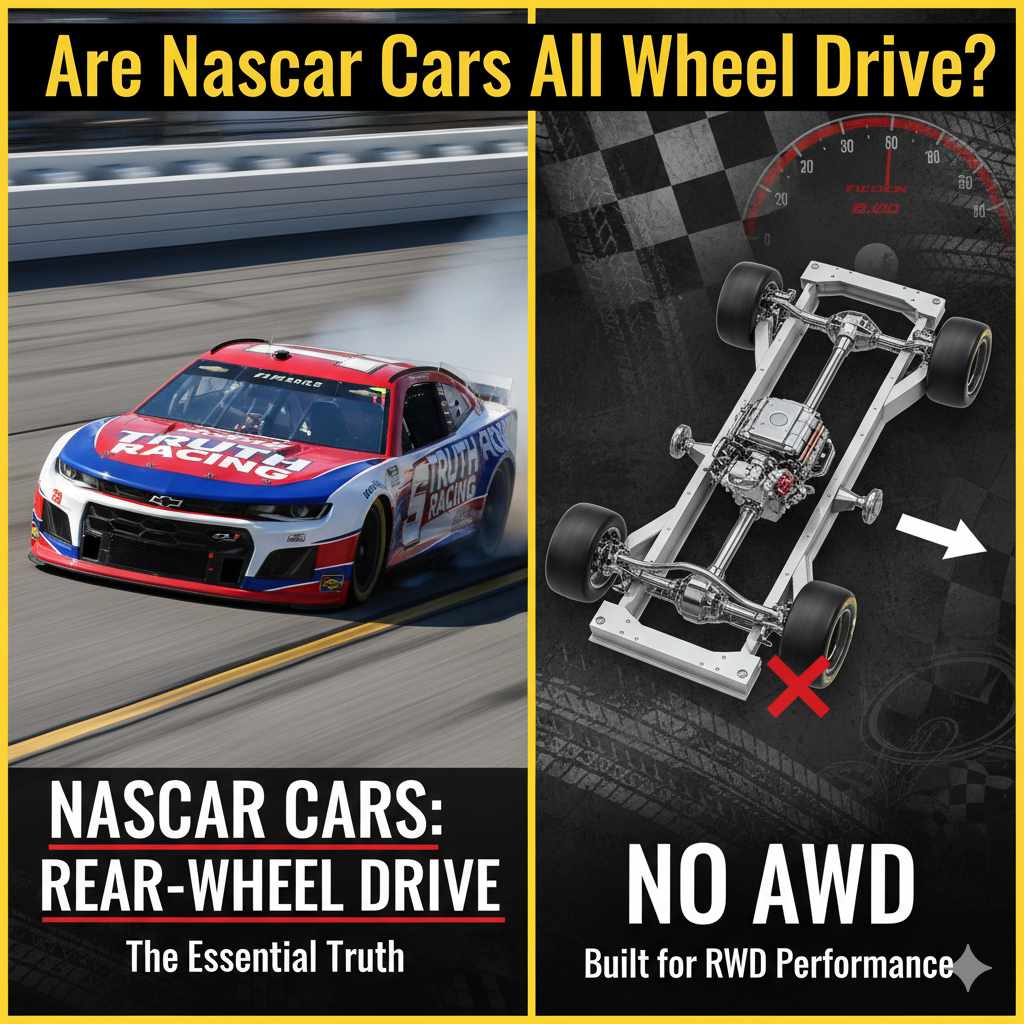
No, NASCAR cars are not all-wheel drive. They are strictly rear-wheel drive, a design choice made for performance, tradition, and specific racing regulations.
Ever wondered about the power behind those roaring NASCAR machines? You’ve probably seen them hug the curves at incredible speeds and thought, “How do they do that?” A common question that pops up is whether these race cars use all-wheel drive (AWD) to grip the track. The truth is, it’s a bit simpler – and more fascinating – than you might think. Don’t let the complexity of racing confuse you! We’re here to break down exactly how NASCAR cars put their power to the pavement in a way that’s easy to understand. Stick around, and you’ll know all about NASCAR’s drivetrain in no time.
The Heart of the Beast: NASCAR Drivetrain Explained
When you watch a NASCAR race, you’re seeing pure performance engineered for the track. One of the key aspects of this performance is how the engine’s power gets to the wheels. Unlike many everyday cars that offer all-wheel drive for better traction in various conditions, NASCAR vehicles have a specific setup that’s been a hallmark of the sport for decades.
Rear-Wheel Drive: The Classic Choice
NASCAR cars exclusively use a rear-wheel drive (RWD) system. This means that the engine’s power is sent only to the rear wheels. Why choose this setup over AWD, especially when AWD is known for its grip? Several crucial factors come into play, focusing on how the cars behave and how the sport is governed.
Performance and Handling: RWD is often preferred in racing for its distinct handling characteristics. It allows for precise control during acceleration, braking, and cornering. Racers can use throttle control to subtly influence the car’s balance in turns, a technique that’s integral to competitive driving.
Simplicity and Weight: A RWD system is generally simpler and lighter than an AWD system. AWD requires extra components like a transfer case, front driveshaft, and differential, all of which add weight and complexity. In racing, every extra pound and every potential failure point is a concern.
Tradition and Rules: The NASCAR sanctioning body has long mandated RWD. This tradition is deeply woven into the fabric of stock car racing. Sticking to RWD ensures a level playing field and fosters a specific type of racing that fans have come to love.
Why Not All-Wheel Drive?
You might be thinking, “But AWD offers better traction, right?” While AWD excels in slippery conditions like snow or rain for everyday driving, it’s not the ideal solution for the highly controlled environment of a race track where NASCAR cars operate.
Track Conditions: NASCAR tracks, while sometimes affected by weather, are primarily dry asphalt. The grip provided by four driving wheels isn’t as critical as it might be on a public road in adverse weather.
Tuning and Control: With RWD, engineers and drivers have a very specific way of modulating power to achieve desired handling. The rear wheels are responsible for both propulsion and steering response, a nuance that experienced drivers master. Introducing AWD would fundamentally change how the car behaves and how it can be tuned.
Complexity and Maintenance: As mentioned, AWD adds complexity. In a sport where mechanical failures can be catastrophic and pit stop efficiency is vital, maintaining a simpler mechanical system is a significant advantage.
A Look Under the Hood (and Chassis!): The Drivetrain Components
Let’s dive a little deeper into what makes a NASCAR car’s RWD system tick. It’s a robust setup designed to handle extreme forces.
The Powertrain Chain
The power flows from the engine through a series of components to reach those rear wheels:
1. Engine: A powerful V8 internal combustion engine is the source of all the horsepower.
2. Clutch: This allows the driver to disconnect the engine from the transmission, enabling gear changes and smooth starts.
3. Transmission: A specialized manual transmission, typically with 4-5 speeds, is used. These are built to be incredibly strong for the demands of racing.
4. Driveshaft: A long, rotating shaft that transmits power from the transmission to the rear axle differential.
5. Rear Axle and Differential: The differential splits the power from the driveshaft to the two rear wheels, allowing them to rotate at different speeds when turning. NASCAR cars often use a quick-change rear end, allowing mechanics to swap gear ratios quickly between practices or races to adapt to track conditions.
Simplicity is Strength
The RWD setup means there are no front driveshafts, no front differential, and no complex electronic all-wheel-drive control systems. This focus on essential components contributes to the reliability and raw performance that NASCAR is known for.
Performance Versus All-Weather Capability
It’s important to understand that NASCAR cars are purpose-built machines. Their design prioritizes racing performance over the versatility needed by an everyday vehicle.
NASCAR Cars: Built for Speed on a Track
Aerodynamics: Every surface is sculpted to reduce drag and create downforce, pushing the car onto the track for better grip – something AWD can’t fully substitute for.
Suspension: Highly tunable suspension systems allow for minute adjustments to handle different track banking and tire wear.
Tires: Racing slick tires are designed for maximum grip on dry asphalt but offer almost no traction in wet or snowy conditions.
Engine Power: Massive horsepower is delivered to the rear wheels, requiring precise driver input to manage traction.
Everyday Cars: Versatility is Key
Everyday cars with AWD are designed for a much broader range of conditions:
Improved Traction: AWD systems automatically send power to the wheels with the most grip, enhancing stability on slippery surfaces like ice, snow, or wet roads.
Easier Driving: For many drivers, AWD offers a sense of security and confidence when driving in less-than-ideal weather.
Fuel Efficiency: Modern AWD systems are increasingly efficient, often able to disengage when not needed to save fuel, unlike a permanently engaged system. Check out resources from the U.S. Department of Energy on how drivetrain impacts fuel economy to see the everyday considerations.
The Role of Weight in NASCAR
Weight is a critical factor in any racing series. Adding the components necessary for all-wheel drive would significantly increase a NASCAR car’s weight.
Weight Distribution and Balance
A RWD system generally allows for better weight distribution and balance, which is crucial for predictable handling. Engineers can fine-tune how the car’s mass is distributed front-to-rear and side-to-side.
The Minimum Weight Rule
NASCAR has strict minimum weight regulations for its cars. These rules include the weight of the car, driver, and safety equipment. Staying at or above this minimum weight is essential for competition. Adding unnecessary weight from an AWD system would either require lighter components elsewhere (potentially compromising durability) or put the car at a competitive disadvantage.
NASCAR Rules and Regulations: The Final Word
The decision to mandate rear-wheel drive is also firmly cemented in NASCAR’s rulebook. These rules are designed to keep the competition close and maintain the sport’s traditional character.
A Tradition of RWD
From the early days of stock car racing, RWD has been the standard. This continuity is part of the sport’s appeal. Changing to AWD would fundamentally alter the racing dynamics, the cars themselves, and years of racing history.
Maintaining a Level Playing Field
Standardizing the drivetrain to RWD ensures that all competitors are working with the same basic platform. While teams excel in engineering and driver skill, the underlying drivetrain technology remains consistent to foster close racing.
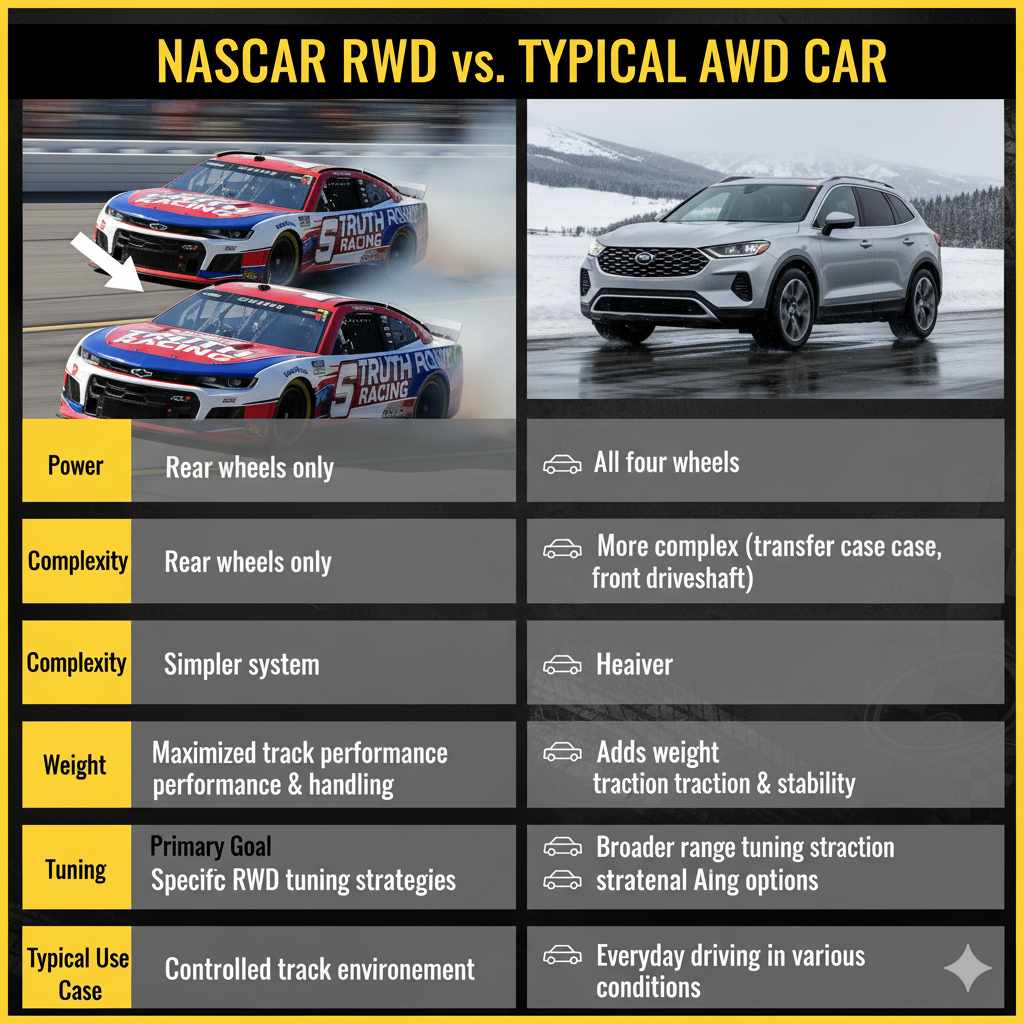
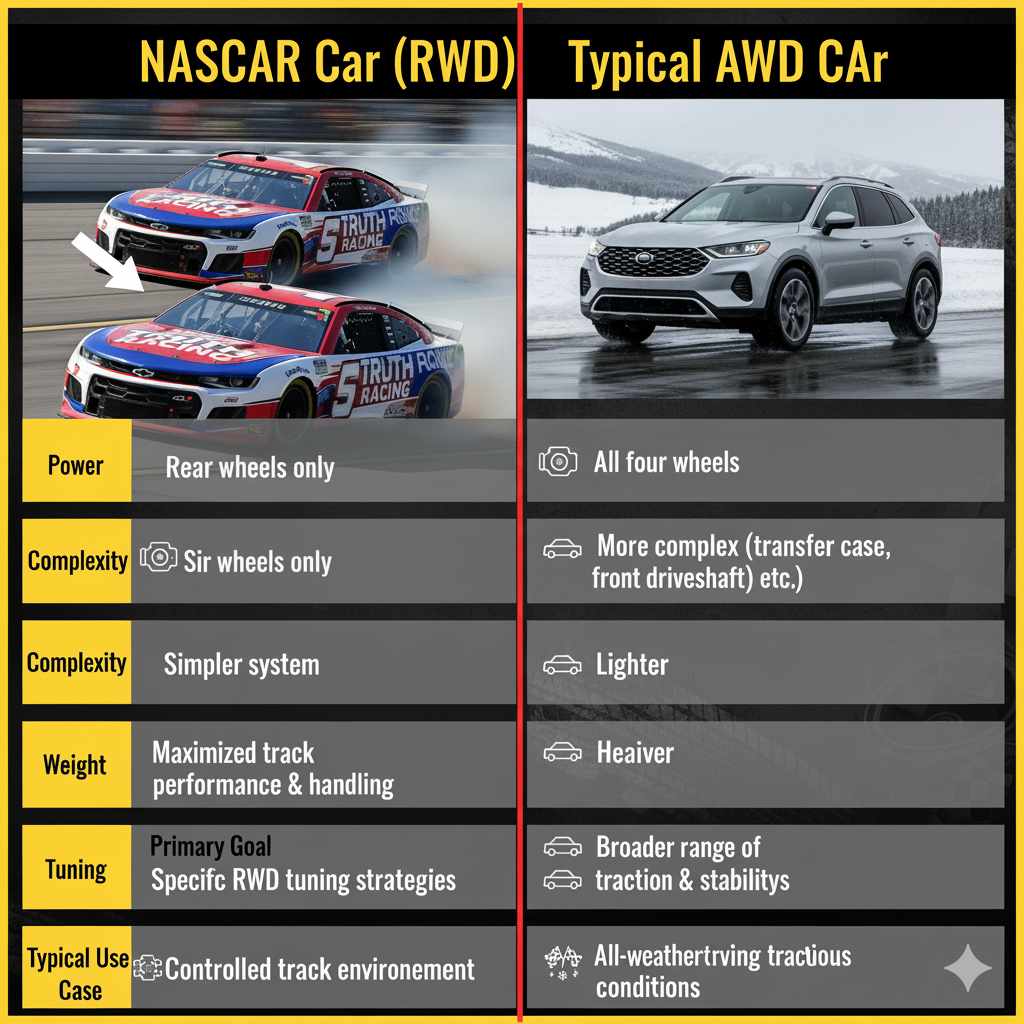
Table: NASCAR RWD vs. Typical AWD Car
To help visualize the differences, let’s look at a simple comparison:
| Feature | NASCAR Car (RWD) | Typical AWD Car |
|---|---|---|
| Power Delivery | Rear wheels only | All four wheels |
| Complexity | Simpler system | More complex system (transfer case, front driveshaft, etc.) |
| Weight | Lighter | Heavier |
| Primary Goal | Maximized track performance and handling | All-weather traction and stability |
| Tuning Flexibility | Specific RWD tuning strategies | Broader range of traction options |
| Typical Use Case | Controlled race track environment | Everyday driving in various conditions (rain, snow, etc.) |
FAQs: Your NASCAR Drivetrain Questions Answered
Let’s tackle some common questions beginners might have about NASCAR cars and their drivetrains.
Are all NASCAR series rear-wheel drive?
Yes, in the top three NASCAR national series – the Cup Series, Xfinity Series, and Gander Outdoors Truck Series – all vehicles are mandated to be rear-wheel drive. This is a fundamental rule of the competition.
Why do NASCAR cars have such massive engines if they’re only RWD?
The massive engines provide the immense horsepower needed for high-speed racing. While RWD delivers this power to only two wheels, it requires significant torque and engine output to overcome aerodynamic drag, friction, and maintain speed down the straightaways and out of corners. The driver then uses skill to manage this power through the rear wheels.
Could NASCAR cars be faster with all-wheel drive?
It’s a complex question. While AWD could potentially offer more mechanical grip, particularly out of slower corners, it would also add weight and complexity. NASCAR racing often favors cars that are precisely tunable for specific tracks and driven with masterful throttle control. The current RWD setup allows for a unique driving style and a certain type of racing spectacle that fans enjoy. It’s less about raw grip and more about how drivers use* the power they have.
Does the type of track affect NASCAR’s RWD setup?
Absolutely. NASCAR teams adjust gear ratios in their quick-change rear ends based on the track. For short tracks with lots of braking and acceleration, they’ll use different ratios than for large, high-speed superspeedways. The RWD system’s adjustability is key to optimizing performance for vastly different circuits.
What about safety features and drivetrains? If RWD is less stable, how is it safe?
NASCAR cars are incredibly safe due to a combination of factors that go far beyond just the drivetrain. They feature robust chassis design, advanced safety cells, extensive roll cages, fire suppression systems, and high-spec safety gear for the drivers. The drivers themselves are highly skilled athletes trained to manage the RWD dynamics at extreme speeds. While RWD can be more challenging to handle at the limit, it’s precisely this challenge that racing is all about, and it’s managed through driver skill and vehicle engineering within the RWD framework.
How does RWD affect tire wear in NASCAR?
RWD systems place a significant load on the rear tires, which are responsible for both acceleration and providing a large portion of the grip needed for cornering. This means rear tire wear is a critical factor in NASCAR strategy. Teams must manage tire degradation throughout a race by adjusting driving style, pit stop strategies, and sometimes even car setup to conserve rear tires.
Is it possible to convert a NASCAR car to AWD?
Legally, within NASCAR competition, no. The rules strictly prohibit it. If you were to somehow build a non-competitive replica or a custom car inspired by NASCAR, it would involve extensive custom fabrication to add all the necessary AWD components. It would be a massive undertaking and completely outside the spirit and rules of actual NASCAR racing.
Conclusion: Power to the Rear, Glory to the Driver
So, there you have it! The essential truth is that NASCAR cars are not all-wheel drive; they are, and always have been, rear-wheel drive machines. This fundamental design choice isn’t just a quirk of tradition; it’s integral to the performance, the handling characteristics, and the very nature of stock car racing.
The RWD setup allows drivers to master the delicate balance of throttle and steering, creating the thrilling, sideways action that captivates millions. It’s a system that prioritizes raw power delivery to the track, enabling incredible speeds and daring overtakes. While AWD offers benefits for everyday driving in varied conditions, NASCAR is a specialized sport with a unique set of demands. The simplicity, lighter weight, and specific performance tuning made possible by rear-wheel drive define the driving experience and the competition itself.
Understanding this simple yet crucial aspect of a NASCAR car helps demystify the sport and appreciate the incredible skill of the drivers who harness this power every weekend. It’s a testament to how specific engineering choices shape the spectacle we love. From the engine’s roar to the screech of tires, it all flows through those two driven rear wheels, delivering excitement lap after lap.