Car Engine Replacement Cost: $1,000 to $7,500 Total
A car engine replacement cost in the $1,000 to $7,500 range is more believable when the quote spells out the engine type, labor hours, parts source, fluids, gaskets, programming, and warranty; a vague estimate can leave out extra charges. A bad quote can turn the repair into a money sink or leave you with a car that still won’t run right. This guide shows how to read the estimate, spot omissions, and decide whether replacement or selling makes more sense.
Engine replacement quote decoder table

| Line item | Typical cost range | When the charge is legitimate |
|---|---|---|
| Used engine | $500-$2,000 | The donor engine is a direct fit and the quote states its mileage, source, and warranty window. |
| Remanufactured engine | $1,800-$4,500 | The engine has been disassembled, inspected, machined, and reassembled, with a stronger warranty. |
| New OEM or crate engine | $3,500-$8,500 | The vehicle is high value, build-focused, or needs a brand-new replacement from the start. |
| Labor | $1,000-$2,500 | The shop lists hours, rate, and whether the job is straightforward or needs extra access work. |
| Core charge | $200-$500 deposit | The old engine must be returned, usually complete, to recover the deposit. |
| Programming or immobilizer work | Quoted separately | Late-model vehicles may need ECU programming, key matching, or immobilizer setup. |
| While-out parts | Usually modest, but variable | The quote names gaskets, fluids, belts, hoses, seals, thermostat, and water pump where needed. |
What should a complete engine quote include?
A complete engine quote should split out the engine, labor, core charge, and every required part. If those items are folded into one number, you cannot tell whether the estimate is fair, whether another charge is coming later, or whether the job includes the parts that prevent a repeat failure.
Engine price and type
The quote should state whether the shop is installing a used engine, remanufactured engine, or new OEM or crate engine. That matters because used engines have the lowest upfront cost, remanufactured engines usually give a better mix of cost and reliability, and new OEM or crate engines sit at the highest price tier.
A used engine is pulled from a donor vehicle. It is the cheapest path, but also the riskiest because its history is often unknown. Typical warranty coverage is 30-90 days, which means the buyer gets limited protection if hidden wear shows up after installation.
A remanufactured engine is disassembled, inspected, machined, and reassembled. Some sellers advertise warranties in the 1-3 year or three-year/100k range, and a longer warranty can offer better value than a short used-engine warranty.
A new OEM or crate engine is the top-cost option. It is usually the right call for higher-value vehicles, build-oriented owners, or cases where long-term reliability matters more than saving money upfront.
Labor hours and shop rate
Labor is usually listed by hours and rate rather than as one lump sum. A straightforward engine swap is often around 8-15 hours, while a more complex job with tighter packaging, extra accessories, or more electronics may be around 20-30 hours.
One source pegs independent shop labor at $110/hr, while another estimates independent-shop labor at $800-$2,000. A salvage-yard engine swap is often quoted at $1,500-$4,000 total, which shows how quickly labor can dominate the bill.
Core charge and return rules
The core charge is usually a refundable deposit of about $200 to $500. The shop or parts supplier keeps it until the old engine is returned. That old core usually has to be complete enough to rebuild or remanufacture, so missing pieces can reduce or wipe out the refund.
If the quote does not explain the core return window, shipping responsibility, and condition requirements, ask for it in writing. A missing core refund can erase part of the savings on a cheaper engine choice.
Add-on parts that should be named
The estimate should list any gaskets, fluids, filters, seals, mounts, and accessory parts that are included. Most shops also recommend replacing the timing belt or chain, water pump, thermostat, and accessory belts while the engine is out. Those parts are far cheaper to change during the swap than after the engine is back in place.
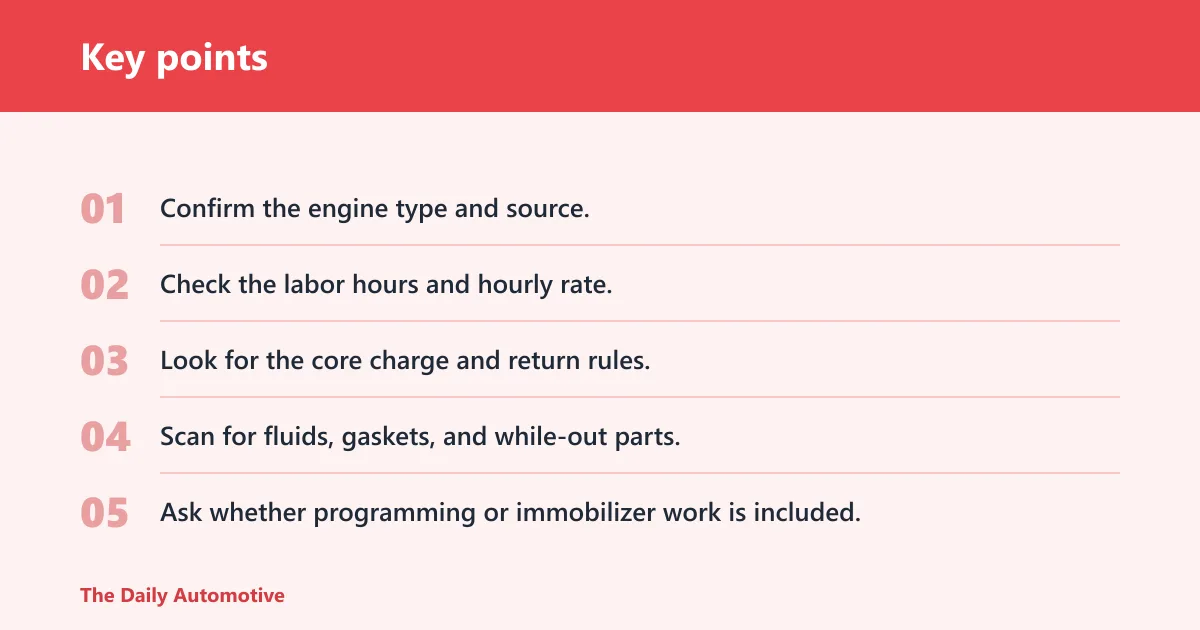
- Confirm the engine type and source.
- Check the labor hours and hourly rate.
- Look for the core charge and return rules.
- Scan for fluids, gaskets, and while-out parts.
- Ask whether programming or immobilizer work is included.
- Compare the total to the car’s running-condition value.
Used vs remanufactured vs new engine
Used, remanufactured, and new engines are different repair paths. The cheapest quote can become the worst outcome if the engine fails after installation and you pay for labor twice. The best choice depends on vehicle value, how long you plan to keep it, and how much risk you can accept.
Used engine
A used engine is the lowest upfront-cost option at $500-$2,000 for the engine alone. It can make sense on a low-value daily driver, but the short 30-90 day warranty leaves less protection if internal wear, sludge, or overheating damage shows up later.
Say your compact sedan has 180,000 miles and needs an engine. A used replacement may seem cheap on paper, but if it fails after installation, the second labor bill can make it the most expensive path.
Remanufactured engine
A remanufactured engine is often the best balance of price and reliability. With engine pricing listed at $1,800-$4,500 and total installed cost commonly $4,000-$7,000, it is often the practical middle ground when the car still has enough value to justify the repair.
The longer warranty helps. A 1-3 year warranty gives more risk protection than a short used-engine warranty, and that matters when the vehicle is expected to stay on the road for several more years.
New OEM or crate engine
A new OEM or crate engine is the highest-cost choice, with pricing listed at $3,500-$8,500 and new OEM dealer pricing that can reach $6,000-$12,000+. It is the right option when the vehicle is high value, hard to replace, or being kept for a long time.
That cost makes less sense on an aging commuter unless the car has unusual value, a special configuration, or expensive supporting parts that would make replacement vehicle shopping harder than the repair.
Long block vs short block
A long block includes the heads and valve train, so it is usually the more complete bolt-on solution for most replacement buyers. A short block includes the block, crankshaft, pistons, and rods, but requires reuse or sourcing of the heads and top-end components. That makes short blocks better suited to builders than most replacement customers.
Why labor changes the total so much

Labor is often the difference between a manageable estimate and a repair that crosses the value line. Even when the engine price looks fair, the installation can add another $1,000-$2,500, and more on vehicles that are hard to access or need electronic setup after installation.
Straightforward swaps
Some engines come out and go back in with relatively few complications. Those jobs are closer to the 8-15 hour range and often fit the lower end of the installed total, especially on older, simpler vehicles with less electronics.
Complex swaps and extra access work
Complex swaps can run 20-30 hours when the engine bay is crowded, the drivetrain layout is tighter, or related parts must be removed to reach the engine. Trucks, AWD vehicles, and late-model vehicles often create more labor than the same engine would in a simpler platform.
Suppose a late-model crossover needs a replacement engine plus immobilizer matching. The engine itself may fit, but the car may still not start until the ECU and security system are programmed correctly.
Programming and immobilizer matching
ECU programming or immobilizer matching is sometimes required on late-model swaps. That adds cost and delay, and it is more common on modern vehicles with stronger theft protection and tighter engine management integration.
Should you replace the engine or sell?
Engine replacement stops making sense when the repair bill gets too close to what the car is worth running. A common rule of thumb is to use about 50% of the vehicle’s running-condition value as the decision line. If the estimate lands near or above that point, selling often deserves a hard look.
Use the 50% value rule
Compare the total installed cost against the car’s running-condition value, not just the engine price. If the car would be worth $8,000 running and the engine job comes to $5,000, the repair is already beyond the 50% line.
Check running-condition value
Use the value the car would have if it were fixed and roadworthy, not the broken-car trade-in figure. That keeps the decision tied to what the car would actually be worth after the repair.
Watch for repeat-failure risk
A cheap used engine becomes a poor bet if the car already has cooling issues, neglected maintenance, or a history of overheating. Repeat labor can turn the “budget” option into the most expensive outcome.
Vehicle type cost ceilings
Vehicle type changes the ceiling quickly. Compact cars usually sit lower, while trucks, SUVs, hybrids, and late-model vehicles often push the installed total higher because of packaging, electronics, and drivetrain complexity.
| Vehicle type | Sane installed-cost ceiling | Repair or sell threshold |
|---|---|---|
| Compact and midsize cars | About $4,000-$5,500 | Sell if the quote approaches 50% of running-condition value |
| Trucks and SUVs | About $5,500-$7,500 | Repair can make sense if the frame, transmission, and body are strong |
| Hybrids and late-model vehicles | About $6,000-$8,500 | Factor in ECU programming, battery system interaction, and parts availability |
| High-mileage daily drivers | About $3,500-$5,500 | Repair only if the rest of the car is in solid shape |
For context, a Ford F-250 diesel example reaches $4,000-$7,000 used and $8,000-$12,000 remanufactured. A Chevy Silverado 5.3L V8 example reaches $1,800-$3,200 used and $4,000-$6,500 remanufactured. Those examples show how engine choice and vehicle segment move the ceiling fast.
While the engine is out
The cheapest time to replace certain wear items is while the engine is already out. Most shops recommend replacing the timing belt or chain, water pump, thermostat, and accessory belts during the swap. Cooling system parts are especially important because a neglected cooling problem can damage the new engine too.
Cooling system parts
Thermostat, water pump, hoses, and seals are often inexpensive compared with a second engine job. If the old engine failed from overheating, these parts move from “nice to have” to “must inspect carefully.”
Belts, hoses, seals, and mounts
Belts, hoses, seals, and engine mounts are easier to change with the engine out than after the car is assembled again. Leaving a tired belt or leaking seal in place can create another labor bill for a part that was easy to reach the first time.
A common first-timer mistake is approving only the engine itself, then declining the low-cost while-out parts. That can save a little today and cost far more when the same labor has to come off again.
Frequently asked questions
How much does it cost to replace a car engine?
Engine replacement commonly lands from a few thousand dollars to well over that, depending on engine type and vehicle complexity. Larger and more complex vehicles push higher.
What is the total cost of engine replacement with labor?
The total depends on whether the shop installs a used, remanufactured, or new engine, plus labor and related parts. New OEM jobs can run $6,000-$12,000+ at a dealership.
Is it cheaper to rebuild or replace an engine?
Rebuilds can be cheaper in some cases, but replacement is often easier to price and less uncertain. A remanufactured engine is usually the middle ground for most drivers because it is disassembled, machined, and reassembled, with a better warranty than a used engine and less risk than a home-style rebuild.
Should I buy a used, remanufactured, or new engine?
Used is the cheapest and riskiest, with a typical 30-90 day warranty. Remanufactured is the best balance for many drivers, with a 1-3 year warranty and midrange cost. New OEM or crate engines suit high-value vehicles, special builds, or owners who want the highest-cost, lowest-uncertainty option.
How long does an engine replacement take?
Most straightforward swaps are commonly 8-15 labor hours, while complex swaps can take 20-30 hours. Real calendar time can stretch further if the shop is waiting on parts, machine work, programming, or a compatible engine. Late-model vehicles often take longer because of electronics and immobilizer setup.
Can I save money by supplying my own engine to the shop?
Sometimes, but not always. Customer-supplied engines can create fitment problems, freight damage concerns, return headaches, and warranty disputes if the part turns out wrong. A shop-supplied engine may cost more upfront, but it often reduces risk and simplifies warranty handling if something is off.
Products related to this article
Sponsored / affiliate links. As an Amazon Associate I earn from qualifying purchases. I may earn additional commission from eligible campaigns.