What Are Automotive Alternative Services?
Automotive alternative services are non-dealership options for maintenance, diagnostics, and repairs, including independent shops, specialists, fleet shops, and mobile service. They often cut routine maintenance bills, especially for oil changes, brake work, and other repeat jobs, while dealer service can still be the better call for warranty work and brand-specific electronics. Pick the wrong shop and you can pay twice for labor, miss the real fault, or run into warranty trouble. This guide explains what each option does, when it costs less, when it does not, and how to vet one before you book.
Quick answer
Automotive alternative services are the repair and maintenance options you can use instead of a franchised dealer. The term covers independent general repair shops, European and import specialists, fleet-focused shops, and mobile or convenience service providers. The useful distinction is simple: they are non-dealership providers, but they are not all built for the same jobs.
That matters because a routine oil change is not the same job as diagnosing a failed module on a late-model German sedan. Some alternative shops are set up for preventive maintenance and common repairs. Others have factory diagnostics, programming access, or brand-specific tooling. A few are built around speed and logistics, not deep diagnostic work.
In plain English, the phrase means “other places you can take the car.” The better question is which place fits the repair, the vehicle, and the warranty status.
📊 Casey’s Automotive states business hours of Monday through Friday, 7:00am to 6:00pm. Source: Caseysautomotive.
What counts as an alternative to dealership service?
Any non-dealer business that services cars can count, but the fit depends on scope. An independent auto repair shop usually handles general maintenance and repair. A European specialist focuses on European brands such as BMW, Mercedes-Benz, Audi, Volkswagen, Volvo, MINI, and Porsche. Fleet shops support commercial vehicles. Mobile providers handle simpler work at a location you choose.
Dealership alternatives usually compete on labor structure, convenience, and repair flexibility. They are often a better value for out-of-warranty work, routine upkeep, and diagnosis on common systems. Dealers still matter for some software updates, warranty claims, security programming, and repairs tied tightly to brand systems.
So the category is broad. The job type decides whether the alternative is a smart choice.
Which service type fits your need?
Start with the vehicle symptom or service request, then match the shop to that need. A brake pad replacement, tire rotation, or inspection-based maintenance plan can fit an independent generalist. A DPF fault, control-module issue, or brand-specific electrical problem may belong with a specialist or dealer. Fleet work needs record keeping. Mobile service suits simple, low-disruption tasks.
- Independent general repair: Best for oil changes, brakes, tires, AC service, inspections, and many common repairs.
- European and import specialist: Best for BMW, Mercedes-Benz, Audi, Volkswagen, Volvo, MINI, Porsche, and similar vehicles when diagnostics or programming matter.
- Fleet shop: Best for commercial vehicles that need repair history, scheduling control, and repeat service planning.
- Mobile or convenience service: Best for easy maintenance, battery service, or other work that does not require a lift-heavy shop visit.
Say your 2019 Volkswagen needs a basic brake inspection and front pads. A specialist or strong independent shop may be a fit. Say the car shows a warning tied to a control module and the shop cannot access brand software. That is where the dealer or European specialist becomes the safer call.
Alternative service decision matrix
This matrix is the quickest way to compare a dealer, an independent generalist, a European specialist, a fleet shop, and a mobile or convenience provider. Use it to match the vehicle need to the shop type, then ask about diagnostics, warranty coverage, and parts sourcing before you book.
| Vehicle need | Dealer | Independent generalist | European specialist | Fleet shop | Mobile or convenience service |
|---|---|---|---|---|---|
| Oil changes, filters, fluid checks | Good, especially during warranty | Usually the best fit | Good if the car is a European model | Good for scheduled commercial units | Good for simple maintenance |
| Brakes, tires, alignments | Good, often pricier | Usually the best fit | Good if vehicle-specific setup matters | Good for work trucks and vans | Limited, depending on equipment |
| Factory diagnostics, programming, brand software | Best fit for many late-model issues | Only if the shop has the right tools | Best fit for many European brands | Rarely the right choice | Usually not the right choice |
| Electrical faults, warning lights, ADAS-related complaints | Strong option | Only if diagnostic capability is proven | Strong option for import vehicles | Limited | Limited |
| Fleet history, repeat service, same-day turnaround | Possible, but often less efficient | Possible for small fleets | Possible for mixed import fleets | Best fit | Usually not the right choice |
| Convenience, pickup, drop-off, night drop | Sometimes | Common | Common | Sometimes | Best fit |
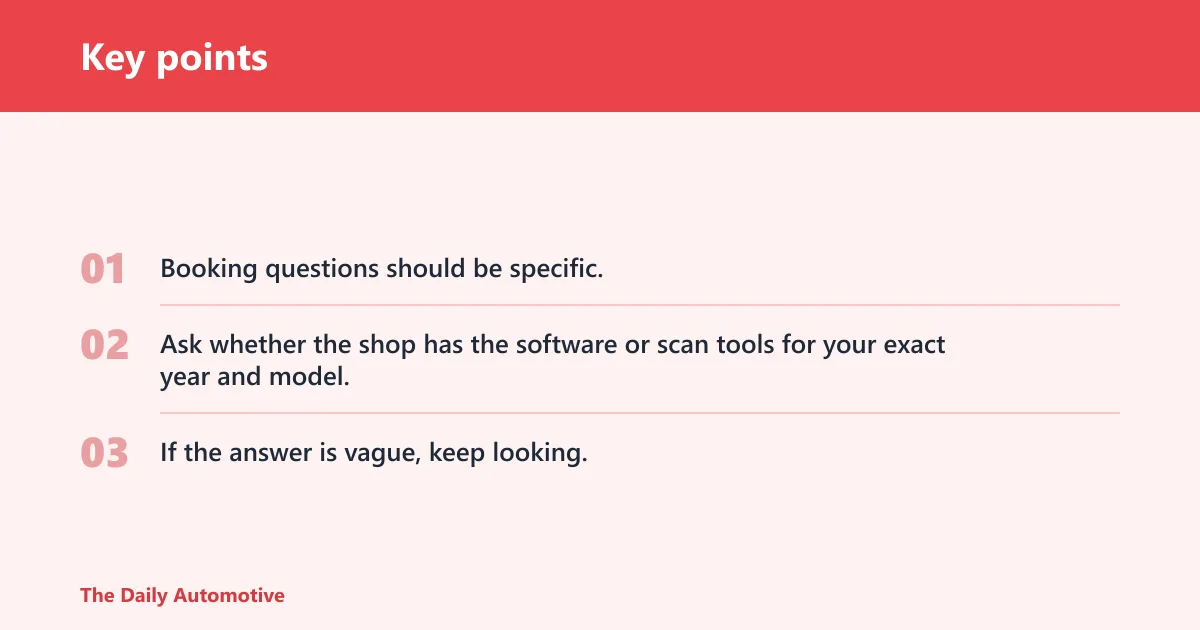
Booking questions should be specific. Ask whether the shop has the software or scan tools for your exact year and model, whether parts carry warranty coverage for both parts and labor, and whether the quote includes programming or calibration if the job needs it. If the answer is vague, keep looking.
Can an alternative shop save you money?
Yes, often on routine maintenance, common wear items, and straightforward repairs. Independent shops usually carry lower labor overhead than dealers, and that can trim the bill. Savings shrink when the job needs factory software, security access, ADAS calibration, or brand-specific diagnostics. Those jobs can close the gap fast.
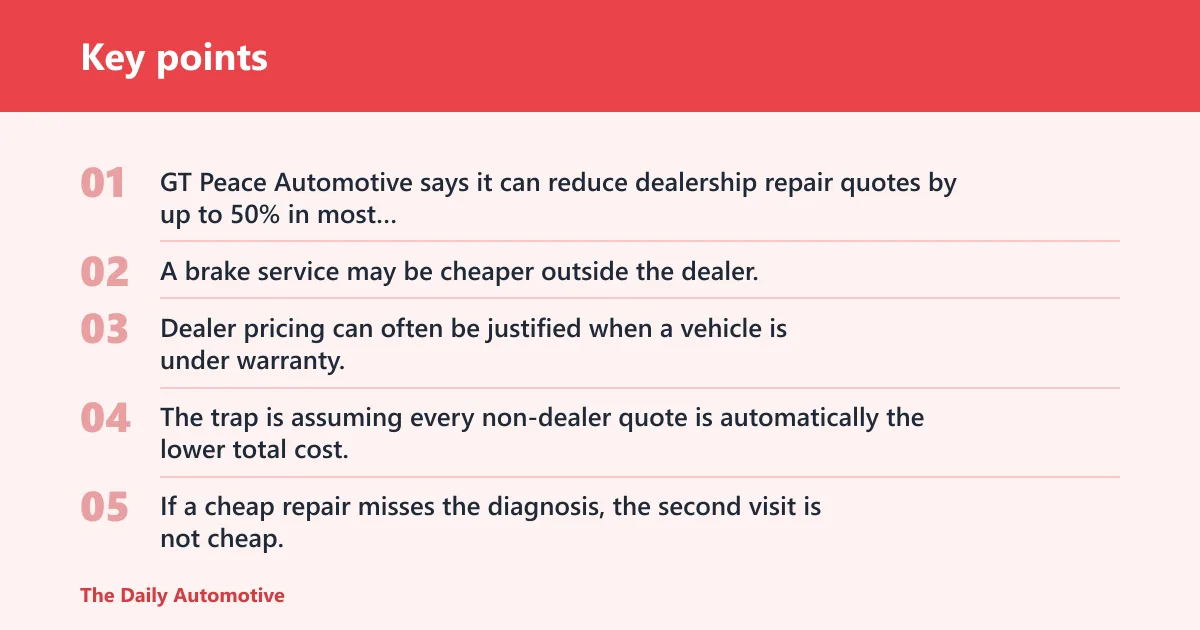
GT Peace Automotive says it can reduce dealership repair quotes by up to 50% in most cases, but that kind of comparison depends on the exact job. A brake service may be cheaper outside the dealer. A programming-intensive repair may not be.
Dealer pricing can often be justified when a vehicle is under warranty, the issue appears tied to a manufacturer campaign, or the repair needs brand-specific tools the alternative shop may not have. The trap is assuming every non-dealer quote is automatically the lower total cost. If a cheap repair misses the diagnosis, the second visit is not cheap.
Cost traps to watch for
Watch for add-ons that are not explained in writing. Programming, sensor calibration, fluid specification, and diagnostic time can change the final total. Also ask whether the quote includes parts, labor, and any required recheck. GT Peace Automotive backs work with a 2-year or 24,000-mile guarantee, which is useful only if you know what it covers and what it excludes.
What a good alternative shop should offer
A solid shop should show training, process, and logistics, not just a low price. Look for ASE-certified technicians, clear diagnostic methods, written findings, and a service menu that matches the car. If the shop handles European vehicles, ask about factory diagnostics and software access for the exact brand and model.
Casey’s Automotive lists ASE-certified technicians, and that credential signals technician training and competence. It also offers an unlimited lifetime warranty on select parts, plus free loaner vehicles, shuttle services, and concierge pickup and delivery at no additional cost. Those are the kinds of details that help you judge the operation, not just the ad.
Transparent inspection process matters. Written findings and photo documentation on inspection reports let you see what failed, what is wearing, and what can wait. That is better than a vague phone call that says “it needs work.”
Courtesy logistics that reduce hassle
Ask about the actual handoff options. Dulles South Chantilly Automotive lists a 24-hour drop box and a free shuttle by appointment. Casey’s Automotive states business hours of Monday through Friday, 7:00am to 6:00pm, which helps with planning. Courtesy logistics are not a luxury when the car is your only ride.
Are alternative shops reliable for European cars?
They can be, but only if the shop has the right diagnostic depth. European and luxury vehicles often rely on factory diagnostics, brand-specific software, and proper procedures for troubleshooting and repairs. A generalist can still be the right choice for brakes, tires, fluids, and other routine work. The risk rises when the issue involves coding, modules, or calibration.
Factory diagnostics matter because they help the shop read fault data the generic scan tool may miss. On BMW, Mercedes-Benz, Audi, Volkswagen, Volvo, MINI, and Porsche, that can change the repair path entirely. Without the right toolset, the shop may guess, replace parts, and still leave the problem unresolved.
GT Peace Automotive says it specializes in European import and domestic repair, and it lists BMW, Mercedes, MINI, Audi, and more among its high-end European makes. That is the kind of specialization to look for when the car is no longer a simple maintenance job.
Suppose an Audi has a warning light after a battery replacement. A basic shop may clear the code and send it out. A European specialist is more likely to know whether the car needs a battery registration, a software reset, or a deeper charging-system diagnosis.
Maintenance versus repair at an alternative shop
Maintenance is scheduled care that helps prevent failure. Repair fixes something that has already broken or begun to fail. The difference matters because maintenance can often be handled by a broad independent shop, while repair may require deeper diagnostics, parts verification, or programming. Mixing the two up leads to bad shop selection.
Preventive maintenance includes oil changes, brake inspections, tire service, and inspection-based recommendations. Repair includes fixing leaks, replacing failing sensors, correcting AC faults, and addressing electrical problems. If the issue is routine, a generalist often makes sense. If the car has warning lights, intermittent faults, or software-related symptoms, ask about diagnostic capability first.
A common first-timer mistake is booking “a brake job” when the complaint is actually a pulsation, noise, and a traction-control warning at the same time. That is not one simple service. It is a diagnosis plus a repair, and the shop needs the right tools to split those tasks correctly.
- Describe the symptom in plain language.
- Ask whether the shop performs the needed diagnostic step in-house.
- Confirm whether the quote covers parts, labor, and any calibration.
- Ask what warranty applies to the repair and to the parts.
- Request written findings before authorizing major work.
Can alternative automotive services handle fleet vehicles?
Yes, if the shop is set up for commercial use. Fleet service is different from a one-off consumer repair because the shop needs to track prior repair and maintenance history, keep vehicles moving, and handle repeat bookings without losing continuity. Some fleet shops also offer same-day turnaround for routine work.
That history matters. A van with recurring brake wear, for example, needs a record of past service and parts choices so the next repair is not treated like the first one. Commercial operators should ask how the shop stores prior work, whether it can prioritize downtime-sensitive repairs, and whether it can support mixed vehicle types.
If the fleet includes light trucks, cargo vans, or service vehicles, confirm whether the shop handles those classes routinely. The best fleet provider is the one that can document the vehicle’s service path, not just change parts quickly.
How do I choose a trustworthy alternative auto repair shop?
Start with proof, not promises. Look for ASE-certified technicians, a transparent inspection process, clear warranty terms, and the tools needed for your vehicle. A trustworthy shop explains what it found, what it recommends, and why. It also tells you when it is not the right place for the job.
Use these checks before booking: ask whether the shop has factory diagnostics for your make, whether photo documentation is part of the inspection report, whether labor and parts are covered together or separately, and whether it can handle shuttle, loaner, or drop-off logistics. Dulles South Chantilly Automotive says it serves all makes and models and offers a free shuttle by appointment, which are useful details, but they do not replace the need to ask job-specific questions.
Review volume can help, but it should not be the main filter. The real question is whether the shop can match the repair to the right process.
What should I ask before booking an alternative auto service?
Ask the questions that expose scope, tools, and warranty terms. The right answers tell you whether the shop is set up for your car and your repair. If the response is vague, incomplete, or rushed, that is a sign to keep searching. Good shops do not mind careful customers.
- Do you handle my exact make, model, and year regularly?
- Do you have factory diagnostics or brand-specific software for this job?
- Will you provide written findings and photo documentation?
- What does the warranty cover: parts, labor, or both?
- Is there a loaner vehicle, shuttle, pickup, delivery, or night drop option?
- Will any programming, calibration, or registration add to the estimate?
- For fleet work, do you keep prior repair and maintenance records?
One more useful check: ask who performs the work. Casey’s Automotive lists ASE-certified technicians, and credentialed staff can be a good sign, but you still want the shop to explain how the technician will diagnose the fault. Training helps. Process closes the loop.
Frequently asked questions
What are automotive alternative services?
Automotive alternative services are non-dealership places to get maintenance, diagnostics, and repairs. That includes independent shops, European specialists, fleet shops, and mobile service. The key question is not whether they are “alternative,” but whether they have the right tools and process for your car and the job.
Are alternative auto services cheaper than a dealer?
Often on routine maintenance and common repairs, yes. Not always on software-heavy or brand-specific work. The price gap can narrow when programming, calibration, or factory diagnostics are required, so compare the full job, not just the headline labor rate or the first estimate.
What services can an independent shop handle?
An independent shop usually handles oil changes, brake work, tires, AC service, inspections, and many common mechanical repairs. Some can also handle diagnostics and more complex jobs. Before booking, ask whether the shop has the scan tools, software access, and experience needed for your exact vehicle.
Are alternative auto services reliable for European cars?
They can be reliable when the shop has factory diagnostics, brand-specific procedures, and experience with European and import models. BMW, Mercedes-Benz, Audi, Volkswagen, Volvo, MINI, and Porsche often need more than a generic scan. For routine maintenance, a strong generalist may still be enough.
Do alternative shops offer warranties or loaner cars?
Many do, but the terms vary. Some shops offer parts-only coverage, while others include parts and labor. Examples in the market include an unlimited lifetime warranty on select parts and a 2-year or 24,000-mile guarantee. Also ask about loaners, shuttle service, pickup and delivery, and drop-box options.
Products related to this article
Sponsored / affiliate links. As an Amazon Associate I earn from qualifying purchases. I may earn additional commission from eligible campaigns.