Tar Cleaner for Cars: Tested & Reviewed (3 Picks)
For most cars, start with a citrus-based tar remover for fresh spots, move to a stronger solvent for baked-on tar, and reserve adhesive remover for sticker residue. That is the safest three-step order by contamination level and paint risk. Skip it and you can smear tar, stain trim, or dull sensitive coatings. This guide ranks three tar cleaners for paint, wheels, glass, chrome, plastic, and coated finishes, with the best pick for each contamination level.
Tar cleaner picks and uses
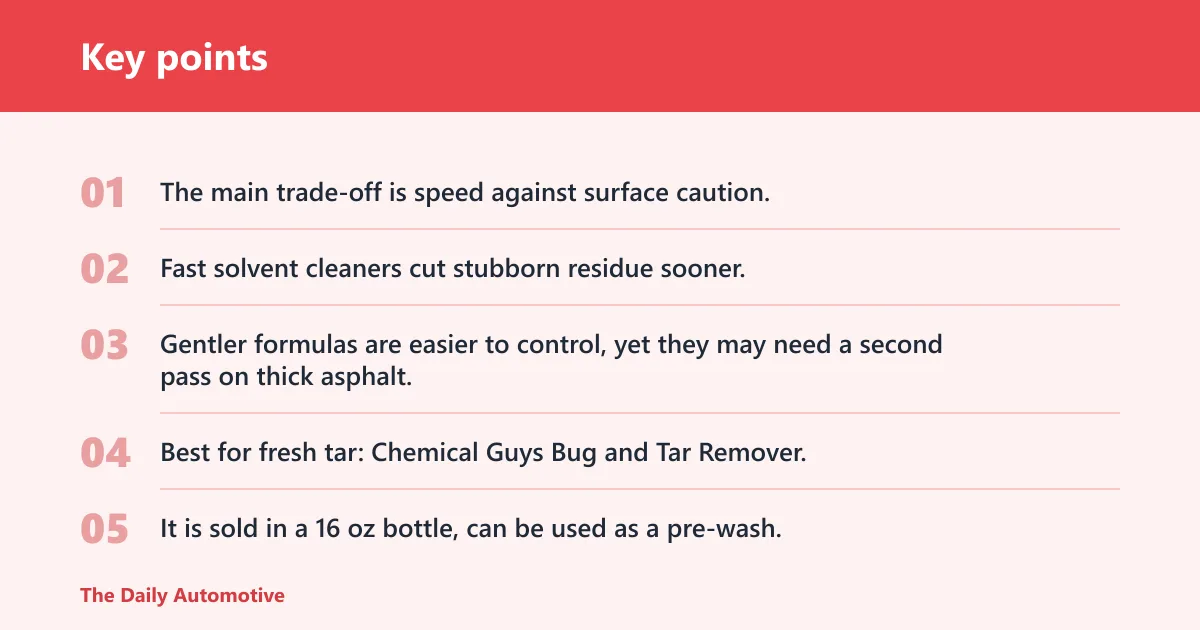


The main trade-off is speed against surface caution. Fast solvent cleaners cut stubborn residue sooner, but they leave less room for error on warm panels, fresh paint, matte finishes, and trim. Gentler formulas are easier to control, yet they may need a second pass on thick asphalt, road tar, or glue.
Best for fresh tar: Chemical Guys Bug and Tar Remover. It is sold in a 16 oz bottle, can be used as a pre-wash, and is listed as foam-cannon compatible. That makes it the most flexible pick for light contamination on paint, glass, chrome, and plastic.
Best for baked-on residue: Stoner Car Care Tarminator. It comes in a 10 oz cleaner format and is the quickest of the three top picks on the page, with a 30 to 60 second working window. That speed suits stubborn lower-panel spots when the panel is cool and the finish is solid clear coat.
Best for adhesive cleanup: Gtechniq W7 Tar and Glue Remover. It is a 500ml professional-grade bottle made for tar and glue removal. When the problem is sticker residue, badge glue, or thick adhesive film, it fits better than a general bug-and-tar spray.
| Pick | What it is best for | Safety notes |
|---|---|---|
| Chemical Guys Bug and Tar Remover | Fresh spots, pre-wash tar, light road film | Safe on paint, glass, chrome, and plastic; foam cannon use is listed |
| Stoner Car Care Tarminator | Baked-on tar and stubborn lower-panel residue | Safe on clear coats; use a short dwell window |
| Gtechniq W7 Tar and Glue Remover | Tar plus glue, sticker residue, hardened adhesive | Professional-grade cleaner; stronger than a general bug remover |
Tar cleaner decision table
This table separates contamination severity from product class. That matters more than brand loyalty. Fresh tar often needs a milder citrus spray, while baked-on asphalt or sticker residue needs a stronger solvent or dedicated adhesive cleaner.
| Contamination type | Safest product class | Max dwell time |
|---|---|---|
| Fresh tar | Citrus bug-and-tar spray | 30 to 60 seconds on a cool panel |
| Baked-on tar | Stronger tar solvent | Up to 2 minutes if the label allows it |
| Tree sap | Tar-and-glue remover or adhesive remover | 30 to 60 seconds before checking |
| Sticker adhesive | Dedicated adhesive cleaner | 30 to 60 seconds, then wipe and inspect |
| Wheel-well buildup | Tar remover only after washing off loose grit | 30 to 60 seconds on a cool, clean surface |
| Coated cars | Coating-compatible tar remover with label approval | Shortest label-approved dwell time |
Do not use if: the panel is hot, in direct sun, or already showing softening clear coat, hazy plastic, swollen trim, or a matte finish that the label does not specifically approve.
What each top pick does best
Chemical guys bug and tar remover
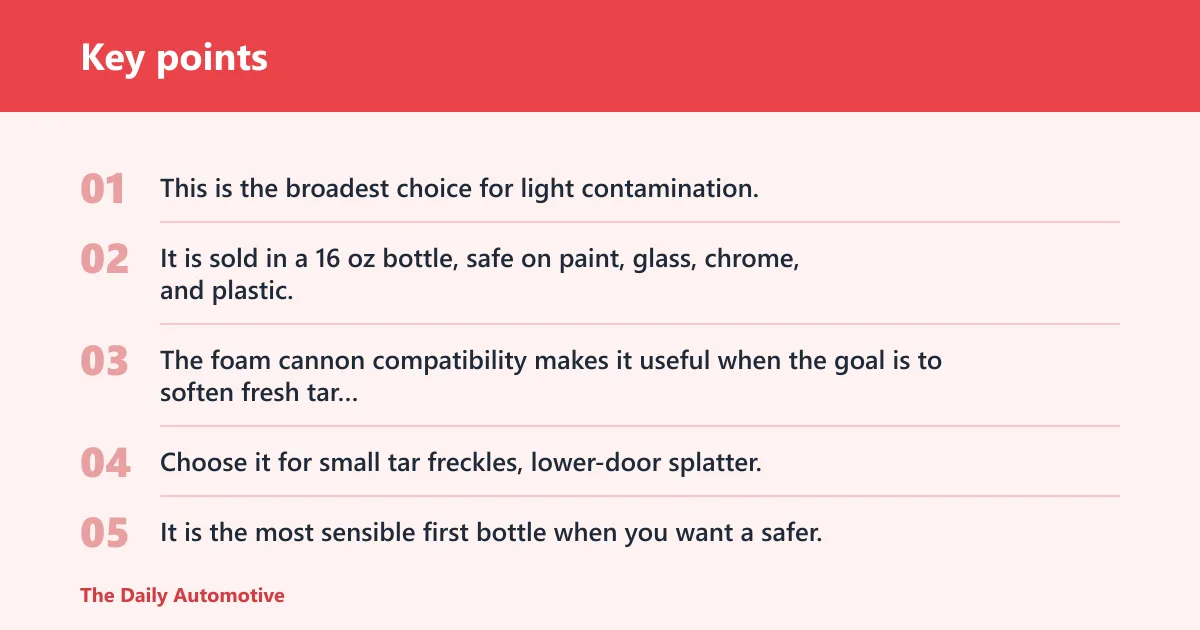
This is the broadest choice for light contamination. It is sold in a 16 oz bottle, safe on paint, glass, chrome, and plastic, and can be used as a pre-wash. The foam cannon compatibility makes it useful when the goal is to soften fresh tar before hand contact, not attack a thick, baked-on patch in one pass.
Choose it for small tar freckles, lower-door splatter, and routine cleanup after highway driving. It is the most sensible first bottle when you want a safer, general tar cleaner that can also do bug residue and light grime without pushing into heavy adhesive territory.
Stoner car care tarminator
Tarminator is the speed pick. Its 10 oz format is compact, and the listed 30 to 60 second dwell time shows how it is meant to work: short contact, wipe, inspect, and repeat only if needed. It is safe on clear coats, which makes it the sharper choice for stubborn asphalt dots on painted lower panels.
Use it when fresh spots have aged into hard, dark deposits. It is the strongest fit for a lower rocker panel cleanup where the contamination is visible and the finish is not delicate. The short working window also reduces the chance of over-soaking adjacent trim.
Gtechniq W7 tar and glue remover
W7 is the specialist of the three. At 500ml, it is aimed at tar and glue removal rather than broad bug cleanup. That matters when the job is old badge adhesive, sticker residue, or a tar-and-adhesive mix that resists a normal bug-and-tar spray.
It belongs in the “need a stronger answer” category, especially when a residue is sticky rather than oily. If the contamination is more glue than tar, this is the right class of product to reach for before you try clay or polishing.
Picture a sedan with black tar specks along the rear doors after a wet commute. A gentle spray may loosen the fresh spots in one pass. Now picture the same car two weeks later, with crusted dots on the rocker and a sticker shadow near the fuel door. That second job calls for a stronger solvent or adhesive cleaner, not the same light-duty bottle.
How safe is tar remover on paint?
Tar remover can be safe on paint and clear coat, but only when the product label supports the surface and the panel stays cool. Fresh cured paint is usually more forgiving than soft, recently refinished paint. Direct sun, high panel temperature, and long dwell time raise the risk of staining, softening, or dulling.
Clear coat and cured paint
Clear coat is the standard target surface for most tar removers. Stoner Tarminator is specifically listed as safe on clear coats, while Chemical Guys Bug and Tar Remover is listed for paint. Even then, the right approach is a small test spot, short contact, and wipe-off before the solvent dries.
Do not assume that “paint safe” means endless dwell time. A cleaner can be safe on cured clear coat and still be too aggressive if left on a hot black hood or a freshly refinished panel.
Plastic, chrome, glass, and trim
Chemical Guys Bug and Tar Remover is listed as safe on paint, glass, chrome, and plastic. Meguiar’s Heavy Duty Bug & Tar Remover is listed as safe on paint, glass, and plastics. Rain-X Pro 3-in-1 Bug & Tar Remover is also described as safe on all vehicle surfaces and as a streak-free water-based formula.
That said, “safe” still depends on the exact trim type. Soft rubber, matte plastic, and old emblems can react differently than glass or chrome. Wipe residue fully and do not let solvent sit at panel edges or in textured trim grain.
Coated cars and matte finishes
Ceramic-coated cars are not all the same. Some tar removers are coating-friendly in short contact, while others are better reserved for spot use only. The safest rule is to follow the label and keep dwell time to the shortest allowed window. Matte finishes deserve extra caution because any polishing or strong solvent residue can leave a visible mark.
A common first-timer mistake is treating a ceramic-coated car like an armored surface. The coating helps with release, but it does not justify longer dwell time or hotter panels. On matte paint, avoid aggressive tar products unless the label specifically approves that finish.
Which formula fits the job?
Spray, gel, foaming, and water-based formulas solve different problems. Spray and aerosol products are usually faster and easier on vertical panels. Gels and clingier formulas stay put longer, which helps on stubborn residue. Water-based formulas are often preferred when streak control matters more than brute force.
Spray versus gel
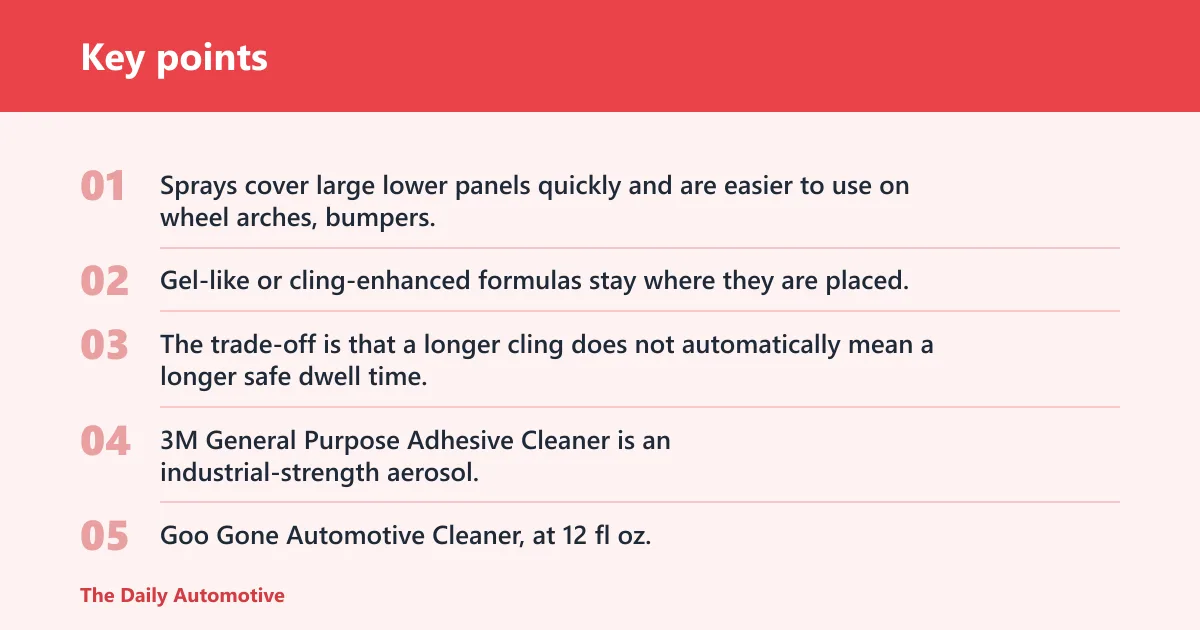
Sprays cover large lower panels quickly and are easier to use on wheel arches, bumpers, and rocker panels. Gel-like or cling-enhanced formulas stay where they are placed, which helps with glue or tar on vertical surfaces. The trade-off is that a longer cling does not automatically mean a longer safe dwell time.
3M General Purpose Adhesive Cleaner is an industrial-strength aerosol, and that suits pre-paint prep and heavy tar use cases where fast evaporation matters. Goo Gone Automotive Cleaner, at 12 fl oz, is the more general automotive adhesive cleaner and is useful when the job is tar plus stickers rather than a full lower-panel solvent wash.
Fast-evaporating versus slow-evaporating
Fast-evaporating cleaners usually fit stubborn spots and prep work, especially where you want the residue lifted and gone before it has time to spread. Slow-evaporating formulas give more working time, but only if the product label supports longer dwell. CarPro Tar X is described as pH neutral and safe on paint, glass, and plastic, with slow evaporation and a citrus scent.
That slower evaporation can help on isolated marks, but it still needs a cool surface. If the panel is hot enough to flash the product, the window gets shorter and the risk goes up.
Foaming, water-based, and solvent formulas
Foaming formulas help visibility and cling. Meguiar’s Heavy Duty Bug & Tar Remover is a foaming formula in a 15 oz size, with cling-enhanced application and safe use on paint, glass, and plastics. That makes it a useful middle ground for visible tar and bug residue on vertical panels.
Water-based formulas tend to feel less harsh to many users and may leave less streaking. Rain-X Pro 3-in-1 Bug & Tar Remover is a 16 oz water-based formula and is described as streak-free. Solvent formulas, including heavier products like Gtechniq W7, are better reserved for the contamination level that actually needs them.
Choose Chemical Guys if… / Choose Stoner if… / Choose Gtechniq if…
Choose Chemical Guys Bug and Tar Remover if you want one bottle for fresh tar, pre-wash use, and light contamination on paint, glass, chrome, and plastic. It also makes sense if you prefer a general-purpose cleaner that can be used before hand-washing and you want the added flexibility of foam cannon use.
Choose Stoner Car Care Tarminator if the tar is already baked on, you want the quickest reaction window, or you are cleaning a narrow lower-panel section and need a compact 10 oz bottle. It is also the better fit when the main concern is clear coat safety and fast spot cleanup.
Choose Gtechniq W7 Tar and Glue Remover if the contamination is adhesive-heavy, the residue is sticky, or you are dealing with tar plus glue from stickers or emblems. The 500ml size suits repeated use, and the product class is better aligned with heavy-duty glue removal than with light bug film.
For small tar spots, use the mildest product class that can move the contamination. For a full lower-panel cleanup, step up to the stronger solvent only after confirming the panel is cool and the finish is compatible. For heavy baked-on residue, expect more than one pass, and stop if the surface starts to haze or smear.
Other tar removers to know
Meguiar’s Heavy Duty Bug & Tar Remover is a 15 oz foaming formula that is safe on paint, glass, and plastics, with a cling-enhanced application that helps it stay put. It is a practical middle choice when you want visible coverage and a cleaner that is not purely a spot-treatment bottle.
Armor All Bug and Tar Remover comes in a 16 oz size and is described as wax-safe, safe on exterior finishes, and designed to preserve wax protection. That matters for drivers who want cleanup without stripping every bit of existing protection from the panel.
Rain-X Pro 3-in-1 Bug & Tar Remover is another 16 oz option. Its water-based formula and streak-free finish make it a reasonable choice for owners who want a lighter-feeling cleaner for exterior surfaces, though it is not the first call for deep, baked-on asphalt.
Goo Gone Automotive Cleaner is listed at 12 fl oz and is aimed at adhesive removal while remaining automotive-surface safe. It works on tar and stickers, which makes it more useful for residue and labels than for heavy road build-up.
CarPro Tar X Tar & Adhesive Remover is a pH neutral formula that is safe on paint, glass, and plastic. Its slow evaporation and citrus scent place it in the controlled-use category for tar and adhesive removal, especially where the user wants more working time than a quick-flash aerosol gives.
3M General Purpose Adhesive Cleaner is the industrial-strength aerosol in this group. It is the best fit for heavy tar use cases and pre-paint prep, where fast evaporation and residue removal matter more than broad surface-polish friendliness.
- Wash off loose grit first so you do not grind dirt into the finish.
- Work on a cool panel out of direct sun.
- Start with the least aggressive class that matches the contamination.
- Keep dwell time short and label-guided.
- Wipe clean, inspect, and repeat only if the surface still needs it.
- Finish by reapplying protection if the product or the job removed wax.
Frequently asked questions
What is the best tar remover for cars?
For most cars, Chemical Guys Bug and Tar Remover is the safest first step for fresh spots, Stoner Car Care Tarminator is the better fit for baked-on residue, and Gtechniq W7 Tar and Glue Remover is the specialist for adhesive-heavy jobs. The best choice depends on the contamination, not just the brand.
Is tar remover safe on car paint and clear coat?
Yes, many tar removers are made for paint and clear coat, but only within the label’s limits. Stoner Tarminator is listed as safe on clear coats, and Chemical Guys Bug and Tar Remover is listed as safe on paint. Always use the shortest dwell time the product allows, especially on hot panels or fresh repairs.
How long should tar remover sit before wiping it off?
Fast-acting products often work in 30 to 60 seconds, and stubborn spots may allow up to two minutes if the label says so. Do not treat that as a universal rule. Temperature, sun, and panel heat can shorten the safe window, so cool surfaces only is the safer standard.
Can tar remover remove tree sap and adhesive too?
Sometimes, yes. Adhesive-focused products and tar-and-glue removers are the better match for tree sap and sticker residue than a basic bug spray. Goo Gone Automotive Cleaner and Gtechniq W7 are more appropriate when the contamination is sticky rather than oily or asphalt-like.
Which tar remover works best on stubborn baked-on tar?
Stoner Car Care Tarminator is the strongest fit from the three top picks for baked-on tar because it is the quickest and is safe on clear coats. For tar plus adhesive or very stubborn residue, Gtechniq W7 or 3M General Purpose Adhesive Cleaner may be the better class of product.
Can I use tar remover on plastic, chrome, and glass?
Often yes, but only with the right product. Chemical Guys Bug and Tar Remover is listed as safe on paint, glass, chrome, and plastic, and Meguiar’s Heavy Duty Bug & Tar Remover is listed as safe on paint, glass, and plastics. Even then, spot test first and avoid lingering on textured trim.
What should I use for a few small tar spots versus a full lower-panel cleanup?
For a few small spots, use the mildest compatible spray and stop as soon as the tar releases. For a full lower-panel cleanup, choose a larger-use bottle and a product that can cover more area without constant reapplication. Chemical Guys is the more flexible small-job pick; Tarminator suits heavier lower-panel work.
Which tar remover is best for budget buyers?
Budget buyers should start with the product that fits the most common job, not the strongest bottle on the shelf. Chemical Guys Bug and Tar Remover is the broad, low-risk choice for light use, while the 10 oz Tarminator makes sense when a smaller bottle is enough for targeted cleanup.
Products related to this article
Sponsored / affiliate links. As an Amazon Associate I earn from qualifying purchases. I may earn additional commission from eligible campaigns.