Best Portable Tire Inflators for Cars (2026): We Compared
For many drivers, the best overall portable air compressor is a 12V plug-in unit that can add roughly 25 to 35 psi quickly, with a digital gauge and an auto shutoff set for your tire size. A weak inflator wastes time on a shoulder stop, and underinflation hurts safety and tire wear. This guide matches compressor type, power source, and tire size to real use cases, then shows which specs matter before you buy.
Quick comparison
| Product | Badge | Best for | Price | ||
|---|---|---|---|---|---|
 |
AstroAI AIRUN H Tire Inflator Portable Air Compressor, 12VAstroAI | Our pick | 12V DC · digital gauge · LED light | $30.39
Price as of 28 Oct 2026
|
View |
 |
CARSUN 20V Cordless Tire Inflator Portable Air Compressor,CARSUN | Also great | 20V cordless · digital gauge · 150 PSI | $49.99
Price as of 28 Oct 2026
|
View |
 |
150 PSI Tire Inflator Portable Air Compressor with Digitalinzeetor | Budget pick | 150 PSI · 12V DC · auto shutoff | $16.98
Price as of 28 Oct 2026
|
View |
 |
ALL-TOP Air Compressor Kit, Dual Cylinder 12V PortableALL-TOP | Upgrade pick | Dual cylinder · 12V portable · 150 PSI | $189.99
Price as of 28 Oct 2026
|
View |
 |
Tire Inflator Portable Air Compressor, 3X Faster InflationMotorenbau | Pair with it | Cordless · digital gauge · 3X faster | $29.99
Price as of 28 Oct 2026
|
View |
If you want the short version, the right choice depends on where the compressor will live and how much air it needs to move. Roadside emergency use points to 12V DC, garage top-offs point to 120V AC, and cordless units trade speed for grab-and-go convenience.
How we chose
This roundup is based on manufacturer specs, listing details, and published buyer feedback. The filters were simple: power source, stated PSI, stated airflow where available, hose length or reach, and whether the unit includes auto shutoff and a readable pressure gauge.
The list also separates tire inflators from heavier true air compressors. That matters because a compact tire pump can be perfect for a sedan but still be a poor fit for repeated truck tire fills or tool use.
| tire size or use case | recommended power source | minimum practical specs | common failure risk |
|---|---|---|---|
| sedan | 12V DC or cordless | Enough PSI to reach the door-jamb placard, digital gauge, auto shutoff, hose that can reach all four tires without moving the unit | Overheating on a long top-off, or a gauge that is hard to read in daylight |
| SUV | 12V DC for roadside use, 120V AC for garage use | Higher PSI headroom and better flow rate than a small compact unit, plus a longer hose | Slow fills if the pump is too small, especially after a pressure drop |
| truck | heavy-duty 12V DC or a true workshop compressor | At least 100 PSI, stronger airflow, long hose, and a duty cycle suited to repeated fills | Weak 12V outlets, long fill times, and heat shutdowns |
| emergency-only storage | small 12V DC or cordless | Compact body, built-in light, auto shutoff, and a gauge you can trust in a dark shoulder stop | Battery fade, short hose reach, or a pump that is too slow for a low tire |
12V tire inflators: best for roadside use
For most drivers, the best portable air pump for car tires is a 12V DC inflator with auto shutoff and a digital gauge. It plugs into the vehicle’s cigarette-lighter outlet, so it is the safest default for roadside stops and low-pressure emergencies when wall power is not available.
AstroAI AIRUN H is the best fit if you want a compact 12V plug-in inflator for routine car-tire emergencies and top-offs. Its listing says it uses a standard 12V car outlet, includes auto shutoff, and comes with adapters for tires, balls, and bikes.
The tradeoff is simple: this is a tire inflator, not a workshop compressor. The 9.8-foot cord helps, but long trucks and some awkward parking angles can still make reach a problem.
inzeetor 150 PSI Tire Inflator is the budget-leaning 12V pick for drivers who want a simple emergency pump with a digital display. The listing calls out 150 PSI, 12V DC power, and auto shutoff, which makes it a practical glovebox or cargo-area choice.
The drawback is that the listing does not suggest heavy-duty use. For larger tires or repeated fills, you should expect slower work and more heat than a stronger dual-cylinder unit.
What to expect from a cigarette-lighter plug
A 12V inflator is only as useful as the vehicle outlet and the wiring behind it. If the outlet is weak, loose, or fused for low draw, the pump may run slowly or shut off early under load. Keep the engine running unless the manual says otherwise.
One more point matters: long extension cords can create voltage drop, which reduces performance. A compact 12V inflator with a short, direct cable is usually the safer bet than a longer setup that arrives with more reach but less real power at the pump.
Common limitations on long fills
Long fills are where small 12V units show their limits. PSI tells you the maximum pressure target, but flow rate determines how quickly the pump moves air, and that is the number that starts to matter as tire volume grows.
A weak gauge also creates trouble. If the display is hard to read, or if it lags and bounces, you can stop too early or overshoot the target pressure.
120V tire inflators: best for garage top-offs
A 120V AC inflator is the better answer for home or garage use when you have a wall outlet nearby. It avoids vehicle battery drain, often fills faster than a small 12V pump, and is easier to use for regular top-offs before a trip.
CARSUN 20V Cordless Tire Inflator is cordless, so it belongs in this section only as a portability option with garage-friendly convenience. Its listing says it has a digital pressure gauge, auto shutoff, LED light, and 150 PSI.
The main drawback is battery dependence. Once charge drops, fill speed and runtime drop with it, so this is less appealing for repeated fills on multiple low tires.
Why wall power changes speed
Wall power gives a compressor a steadier source than a car outlet or battery pack. That usually means less slowdown as pressure climbs and less chance of stalling midway through a fill.
When AC beats 12V
Choose 120V if the compressor will live in a garage or other place with outlets nearby. It is the cleaner choice for seasonal pressure checks, multi-tire top-offs, and anyone who does not want to rely on the vehicle’s outlet.
It is also the better option if your routine includes several cars. One common first-timer mistake is buying a tiny 12V unit for home use, then finding that it gets warm halfway through the second tire.
Cordless inflators: best for portability
Cordless rechargeable inflators are worth it when convenience matters more than fill speed. They are the easiest to carry, the least dependent on a car outlet, and the best fit for apartments, quick roadside top-offs, and people who do not want cables snaking across a driveway.
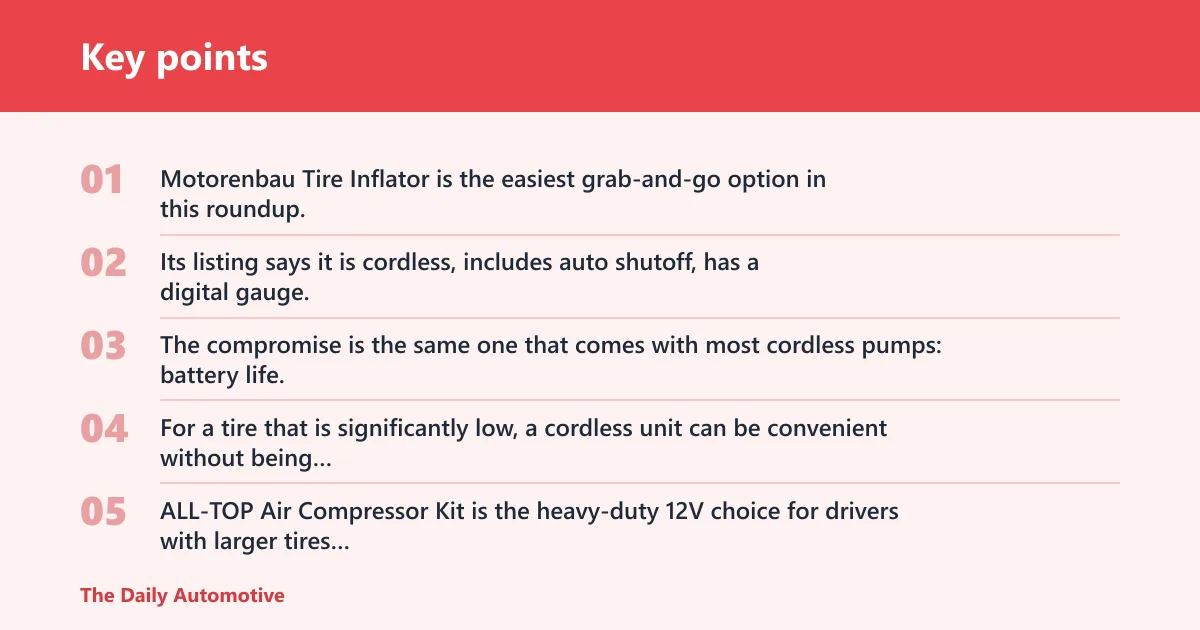
Motorenbau Tire Inflator is the easiest grab-and-go option in this roundup. Its listing says it is cordless, includes auto shutoff, has a digital gauge, and offers preset modes for different items.
The compromise is the same one that comes with most cordless pumps: battery life. For a tire that is significantly low, a cordless unit can be convenient without being the fastest answer.
ALL-TOP Air Compressor Kit is the heavy-duty 12V choice for drivers with larger tires and off-road needs. The listing says it is a dual-cylinder unit with 12.35 ft³/Min airflow, 150 PSI max, and a long hose, which is why it fits truck and RV duty better than a compact inflator.
The drawback is bulk and price. It is not the compact emergency tool most sedan owners want to store under a seat.
Battery tradeoffs versus corded units
Popular Mechanics notes that cordless compressors are available in 18, 36, and 60 volts. More voltage can help, but cordless units still have a battery ceiling, while corded 12V and 120V models can keep running as long as power is available.
If the goal is one pump for occasional roadside use, cordless makes sense. If the goal is repeated fills or larger tires, a corded unit is the safer buy.
Which one should you buy?
For sedan drivers, start with a compact 12V inflator with auto shutoff and a clear digital gauge. The AstroAI and inzeetor models fit that role, with the AstroAI better suited to buyers who want a longer cord and a more familiar emergency setup.
For SUV owners, a stronger 12V unit or a wall-powered garage inflator is the better path. For truck tires, the ALL-TOP unit is the clearest fit in this list because its dual-cylinder design and listed airflow are aimed at larger tires rather than quick sedan top-offs.
For emergency storage, cordless is attractive if you want the least cable clutter and the quickest grab. Say your trunk inflator is meant for a winter shoulder stop in a dark parking lot; a built-in light, auto shutoff, and a readable gauge matter more than fancy extras.
Suppose you keep the pump in an apartment closet and only need it for monthly checks. In that case, a cordless or 120V unit is easier to live with than a 12V-only inflator that depends on the car being nearby.
How to choose
Start with power source. If the compressor will live in the car, buy 12V DC. If it will live in the garage, 120V AC is usually the better fit. If you need no-cord convenience, choose cordless and accept the battery tradeoff.
Then check PSI and flow rate. PSI tells you whether the pump can reach the pressure you need. Flow rate, often listed as CFM or liters per minute, tells you how quickly it can add air. The same source notes compact compressors typically produce between 1.0 and 2.8 cfm, while a heavier-duty 12V unit here lists 35 liter/minute flow rate and 100 PSI pressure.
Use tire size as the deciding factor. A sedan can live with a small compact inflator. SUVs want more reach and more flow. Trucks need the most patience, the longest hose, and the strongest pump in this list.
Do not ignore the gauge. An inline pressure gauge is easier to use than guessing from sound or feel. Built-in gauges are convenient; external gauges can be easier to read and verify if the onboard display is dim or inaccurate.
Watch hose length and noise. A hose that is too short turns a simple top-off into a juggling act. Noise matters too, especially in a garage, apartment lot, or early-morning driveway. Road & Track says it measured noise with a decibel meter in portable compressor testing, which is exactly the kind of spec buyers should check before they buy.
Portable compressor power source matters more than most buyers expect. Electric units cover nearly all tire inflation needs. Gas-powered portable compressors are a different category and are better suited to workshop or field use where mobility and sustained output matter more than quiet operation.
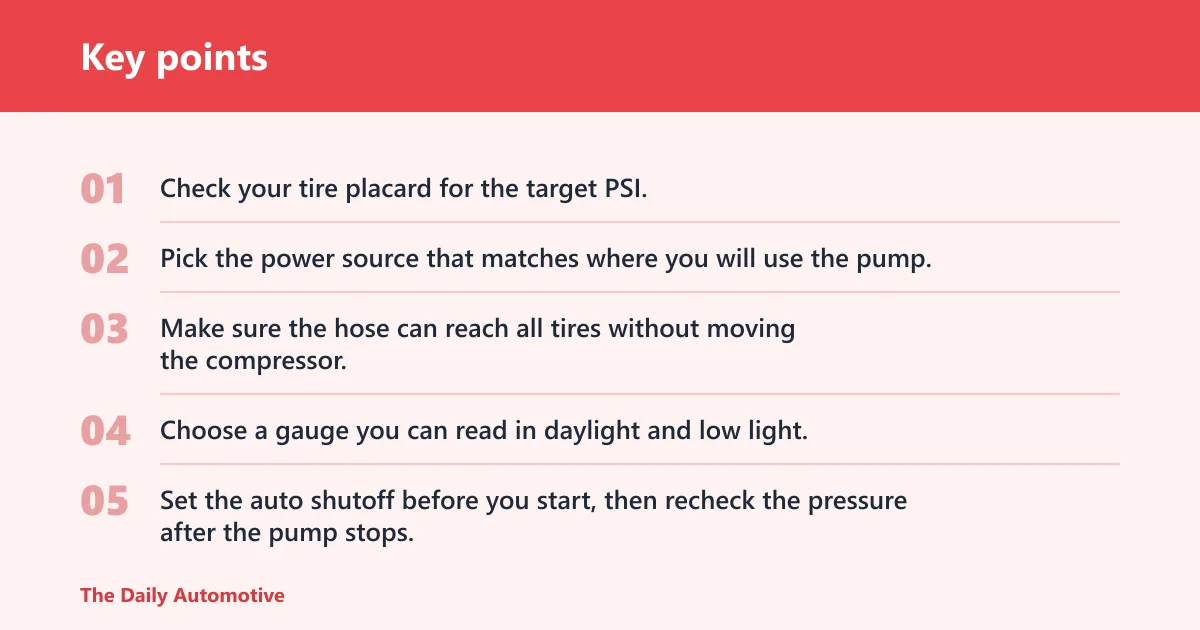
- Check your tire placard for the target PSI.
- Pick the power source that matches where you will use the pump.
- Make sure the hose can reach all tires without moving the compressor.
- Choose a gauge you can read in daylight and low light.
- Set the auto shutoff before you start, then recheck the pressure after the pump stops.
How do you use a portable air compressor for tires?
Attach the hose to the tire valve, set the target pressure if the unit has auto shutoff, and start the compressor with the vehicle manual in mind. Keep an eye on the gauge, stop at the recommended PSI on the door placard, and recheck the pressure after a short pause if the reading seems unstable.
Follow the vehicle and product manual. Never work under a vehicle supported only by a jack; use jack stands on level ground if any wheel service is involved. For tire inflation alone, keep the hose clear, the valve connection tight, and the compressor on stable ground.
A common first-timer mistake is inflating a warm tire to the same number expected after the car has sat overnight. Tire pressure changes with temperature, so the placard number still matters, but the reading may shift after a drive or on a hot day.
How fast should a portable tire inflator fill a car tire?
For a typical car tire, a good portable inflator should add air quickly enough that a roadside top-off does not turn into a long wait. As a practical target, the best units can add 25 to 35 psi quickly, while compact models still need to be judged on how long they take to reach the final pressure.
PSI sets the pressure target, but flow rate determines how quickly air moves. A pump with high maximum pressure can still feel slow if its airflow is weak. That is why flow rate matters more on larger tires and why truck owners should not shop on PSI alone.
Road & Track says it tested portable air compressors for automotive applications and measured the time taken and maximum psi achieved. That is the right pair of numbers to compare when you want a real speed picture.
What PSI should I look for in a car tire compressor?
Look for a compressor with enough maximum PSI to exceed your tire’s target pressure comfortably. For passenger cars, many portable units land in the 100 PSI to 150 PSI range, and that is usually enough headroom for standard tire work. The more useful number is whether the compressor can hold a steady fill rate while it reaches that target.
The useful number is not the biggest number on the box. It is the pressure the compressor can reach while still moving air at a sensible rate. For compact tire inflators, that means checking PSI alongside flow rate and duty cycle.
One compact mini compressor is rated at 250 PSI pressure, while a heavy-duty 12V compressor lists 100 PSI pressure rating and 35 liter/minute flow rate. Those two numbers point to very different jobs.
Are cordless tire inflators worth it for roadside use?
Cordless tire inflators are worth it for roadside use when you want the fastest setup and the least cable hassle. They are especially useful for drivers who do not want to depend on a cigarette-lighter plug or who keep the compressor outside the vehicle most of the time.
The tradeoff is runtime and fill strength. The same source notes cordless compressors are available in 18, 36, and 60 volts, but battery size still limits how long the unit can run. For a slow leak or a light top-off, cordless is convenient. For a very low tire, a 12V corded unit is usually safer.
What size portable air compressor do I need for SUV or truck tires?
For SUV tires, choose a compressor with stronger airflow than the smallest compact pumps and a hose long enough to reach around the vehicle. For truck tires, move up to a heavy-duty 12V unit or a true workshop compressor, because larger tire volume needs more air delivery than a tiny emergency inflator can provide comfortably.
The ALL-TOP listing is a clear example of the truck-side of the market: dual cylinders, 12.35 ft³/Min airflow, 150 PSI, and a long hose. That is the kind of setup that makes sense for larger tires and off-road use, not just sedan top-offs.
Frequently asked questions
What is the best portable air compressor for car tires?
For most drivers, the best portable air compressor for car tires is a 12V plug-in inflator with auto shutoff and a digital gauge. That setup gives you the right balance of speed, portability, and roadside usefulness. If you inflate mostly at home, a 120V model is the better daily tool.
What is the best portable air pump for car tires?
The best portable air pump for car tires is the one that matches your power source and tire size. Small sedans can use a compact 12V or cordless pump. SUVs and trucks need more airflow, a longer hose, and enough pressure headroom to finish the job without overheating.
Should I buy a 12V or 120V portable tire inflator?
Buy 12V if you want roadside readiness and car-based power. Buy 120V if the pump will stay in a garage or other place with a wall outlet nearby. A 120V unit often fills faster, while a 12V unit is the better emergency tool.
Products related to this article
Sponsored / affiliate links. As an Amazon Associate I earn from qualifying purchases. I may earn additional commission from eligible campaigns.