
Banks That Give Loans For Branded Title Cars Near You
Many large banks do not finance branded-title cars; nearby options are often credit unions and community banks. Applying without checking policy can waste time, trigger hard pulls, and lead to denials or overpriced loans. Start by checking local credit unions, community banks, and specialty lenders, then compare title rules and fit the lender to your credit, title history, and down payment.
What lenders may finance a branded title car?
Branded-title financing is narrower than standard auto lending. Credit unions, some community banks, specialty lenders, and a few online auto lenders may review these files, but the title brand, vehicle age, mileage, and your credit profile all matter. Major banks often decline these loans or limit them sharply.
Branded titles lenders treat more cautiously
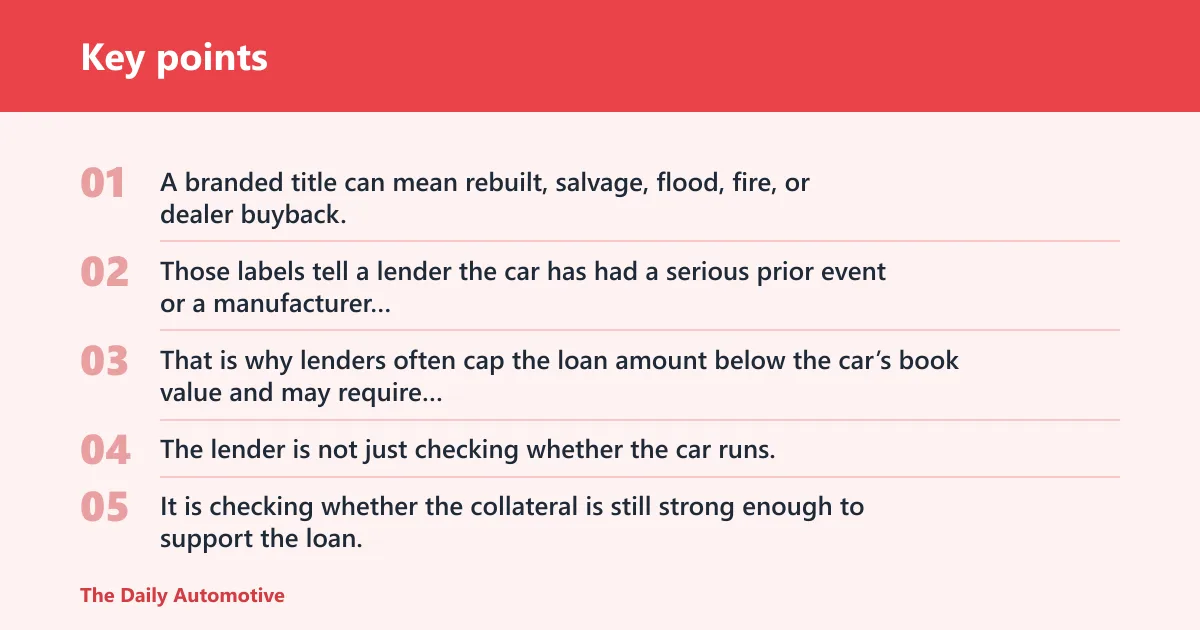
A branded title can mean rebuilt, salvage, flood, fire, or dealer buyback. Those labels tell a lender the car has had a serious prior event or a manufacturer buyback history, which usually lowers collateral value and raises the chance of hidden damage or weak resale value.
That is why lenders often cap the loan amount below the car’s book value and may require a higher down payment. The lender is not just checking whether the car runs. It is checking whether the collateral is still strong enough to support the loan.
Credit unions and community banks
Credit unions are often the best nearby place to start. Some credit unions will finance rebuilt title cars, and credit unions frequently beat traditional banks on interest rates. Community banks can also be flexible when the vehicle is older but still well documented and locally inspected.
These lenders may be more willing to look at the full file, including your membership, payment history, and debt load. A borrower with stable income and a modest loan request has a better chance than someone asking for a large percentage of a high-risk car’s value.
Specialty lenders and online auto lenders
Specialty lenders focus on non-standard collateral, so they may be open to branded-title vehicles that a mainstream bank would not touch. Many ask for an independent fair market value appraisal before they approve the loan, especially on older cars or those with unclear repair history.
Some online auto lenders also review branded-title cases. Consumer Reports notes that the best car-loan options do not always come from a bank, and that banks, credit unions, online lenders, and captive finance are major auto-finance sources. That makes comparison essential. (Consumerreports)
Why major banks often say no
Major banks often have stricter underwriting than credit unions.
Even when a bank will review the application, it may impose age, mileage, and down-payment limits that rule out a large share of branded-title inventory.
Branded title lender fit matrix
This matrix helps you match the title type, credit band, vehicle profile, and down payment to the lender type most likely to review the file. It is a screening tool, not a promise of approval. The lower the title confidence, the more likely the lender is to trim the loan amount or pass on the deal. The closer the car is to clean-title value, and the cleaner your credit file, the better your odds.
| Title type | Estimated credit band | Vehicle age and mileage | Down payment range | Most likely lender type | Appraisal or inspection trigger |
|---|---|---|---|---|---|
| Rebuilt | Good to excellent | Under 7 years old; under 75,000 miles | 10% to 20% | Credit union, community bank, some banks with branded-title policy | Independent fair market value appraisal often requested; inspection likely |
| Rebuilt | Fair | 7 to 10 years old; 75,000 to 120,000 miles | 15% to 20% | Credit union, specialty lender | Appraisal likely; lender may cap loan-to-value near 60% to 70% |
| Salvage | Good to excellent | Under 6 years old; low mileage with repair records | 20% or more | Specialty lender, select credit union | Appraisal very likely; extra inspection common |
| Flood | Excellent only, if reviewed at all | Usually lower mileage and recent repairs, but lender skepticism remains high | 20% or more | Specialty lender only in many cases | Appraisal and inspection expected; many lenders decline outright |
| Fire | Good to excellent | Older cars face higher decline risk | 15% to 25% | Specialty lender, community bank on a case-by-case basis | Appraisal likely; documentation of repairs matters |
Rebuilt title fit by credit band
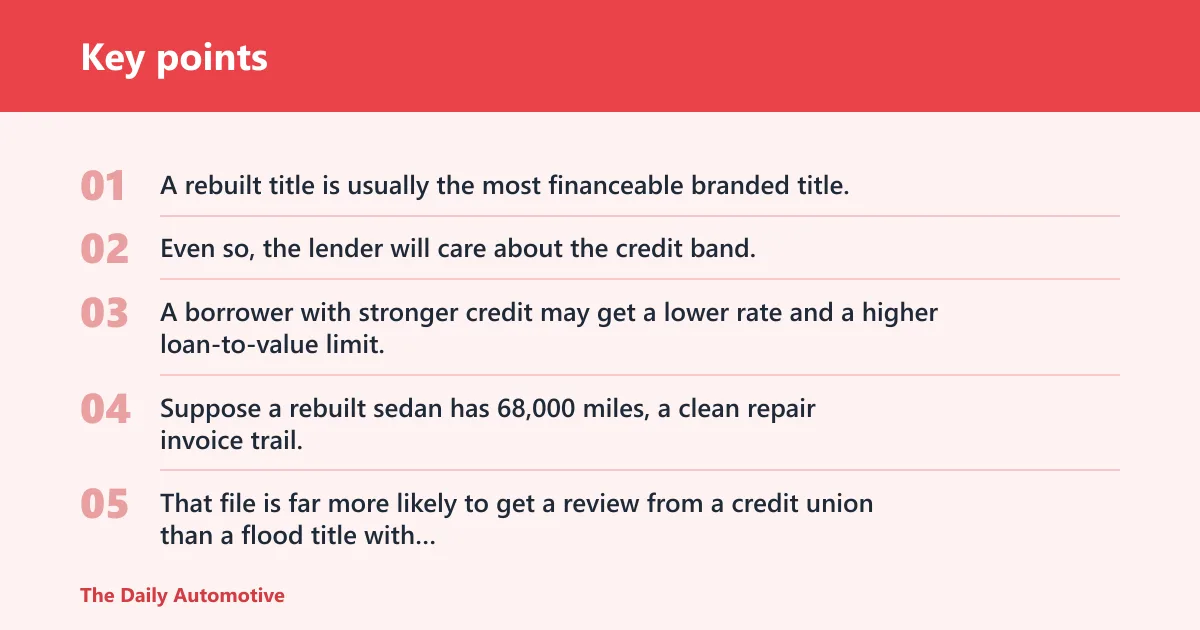
A rebuilt title is usually the most financeable branded title, because the car has been repaired and inspected. Even so, the lender will care about the credit band. A borrower with stronger credit may get a lower rate and a higher loan-to-value limit.
Suppose a rebuilt sedan has 68,000 miles, a clean repair invoice trail, and a borrower with solid credit asks for a 15% down payment. That file is far more likely to get a review from a credit union than a flood title with the same mileage and cash down.
Salvage, flood, and fire title risk
Salvage, flood, and fire titles usually sit in separate risk buckets. Flood title cars are often the hardest to finance because water damage can hide electrical and corrosion problems. Fire damage can also be hard to price because repairs may not fully restore structural or wiring integrity.
Salvage titles can be financeable if the car has clear repairs and a favorable appraisal, but lenders still see them as riskier than rebuilt titles. The lower the title confidence, the more likely the lender is to shrink the loan amount or decline the file.
Age, mileage, and down payment ranges
Rebuilt-title vehicles may face age, mileage, and down payment limits that vary by lender and can change over time.
Those examples show how age and mileage can stop a deal before rate shopping even starts. A car with 130,000 miles may be fine as transportation, yet still miss the lender’s collateral screen. A larger down payment can help, but it cannot fix a vehicle that falls outside policy.
Approval flags and appraisal triggers
Lenders look for repair records, title history, mileage consistency, and a valuation that supports the loan amount. If the appraisal comes back low, the lender may approve a smaller loan than you requested or ask for more cash down. If the value is too weak, the deal can fail.
Can major banks finance rebuilt title cars?
Sometimes, but not often, and not on loose terms. Some banks will review rebuilt-title vehicles, yet others will not. Major banks are more likely than credit unions to apply tight age, mileage, and loan-to-value rules, and some will decline branded-title collateral entirely.
When a bank may still review the deal
A bank is more likely to review the file when the car is late-model, the mileage is moderate, the repair history is well documented, and the borrower has strong income and credit. Relationship discounts may apply at some banks, but those discounts do not override collateral rules.
Why loan-to-value caps matter
Loan-to-value limits matter because the lender wants room between the loan balance and the car’s resale value. Branded-title cars often sell for less than clean-title cars, so a bank may only lend against a fraction of the appraised value. That can force a larger down payment.
What makes a file easier to approve
Cleaner credit, lower debt, steady income, and a well-documented rebuilt title all help. A car that sits within the lender’s age and mileage limits helps too. The closer the appraisal is to the asking price, the less risk the lender takes on.
How do appraisals and inspections affect approval?
Many financing companies request an independent Fair Market Value appraisal before approving a rebuilt-title loan. That step helps the lender confirm what the car is worth today, not before the damage. An inspection may also be required, especially for older branded-title cars.
When an independent appraisal is required
An appraisal is most likely when the car is older, has a branded history, or sits near a lender’s limit for age or mileage. The appraisal can confirm whether the car’s value supports the requested loan amount. If not, the lender may cut the approval amount or deny the loan.
Picture a 9-year-old rebuilt crossover with 92,000 miles and a strong repair file. If the appraisal comes in well below the asking price, the buyer may still get approved, but only for the lower appraised amount. That changes the down payment and can change the whole deal.
How value changes the loan amount
Lower appraised value usually means lower financing. If the lender will only advance 65% of appraised value, the borrower must cover the rest in cash. This is where branded-title buyers get surprised: the selling price and the lender’s number are often not the same.
Why age and mileage can stop the deal
Age and mileage can break a deal even when the repair story looks strong. Some lenders use age and mileage limits for rebuilt-title vehicles. If the car misses those thresholds, the lender may not move to appraisal at all.
What should you bring before preapproval?
Bring documents that let the lender verify the car, the repairs, your identity, and your ability to pay. Preapproval is useful because it shows your likely borrowing limit before you negotiate with a dealer, which lowers markup risk and helps you avoid cars that will not fit the file.
Title history and vehicle records
Bring the title brand, VIN, repair invoices, salvage-rebuild paperwork if applicable, registration history, and any inspection reports. Lenders need to see how the car moved from damage status to roadworthy status. Clean paperwork can matter as much as the car’s current appearance.
Income, identity, and residence proof
Gather recent pay stubs, W-2s or tax returns if requested, a government ID, and proof of address such as a utility bill or lease. A lender wants to see that the borrower’s income is stable enough to support the payment, insurance, and maintenance costs tied to a riskier car.
Insurance and payoff details
If you are refinancing or trading in a vehicle, bring the current payoff amount. If the new car needs specific coverage, ask the insurer what they will write for a branded-title vehicle before you apply. Some lenders will not finish approval without proof of insurability.
- Check the title brand and confirm whether it is rebuilt, salvage, flood, fire, or dealer buyback.
- Match the car’s age and mileage to lender rules before you apply.
- Collect repair records, title paperwork, and inspection results.
- Gather income, identity, and residence documents.
- Ask whether an appraisal is required and who orders it.
- Request preapproval from a credit union, community bank, or specialty lender.
How do you find nearby lenders that may consider it?
Start by filtering local credit unions, community banks, and specialty lenders by title type before you apply. Do not assume a nearby branch will handle branded collateral just because it offers auto loans. Ask directly whether they review rebuilt, salvage, flood, or fire titles.
Filter by title type before applying
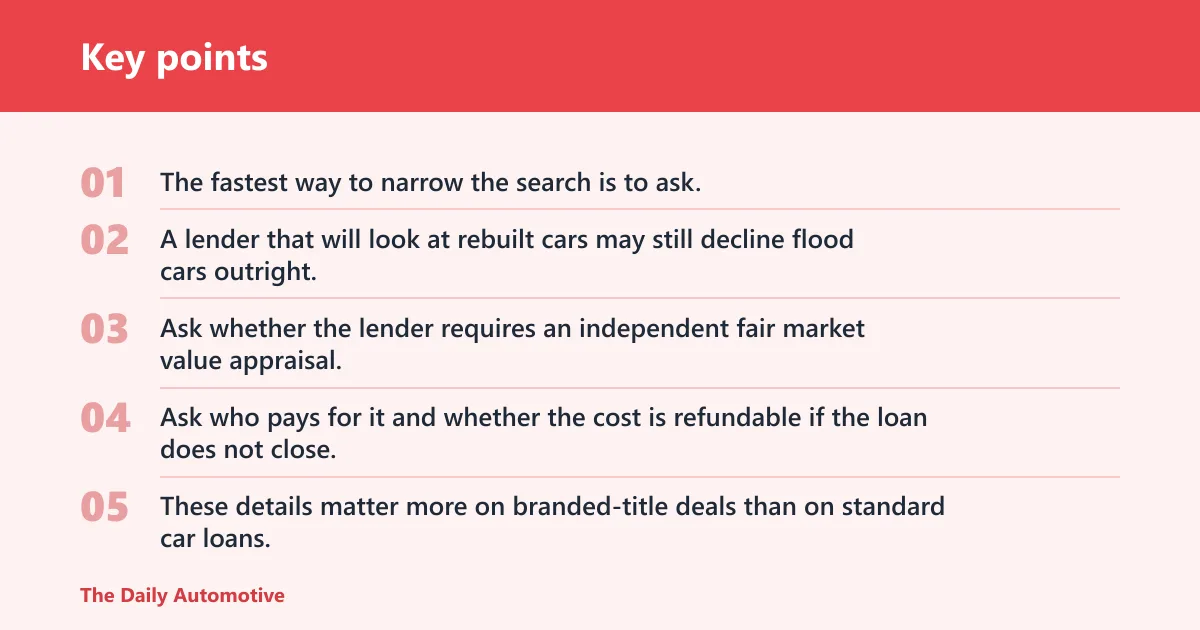
The fastest way to narrow the search is to ask, “Do you finance rebuilt titles?” and then ask the same question for salvage, flood, and fire titles if needed. A lender that will look at rebuilt cars may still decline flood cars outright. Separate the buckets.
Ask about inspection and appraisal rules
Ask whether the lender requires an independent fair market value appraisal, a physical inspection, or both. Ask who pays for it and whether the cost is refundable if the loan does not close. These details matter more on branded-title deals than on standard car loans.
Compare rates, fees, and down payment terms
The same source says credit unions frequently beat traditional banks on interest rates, but rates alone do not settle the issue. Compare the total cost: rate, term, fees, required down payment, and any loan-to-value limit. A lower rate can still lose if the lender only finances a small share of appraised value.
Use preapproval before dealer negotiation
Preapproval helps you see your ceiling before you start negotiating. It can keep you from agreeing to a car that the lender will not fund. It also gives you a baseline to compare dealer financing against, which matters because dealer markup can be harder to spot on a branded-title vehicle.
A common first-timer mistake is picking a car first and the lender second. Say your budget allows a $14,000 purchase, but the lender’s appraisal only supports $10,500. If you do not know that before shopping, you may lose the deal or have to cover the gap with more cash than planned.
Frequently asked questions
What banks give loans for branded title cars near me?
Nearby options usually start with credit unions and community banks, then move to specialty lenders and selected banks with branded-title policies.
Can I get a loan on a rebuilt title car?
Yes, but the file must usually be stronger than a standard auto-loan application. Rebuilt-title cars are more likely to qualify than salvage, flood, or fire titles, especially when the vehicle is newer, the mileage is moderate, and the borrower can make a sizable down payment and show solid credit.
Which banks finance salvage or rebuilt title cars?
Some banks do, but not all. Credit unions and specialty lenders are often more flexible on salvage and rebuilt collateral than large national banks.
Do credit unions finance branded title vehicles?
Yes. Many credit unions will finance salvage or rebuilt title cars, and they are often more flexible than traditional banks. They may still require a strong application, proof of repairs, and a down payment. Membership rules vary, so you need to confirm eligibility before you count on the loan.
What down payment do lenders require for a rebuilt title car?
There is no universal number, but 10% to 20% is common in the examples above. A larger down payment can help offset the lender’s risk and may improve approval odds when the vehicle’s value is weaker.
Will a branded title car need an appraisal for financing?
Often yes. Many financing companies request an independent Fair Market Value appraisal before approving a rebuilt-title loan, and inspections are common too. The appraisal can lower the approved loan amount if the car’s value comes in below the sale price or the lender’s risk threshold.
Products related to this article
Sponsored / affiliate links. As an Amazon Associate I earn from qualifying purchases. I may earn additional commission from eligible campaigns.
 Huidasource Seat Covers Full Set, Universal Fit for Cars SUVs Trucks, Gray
 Touch Up Paint for Cars, 3-Pack - White Car Scratch Repair Pen, Color Accurate Automotive Touch Up Paint, Long-Lasting Scratch Resistance, Fast-Drying & User-Friendly, Safe & Water-Resistant for Automotive & Household Touch-Ups