Is It Better to Negotiate Monthly Payment or Total Price?
Negotiate the out-the-door price first, then use the monthly payment only as a budget check. Otherwise, a dealer can tuck a higher rate, longer term, or add-ons into a payment that looks fine. That mistake can cost you hundreds or thousands over the loan. This guide shows the two-step method and the traps to avoid.
Should you negotiate price or payment?

Negotiate the out-the-door price first. Put the monthly payment in a second pass, after the car’s full purchase cost is fixed. That order matters because the payment can change with the loan term and interest rate, while the out-the-door price tells you what the car actually costs to buy.
The out-the-door price includes taxes, registration fees, documentation fees, and dealer add-ons, and it is the amount you would pay to drive the car home if you were paying cash. It does not include financing unless the dealer rolls financing charges into the sale in some separate way. That is why the total deal should be treated as one whole number, then split into price, trade-in, and financing.
The monthly payment is a budget figure to check after the out-the-door price is fixed. It helps, but it is not the best starting point because dealers can lower it by extending the loan term or changing the rate. A payment that fits your budget can still cost more over the life of the loan.
Price vs. payment decision table
| Negotiation path | What the buyer controls | What can be hidden | Ask for next | Red-flag outcome |
|---|---|---|---|---|
| Price-first | Out-the-door price, including fees and required add-ons | Little, if you keep financing out of the first round | Buyer’s order that matches the agreed out-the-door price | Dealer stretches the term or marks up APR after the price is set |
| Payment-first | Monthly payment only | Higher total price, longer term, APR markup, add-ons | Exact out-the-door price and exact loan term | A low payment hides a bigger total because the loan runs longer |
| Price-plus-payment check | Out-the-door price first, then payment ceiling from your budget | Less, if you verify the rate and term separately | APR, term, and total of payments | Payment fits only because the dealer pushes the term too far |
| Blended deal | One monthly number with price, trade-in, and financing mixed together | Trade-in value, rate markup, dealer add-ons, and the real car price | A split worksheet for price, trade-in, and financing | The worksheet looks affordable, but the buyer pays more in total |
Say the out-the-door price is $30,000 and the loan rate is 7% for 60 months; the payment works out to about $594 a month. On a $30,000 loan at 7% for 60 months, the payment is about $594 a month, and the total paid is about $35,642. Stretching the same deal to 72 months can lower the payment to about $511 and raise the total paid to about $36,835. Lower payment. Higher cost.
A common first-timer mistake is to say, “I need a payment under $500,” before the price is set. The dealer can make that work by changing the term, the rate, or the package of add-ons. The number looks better. The deal does not.
Why do dealers push the monthly payment?
Dealers push the monthly payment because it is easy to shape. A longer loan term lowers the payment, and a small rate markup can still leave the payment looking acceptable. That makes the bill feel manageable while the total cost rises.
This is why a dealer quote can differ from out-the-door price by a thousand dollars or more. The buyer may focus on the monthly number and miss the real purchase price, the fees, or the loan terms that make the payment possible. The payment is a result, not the deal itself.
Interest rate matters too. If you bring a pre-approval from a credit union or bank before visiting a dealership, you have a rate floor to compare against. The rate from your pre-approval is the floor the dealer’s financing has to beat. Dealers can add a margin on top of the lender-approved rate, so you should know the exact loan term and interest rate before signing.
How term and rate change the bill
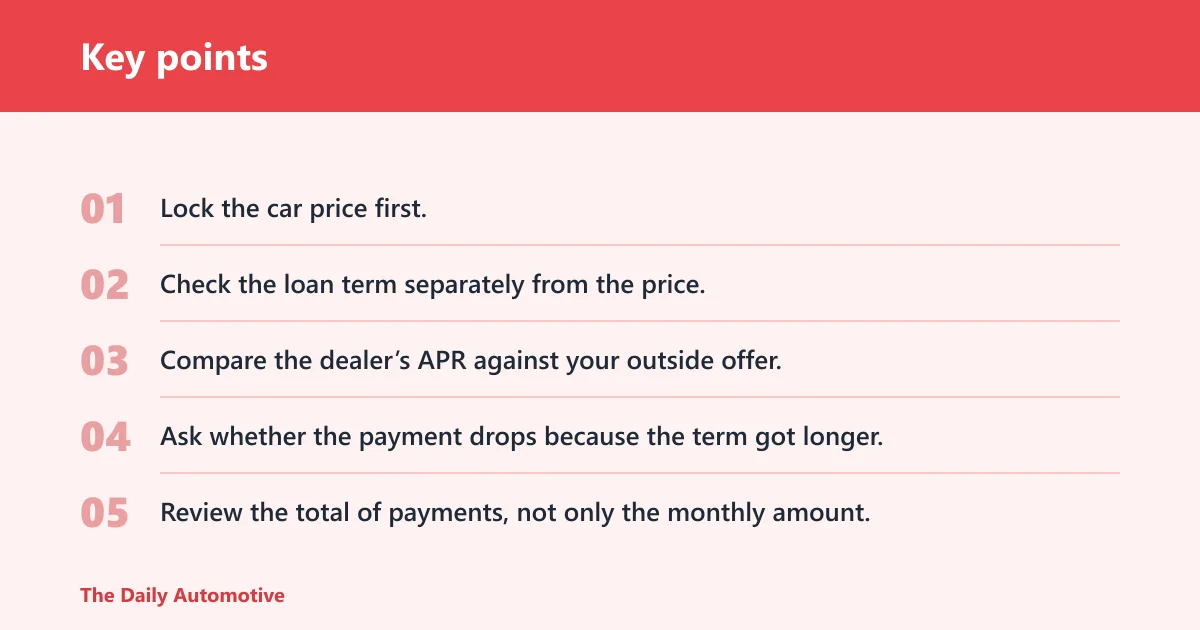
- Lock the car price first.
- Check the loan term separately from the price.
- Compare the dealer’s APR against your outside offer.
- Ask whether the payment drops because the term got longer.
- Review the total of payments, not only the monthly amount.
Suppose the payment looks attractive because the dealer moves from 60 months to 84 months. The monthly number drops, but the longer loan term quietly costs more in interest. That is why the payment should be a check after the price is fixed, not the number that sets the whole negotiation.
What should you lock in before financing?
Lock in the out-the-door price, then confirm the trade-in, then compare financing. Get pre-approved before shopping so you have a benchmark. Bring a pre-approval from a bank, credit union, or online lender, and use it to see whether dealer financing is actually better.
The guide recommends settling the price, then the trade-in, then financing as three separate deals. If you blend them together too early, the dealer can move numbers around and make a worse deal look better. The car, the fees, the products, and the interest should be treated as one whole-deal total, then checked line by line.
That means you should ask for the buyer’s order before signing. It should generally match the agreed out-the-door price. If the sheet shows a different total, or if you spot a fee or product that was not discussed, stop and question it before anything is final.
What to verify before signing
- The exact out-the-door price
- The exact loan term
- The exact interest rate
- Whether any dealer add-ons are required
- Whether the buyer’s order matches the agreed total
A lower-rate offer from the dealer can help, but only if it is real and written clearly. Compare it against your outside financing offer. If the dealer cannot beat your pre-approval, you already have the benchmark you need.
How do trade-ins and add-ons change the deal?
Trade-in value should be negotiated separately from vehicle price and financing. If the trade-in is folded into the same conversation too soon, it becomes harder to tell whether the dealer improved the car price or simply padded the trade number while moving the rest of the deal in the other direction.
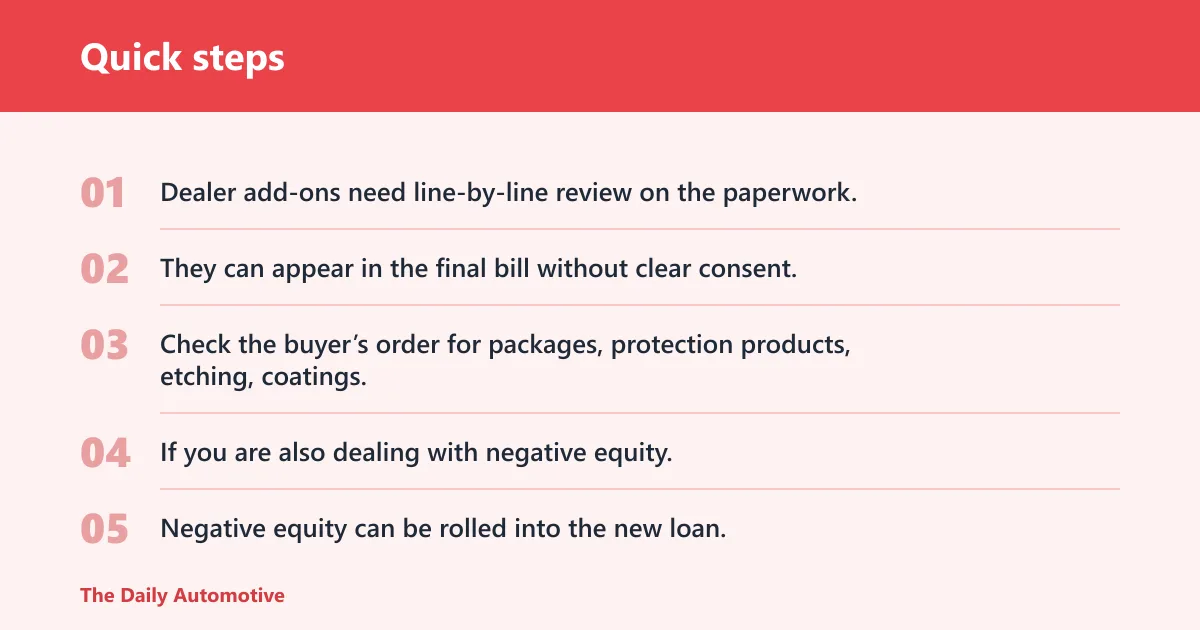
Dealer add-ons need line-by-line review on the paperwork. They can appear in the final bill without clear consent, and they can raise the out-the-door amount fast. Check the buyer’s order for packages, protection products, etching, coatings, or anything else that was not part of the agreed price.
If you are also dealing with negative equity, the payment discussion matters more after the price is fixed. Negative equity can be rolled into the new loan, which makes the payment easier to hide and the total cost harder to see. Keep the vehicle price, trade-in value, and payoff balance separate on the page.
Trade-in and paperwork red flags
| Item | What to check | Why it matters |
|---|---|---|
| Trade-in | Separate offer, separate line on the buyer’s order | Prevents the dealer from hiding a weaker car price inside a better-looking trade number |
| Add-ons | Each item listed line by line | Stops required or unwanted products from inflating the out-the-door total |
| Buyer’s order | Matches the agreed out-the-door price | Reveals hidden fees before you sign |
| Financing | Exact APR and term | Shows whether the payment is low because the loan got longer |
Keep items out of airbag zones and the driver’s view, and check local laws. If the deal involves equipment, accessories, or anything installed on the vehicle, follow the vehicle or product manual; never work under a vehicle held only by a jack.
How do you know if the payment is too high?
A payment is too high if it strains your monthly budget even after the out-the-door price is fixed, the term is clear, and the rate matches or improves on your outside offer. If the only way to reach the payment target is to stretch the loan term too far, the deal needs another look.
Use the payment as a budget check, not as the headline number. Once the price is locked, ask whether the monthly amount still leaves room for insurance, fuel, maintenance, and the rest of your household bills. If the dealer needs to extend the term again to make the number work, the total cost is climbing.
The payment conversation can still help in a strict-budget case. If you have a hard monthly ceiling, state it after you have the out-the-door price. That way the dealer can quote a payment against a real deal instead of using the payment to steer the whole negotiation.
How to negotiate with a car dealer without getting tricked by financing? Keep the price, trade-in, and financing separate; demand the buyer’s order; verify the APR against your pre-approval; and do not accept a payment until the exact loan term is written out. If the dealer extends the term or marks up the rate, the monthly number can look fine while the total moves in the wrong direction.
Frequently asked questions
Is it better to negotiate monthly payment or total price on a car?
Negotiate the total price first. The monthly payment should come later as a budget check. A payment can be lowered by stretching the term or changing the rate, so it can hide a higher total cost even when it looks affordable.
Why do dealers focus on monthly payment instead of total price?
Monthly payment is easier to manipulate. A dealer can stretch the loan term or adjust the interest rate to reach a payment that feels comfortable. That can distract from a higher out-the-door price, added fees, or a more expensive loan overall.
Should I negotiate the out-the-door price before discussing financing?
Yes. Set the out-the-door price first, then talk about financing. That keeps taxes, registration fees, documentation fees, and required dealer add-ons in view before the loan terms enter the conversation. After that, compare the dealer’s rate with your pre-approval.
How do I know if a car payment is too high?
A payment is too high if it forces you to stretch the loan term beyond what makes sense for your budget and the car’s total cost. Check the exact term, the APR, and the total of payments before you decide that the monthly number is acceptable.
What is the difference between out-the-door price and monthly payment?
The out-the-door price is the full amount needed to buy the car and drive it home if paying cash, including taxes, registration fees, documentation fees, and dealer add-ons. The monthly payment is only the installment you pay over time after financing is added.
Can a lower monthly payment hide a higher car price?
Yes. A lower payment can come from a longer loan term or a changed interest rate, and both can make the total deal more expensive. That is why the payment should be checked only after the out-the-door price is locked.
How do I negotiate with a car dealer without getting tricked by financing?
Start with the out-the-door price, then separate the trade-in, then compare financing against your outside pre-approval. Read the buyer’s order line by line, and ask for the exact term and APR before signing. If the payment drops only because the term grows, walk back to the total.
Products related to this article
Sponsored / affiliate links. As an Amazon Associate I earn from qualifying purchases. I may earn additional commission from eligible campaigns.