What Is a Certified Pre-Owned Car and Is It Worth the Extra Cost?
A certified pre-owned car is worth the extra cost only when the price premium is smaller than the warranty coverage and inspection value being bought, usually about 5% to 10% over a similar used car. Skip that comparison and you can pay too much for protection you may never use. This guide explains what CPO means, what the warranty usually covers, and how to judge the premium against repair risk and deductible costs.
Manufacturer vs. dealer programs and inspection basics
A certified pre-owned car is a used vehicle that meets a brand’s or dealer’s certification rules and is sold with added inspection, reconditioning, and some form of warranty coverage. The details vary a lot. Manufacturer-backed programs are usually tighter, while dealer-backed programs can be broader but less consistent.
Manufacturer-backed vs. dealer-backed certification
Manufacturer-backed CPO programs usually limit age and mileage, require a long checklist, and include factory-backed warranty coverage. Dealer-backed programs can certify more vehicles, but the inspection standard, warranty length, and deductible rules depend on that dealer or dealer group. That difference matters more than the badge on the windshield.
Eligibility rules and model limits
Most CPO programs restrict vehicles by age, mileage, trim, accident history, and sometimes prior use as a rental or fleet vehicle. Some brands allow only late-model units with relatively low miles. Others set a looser ceiling. If a car misses the rules, it is simply a used car, even if a dealer says it is “almost certified.”
Inspection, reconditioning, and warranty basics
CPO pricing usually bundles three things: an inspection checklist, reconditioning work, and warranty coverage. The inspection may cover dozens or even more than 100 points, depending on the program. Reconditioning can include brakes, tires, fluids, filters, batteries, and repairs needed to meet cosmetic and mechanical standards.
What’s the difference between certified pre-owned and used?
A certified pre-owned car is still a used car, but it has passed a certification process and usually comes with a warranty and documented reconditioning. A non-certified used car usually costs less, may have more wear, and may come with limited or no warranty. Certification cuts some risk, but it does not remove it.
Price, condition, and history differences
The biggest visible difference is price. A CPO listing often carries a premium over a similar non-certified used car with the same year, mileage, and trim. In return, the buyer is paying for inspection labor, repairs made before sale, and warranty coverage. Condition should be better on average, but not perfect.
What certification adds to the sale
Certification adds a defined inspection standard, some reconditioning, and a warranty that often extends beyond the remaining factory coverage. It may also include perks such as roadside assistance or a vehicle exchange policy, depending on the brand. Those extras matter only if they are written into the program, not assumed from the ad.
What it does not guarantee
Certification does not mean the car has never been damaged, never needed repairs, or has a flawless service record. It does not replace a vehicle history report or an independent inspection. A CPO car can still have prior bodywork, a short remaining warranty, or wear items that will need attention soon after purchase.
What the CPO warranty usually covers
A CPO warranty usually adds coverage beyond a standard used-car sale, often including powertrain parts and, in some programs, bumper-to-bumper coverage for a limited term. The key details are the term length, deductible, transferability, and exclusions. Those details can change the value by a lot more than the word “certified.”
Powertrain vs. bumper-to-bumper coverage
Powertrain coverage usually focuses on engine, transmission, transaxle, driveshaft, and similar major mechanical parts. Bumper-to-bumper coverage is broader and can include many electrical and interior systems, but it still excludes routine maintenance and wear items. Some CPO plans begin with full coverage and then switch to powertrain-only protection later.
Deductibles, term length, and transferability
A deductible is the amount paid per covered repair visit, and it is often about $0 to $100 on many factory-backed programs, though dealer programs can differ. Term length may be measured in months and miles, and some plans are transferable to a later owner. Transferability can raise resale value, but only if the remaining term is meaningful.
Common exclusions to watch
Most CPO warranties exclude wear items such as tires, brake pads, clutch material, wiper blades, and routine maintenance. They may also exclude damage from neglect, abuse, racing, floods, or modifications. Read the exclusions line by line, because each one can cut into the value. A short warranty with a long exclusion list is not the same as broad repair protection.
What does certified pre-owned mean on a car?
It means the vehicle was inspected against a certification checklist, reconditioned to meet that program’s standards, and sold with warranty coverage tied to the program’s rules. The certification should be documented in writing. If the dealer cannot show the checklist, the warranty booklet, and the included repairs, the label is not doing enough work.
Inspection checklist and road test expectations
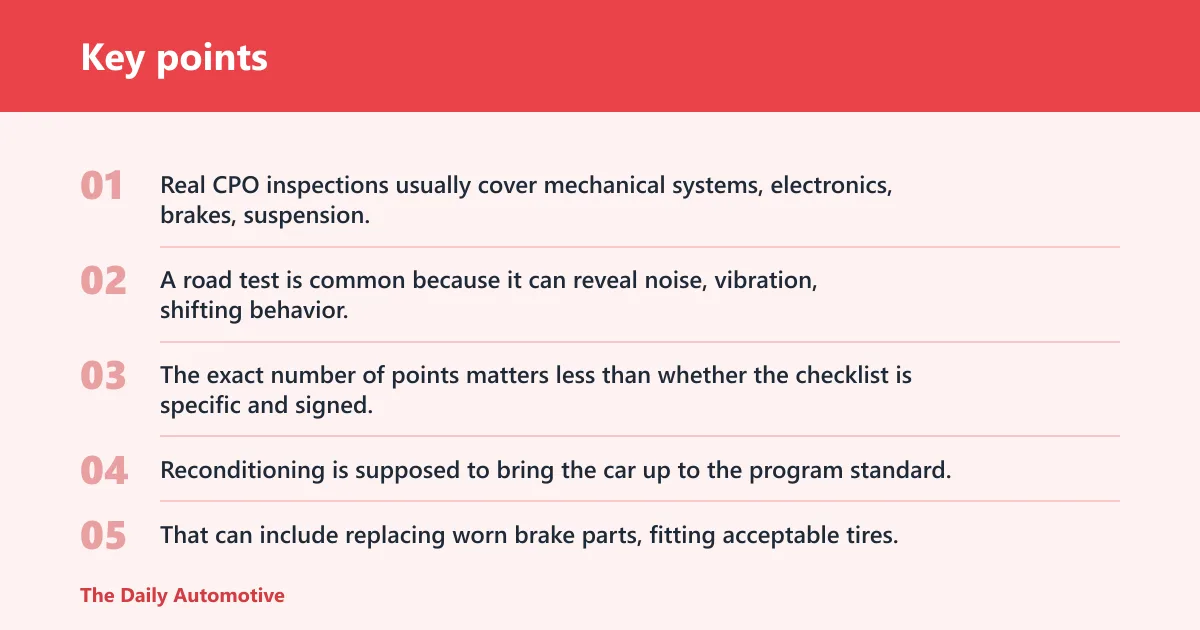
Real CPO inspections usually cover mechanical systems, electronics, brakes, suspension, steering, safety equipment, fluid leaks, tires, and exterior and interior condition. A road test is common because it can reveal noise, vibration, shifting behavior, and warning lights that a static inspection misses. The exact number of points matters less than whether the checklist is specific and signed.
Reconditioning standards and cosmetic thresholds
Reconditioning is supposed to bring the car up to the program standard, not to perfect condition. That can include replacing worn brake parts, fitting acceptable tires, topping off or changing fluids, replacing filters, and installing a new battery if needed. Cosmetic thresholds vary too; minor chips may be allowed, while dents, heavy wear, or cracked trim may not.
How vehicle history reports fit
A vehicle history report can show accident entries, title status, odometer checks, and some service records. It cannot show every repair, every undocumented collision, or every problem a car has ever had. Use it as a filter, not as a guarantee. If the report shows salvage, flood, or odometer problems, walk away.
Decision matrix
| Buyer scenario | Premium to accept | Warranty features that matter | Red flags that make CPO poor value | Recommended alternative |
|---|---|---|---|---|
| Budget-first | 0% to 4% | Low or no deductible, clear history, at least some powertrain coverage | Markup above 5%, short warranty, expensive add-ons, tire or brake wear already due | Non-CPO used car with an independent inspection and a repair reserve |
| Long-term keeper | Up to 8% | Long term, transferable coverage, broad component list, low deductible | Coverage ends before years of ownership are done, exclusions are narrow, maintenance history is thin | Late-model used car with strong service records and a savings fund for repairs |
| Low-mileage commuter | 5% to 10% | Roadside assistance, electronics coverage, short-term bumper-to-bumper protection | Commuting miles are low enough that repair risk is modest, but premium is high | Clean used car with factory warranty remaining |
| Risk-averse buyer | Up to 10% | Factory-backed coverage, $0 to $100 deductible, detailed inspection report | Dealer-backed program with vague exclusions, missing inspection paperwork, no transferability | CPO only from a brand program with full documents |
| Near-new car shopper | 0% to 6% | Remaining factory coverage plus CPO extension, very low miles | Premium approaches the gap to a new car, making the value spread too thin | New car if incentives, rate support, or warranty length are stronger |
Is a certified pre-owned car worth the extra cost?
A CPO car is worth the extra cost when the premium is still smaller than the value of the added warranty term, the deductible structure, and the repair risk you are avoiding. It stops making sense when the markup is close to the expected repair reserve on a clean used car, or when a new car is only slightly more expensive.
How to judge the premium against warranty value
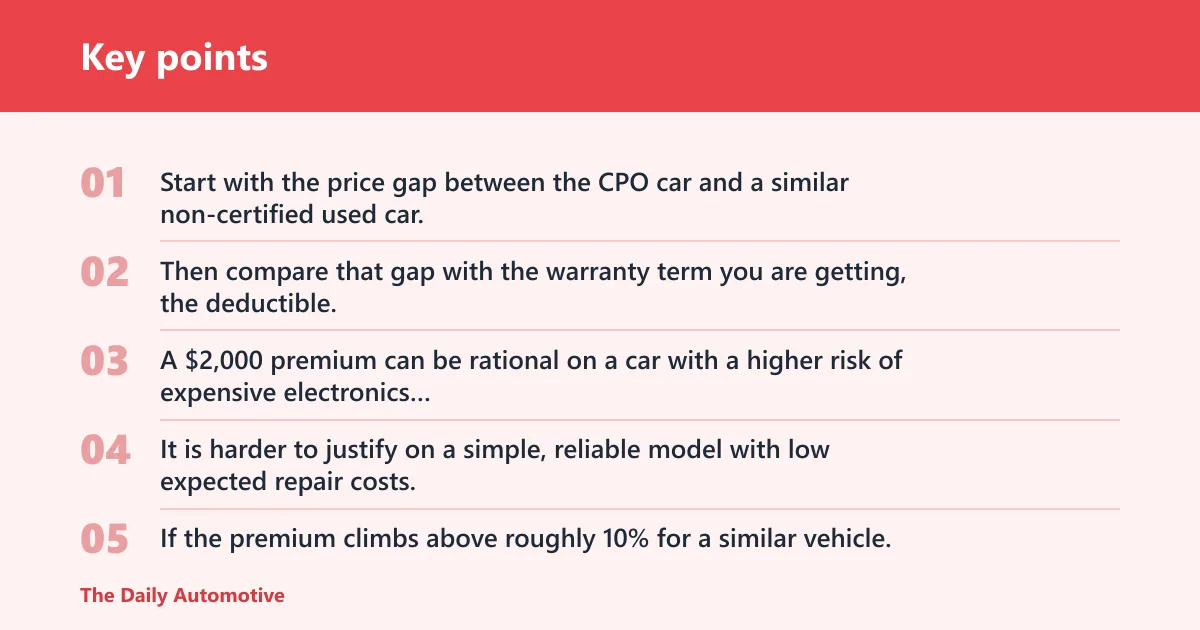
Start with the price gap between the CPO car and a similar non-certified used car. Then compare that gap with the warranty term you are getting, the deductible, and the parts most likely to fail on that model. A $2,000 premium can be rational on a car with a higher risk of expensive electronics failures. It is harder to justify on a simple, reliable model with low expected repair costs.
When a CPO markup is too high
If the premium climbs above roughly 10% for a similar vehicle, the value case gets weaker fast unless the program adds unusually strong coverage. If the warranty is short, the deductible is high, or the exclusions are broad, the certification premium may be paying for a sign, not meaningful protection. That is where shoppers should slow down.
When used plus a repair reserve makes more sense
For a lower-priced used car, setting aside a repair reserve can beat paying for certification. Suppose a $17,000 used sedan and a $19,000 CPO sedan are otherwise similar. If the CPO warranty is short and the deductible is $100, the extra $2,000 may be better kept as a repair fund, especially if the model has inexpensive parts and a strong reliability record.
Buyer-type guidance
A common first-timer mistake is treating CPO as the default answer. It is not. Risk-averse buyers often get real value from CPO, especially on higher-tech cars. Budget-first buyers usually do better with a clean used car and an inspection. Long-term owners should focus on total ownership cost, not the label on the window sticker.
How much more expensive is a CPO car?
The CPO premium is market-dependent, but a common rule of thumb is about 5% to 10% over a similar non-certified used car. Some models and regions run lower, and hot inventory can run higher. The right comparison is not to another trim line; it is to a similar car with similar miles, history, and equipment.
What drives the markup
Dealers build certification cost into the price because inspection time, reconditioning, warranty backing, and sometimes roadside benefits all carry cost. Supply matters too. If a specific model is in demand and few similar used cars are available, the CPO premium often climbs. If inventory is heavy, the gap can shrink.
How to compare to a non-certified listing
Use the same year, trim, drivetrain, mileage range, and equipment level. Then compare asking price, accident history, tire condition, brake life, and whether each car still has factory warranty remaining. A cheaper non-CPO listing can still be the better buy if it is cleaner, newer, or covered longer by the original warranty.
Can you negotiate the price of a certified pre-owned car?
Yes. CPO cars can often still be negotiated, even if the certification line item is less flexible than the total price. Dealers may hold more firm on the certification package, but the asking price, fees, accessories, and trade-in offer can still move. The best bargaining point is a similar non-CPO listing and a clean history report.
Where price flexibility still exists
Price flexibility often shows up in the final sale price, doc fee treatment, add-ons, and financing terms. Some dealers will not remove certification charges, but they may lower the total price to compete with similar cars nearby. Ask for the out-the-door number, not just the advertised price.
How to read the fine print on add-ons
Watch for paint protection, wheel coverage, nitrogen fills, VIN etching, or aftermarket service contracts that are packaged beside the CPO label. Those items are separate from factory-backed certification. If they are included, make the dealer show each cost line by line. A bundled add-on can make a fair CPO deal look expensive.
What should I check before buying a CPO car?
Check the inspection report, warranty booklet, vehicle history report, and every deductible or exclusion before you sign. Also verify the exact vehicle identification number, because one letter mistake can ruin the paperwork. The certification label only matters if the documents match the car in front of you.
Buyer’s checklist
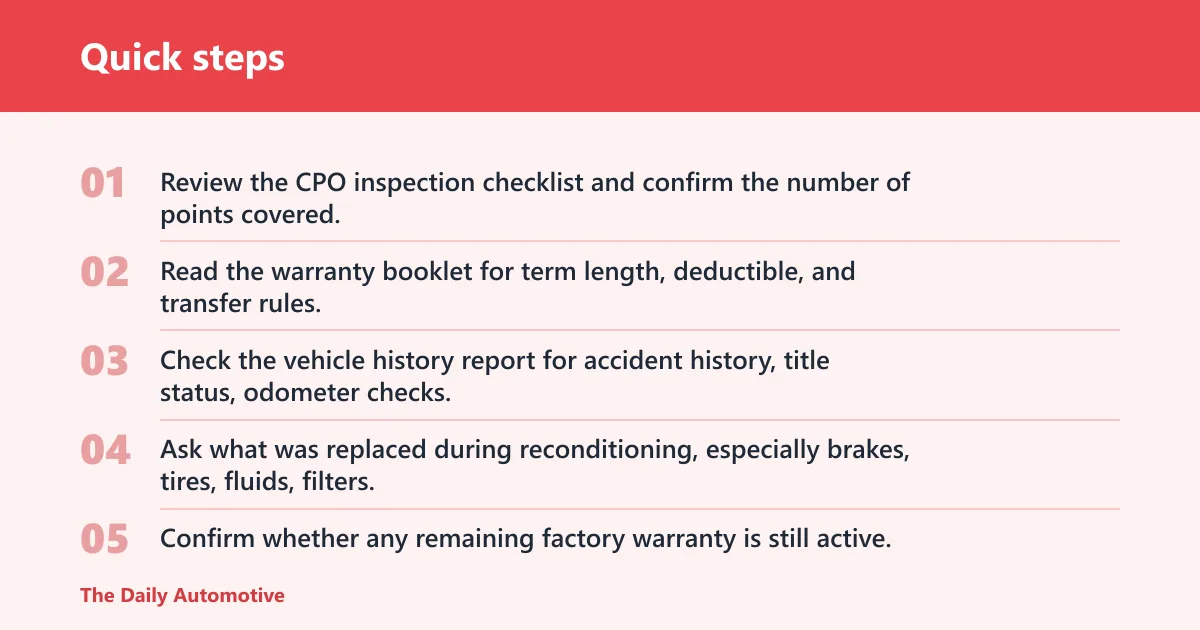
- Review the CPO inspection checklist and confirm the number of points covered.
- Read the warranty booklet for term length, deductible, and transfer rules.
- Check the vehicle history report for accident history, title status, odometer checks, and service entries.
- Ask what was replaced during reconditioning, especially brakes, tires, fluids, filters, and battery.
- Confirm whether any remaining factory warranty is still active.
- Get the out-the-door price in writing, including fees and add-ons.
- Arrange an independent inspection if the program is dealer-backed or the paperwork is thin.
Two common examples
Picture a 3-year-old compact SUV with 28,000 miles, a $1,400 CPO premium, and a $100 deductible. That can be reasonable if the warranty adds meaningful coverage on electronics and the car has a clean history report. If the same SUV has worn tires and a short warranty term, the premium is harder to defend.
Say your budget caps a midsize sedan at $18,000. If the CPO version is $19,800 and the non-CPO version is $18,200, the $1,600 gap may be too large if both cars have similar mileage and service records. In that case, a used car plus a repair reserve can be the smarter move.
Is certified pre-owned better than buying new?
Not always. A CPO car can be a better value than new when the price gap is large and the warranty coverage is strong. A new car can be the better deal when incentives, financing, and full factory coverage narrow the cost difference. Compare the total cost, not the sticker alone.
What changes the answer
If a new car comes with lower financing costs, a longer factory warranty, or a small price gap, CPO loses some appeal. If the CPO car is much cheaper and still has low miles, CPO may win. The decision turns on the real difference in cash outlay, not the sales pitch.
Frequently asked questions
Is a certified pre-owned car worth it?
It is worth it when the price premium is modest and the added warranty, inspection, and reconditioning reduce real risk. It is less attractive when the markup is large, the deductible is high, or the coverage is short. The right answer depends on the car and your tolerance for repair risk.
What does a CPO warranty usually cover?
It often includes powertrain coverage and, in some programs, bumper-to-bumper coverage for a limited time. The exact plan may include a deductible and can exclude wear items, maintenance, and damage from neglect or abuse. Read the booklet, not the ad headline.
Products related to this article
Sponsored / affiliate links. As an Amazon Associate I earn from qualifying purchases. I may earn additional commission from eligible campaigns.
 Half Car Cover SUV,Top Cover with Red Reflective Strip, Hail Protector Car Cover with Cotton Liner, Sunroof & Windshield Cover for Ice and Snow, All Weather Car Body Cover for Sun, Rain, Dust
 Roadside Assistance Emergency Kit,Vehicle Truck Car Safety Roadside Emergency Kit with Reflective Warning Triangle Tow Strap Reflective Vest etc