How to Negotiate a Car Lease Price and Fees Before Signing
Negotiate a lease by cutting the vehicle’s selling price first, then checking the money factor, mileage allowance, and fees before you talk about the monthly payment. Skip those line items, and a low payment can hide extra profit in the deal. This article shows you how to read a lease worksheet and press on the parts that move the quote.
This guide is part of our Car Dealer Money Guide: Negotiating, Financing, Leasing, Trading In and Selling series.
Can you negotiate a car lease price?
Yes. The vehicle’s price is still negotiable in a lease because the payment starts with the negotiated selling price, then runs through the capitalized cost, residual value, money factor, term, and fees. If you focus only on the monthly payment, you can miss a higher cap cost or a marked-up money factor that keeps the quote high.
What part of a lease is actually negotiable
The parts that usually move first are the selling price, the money factor if the lender allows it, dealer-added fees, mileage allowance, and some drive-off items. The residual value is usually set by the lender or captive finance arm. That is why two leases with the same car can still produce very different payments.
Why the monthly payment alone can mislead you
A low monthly payment can come from a longer term, a higher residual assumption, a lower mileage allowance, a bigger drive-off, or a cash-heavy cap cost reduction. Those tactics can make the payment look attractive while the total lease cost stays high. Compare the full worksheet, not just the number in the ad.
The three numbers that drive the quote
The core numbers are the capitalized cost, the money factor, and the residual value. The cap cost is the price base. The money factor is the finance charge. The residual is the amount the lender expects the vehicle to be worth at lease end. Change any one of them, and the payment changes.
Lease worksheet
Ask for the lease worksheet before you discuss monthly payment. You want the quoted cap cost, residual percentage, money factor, fees, mileage allowance, and due-at-signing line by line. If the dealer will not show those figures, you are negotiating in the dark.
| Quoted value | Target value | Negotiation lever | Expected monthly impact |
|---|---|---|---|
| Selling price / cap cost: $38,900 | $37,500 | Push the selling price down before lease math starts | About $39 lower over 36 months before tax, assuming roughly 55% residual and a 0.00200 money factor |
| Money factor: 0.00240 | 0.00180 | Ask for the lender’s buy rate; challenge dealer markup | About $18 to $25 lower per month on a mid-priced lease |
| Residual value: 54% | Same, if lender set | Usually not negotiable; verify against the published program | No change unless mileage or term changes |
| Acquisition fee: $995 | $695 to $795 if allowed | Ask whether the fee is marked up above the lender charge | About $6 to $8 lower per month if $300 is removed over 36 months |
| Doc fee: $499 | State-regulated or lower dealer amount | Ask for the fee to be capped or offset in the price | About $3 to $14 lower per month, depending on amount and term |
| Mileage allowance: 10,000 miles per year | 12,000 to 15,000 if needed | Match the allowance to your driving, then recheck the residual | Higher allowance usually raises payment; the jump varies by model |
| Due at signing: $3,200 | First payment, taxes, registration only | Move upfront money out of cap reduction when possible | Higher due-at-signing lowers payment, but adds risk if the vehicle is stolen or totaled |
| Add-ons: nitrogen, coating, VIN etch | Remove or decline | Strip products that do not affect the lease math | Usually $5 to $20 lower per month, depending on bundle size |
Red flags: a quote that hides a higher money factor, an acquisition fee above the lender’s standard charge, “required” add-ons, an unusually low mileage allowance, or a payment that looks cheap only because a large amount is due at signing.
Start with the capitalized cost
The cap cost is the first place to negotiate because it sets the rest of the lease math. The gross cap cost is the starting figure before reductions. The adjusted cap cost is what remains after rebates, trade-in credit, and any cap cost reduction are applied. A lower cap cost usually means a lower payment.
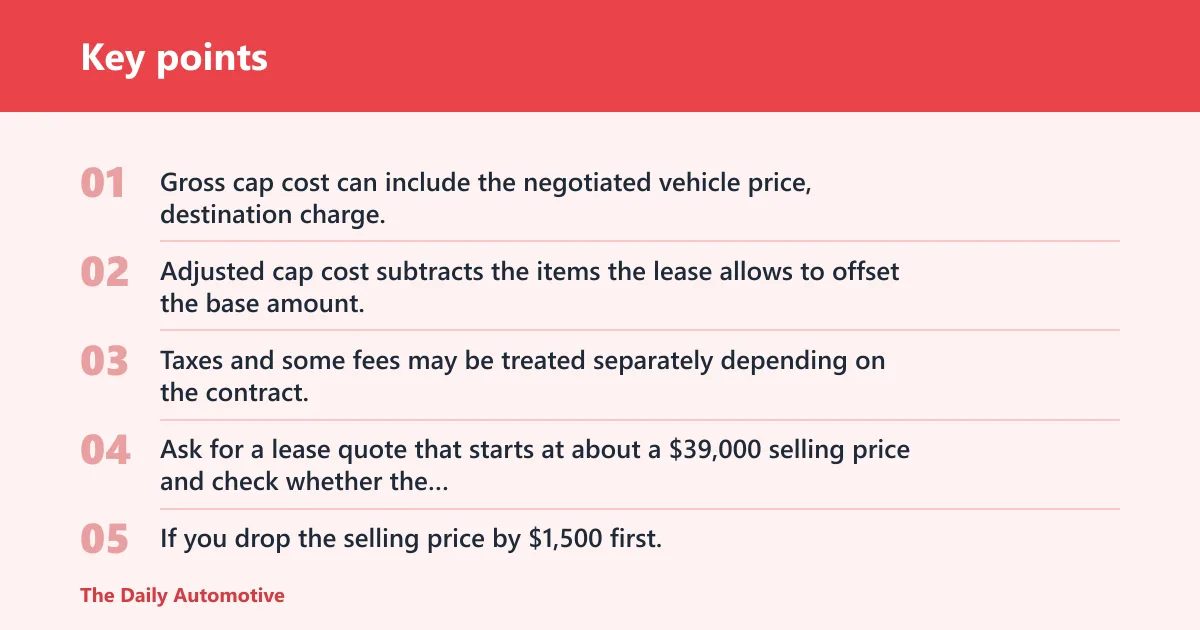
Gross cap cost versus adjusted cap cost
Gross cap cost can include the negotiated vehicle price, destination charge, and selected add-ons. Adjusted cap cost subtracts the items the lease allows to offset the base amount, such as manufacturer cash applied to the deal, trade equity, or a cash down payment. Taxes and some fees may be treated separately depending on the contract.
Ask for a lease quote that starts at about a $39,000 selling price and check whether the dealer adds a roughly $795 acquisition fee and a $499 doc fee into the amount financed. If you drop the selling price by $1,500 first, that change usually beats any later attempt to shave a few dollars from the monthly payment.
What down payment does and does not fix
A down payment can lower the monthly bill because it reduces the amount financed. It does not repair a bad price, and it does not change the residual or the money factor. Large cap cost reductions also put cash at risk if the vehicle is stolen or totaled early in the lease.
Where destination charges, rebates, and add-ons belong
Destination is part of the vehicle price and should be included in the price discussion from the start. Manufacturer rebates, loyalty money, and conquest cash can reduce the deal if you qualify. Add-on products such as paint protection, wheel coverage, and security etching belong in a separate yes-or-no decision, not buried in the lease quote.
Can you negotiate the money factor on a lease?
Sometimes. The money factor may be negotiable if the dealer is marking up the lender’s buy rate, but the amount is constrained by the credit tier and the finance program. Treat it like lease interest. Even a small markup can add meaningful cost over the term.
How to convert money factor to an APR equivalent
A common conversion is money factor × 2,400 = approximate APR. A money factor of 0.00200 works out to about 4.8% APR. A money factor of 0.00150 is about 3.6% APR. That conversion helps you compare a lease finance charge with a loan rate, even though the structures are not identical.
Why dealer markup on the money factor matters
Dealer markup on the money factor raises the finance charge for the full lease term. Because the charge applies every month, even a small increase can add up fast. Ask whether the quoted number is the lender’s published buy rate or a marked-up figure. If the dealer will not say, ask for the worksheet.
How credit tier and lender program affect the number
Your credit tier affects which money factor the lender offers. Stronger credit usually qualifies for the best program, while weaker tiers can get higher factors or stricter approval terms. The dealer may also have a separate captive-finance program with its own rate, residual, and incentive rules.
Residual value and lease term

The residual value is usually set by the lender, not the dealer, and it is rarely negotiable on a standard lease. It changes with term and mileage allowance. Shorter terms and lower mileage usually produce a higher residual percentage, which can help the payment, but the monthly number still depends on the cap cost and money factor.
How 24, 36, 39, and 42 months change the deal
Twenty-four-month leases often carry higher monthly payments because the vehicle is depreciated over a shorter span, though the residual can stay relatively strong. Thirty-six months is common because it often aligns well with warranty coverage. Thirty-nine and 42 months can stretch the term enough to lower the payment, but the residual may fall and the vehicle may drift past full warranty coverage.
Why mileage allowance changes the residual and payment
Common mileage allowances are often around 10,000 to 15,000 miles per year. Higher annual mileage usually lowers the residual percentage, which raises the payment. If you drive more than the allowance, the lease charges an overage fee per mile at turn-in, so it is cheaper to choose the right allowance upfront than to pay for miles later.
Picture a shopper who expects 14,000 miles a year but signs for 10,000 because the payment looks better. The lease may seem cheaper on day one, yet the overage charge at turn-in can erase much of that savings. Choose the mileage that fits the driving pattern, then judge the payment from there.
How warranty coverage should line up with term length
Try to keep the lease term within or close to the factory warranty period when possible. That limits repair exposure near the end of the lease and helps avoid paying for wear items that show up after the basic warranty ends. A term mismatch can make an otherwise good payment less attractive.
What fees on a lease are negotiable?
Some fees can be negotiated or checked for markup, while others are fixed by the lender or the state. The important step is to separate lender-set charges from dealer-controlled add-ons. Do not assume every fee is fair just because it appears on the worksheet.
Acquisition fee and dealer markup
The acquisition fee is a lease inception charge from the lender. In many deals it is standard, but some dealers mark it up. Ask for the lender’s base fee and compare it to the figure on the quote. If the dealer added extra profit, push it back down or ask for a matching price reduction elsewhere.
Doc fee, registration, and add-on products
Doc fees are often dealer-set and can vary widely by store and state. Registration and title charges are usually government-based and much less flexible. Add-on products are the easiest thing to decline because they rarely affect the lease structure, yet they can quietly add monthly cost if folded into the cap cost.
Drive-off costs versus cap-cost reduction
Drive-off costs usually include the first payment, taxes, registration, and sometimes a security deposit. Due-at-signing is the amount you pay when you pick up the car. Cap-cost reduction is different: it is money used to lower the lease balance and monthly payment. When possible, keep the upfront money to the required charges rather than loading the cap cost.
Disposition fee at lease end
The disposition fee is the end-of-lease return charge if you hand the vehicle back. It is commonly charged by the lender or captive finance arm, though some loyalty or buyout scenarios may waive it. Ask about it before signing so the end-of-lease cost does not surprise you later.
How do you negotiate a car lease deal?
Start with the quote sheet, not the monthly number. Ask the dealer for the lease worksheet, verify the selling price, cap cost, money factor, residual percentage, mileage allowance, and all fees, then compare the offer line by line with another dealer’s quote. That order keeps the conversation on the structure of the deal, not the payment alone.
Use dealer quotes in the right order
- Ask for the out-the-door selling price and the lease worksheet.
- Check the cap cost, residual percentage, and money factor.
- Verify the mileage allowance and term length.
- Review acquisition, doc, registration, and add-on charges.
- Confirm due-at-signing before discussing monthly payment.
Check loyalty and conquest incentives
Loyalty and conquest incentives are manufacturer cash offers that can reduce the lease price if you qualify. Loyalty usually rewards current-brand owners or lessees. Conquest targets shoppers coming from a competing brand. Ask whether the incentive is applied as cap cost reduction or as a separate rebate, and make sure it appears in the quote.
Compare multiple offers line by line
Two quotes with the same payment can still differ in cap cost, money factor, fees, and mileage. Compare the line items, not just the bottom line. If one offer uses a lower payment but a higher due-at-signing or a longer term, the comparison is not equal.
A common first-timer mistake is to accept a payment that looks only a few dollars lower, then discover the lease uses a higher money factor and a bundled add-on package. That small payment win can cost more over the full term than a cleaner quote with a slightly higher monthly figure.
Frequently asked questions
What part of a lease is negotiable?
The selling price, dealer add-ons, some fees, and sometimes the money factor are the main items to press. The residual value is usually set by the lender and is rarely negotiable. Mileage allowance also matters because it changes the residual and the monthly payment.
Can I negotiate a lease buyout price?
Sometimes, especially if the buyout is an early payoff or the vehicle’s market value is lower than the contract residual. End-of-lease buyouts are often set by the contract, but some lenders or dealers may adjust fees or buyout support in limited situations. Ask for the payoff in writing.
Products related to this article
Sponsored / affiliate links. As an Amazon Associate I earn from qualifying purchases. I may earn additional commission from eligible campaigns.