Is the Sticker Price Negotiable on a Used Car?
Yes, a used-car sticker price is often negotiable, but not always. If the car is priced to market, fresh on the lot, or marked “no-haggle,” expect less room. If you miss that, you can overpay or lose ground on trade-in, financing, and add-ons. This guide shows when the asking price moves, what else you can negotiate, and what to do when the dealer says no.
Negotiating the out-the-door total instead of the sticker
When the asking price is a starting point
The sticker price is the dealer’s asking price for the vehicle itself. It is a starting point, not the total amount you will pay to drive away. In many deals, the dealer can move on price, especially if the car has been sitting, has cosmetic issues, or faces direct competition from similar listings.
When the price is effectively fixed
Some used cars carry very little price flexibility. High-demand models, fresh arrivals, certified pre-owned units, and cars marked “no-haggle” often leave little room on the sticker price. If the dealer already priced the car at the market level, your better move is to press the out-the-door total, accessories, or financing terms instead.
Why the out-the-door total matters more
The out-the-door price is the full amount due to take the car home. It includes the vehicle price, sales tax, title fee, registration, plate fees, and dealer doc fee. OTDCheck says to negotiate based on the out-the-door price, not the monthly payment. That keeps the deal focused on the real cost.
Sticker price checklist
This checklist shows when the sticker price is likely to move and when another part of the deal is a better target. Use it before you sit down with the salesperson.
| Dealership condition | What part of the deal is realistically negotiable | The exact line to say |
|---|---|---|
| High-demand car | Usually the out-the-door total, add-ons, or financing terms; sticker price may be close to fixed | “If the price is firm, show me the best out-the-door number with no extras I did not ask for.” |
| Car over 45 days on the lot | Sticker price, dealer add-ons, and sometimes doc fee if state law allows | “Since it has been here over 45 days, what is the lowest out-the-door price you can do today?” |
| Car over 60 days on the lot | Sticker price often has more room; dealer may also trim add-ons to move inventory | “A car sitting over 60 days usually has room. Where can you move on price or fees?” |
| Vehicle with add-ons | Dealer add-ons are often negotiable or refusible | “Remove the paint sealant, nitrogen tires, and VIN etching if they are not part of the purchase.” |
| Vehicle with price markup | Market adjustment can sometimes be reduced, but not always; if not, ask for a lower out-the-door total | “If the markup stays, then the only number I will compare is your out-the-door price.” |
| Vehicle with obvious cosmetic or mechanical flaws | Sticker price and any repair-related fees | “The tire wear and bumper damage change the value. Rework the price to reflect that.” |
What should you ask for instead?
If the dealer will not move much on sticker price, ask for a better out-the-door price, lower add-ons, or a smaller fee stack. The goal is not to win one line item. The goal is to cut the total amount due and avoid paying for items that do not help you.
Ask for the out-the-door price first
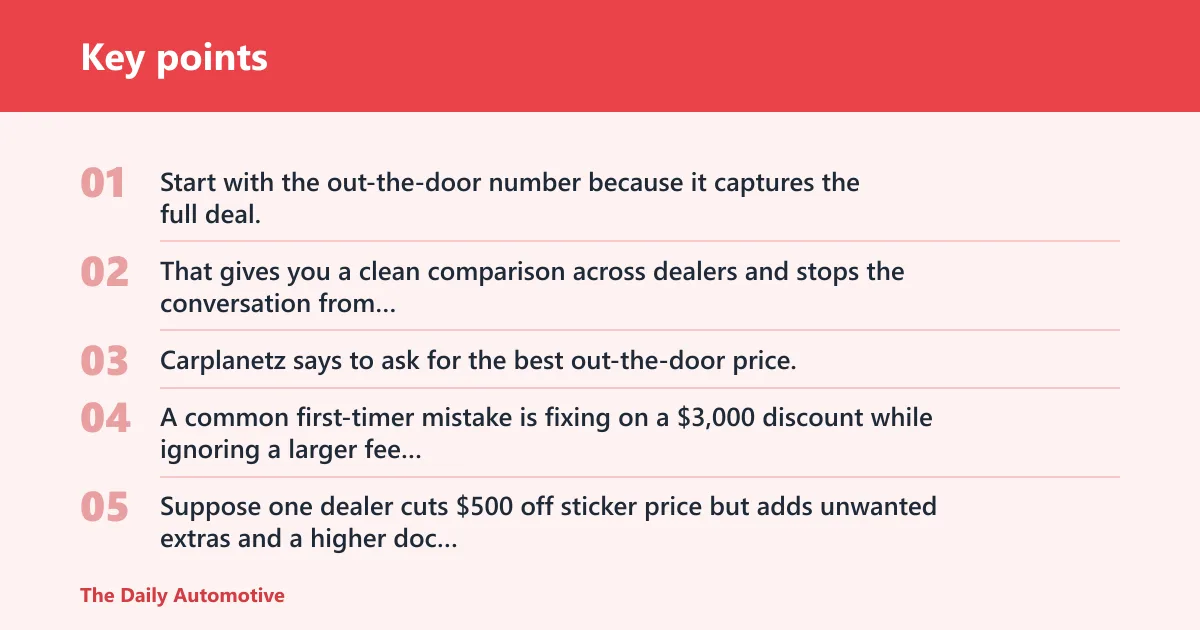
Start with the out-the-door number because it captures the full deal. That gives you a clean comparison across dealers and stops the conversation from drifting into monthly payments. Carplanetz says to ask for the best out-the-door price, and that is the right anchor when you want a real answer.
A common first-timer mistake is fixing on a $3,000 discount while ignoring a larger fee stack. Suppose one dealer cuts $500 off sticker price but adds unwanted extras and a higher doc fee. Another dealer holds sticker price steady but gives a lower out-the-door total. The second deal can still be cheaper.
Push dealer add-ons out of the deal
Dealer add-ons include paint sealant, nitrogen tires, VIN etching, and extended warranties. The same source says dealer add-ons are negotiable or refusible. If you do not want them, say so clearly and ask for a revised sheet with those items removed. Extra products are often easier to cut than the base car price.
Ask for a smaller doc fee if state law allows
The dealer documentation fee is a dealer-added fee, and state law may cap it or limit how far it can move. The same source says documentation fees should not exceed $200-300. Do not assume that figure applies everywhere, but do treat a high doc fee as a bargaining point when the dealer has room to adjust it.
Keep the trade-in separate
Trade-in value is a separate negotiation from the purchase price. Dealers often offer less than private sale value, but the trade-in can still lower the taxable amount in some states. Negotiate the car price first, then discuss the trade-in as its own step so the dealer cannot blur the numbers.
Which fees are negotiable on a used car?
Some fees are fixed by government rules, while others come from the dealer and may move. Taxes, title, registration, and plate fees are mandatory. Dealer doc fees, add-ons, and market adjustments are where negotiation usually has more room, though local law and dealer policy still matter.
Dealer documentation fee
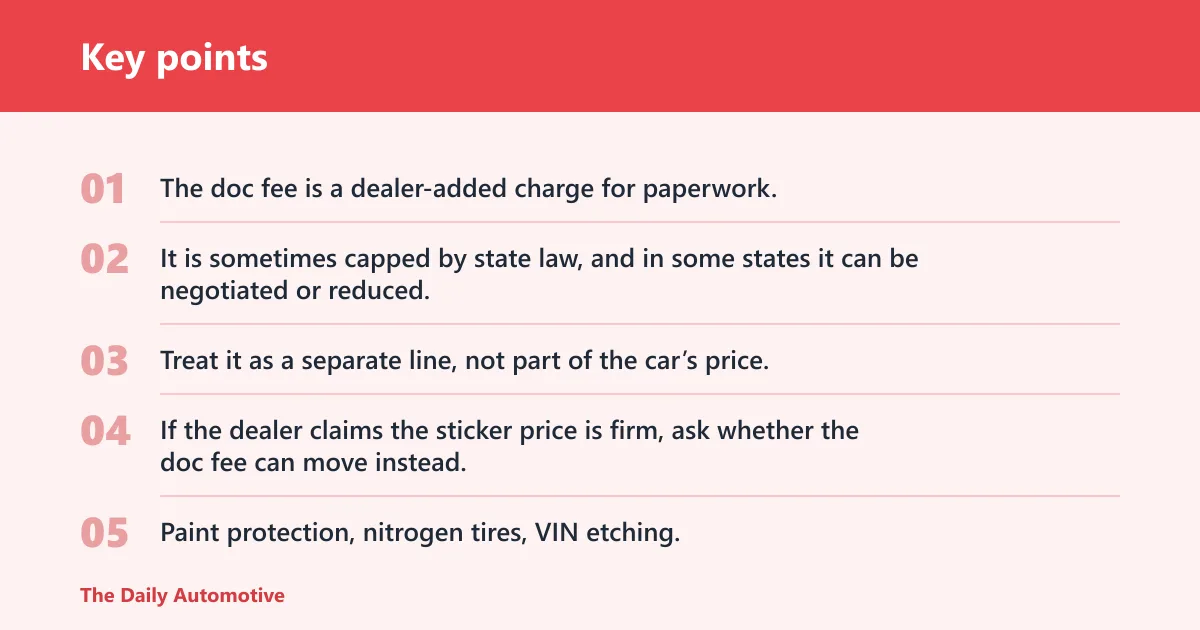
The doc fee is a dealer-added charge for paperwork. It is sometimes capped by state law, and in some states it can be negotiated or reduced. Treat it as a separate line, not part of the car’s price. If the dealer claims the sticker price is firm, ask whether the doc fee can move instead.
Dealer add-ons and protection packages
Paint protection, nitrogen tires, VIN etching, and extended warranties are the most common add-ons to challenge. The same source describes these items as negotiable or refusible. If you did not request them, ask for a version of the deal without them. If the car is otherwise right, this is one of the easiest places to cut cost.
Market adjustment or markup
A market adjustment is an amount added on top of the sticker price. The same source says it is pure profit for the dealer. You may see it on high-demand vehicles or fresh inventory that sells fast. If the dealer will not remove it, do not argue in circles. Shift to the out-the-door total and compare another car.
Taxes, title, registration, and plate fees
These are mandatory fees. The same source lists sales tax, title fee, registration, and plate fees as required. They are not the place to haggle. Focus your effort on the dealer-controlled parts of the deal instead, because that is where the savings usually come from.
How much lower should you offer?
Start from fair market value, then adjust for the car’s condition, days on lot, and any history issues. A low offer should be anchored in market data, not hope. If you come in far below the market without a reason, the dealer may ignore you rather than counter.
Use fair market value as the ceiling
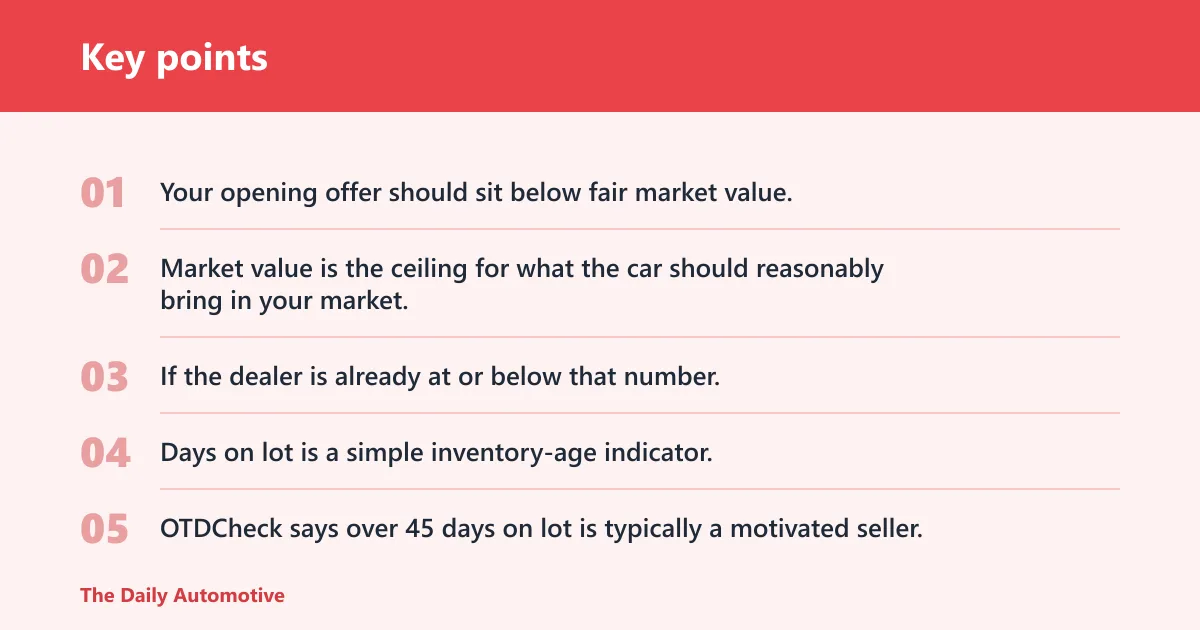
Your opening offer should sit below fair market value, but not so far below that it ends the conversation. Market value is the ceiling for what the car should reasonably bring in your market. If the dealer is already at or below that number, the sticker price may not have much room.
Adjust for days on lot and VIN history
Days on lot is a simple inventory-age indicator. The same source says over 45 days on lot is typically a motivated seller, and over 60 days on lot is a strong negotiation lever. A VIN check can also show accidents, title status, and prior owners; OTDCheck recommends checking a VIN before finalizing a used-car purchase.
Say your target car has been listed for about two months and the VIN history shows a prior accident on part of the vehicle. That does not mean the dealer must slash the price, but it does give you a clean reason to ask for a lower number or for the dealer to remove add-ons before you sign.
Leave room for a counteroffer
Do not make your first offer your last offer. Leave room for the dealer to come back with a number that still feels like progress. If you start too high, you lose room to move. If you start too low, the salesperson may stop negotiating and move on to another buyer.
Know when a low offer will be ignored
If the car is fresh, priced tightly, and already drawing traffic, a deep discount offer may go nowhere. The same is true for limited units and high-demand trims. In that case, the smarter move is to hold your line on fees, add-ons, and the out-the-door total, or to move on.
When the dealer says no
When the salesperson refuses to move off sticker price, do not keep repeating the same ask. Ask for a line-by-line out-the-door sheet, then decide which part of the deal still has room. If the car price holds, shift to accessories, financing, or warranty only if those items are truly optional.
Ask for a line-by-line sheet
Request every charge in writing. That forces the dealer to separate the vehicle price, dealer fees, government fees, and add-ons. It also helps you spot anything you can refuse. If the dealer will not itemize the deal, that is a warning sign.
Shift only to other negotiable parts
Do not let the conversation drift into monthly payment first. Not focusing on financing when negotiating price, and instead negotiating from the out-the-door price rather than the monthly payment. Keep the vehicle price separate, then decide whether a rate, warranty, or accessory change still matters.
Walk away from forced add-ons and hidden fees
The same source says dealers may add hidden fees to the final cost. If a dealer insists on unwanted add-ons or slips in unexplained charges, walk away. A cheaper-looking sticker price means little if the final sheet is padded with extras you did not request.
Decide when to leave and keep shopping
If the dealer will not budge on sticker price, will not remove extras, and will not explain the out-the-door total clearly, leave. Another car can be a better deal. The right response is not to rescue a bad deal with a bigger monthly payment or a longer loan.
When is the best time to negotiate?
The best time to negotiate is usually late in the month, late in the quarter, or later in the inventory cycle. Dealers want older cars moving, and that pressure grows as the unit ages. If the car has been sitting over 45 days, your position improves. Over 60 days, the dealer may be much more open.
End of month and end of quarter
Sales teams often care about month-end and quarter-end numbers. That can create room for a better deal, especially if the car is also aging on the lot. Timing alone will not beat a bad price, but it can tip a close deal in your favor.
Older units versus fresh arrivals
Fresh arrivals usually leave less room on sticker price. Older units create more pressure because they tie up inventory space and dealer money. If you can choose between two similar cars, the one with more days on lot is usually the better negotiating target.
How competition changes your room to negotiate
If similar listings are cheaper at nearby dealers, use that as your anchor. Competition matters more when the car is ordinary and easy to replace. If the vehicle is high demand, the dealer may ignore a simple comparison and wait for a buyer who will pay closer to asking.
Frequently asked questions
Is the sticker price on a used car negotiable?
Often, yes. The sticker price is a starting point, but it is not guaranteed to move on every car. Fresh inventory, high-demand models, and no-haggle pricing usually leave less room. If the dealer will not move, switch to the out-the-door total, add-ons, or fees.
Should I ask for the out-the-door price or the sticker price?
Ask for the out-the-door price first. It includes the vehicle price, sales tax, title fee, registration, plate fees, and dealer doc fee. That is the number that tells you what the car really costs, and it is the cleanest way to compare one dealer with another.
Are dealer fees negotiable on a used car?
Some are, some are not. Taxes, title, registration, and plate fees are mandatory. Dealer documentation fee may be negotiable or limited by state law. Add-ons and market adjustments are often the easiest dealer charges to challenge if you do not want them.
Is the monthly payment negotiable when buying a used car?
The monthly payment can change, but it is the wrong place to start. A longer loan can make a high price look affordable while increasing the total cost. Focus on the out-the-door price first, then decide whether financing terms still need work.
Can I negotiate a used car price if I’m paying cash?
Cash does not automatically create a bigger discount. Dealers may prefer the simplicity, but the price still depends on demand, inventory age, and market value. Use cash as part of the conversation only if the dealer values a fast, clean sale; do not assume it guarantees a lower sticker price.
What fees should I refuse on a used car deal?
Refuse any add-on you did not ask for, including paint sealant, nitrogen tires, VIN etching, and unwanted warranty packages. Also question hidden fees that are not explained on the sheet. You can negotiate or decline many dealer add-ons, but you should still pay the required government fees.
Products related to this article
Sponsored / affiliate links. As an Amazon Associate I earn from qualifying purchases. I may earn additional commission from eligible campaigns.