Best Car Air Compressors for Tires (2026): We Compared
For many drivers, a 12V portable compressor rated at about 30–35 L/min handles sedan and crossover tires well; a higher-output 150-psi unit with battery or AC power may be a better fit for SUVs and trucks. Weak inflators waste time and can leave you with a tire that is still unsafe. This guide matches compressor class to tire size, power source, and inflation speed.
Quick comparison
| Product | Badge | Best for | Price | ||
|---|---|---|---|---|---|
 |
Tire Inflator Portable Air Compressor,200PSI 20000mAh PumpZXNcar | Our pick | 200PSI · 20000mAh · Cordless | $13.99
Price as of 23 Oct 2026
|
View |
 |
AstroAI AIRUN H Tire Inflator Portable Air Compressor, 12VAstroAI | Also great | 12V DC · 35L/min · Yellow | $30.39
Price as of 23 Oct 2026
|
View |
 |
OlarHike Tire Inflator Portable Air Compressor,DualOlarHike | Upgrade pick | Dual Power · 6000mAh · Fast | $27.98
Price as of 23 Oct 2026
|
View |
 |
160 PSI Tire Inflator Portable Air Compressor Built-inIpflin | Also great | 9600mAh · 12V DC · 160 PSI | $66.65
Price as of 23 Oct 2026
|
View |
Use the table to match compressor class to the job, not the badge. The right call depends on tire size, outlet type, and how many tires you may need to fill before the unit cools down.
How we chose
This roundup focuses on four practical filters: airflow, maximum pressure, duty cycle, and power source. It also separates daily-driver use from larger tire jobs, because the best choice for a sedan is often the wrong choice for a 35-inch tire.
The comparison looked at models for emergency kit use, garage top-offs, road-trip convenience, and larger SUV or truck needs. The reference points here come from published product details and competitor specs, including the 10-model comparison that ranged from $55.99 to $241.00.
Two numbers matter more than marketing copy. PSI tells you the pressure ceiling, while CFM tells you how quickly the compressor can move air. A high PSI number alone does not make a tire fill faster.
Duty cycle matters because heat builds quickly on repeated fills. A 40-minute duty cycle is a strong sign for trail use, while a 20-minute duty cycle may force a wait before you can move on to the next tire on a larger vehicle.
What PSI and CFM do you actually need?
For passenger cars and crossovers, a portable inflator in the roughly 120 to 150 PSI range with about 1.5 to 2.3 CFM is usually enough for top-offs and routine maintenance. For larger SUVs and trucks, the target shifts toward higher airflow, especially when the tires start larger and the fill gap is bigger.
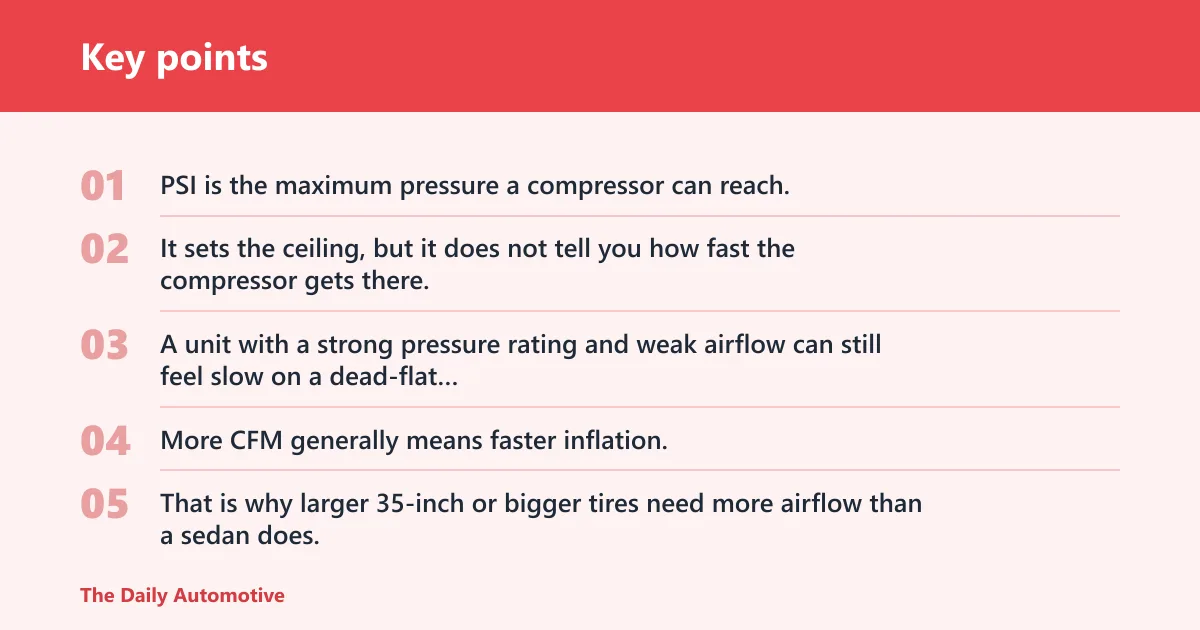
PSI is the maximum pressure a compressor can reach. It sets the ceiling, but it does not tell you how fast the compressor gets there. A unit with a strong pressure rating and weak airflow can still feel slow on a dead-flat tire.
CFM is the free-flow airflow metric. More CFM generally means faster inflation, and that becomes more important as tire volume increases. That is why larger 35-inch or bigger tires need more airflow than a sedan does.
Passenger cars and crossovers
For a sedan, hatchback, or crossover, a compact 12V compressor is usually enough for roadside top-offs and seasonal pressure checks. A model around 30–35 L/min, or roughly the lower end of the 1.5 to 2.3 CFM band, is the practical floor for this job.
What matters most here is convenience. You want a unit that plugs into the car cleanly, runs without tripping the fuse, and reaches the target pressure without sitting there long enough to overheat.
SUVs and light trucks
For SUVs and light trucks, especially when you are topping off several tires, airflow starts to matter more than the maximum pressure label. The guide’s off-road benchmark points to at least 150 PSI for serious use and more than 2.0 CFM for airflow.
That does not mean every family SUV needs a compressor-grade rig. It does mean you should expect a slower fill if you buy a basic cigarette-lighter unit and then ask it to recover several large tires in a row.
33-inch and 35-inch-plus tires
For up to 33-inch tires, the practical target is still a moderate compressor with enough airflow to keep fill times reasonable. For 35-inch or larger tires, you want airflow ideally 5 CFM or more, because volume grows fast and weak inflators become a patience test.
That is the point where duty cycle and power source stop being optional details. If you regularly air up more than one big tire, a battery-clamp setup or a multi-power unit is usually the better buy.
AstroAI AIRUN H: best for light-duty 12V use
Based on the listed 12V DC design and 35L/min airflow, this AstroAI unit fits drivers who need a straightforward trunk or garage inflator for car, motorcycle, or bike tires. It makes sense for routine top-offs, not for repeated large-tire fills.
The main advantage is simple speed for its class. The drawback is equally clear: a 12V corded unit still depends on the vehicle’s accessory outlet, so it is not the best pick if you expect to inflate multiple larger SUV tires back to back.
ZXNcar portable compressor: best for cordless convenience
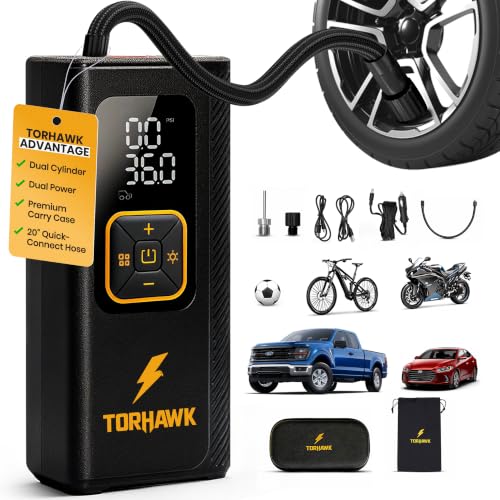
This cordless model suits drivers who value portability more than raw output. The 200PSI rating and 20000mAh battery make it attractive for emergency kits, short roadside stops, and occasional use where a power cord would be annoying.
Its strength is obvious: no need to hunt for a working outlet. The drawback is that cordless convenience can come with slower real-world recovery than a compressor-grade, battery-clamp unit when you are dealing with larger tires or several fills in a row.
OlarHike dual power inflator: best for mixed power use
This OlarHike model is aimed at drivers who want both cordless flexibility and a hardwired option. Dual power is useful when you want to start inflation in the driveway, then keep the unit ready for travel without relying on just one source.
The appeal is versatility. The drawback is that dual-power products often sit in the middle of the pack on raw output, so they can be a compromise if you need one compressor to handle frequent, larger tire jobs.
Ipflin battery and 12V compressor: best for stronger portable output
This Ipflin unit is the strongest of the four on paper for drivers who want more headroom. The listed 160 PSI rating, 9600mAh battery, and included 12V DC cord make it the most flexible choice here for mixed use and bigger tires.
The drawback is price. At $66.65, it sits above the entry-level units, and its value depends on whether you actually need the extra headroom and battery size. For a simple sedan top-off, it may be more compressor than you need.
Tire size decision matrix
This matrix ties the tire job to the minimum acceptable pressure ceiling, airflow, and duty cycle. The goal is not to buy the biggest number on the box. The goal is to buy enough compressor for the tire you actually need to fill.
| Use case | Tire size | Fill speed goal | Power source | Minimum PSI | Minimum CFM | Minimum duty cycle |
|---|---|---|---|---|---|---|
| Emergency roadside kit | Passenger car | Moderate top-off | Cigarette lighter plug | 120 PSI | 1.5 CFM | Short bursts with cool-down breaks |
| Daily driver garage use | Passenger car or crossover | Faster top-off | 12V plug or battery clamps | 150 PSI | 2.0 CFM | At least 20 minutes |
| Family SUV | Up to 33-inch tires | Steady multi-tire use | Battery clamps or multi-power | 150 PSI | 2.3 CFM | 20 to 40 minutes |
| Weekend off-road rig | 35-inch and larger | Fast fill after trail run | Battery clamps or dedicated system | 150 PSI | 5 CFM or more | 40 minutes preferred |
Passenger car top-offs
For a sedan or crossover, the compressor only needs to be fast enough to correct pressure without making the process annoying. A standard 12V model is often enough, especially if it has auto shut-off and a gauge you can read without guessing.
Suppose your crossover’s front tire is soft after a weekend road trip. A lighter-plug inflator with modest airflow can handle that job well, because the tire volume is small and the fill target is close.
33-inch tires
For 33-inch tires, you should expect a real step up in airflow and heat management. This is where a stronger 12V or battery-clamp unit makes sense, because the fill cycle is long enough that a cheap inflator starts to feel slow and hot.
A common first-timer mistake is buying a high-PSI inflator and assuming that solves the problem. It does not, if the compressor cannot move enough air or if it shuts down before the second tire is done.
35-inch and larger tires
For 35-inch and larger tires, the rule changes. You want a compressor that can sustain higher airflow, preferably around 5 CFM or more, and that has enough duty cycle to keep going after the first tire or two.
That is also where a direct battery connection becomes much more useful than a cigarette lighter plug. A big tire can expose the weak point in a small socket fast, and the compressor may never show its advertised output if the power source cannot keep up.
Car air compressors checklist
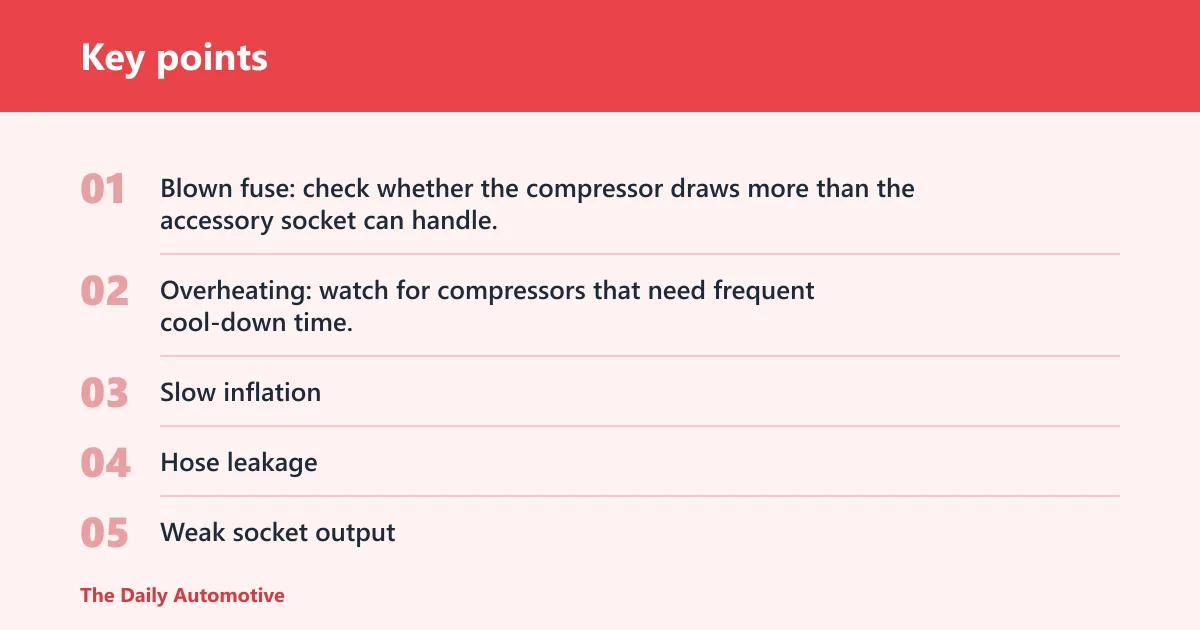
- Blown fuse: check whether the compressor draws more than the accessory socket can handle. Cigarette lighter ports are typically fused at 10 to 20 amps, so a hungry unit may trip the circuit.
- Overheating: watch for compressors that need frequent cool-down time. A 20-minute duty cycle may be fine for one tire, but it can stall a bigger fill sequence.
- Slow inflation: low CFM is the usual cause. If the compressor has decent PSI but weak airflow, the tire still fills slowly.
- Hose leakage: a poor chuck seal or damaged hose can waste air and make the compressor seem weaker than it is.
- Weak socket output: some vehicles limit accessory power enough to slow a compressor or cut it off under load.
ARB air compressor: best for off-road use
ARB is one of the names people look at when they want a serious off-road compressor. In a comparison built around trail use, that matters because the job is less about convenience and more about sustained output, heat control, and repeated tire recovery.
Its advantage is that it belongs in the higher-duty conversation, where 150 PSI and more than 2.0 CFM start to make sense. The drawback is cost and overkill for many daily-driver owners who only need a quick top-off a few times a month.
VIAIR air compressor: best for battery-clamp setups
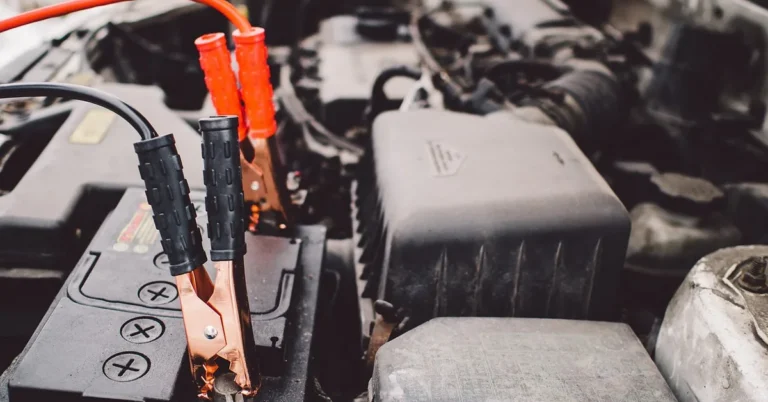
VIAIR’s battery-clamp models, including the 88P and 300P, are a strong fit when you want direct battery connection instead of depending on a lighter socket. That direct path helps with larger fills and reduces the chance that a weak accessory port becomes the bottleneck.
The advantage is power delivery. The drawback is setup friction, because battery clips are less convenient than a plug-and-go inflator when you only need to add a few PSI to one tire.
DEWALT DCC020IB: best for mixed power options
The DEWALT DCC020IB stands out because it offers three power sources: 20V MAX battery, 12V DC, and 110V AC. That makes it one of the most flexible choices for users who split time between driveway, road trip, and garage use.
Its strength is obvious for multi-scenario ownership. The drawback is that versatility can come with a tradeoff in portability and cost, especially if you only need one simple way to inflate passenger-car tires.
Which one should you buy?
If you want an emergency kit inflator, choose the compact corded or cordless option that can handle your tire size without blowing the fuse. For most sedans and crossovers, the AstroAI unit is the safest value play among the listed products because it keeps the use case simple and the 12V setup familiar.
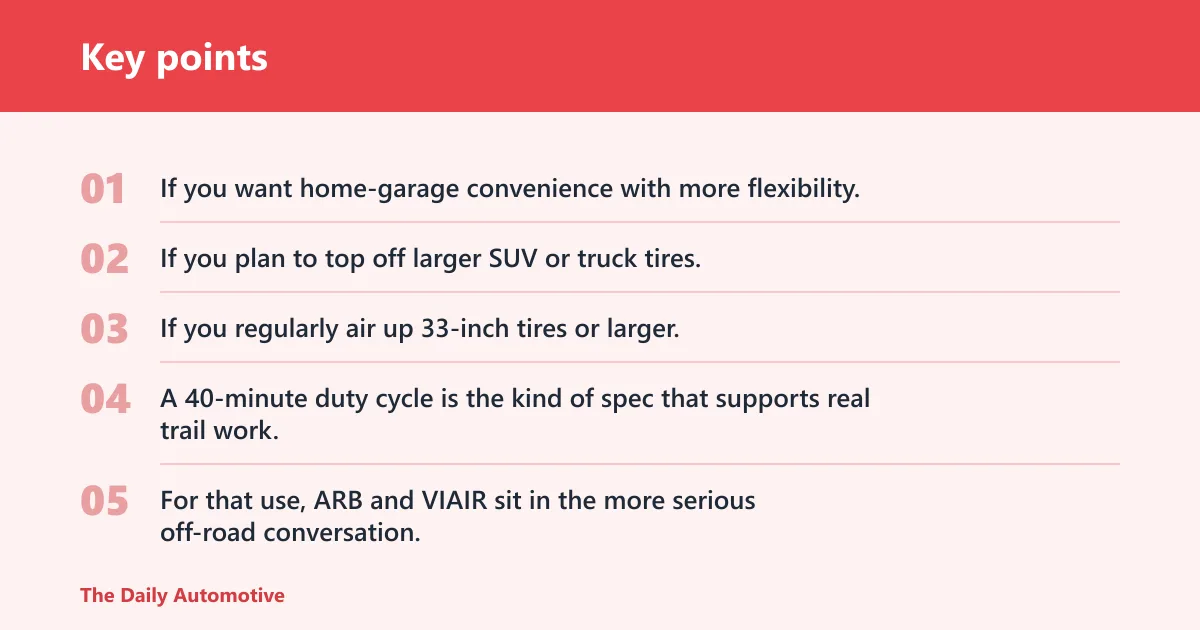
If you want home-garage convenience with more flexibility, the OlarHike or DEWALT-style multi-power approach makes more sense. If you plan to top off larger SUV or truck tires, move toward a battery-clamp or stronger battery-powered design, because the power source matters as much as the pump.
If you regularly air up 33-inch tires or larger, look past the cheapest portable inflators. A 40-minute duty cycle is the kind of spec that supports real trail work, while a 20-minute rating may leave you waiting between tires. For that use, ARB and VIAIR sit in the more serious off-road conversation.
If you mostly road-trip and just want a fast, self-contained backup, the cordless ZXNcar style is easier to stash and faster to deploy. If you want one tool to cover garage, driveway, and the occasional camp or trail stop, the DEWALT DCC020IB is the cleanest multi-source option in the group.
Price also matters. The broader comparison runs from $55.99 to $241.00, so there is a real split between cheap inflators for light duty and compressor-grade units for larger tires and repeated use. Buy for the biggest tire job you actually face, not the least expensive box on the shelf.
Frequently asked questions
What is the best car air compressor for tires in 2026?
The best choice depends on tire size and power source. For most drivers, a 12V inflator with moderate airflow is enough for sedans and crossovers. For SUVs, trucks, and larger tires, a higher-output model with battery-clamp or multi-power support is the better fit.
What PSI should a portable tire inflator have for car tires?
For daily-driver tires, 120 to 150 PSI is a practical range. The ceiling matters, but airflow matters more for speed. A compressor with enough PSI but weak CFM can still take a long time to fill a tire.
Is a 12V tire compressor enough for SUV and truck tires?
Sometimes, yes. For light SUV use and occasional top-offs, a 12V unit can work well. For repeated fills, larger tires, or faster turnaround, a battery-clamp or higher-airflow compressor is the safer choice.
How long does it take to inflate a car tire with a portable compressor?
There is no single answer, because starting pressure, target pressure, and airflow all change the result. A small passenger tire fills much faster than a 35-inch tire, and a higher-CFM compressor will cut the wait noticeably.
What is the difference between a cigarette lighter compressor and battery clamp compressor?
A cigarette-lighter compressor runs from the vehicle’s accessory outlet and is easier to use, but it is limited by that socket’s fuse and power delivery. A battery-clamp compressor connects directly to the battery, which usually gives it more current for bigger jobs.
Which portable air compressor is best for 33-inch or 35-inch tires?
For 33-inch tires, a stronger portable unit with good airflow can work well. For 35-inch and larger tires, look for 5 CFM or more and a long duty cycle. That is where compressor-grade trail models, such as ARB or VIAIR battery-clamp setups, start to make more sense.
Do I need a duty cycle rating when buying a tire air compressor?
Yes. Duty cycle tells you how long the compressor can run before it needs to cool down, and that becomes important when you are filling more than one tire. A 40-minute rating is far more useful for repeated use than a 20-minute rating.
What features should I look for in a car air compressor for emergency use?
Look for auto shut-off, a clear gauge, a hose that seals well, and a power source that matches your vehicle. For emergency use, reliability matters more than extra extras, and a compressor that trips the fuse or overheats is a bad backup.
Products related to this article
Sponsored / affiliate links. As an Amazon Associate I earn from qualifying purchases. I may earn additional commission from eligible campaigns.