Best Vinyl for Car Stickers (2026): Based on Specs and Reviews
Best vinyl for car stickers is cast automotive vinyl for curved panels and long-term outdoor use, while calendared vinyl suits flat windows and short-term decals. Wrong vinyl can lift, shrink, or crack, wasting time and transfer tape. This guide matches vinyl type to surface shape, lifespan, finish, adhesion, and application ease for cars, trucks, windows, and trim.
Quick comparison
| Product | Badge | Best for | Price | ||
|---|---|---|---|---|---|
 |
ORACAL 651 White Gloss Vinyl Roll – Durable Permanent VinylORACAL | Our pick | 24" x 150ft · Glossy · Permanent | $126.95
Price as of 23 Oct 2026
|
View |
 |
VViViD High Gloss Clear Vinyl Transfer Paper Self-AdhesiveVViViD | Pair with it | 12" x 10ft · Clear transfer · Grid | $8.98
Price as of 23 Oct 2026
|
View |
Use this as a first-pass filter: shape first, lifespan second, finish third. A sticker can look fine on a flat door and fail early on a curved badge if the film is too stiff.
Sun, moisture, and washing also change outdoor life, so the same material can age differently on a garage-kept coupe and a daily-driver pickup.
How we chose
The comparison below puts surface fit, expected outdoor life, adhesive behavior, and install difficulty ahead of brand names. That matters more than a cheap flat-panel decal or a premium curved-panel wrap piece.
We also separated printed decals from cut vinyl, because full-color graphics need different support than a single-color door logo. Finally, the table weighs failure risk: peeling, edge lift, fading, and shrinkage.
Cast vinyl: best for curves and long-term use
Cast vinyl is the stronger choice for complex curves, long-term exterior use, and body lines that move in more than one direction. TheCarResource describes cast vinyl as more durable and conformable, and the category is commonly paired with overlaminate or protective lamination for printed decals.
Where it fits best on a car
Use cast vinyl on complex-curved badges, mirror caps, bumper contours, and other shaped panels that would fight a stiffer film. It also makes sense for long-term graphics on painted exteriors, metal, plastic, and glass, all of which are common smooth, non-porous application surfaces.
For outdoor life, cast materials are typically the safer buy when you want 7-10 years of service rather than a shorter budget lifespan. That extra life matters if the decal is large, hard to replace, or exposed to daily sun and wash cycles.
When the higher price makes sense
Cast vinyl costs more up front, but that premium is easier to justify when a decal sits on a curved body panel or when replacement would require pulling trim. If the sticker is supposed to survive several seasons without edge lift, the higher-grade film usually pays back in fewer repairs.
Why overlaminate matters on printed decals
Printed cast decals often benefit from lamination because it adds UV, scratch, and water resistance while helping preserve color brightness. A glossy overlaminate can keep a graphic vivid; a matte overlaminate can cut glare and hide minor surface texture.
That extra layer is common on custom decals because print surfaces take more abuse than simple cut lettering. It is especially useful where pressure washing, road spray, and parked-in-sun exposure all happen in the same week.
Calendered vinyl: best for flat, budget decals
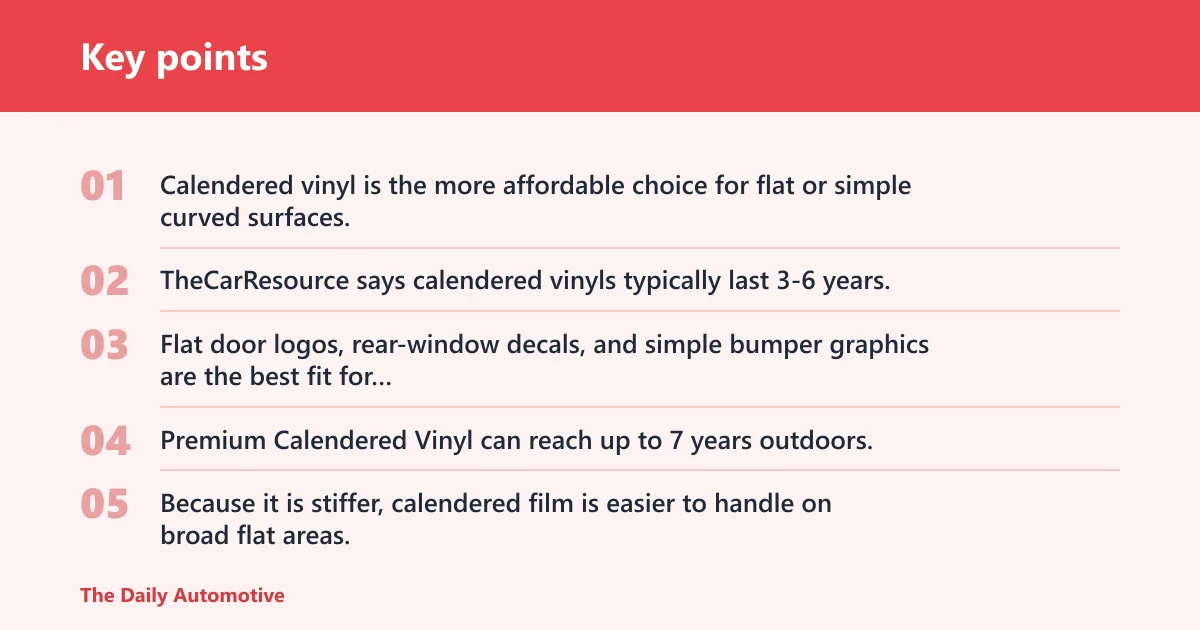
Calendered vinyl is the more affordable choice for flat or simple curved surfaces, especially when the decal does not need to stretch around deep shape changes. The same source says calendered vinyls typically last 3-6 years, and Calendered Vinyl is listed as a 3 mil vinyl with outdoor lifespan up to 5 years.
Best use cases on doors, glass, and simple panels
Flat door logos, rear-window decals, and simple bumper graphics are the best fit for calendered film when the budget matters more than long lifespan. Premium Calendered Vinyl can reach up to 7 years outdoors, but that is still a different choice from cast when the panel is highly curved.
Because it is stiffer, calendered film is easier to handle on broad flat areas. It can also work well for short-run promotional stickers where the owner expects to update the design before long wear becomes a problem.
Where stiffer film can be a problem
On tight curves, calendered vinyl is more likely to bridge edges, wrinkle, or lift early. That failure risk rises when the decal has fine corners or must bend around a badge, trim lip, or bumper recess.
If you are choosing between a cheap large sheet and a smaller cast decal, the smaller cast piece often makes more sense on a demanding surface. Less material does not fix the wrong film type.
Expected lifespan versus lower upfront cost
Outdoor durability ratings are useful only when paired with the car’s real use. A 5-year calendered sticker in heavy sun may age faster than the label suggests, while a garaged 7-year film can outlast expectations.
The practical tradeoff is simple: calendered vinyl saves money now, but cast vinyl usually avoids earlier shrinkage and edge lift on demanding panels.
Permanent adhesive vinyl: best for smooth panels
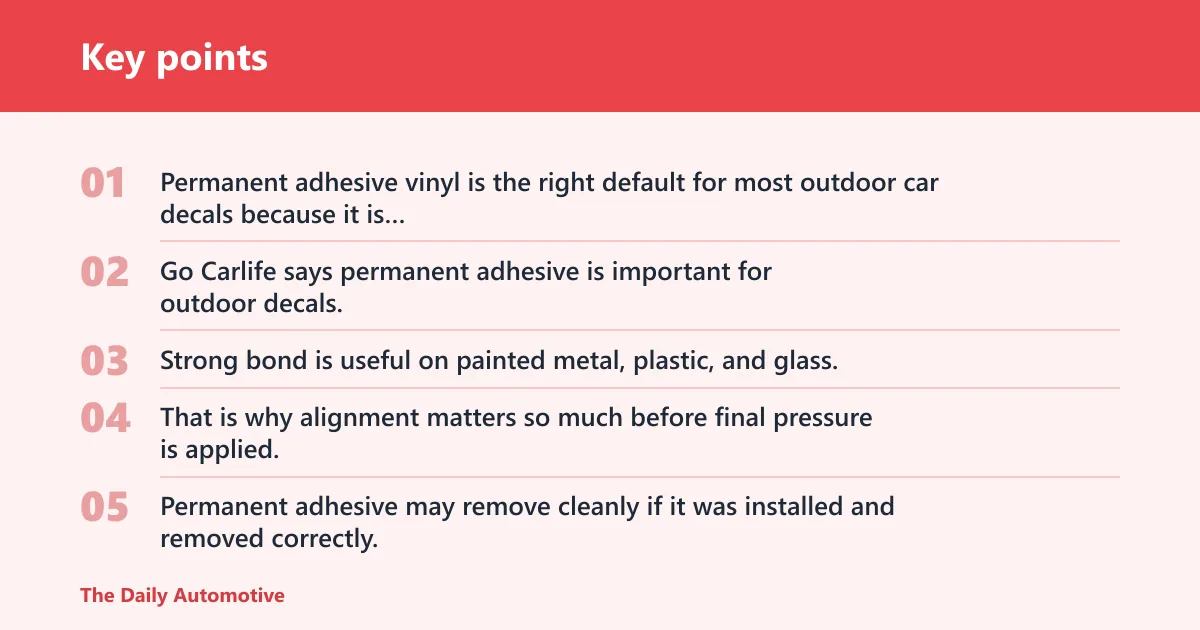
Permanent adhesive vinyl is the right default for most outdoor car decals because it is intended for long-term use and bonds strongly to smooth, non-porous surfaces. Go Carlife says permanent adhesive is important for outdoor decals, and Cardetailflow says permanent vinyl should be premium cast PVC with UV resistance.
How bond strength affects placement and removal
Strong bond is useful on painted metal, plastic, and glass, but it also means repositioning becomes harder once the decal touches down. That is why alignment matters so much before final pressure is applied.
Permanent adhesive may remove cleanly if it was installed and removed correctly, but that is not the same as being easy to move during installation. Treat it as a long-term bond, not a repositionable one.
Why prep matters on painted metal, plastic, and glass
These smooth, non-porous surfaces give the best adhesion only when they are clean, dry, and free of wax, road film, and silicone residue. Decals.com lists painted exteriors, metal, plastic, and glass as valid application surfaces for car decals.
Textured or uneven areas are a poor target because the adhesive cannot fully contact the surface. That is where edge lift starts.
When permanent adhesive is the safer buy
Choose permanent adhesive when the sticker will live outdoors, sit on a clean panel, and stay put through washing and weather. It is the safer call for most daily-driven cars, but only if the installer is ready to place it carefully the first time.
Car sticker decision matrix
This table separates surface shape from lifespan, which is where many bad purchases start. A flat door logo and a curved badge are not the same job, even if they are both “car decals.”
| Scenario | Best vinyl type | Finish | Adhesive | Surface shape | Expected outdoor life | Failure risk | Best use case |
|---|---|---|---|---|---|---|---|
| Flat door logo | Calendered vinyl | Gloss or matte | Permanent adhesive | Flat panel | 3-6 years | Low if surface is clean | Budget branding on doors or quarter panels |
| Rear-window decal | Cast vinyl or premium calendered | Gloss for brightness, matte to cut glare | Permanent adhesive | Flat glass | 5-8 years | Low to moderate if edges are thin | Longer-life graphics on glass with sun exposure |
| Bumper graphic | Cast vinyl | Gloss or matte | Permanent adhesive | Simple curve | 7-10 years | Moderate if the film is stiff | Daily-driver graphics that need flex and durability |
| Complex-curved badge | Cast vinyl | Gloss often hides seams better | Permanent adhesive with air-release | Complex curve | 7-10 years | High if calendered film is used | Trim pieces, emblems, and tight contours |
| Small fine-lettering decal | Cut cast vinyl | Gloss or matte | Permanent adhesive | Flat or simple curve | 5-8 years | Moderate if transfer tape tack is wrong | Layered names, phone numbers, or fleet text |
| Full-color printed sticker | Cast printed vinyl | Gloss or matte with overlaminate | Permanent adhesive | Flat panel | 7-8 years | Moderate if unlaminated | Custom graphics that need UV and scratch protection |
| Simple side stripe | Premium calendered vinyl | Gloss | Permanent adhesive | Simple curve | Up to 7 years | Moderate on tighter bends | Low-cost styling on long door runs |
| Glass shop decal | Calendered vinyl | Gloss | Permanent adhesive | Flat glass | Up to 5 years | Low | Temporary-to-medium-term storefront or shop use |
Which vinyl is easiest to apply without bubbles?
Vinyl with air-release adhesive is easiest to apply without bubbles because the channels let trapped air escape during squeegeeing. That feature is common on premium and cast films, and it is one of the best choices for DIY installers who want a cleaner first pass.
How air-release adhesive changes the install
Air-release adhesive cuts the chance of tiny bubbles becoming permanent defects under the film. It does not replace clean prep or careful pressure, but it gives you more room to correct contact points before the adhesive fully sets.
When transfer tape matters most
Transfer tape matters most for cut vinyl decals, fine lettering, and layered graphics where letter spacing and alignment must stay intact. Medium-tack transfer tape is often the better choice because it holds the design during placement but releases more cleanly after burnishing.
That balance matters when the decal has thin strokes or small islands. Too much tack can pull the vinyl out of place; too little tack can leave letters behind on the liner.
Simple setup checks before you start
- Clean the surface until it is free of wax, dust, and residue.
- Dry it completely; moisture ruins adhesion.
- Work in mild conditions, not on a hot panel or in cold damp air.
- Use the right blade depth so you cut vinyl, not the backing liner.
- Set transfer tape tack to match the size and detail level of the decal.
Say your rear-window decal is 12 inches wide and has thin lettering. A medium-tack tape and a clean, dry pane matter more than the cheapest possible film, because one missed edge can ruin the alignment.
Which one should you buy?
For most buyers, cast vinyl with permanent adhesive is the best all-around pick because it handles curves better and lasts longer outdoors. Calendered vinyl is the better budget choice for flat panels, while printed decals should move up to lamination if color life matters.
Best pick by budget
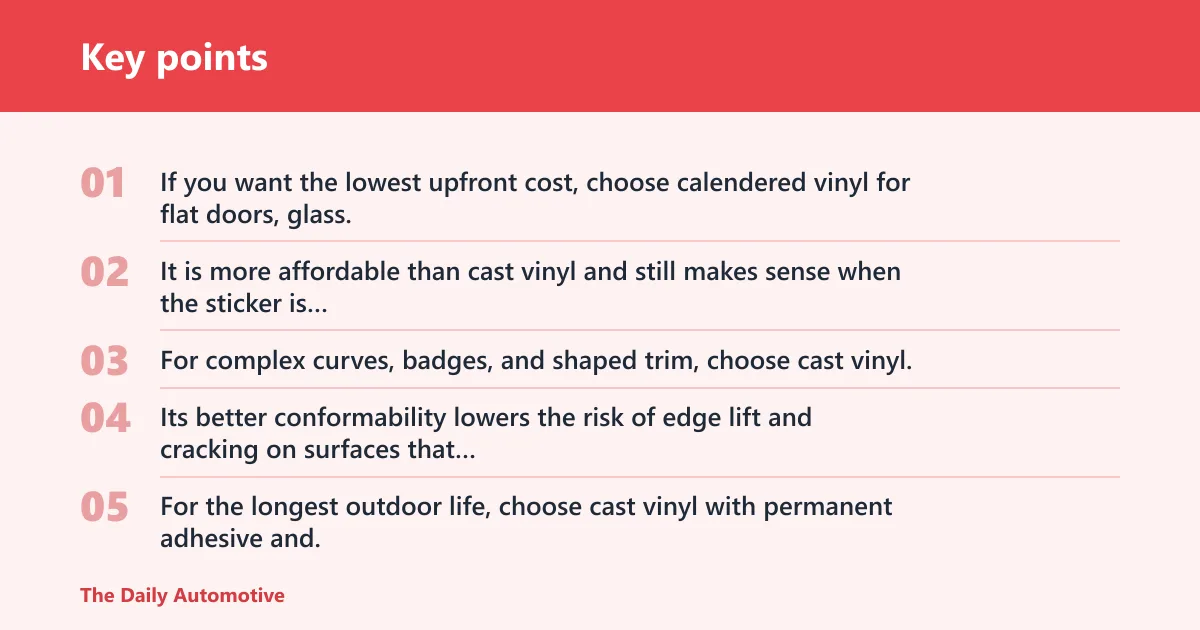
If you want the lowest upfront cost, choose calendered vinyl for flat doors, glass, or simple bumper work. It is more affordable than cast vinyl and still makes sense when the sticker is temporary or the panel is easy.
Best pick by surface shape
For complex curves, badges, and shaped trim, choose cast vinyl. Its better conformability lowers the risk of edge lift and cracking on surfaces that bend in more than one direction.
Best pick by lifespan need
For the longest outdoor life, choose cast vinyl with permanent adhesive and, for printed decals, add overlaminate. That combination is the best answer when you want durability that can survive sun, moisture, and washing better than a basic flat-panel decal.
Best pick by finish preference
Glossy vinyl gives a brighter, sharper look and often suits daily-driver graphics that need visual pop. Matte is the better call when you want less glare or a more muted appearance, especially on glass and black trim.
Suppose you are putting a 6-inch logo on a flat painted door, and the car sits outside every day. Calendered permanent vinyl is usually enough. Now change only one variable: move that same logo onto a curved fuel-door cover, and cast vinyl becomes the safer choice.
A common first-timer mistake is choosing a cheap sheet for a curved badge because the sticker is small. Size does not cancel shape; a 2-inch decal can still fail if the film is too stiff for the contour.
How to choose
Start with the surface, not the color. Flat painted panels, glass, and metal are the easiest targets; textured plastic and uneven trim are not ideal for a clean bond.
Next, match lifespan to use. If the sticker only needs to last a season, calendered vinyl is reasonable. If the goal is multi-year outdoor service, cast vinyl with permanent adhesive is the better buy.
Then decide whether the design is cut or printed. Cut vinyl is best for lettering and simple shapes, while printed decals need lamination if you want better UV, scratch, and water resistance.
Finally, choose the finish and installation setup that fit the job. Gloss or matte is a visual decision, but air-release adhesive, proper transfer tape tack, and careful blade settings make the difference between a clean install and a rework.
Frequently asked questions
What is the best vinyl for car stickers?
Cast automotive vinyl is the best all-around choice for car stickers when you care about durability and curved surfaces. Calendered vinyl is a strong budget option for flat or simple curved panels, but it is less conformable and usually has a shorter outdoor life.
Is cast vinyl better than calendered vinyl for car decals?
Yes, if the decal must wrap curves or last longer outdoors. Cast vinyl is more conformable and typically more durable, while calendered vinyl is stiffer and better for flat surfaces where cost matters more than long service life.
How long does car decal vinyl last outdoors?
It depends on material choice, sun exposure, moisture, and washing. Calendered vinyl is often listed in the 3-6 year range, with examples at up to 5 years and premium calendered up to 7 years. Cast films can reach 7-10 years, with some premium examples rated up to 8 years.
What vinyl is easiest to apply on a car without bubbles?
Air-release adhesive vinyl is the easiest to apply without bubbles because it lets trapped air escape during squeegeeing. That is why premium and cast films are common choices for DIY work, especially when the decal is large or has thin details.
Can permanent vinyl damage car paint?
Permanent vinyl is made for long-term outdoor use and can remove cleanly if it was installed and removed correctly. The risk rises when paint is weak, fresh, damaged, or poorly cured, so clean, healthy factory paint is the safest surface.
What is the best vinyl for curved car surfaces?
Cast vinyl is the best choice for curved car surfaces because it conforms better than calendered film. On complex badges, bumper shapes, and trim contours, that flexibility lowers the chance of lifting, wrinkling, and edge failure over time.
Should I use matte or glossy vinyl for car stickers?
Choose glossy if you want stronger visual pop and brighter color, especially on printed decals. Choose matte if you want less glare or a more subdued look. Finish is mostly preference, but the surface and viewing angle should guide the choice.
Do I need lamination on car stickers?
Lamination is not required for every sticker, but it is a smart add-on for printed custom decals. It adds UV, scratch, and water resistance and helps preserve color brightness, which is especially useful on vehicles parked outside and washed often.
What file format is best for custom car decals?
Vector files are usually the best starting point for custom cut decals because they scale cleanly and keep edges sharp. For printed decals, a high-resolution raster file may also work, but the printer still needs a clean, properly sized source file for accurate output.
Products related to this article
Sponsored / affiliate links. As an Amazon Associate I earn from qualifying purchases. I may earn additional commission from eligible campaigns.