Auto Air Pump for Car Tires: Cordless vs. 12V Compressors
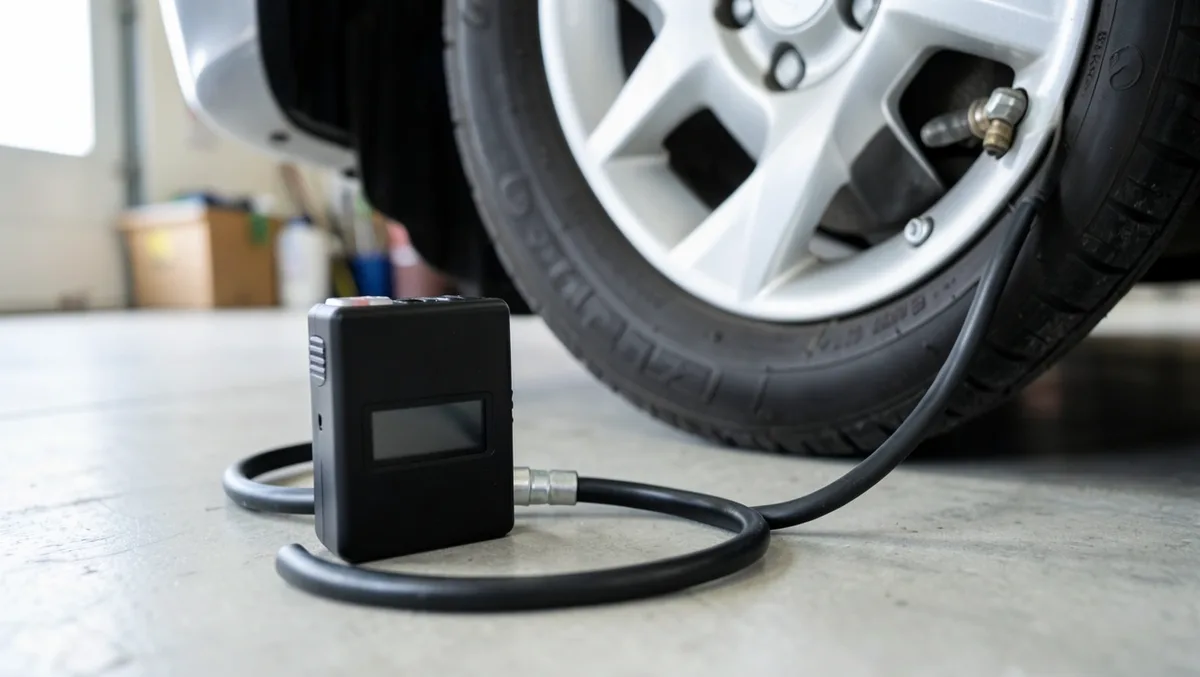
A 12V auto air pump inflates a car tire in a few minutes by plugging into the same outlet you use for a phone charger, no trip to a gas station required.
These pumps read tire pressure on a digital gauge, let you set a target PSI, and shut off automatically once they reach it, so there’s no eyeballing an analog needle or overinflating a tire by accident. Cordless, battery-powered models have also become common, which matters if you ever need to add air before starting the engine or somewhere without a 12V outlet nearby. Below are three options, two plug-in and one cordless, along with the PSI numbers you should actually be using.
What PSI Should You Actually Use?
Every car has a manufacturer-recommended tire pressure, and it isn’t the number stamped on the tire itself. The tire sidewall lists the maximum pressure the tire can safely hold, which is almost always higher than what your vehicle actually needs. The correct number is on a sticker inside the driver’s door jamb (or in the glovebox or fuel door on some older models), and it’s typically 30 to 35 PSI for a passenger car, more for a loaded SUV or truck.
Check pressure when the tires are cold, meaning the car has been parked for at least three hours or driven less than a mile. Driving heats the air inside a tire and can raise the reading by three to five PSI, so a tire that measured 32 PSI cold can show 36 PSI after twenty minutes on the highway – that’s normal, not a leak. A digital auto air pump with an accurate gauge and a preset auto shut-off takes the guesswork out of hitting the door-jamb number exactly, whether you’re topping off before a trip or dealing with a slow leak that tripped the dashboard warning light overnight. If you’d rather use a shop-style compressor instead of a plug-in pump, see our guide on using an air compressor to inflate car tires for the differences.
AstroAI AIRUN H Tire Inflator Portable Air Compressor
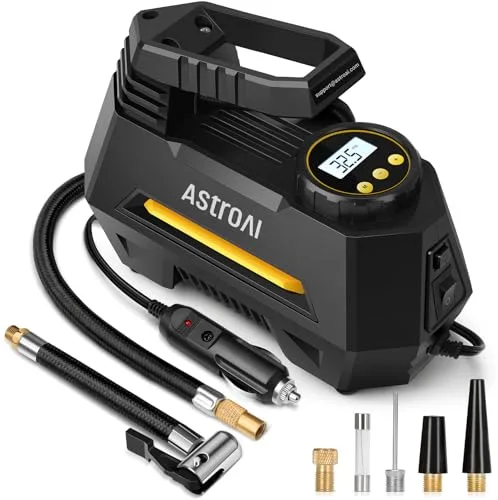
The AstroAI AIRUN H plugs into any 12V outlet and is built around a 120-watt motor that can push a standard passenger tire from 30 to 36 PSI in under a minute, which makes it a solid pick for anyone who wants one inflator to live in the trunk permanently.
Pros:
- 120W motor rated at 35 liters per minute of airflow
- Digital gauge switches between PSI, kPa, Bar, and kg/cm², with auto shut-off at your target
- Backlit LCD and a one-touch LED flashlight for reading the display or working at night
- 9.84-foot cord reaches every tire on most cars without repositioning
- 2-year warranty and a 15A in-line fuse to protect the car’s electrical system
Cons:
- Needs a running or accessory-powered 12V outlet; there’s no battery backup
- Built-in thermal shutoff kicks in after 15 minutes of continuous use, so a very low tire may need a short cooldown partway through
Beyond the headline inflation speed, the kit is what makes this one practical for more than car tires: it ships with two nozzle tips, a needle valve for sports balls, and a Presta-to-Schrader adapter for road and mountain bikes, so the same unit covers a flat car tire, a soft bike tire, and a deflated basketball without buying separate adapters. AstroAI notes it isn’t meant for high-volume inflatables like pool floats or air mattresses, which need far more airflow than any tire pump provides.
Add it to your cart on Amazon.
Rocgorld R8 Tire Inflator Portable Air Compressor
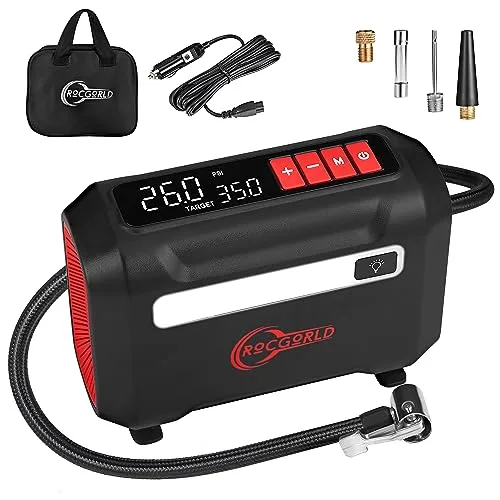
The ROCGORLD R8 trades some of the AstroAI’s accessory kit for raw speed: its 40 liter-per-minute cylinder is rated to inflate a 215/50R17 tire in under a minute and a Tesla-sized 235/40R19 tire in about ninety seconds, both faster than the AIRUN H above.
Pros:
- 40L/min cylinder, rated roughly 3x faster than the R7 model it replaces
- Dual digital LED screen shows the live reading, preset target, and error codes at once
- Auto shut-off plus a memory function that recalls your last preset pressure
- 10-foot power cord and a 2-foot hose, both rated for repeated folding
- Compact at 2.79 x 4.92 x 6.49 inches, with a carrying bag included
Cons:
- 12V DC only, with no battery backup for use away from the car
- Runs on a standard cigarette-lighter adapter, so it draws the same 10-15 amps as other plug-in inflators, which some older vehicles’ outlets can’t sustain for long
The trade-off for that speed is that the R8 is plug-in only, so it needs the engine on or the accessory outlet powered, unlike the cordless option below. For most people that’s a non-issue since a flat tire usually gets fixed with the car running anyway, and the memory function means you won’t have to re-enter your target pressure every time you top off.
See today’s price on Amazon.
OlarHike Dual Power Tire Inflator Portable Air Compressor
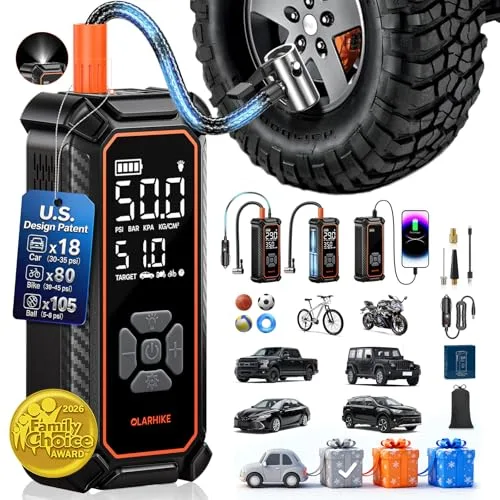
The OlarHike Dual Power Tire Inflator is the pick for drivers who don’t want to be limited to a car’s power outlet. It runs on a built-in rechargeable battery or on a standard 12V DC plug, whichever is on hand, so it works just as well in a driveway or parking garage as it does roadside with the engine running.
Pros:
- Dual power: rechargeable battery or 12V DC plug, whichever is available
- Auto shut-off with a preset target across PSI, BAR, KPA, and KG/CM² units
- Dual LED display shows current and target pressure at the same time
- Battery rated for roughly 18 standard car tire top-offs per charge
- Built-in LED flashlight and a USB output that can charge a phone in an emergency
Cons:
- A full battery recharge takes longer than simply plugging into the 12V outlet, so heavy users may prefer running it corded
- At 1.2 pounds it’s still light, but the built-in battery pack adds bulk compared with plug-in-only models
What sets this inflator apart from the two above is the option to skip the cord entirely. Three built-in 2000mAh cells power the pump on their own, rated for around 18 top-offs on a standard car tire or 11 on a larger SUV tire before it needs a recharge, so it can top off a tire before you even start the engine. Plug it into the 12V outlet instead and it runs on continuous power, the same as any corded inflator.
The dual LED screen shows the live reading next to your preset target, and the auto shut-off cuts power the moment the tire reaches that number, matching the accuracy of the other two picks here. Four preset modes cover cars, bikes, motorcycles, and balls, with a custom setting for anything else, and the whole unit weighs about 1.2 pounds with a padded storage bag included.
Check current availability on Amazon.
Frequently Asked Questions
How Do I Use an Auto Air Pump for Car Tires?
Plug the inflator into your car’s 12V outlet, then screw the hose fitting onto the tire’s valve stem until it stops hissing air. Set your target pressure on the digital gauge, press start, and the pump will shut off on its own once the tire reaches that number. Unscrew the hose and replace the valve cap when you’re done.
What Features Should a Tire Inflator Have?
Look for a digital gauge accurate to about ±1 PSI, an auto shut-off so you can’t overinflate, and at least one nozzle attachment beyond the standard tire valve for balls or bike tires. An LED light is useful for nighttime roadside use, and if you want to use the pump away from the car, look for a battery-powered or dual-power model instead of a 12V-only one.
Can These Pumps Inflate More Than Car Tires?
Yes. Most ship with a needle valve for sports balls and an adapter for Presta bike valves in addition to the standard Schrader nozzle used on car and motorcycle tires. A few, like the AstroAI AIRUN H above, list pool floats and air mattresses as unsupported since those need far more airflow volume than a tire pump provides.
How Fast Do These Air Pumps Work?
For topping off a tire that’s already partly inflated, a few PSI in under a minute is typical for the faster models here. A tire that’s completely flat takes longer, usually several minutes, since the pump has to move a much larger volume of air before the pressure even starts to climb.
Are Portable Tire Inflators Easy to Carry?
Yes, most weigh one to two pounds and are small enough for a glovebox or door pocket. Plug-in models coil their cord and hose into the housing or a carrying bag, while cordless models add a small battery pack but stay in roughly the same size and weight range.
What PSI Should I Set My Auto Air Pump To?
Use the number on the sticker inside your driver’s door jamb, not the maximum pressure printed on the tire sidewall. That door-jamb number is what the vehicle manufacturer actually calibrated the suspension and handling around, and it’s usually a few PSI lower than the tire’s stamped maximum.
Conclusion
All three of these inflators will get a tire from flat to road-ready in a few minutes without a trip to a gas station, so the right pick comes down to how you plan to use it. The AstroAI AIRUN H includes the most accessories for switching between car, bike, and ball, the ROCGORLD R8 inflates a large SUV or Tesla-sized tire fastest, and the OlarHike Dual Power is the only one of the three that works away from a 12V outlet.
Whichever inflator you choose, set it to the pressure listed on your driver’s door jamb sticker rather than the number on the tire sidewall, and check it when the tires are cold for the most accurate reading. For more on choosing between plug-in and cordless options, see our guide to portable air pumps for cars.
Products related to this article
Sponsored / affiliate links. As an Amazon Associate I earn from qualifying purchases. I may earn additional commission from eligible campaigns.