Best Car Alignment Services Near Me: Top Toe Alignment Tools
Wrong toe settings can scrub tires quickly, pull the car off-centre, and waste fuel. This guide explains toe alignment tools, the measurements to ask for, and how to judge a shop before you book.
Top pick for nearby alignment shops


The strongest choice is the shop that can prove the work, not just promise it. Look for a recent before/after printout, stated manufacturer targets, and a clear explanation of whether the job is front-only or four-wheel.
A cheaper quote can be the worse deal if it skips rear axle checks, omits calibration details, or gives you no readings at all. The better shop is the one that shows toe values before and after adjustment and tells you which angles were included.
Quick picks by need
- Front-wheel-drive car with a pull: A front alignment can be enough if the rear axle is fixed and the shop can set front toe back to the original specifications.
- Vehicle with rear tyre wear or a shifted thrust line: Choose a 4-wheel alignment so the shop can check front and rear axle tracking.
- Driver who wants proof: Pick the shop that prints before-and-after readings and names the machine used for the job.
Say your hatchback pulls left at motorway speed and the steering wheel sits a few degrees off-centre after a kerb strike. A proper alignment visit should start with measurements, not with a quick toe tweak alone, because bent parts or worn joints can stop the steering from returning to centre.
Suppose your SUV has even tyre wear at the rear but uneven wear at the front shoulders. A front alignment may be enough if the rear suspension is fixed, but the shop should still confirm rear readings first so a hidden thrust-angle issue does not get missed.
What does toe alignment mean on a car?
Toe alignment is the setting that controls whether the wheels point slightly inward or outward when viewed from above. It is measured as front toe and rear toe, and many alignment jobs focus on toe because it is the adjustment many shops can change directly.
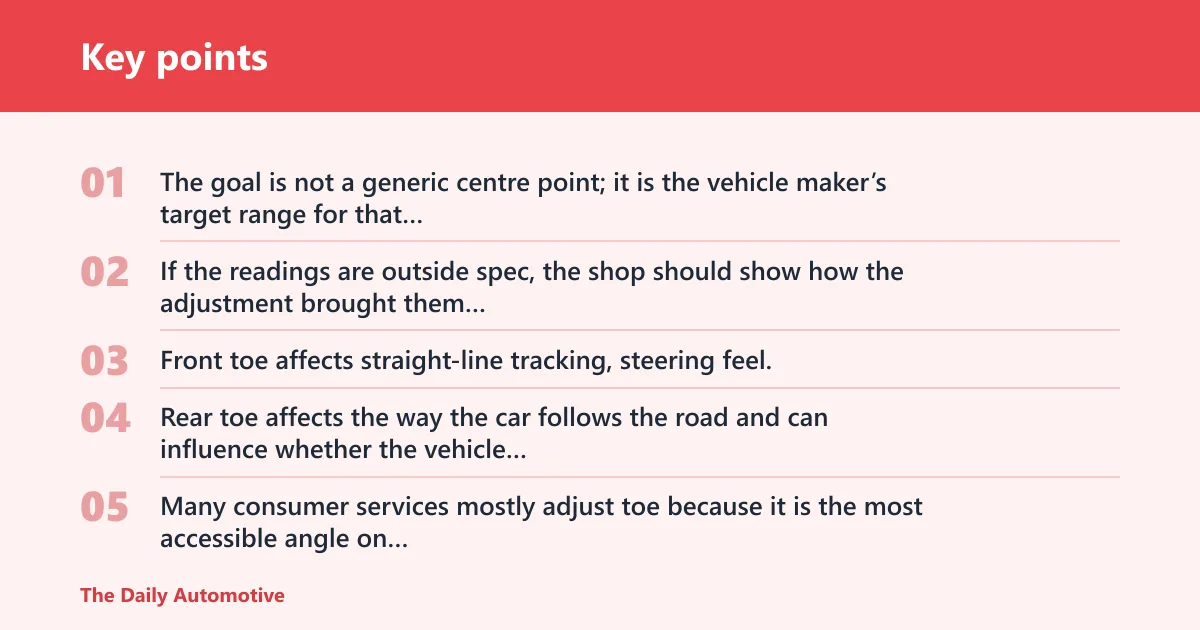
Manufacturer specifications matter here. The goal is not a generic centre point; it is the vehicle maker’s target range for that specific model and suspension layout. If the readings are outside spec, the shop should show how the adjustment brought them back.
Front toe versus rear toe
Front toe affects straight-line tracking, steering feel, and whether the wheel sits centred. Rear toe affects the way the car follows the road and can influence whether the vehicle “crabs” or feels unstable under load.
Many consumer services mostly adjust toe because it is the most accessible angle on common road cars. Camber and caster may be checked, but they are not always adjustable without extra parts or repair work.
Why toe is often the main service adjustment
Toe is often the quickest angle to correct with alignment heads and laser equipment. That does not mean it is the only angle that matters. If toe is set correctly but the steering wheel remains off-centre, the shop should inspect suspension wear, tyre condition, and possible bent components.
How manufacturer specifications set the target
Every alignment job should be judged against the car manufacturer’s specified range. A shop that works to “centre” alone may leave the car outside the best position for handling and tyre life. The printout should show the starting readings and the finished readings.
Toe alignment tools and shop checklist
A competent alignment shop uses digital or laser alignment equipment, a proper lift or rack, and a calibration routine that keeps readings repeatable. Without that, the numbers on screen are much less useful.
| Tool or equipment used | What it measures | What result to ask for | Red flags if the shop cannot provide a before/after printout |
|---|---|---|---|
| Laser alignment equipment | Toe angle and tracking changes at the wheels | Front toe or four-wheel toe set to manufacturer specifications | No written readings, no calibration explanation, or a verbal “it looks fine” only |
| Digital alignment heads | Wheel angle data used to compare current settings with original settings | Before and after numbers for the axle being adjusted | Screen-only results with no printout or no mention of target ranges |
| Alignment lift or rack | Vehicle position during measurement and adjustment | Car set on a proper alignment rack with level runways | Shop uses an ordinary lift with no alignment setup or no room to keep wheels square |
| Calibration checks | Repeatability of the machine and heads | Evidence that the equipment is calibrated and ready before the job starts | Staff cannot say when the equipment was last checked |
Alignment lift or rack setup
An alignment rack, including a 4-post alignment lift, gives the machine a stable platform and the wheels the correct position for measurement. Wide runways matter because the car must sit squarely while the shop reads toe and makes adjustments.
This is one reason a generic tyre bay is not the same as a proper alignment bay. The equipment needs the right floor space, rack geometry, and measuring heads to produce readings that can be compared before and after the service.
What to ask for before booking
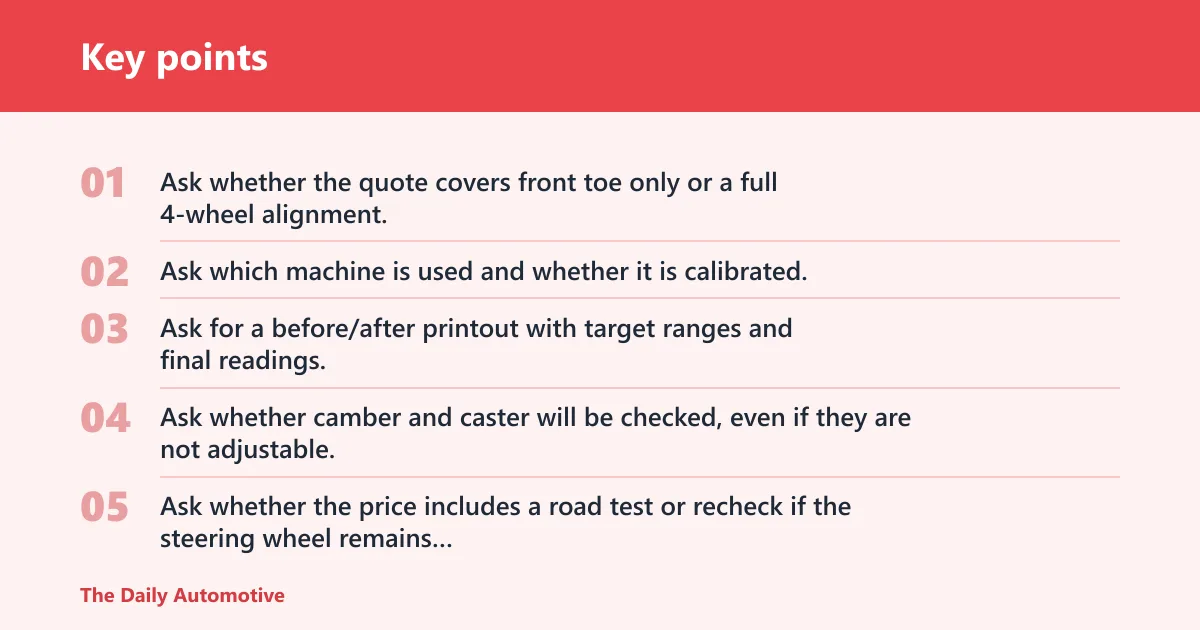
- Ask whether the quote covers front toe only or a full 4-wheel alignment.
- Ask which machine is used and whether it is calibrated.
- Ask for a before/after printout with target ranges and final readings.
- Ask whether camber and caster will be checked, even if they are not adjustable.
- Ask whether the price includes a road test or recheck if the steering wheel remains off-centre.
A common first-timer mistake is booking a quick toe adjustment and leaving without a printout of the alignment readings. If the shop cannot show the numbers, you cannot tell whether the toe was inside spec before the job or only moved partway into range.
Red flags during the visit
If the shop skips calibration, refuses to show readings, or says every car gets the same setting, walk away. Alignment is vehicle-specific. A correct service should name the target values for your car and show the finished result against those targets.
Do you need 2 wheel alignment or 4 wheel alignment?
Choose 2 wheel alignment when the rear axle is fixed and the front end is the only section that needs adjustment. Choose 4 wheel alignment when the car has adjustable rear settings, rear tyre wear, or a symptom that suggests the rear axle is not tracking properly.
Front-only alignment is often enough on many cars with a simple rear suspension layout. Four-wheel alignment is the safer choice when the vehicle is sensitive to rear toe changes, has a history of impacts, or feels unstable even after the front is corrected.
When front-axle-only service fits
Front-wheel-drive cars and many vehicles with a non-adjustable rear axle can be handled with front alignment alone, provided the rear is within spec. National says its front alignment adjusts front toe to original settings, which is the right starting point for cars that only need the front corrected.
When a four-wheel check is the better call
A 4-wheel alignment includes front and rear axle digital tracking. The same source lists this as part of its four-wheel service. That extra check matters when rear toe can influence the way the car goes straight, especially after suspension work or impact damage.
Why some four-wheel jobs still focus on toe
Some four-wheel offerings adjust toe only, even though the shop checks more than one axle. That is still useful if the car’s camber and caster are not adjustable or do not need correction. The important point is that the shop should explain what it checked and what it actually changed.
Halfords offers a 2 wheel alignment at £67.99 and a 4 wheel alignment at £99.99. National prices standard front wheel alignment at £67.99 and four wheel alignment at £99.99. Those figures help you compare quotes, but they do not tell you whether the quote includes printouts, calibration, or a rear-axle check.
Wheel balancing vs wheel alignment
Wheel balancing is not the same as alignment. Balancing corrects uneven weight distribution in the wheel and tyre assembly with offset weights on the rim. Alignment changes the wheel angles so the car tracks correctly.
If the problem is steering pull or an off-centre wheel, alignment is the first place to look. If the problem is speed-related vibration, balance may be the issue instead, especially if the vibration shows up through the seat or steering wheel at a steady speed.
Symptoms that point to balance instead of toe
A vibration at highway speed often points to balance, tyre defects, or wheel damage. Toe problems more often show up as pulling, wandering, or feathered tyre wear. A shop should not guess; it should separate the two checks and explain which one fits the symptom.
Halfords lists wheel balance at £7.99. That is a distinct service from alignment, and it should not be used as a substitute for a geometry check when the steering wheel is off-centre.
When a shop should check both
If you have a recent pothole hit and both a pull and vibration, the shop should check alignment and balance in the same visit if possible. Wheel balancing can reduce vibration, while alignment can correct the geometry that affects straight-line driving and tyre wear.
How do you know if your wheels are out of alignment?
The clearest signs are pulling to one side, an off-centre steering wheel, and uneven tyre wear. A car can also feel darty or unstable at speed. Those symptoms usually point to toe or related geometry settings that are out of the manufacturer range.
The same source says wheel alignment is also known as tracking, and that potholes or kerbs can affect it. That matches the everyday warning signs: a kerb strike can move the angles enough to change how the car goes straight.
What potholes and kerb hits can change
A hard hit can shift toe, bend a wheel, or damage a suspension part. If the impact is severe enough, the car may need more than an alignment. It may need a check for bent steering links, damaged control arms, or wheel damage before any setting is finalised.
Why a car can still feel wrong after alignment
If the steering wheel stays off-centre after a completed alignment, worn suspension bushes, bent parts, or a stretched tie-rod can be the reason. The shop should not keep adjusting toe in circles. It should inspect for the underlying fault and verify that the readings hold after the change.
Choose the shop that can show manufacturer-spec readings, explain which angles were checked, and provide a before-and-after printout. A good quote should name the type of alignment, the equipment used, and what is included in the price.
The same source says alignment helps realign wheels to manufacturer guidelines. The same source says front alignment uses laser aligning equipment and that alignment can reduce tyre and suspension wear while improving handling and fuel consumption. Those are useful claims only if the shop can back them with readable measurements.
What should a shop check besides toe during alignment?
The shop should check camber and caster, plus tyre condition, wheel damage, and suspension wear. Even when only toe is adjustable, the other angles help explain why the car pulled or why the steering wheel did not centre properly after the adjustment.
How much should the quote include?
Ask whether the price includes the inspection, the adjustment, the printout, and a recheck if the wheel is still not centred. A headline price is less useful if it excludes the proof that the settings are now in spec.
Picture a family saloon that has a steady left pull after a tyre change. If the shop only checks front toe and skips the rear, the underlying issue may remain. A four-wheel reading gives a better picture of the car’s actual tracking and makes the result easier to trust.
Frequently asked questions
What is the best car alignment service near me?
The best nearby alignment service is the one that can show before-and-after readings, work to your car’s manufacturer specifications, and explain whether it is doing a 2 wheel or 4 wheel alignment. If it cannot produce a printout, the job is harder to verify.
How much does wheel alignment cost near me?
Costs vary by shop and by service type. As one benchmark, Halfords offers a 2 wheel alignment at £67.99 and a 4 wheel alignment at £99.99. The same source lists the same prices for standard front wheel alignment and four wheel alignment, but you should still confirm what is included.
What tools are used for toe alignment?
Shops use laser alignment equipment or digital alignment heads, along with a proper alignment lift or rack. The key point is repeatable measurement. Ask whether the machine is calibrated and whether the shop will print the before-and-after readings so you can check the result.
Why is my steering wheel off-center after alignment?
An off-centre steering wheel can mean the toe was not centred correctly, or it can point to worn or bent suspension parts. If the readings are in spec but the wheel still sits crooked, the shop should inspect the hardware instead of making another blind adjustment.
Products related to this article
Sponsored / affiliate links. As an Amazon Associate I earn from qualifying purchases. I may earn additional commission from eligible campaigns.