Dealer Financing vs Credit Union Financing: Which Wins?
Credit union financing usually wins on total cost, but dealer financing can beat it when a manufacturer subvented APR is lower than your credit union rate after lender fees and required add-ons are counted. Skip that check, and you can pay more in interest, fees, or markup than the car is worth. I compare both offers on true out-the-door cost, then I look for the rare dealer-finance deal that actually saves money.
This guide is part of our Car buying, financing, and selling guide series.
Dealer financing vs credit union financing: the real trade-off

The real comparison is not “who quotes the lower APR.” It is which offer produces the lower out-the-door monthly payment after term length, fees, add-ons, rebates, and required insurance products are folded in. Dealer financing can look cheaper on the front end and still cost more over the loan life if the payment is padded with extra products or a longer term.
Credit union financing often starts with cleaner pricing because it is direct-lender pricing, but dealer financing has one legitimate advantage: access to captive finance promos tied to a specific model or trim. That is the only time a dealer can truly win on total cost, and it is easy to miss if you only compare the rate line.
| Decision factor | Dealer Financing | Credit Union Financing | Winner |
|---|---|---|---|
| APR and total interest | Can be higher, especially if the dealer adds a markup before presenting the loan. | Usually lower direct-lender pricing; early-2025 average auto loan rates were 6.84% APR. | Credit Union Financing |
| Fees and add-ons | More likely to include F&I add-on pressure and payment padding. | Usually fewer lender-side add-ons; less room for backend profit. | Credit Union Financing |
| Special promo deals | Can win through captive financing and 0% to 1.9% APR on eligible models. | Rarely matches a manufacturer subvented offer on the exact same vehicle. | Dealer Financing |
| Shopping comparison power | Useful if you bring a pre-approval and force a match on the buy rate. | Strong before you visit the showroom; locks a ceiling on your rate. | Tie |
APR and total interest
APR sets the total interest you pay, but only when the term stays the same. A 60-month new car loan on $35,000 at 6.84% APR comes to about $6,300 in total interest, while 10% APR is roughly $9,800. That gap is real money, and it grows fast when the dealer stretches the term.
Fees and add-ons
Dealer financing is often bundled with document fees, gap coverage, service contracts, and other add-ons. Some of those products may fit a buyer’s needs, but they change the real monthly payment and can erase a rate advantage. Credit union offers are usually easier to price cleanly because the lender side is simpler.
Special promo deals
Dealer financing can win when it comes through captive financing, the manufacturer-owned lending arm. Ford Credit and Toyota Financial Services are examples of this setup. If the promo APR is 0% to 1.9% APR and the vehicle qualifies, that deal can beat a credit union even when the credit union’s base rate looks attractive on paper.
How dealership financing works in the F&I office
Dealer financing runs through the dealership’s F&I office, where the finance manager submits the application to a third-party lender network. Dealer financing can also be routed through captive financing, meaning the manufacturer’s own finance arm. The buyer usually sees one presented offer, not the whole ladder of approvals behind it.
Third-party lender network and submitted applications
The dealership sends the application to several lenders and waits for an approval tier. That setup can help a buyer with thin credit or limited history because the dealer is shopping the file for a fit. It can also hide the fact that the approved rate may be higher than the rate shown in the showroom.
Captive finance offers versus arranged financing
Arranged financing uses a bank or credit union the dealer works with. Captive financing is different: the manufacturer subsidizes the rate to move specific inventory. That is why a promo can be attached to one trim and not the one next to it on the lot.
Dealer reserve, rate markup, and add-on pressure
Dealer financing may involve a rate markup before the loan is presented to the buyer. The dealer’s backend profit from that markup is called dealer reserve. That is why a buyer should ask for the buy rate, then ask the dealer to match a written outside pre-approval before agreeing to any add-ons.
How credit union auto loans work
Credit union auto loans are issued by a member-owned lender, so eligibility starts with membership. Some credit unions are local; others are nationwide, including Navy Federal Credit Union and PenFed Credit Union. Their direct-lender pricing is often cleaner because the credit union is not trying to make profit on a markup inside the dealership.
Membership requirements and eligibility
Membership rules vary. Some credit unions require a local connection, employer group, military affiliation, or a small deposit to join. I would check that step early, because a great rate means little if the buyer cannot activate the membership in time.
Pre-approval before you shop
Auto loan pre-approval gives the buyer a rate ceiling before choosing a car. That hard inquiry is usually treated as one inquiry under FICO within a 14–45 day window when shoppers compare offers. Pre-approval also stops the dealer from controlling the only financing number the buyer sees.
Direct-lender pricing and typical APR advantage
Credit union pricing often lands below dealer-arranged pricing because there is less room for markup. In early 2025, the article’s benchmark puts credit union average auto loan rates at 6.84% APR, below roughly 8.2% APR for banks. That spread can matter more than a small rebate if the term is long.
Side-by-side comparison: dealer offer, credit union pre-approval, and manufacturer promo
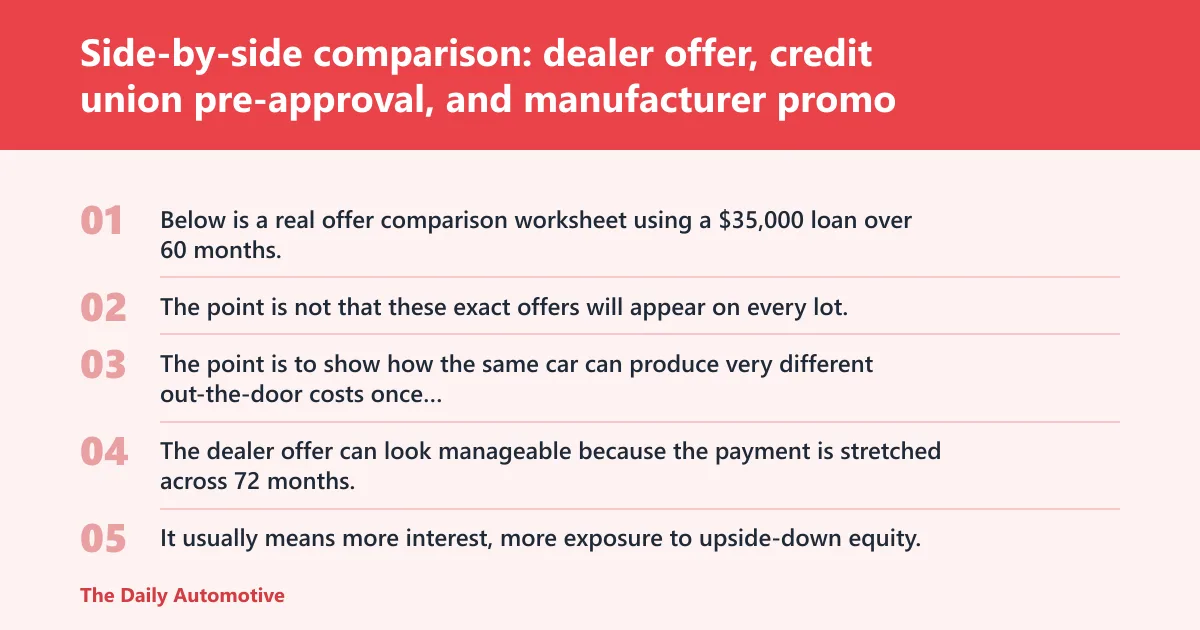
Below is a real offer comparison worksheet using a $35,000 loan over 60 months. The point is not that these exact offers will appear on every lot. The point is to show how the same car can produce very different out-the-door costs once APR, fees, and lender structure are counted together.
| Worksheet item | Dealer offer | Credit union pre-approval | Manufacturer promo |
|---|---|---|---|
| APR | 8.9% | 6.84% | 1.9% |
| Term | 72 months | 60 months | 60 months |
| Lender and dealer fees | $795 dealer/doc fee plus a $300 rate markup | $95 credit union origination fee | $0 promo fee |
| Add-ons | $1,250 in gap and service-contract add-ons | $0 | $0 |
| Rebates or incentive tradeoff | $1,000 dealer cash applied | No rebate assumed | $0 rebate assumed because the promo replaces cash |
| Total interest | About $12,000+ | Approximately $6,300 | About $1,900+ |
| Estimated out-the-door monthly payment | About $569 before insurance and taxes | About $694 before insurance and taxes | About $603 before insurance and taxes |
What the worksheet shows
The dealer offer can look manageable because the payment is stretched across 72 months. That does not make it cheaper. It usually means more interest, more exposure to upside-down equity, and more room for add-ons to hide inside the payment.
The manufacturer promo wins outright if the buyer qualifies for the vehicle and credit tier. The credit union pre-approval beats the dealer offer on clean pricing, but the promo can still win because the APR is subvented. That is the exception buyers should not miss.
Can a dealer beat a credit union auto loan rate?
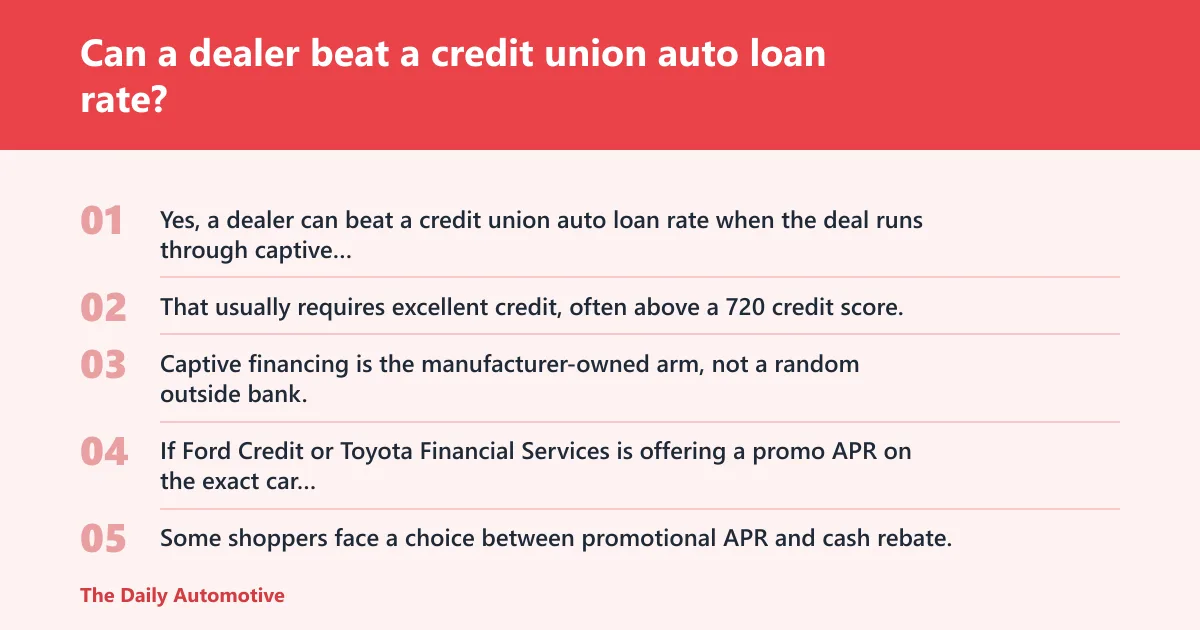
Yes, a dealer can beat a credit union auto loan rate when the deal runs through captive financing with a manufacturer-subvented APR or when rebate stacking changes the math on a specific vehicle. That usually requires excellent credit, often above a 720 credit score, and a model or trim that is eligible for the promo.
When captive financing is the winner
Captive financing is the manufacturer-owned arm, not a random outside bank. If Ford Credit or Toyota Financial Services is offering a promo APR on the exact car being sold, that offer can outrun a credit union loan even if the buyer’s credit union is normally cheaper.
How rebate stacking changes the answer
Some shoppers face a choice between promotional APR and cash rebate. The better deal is the one with the lower total cost, not the larger number in the ad. A low-rate loan with no rebate can still beat a cash rebate paired with a higher APR, but the reverse can happen too if the rebate is large enough.
Which credit score bands are most likely to qualify
Promotional dealer rates mentioned include 0% to 1.9% APR, and those offers are typically reserved for buyers above a 720 credit score. Lower scores do not automatically mean a deal is impossible, but they do narrow the lane and often push the buyer toward standard bank or dealer-arranged pricing. Subprime borrowers usually see the biggest spread between lender types.
How to compare offers with the real offer comparison worksheet
Use the worksheet before signing anything. Put the dealer’s written offer in one column, the credit union pre-approval in the second, and the manufacturer promo in the third. Then compare APR, term, fees, add-ons, rebates, and the monthly payment that actually leaves the showroom.
- Write the cash price of the car first.
- Add every lender fee, dealer fee, and required product cost.
- Record APR and term exactly as shown.
- Subtract any rebate only if it is truly available with that financing path.
- Recalculate total interest on the same loan amount and same term.
- Compare the payment after taxes and required fees, not the teaser payment.
How to spot hidden fee creep
Watch for a longer term, a surprise protection package, or a payment that stays nearly flat even after the rate rises. That is a sign the dealer is moving pieces around rather than improving the deal. Ask for the buy rate in writing and compare it with the approved lender rate on your pre-approval.
Accept, counter, or walk away
Accept if the dealer’s written offer is lower in total cost than your credit union loan and there are no unwanted add-ons. Counter if the only gap is dealer reserve or a fee that can be removed. Walk away if the dealer changes the term, hides products in the payment, or refuses to match a clear outside approval.
Choose dealer financing if… / choose credit union financing if…
Choose dealer financing if the manufacturer promo APR or rebate stack lowers your total cost below the credit union offer on the exact vehicle you want. Choose credit union financing if the dealer adds markup, wraps products into the payment, or stretches the term to make the monthly number look better than it is.
Choose dealer financing if…
- The vehicle qualifies for a captive financing promo at 0% to 1.9% APR.
- Your credit is strong enough to qualify for the promo tier, often above 720.
- The dealer can show the full written math, including rebates, without add-on pressure.
- The total out-the-door cost is lower than your outside pre-approval.
Choose credit union financing if…
- You already have a pre-approval with a lower total cost.
- The dealer refuses to match the buy rate or discloses a markup.
- The payment only looks smaller because the term is longer.
- You want cleaner pricing and less F&I pressure.
Frequently asked questions
credit union financing vs dealer financing
Credit union financing usually wins on total cost because the pricing is often cleaner and less exposed to markup. Dealer financing can win when a captive lender offers a promo APR or rebate on the exact vehicle. The right answer is the lower out-the-door cost, not the lowest headline rate.
financing through credit union vs dealership
Financing through a credit union gives the buyer a direct-lender quote before entering the showroom, which creates a useful ceiling on the rate. Dealership financing can still beat it if the dealer has a manufacturer-subsidized promo, but the buyer should compare fees, term, and add-ons before deciding.
is it better to finance through dealership or credit union
It is better to finance through the dealership only when the dealership’s captive finance offer or rebate stack lowers the true cost below the credit union loan. If the dealer is using rate markup, add-ons, or a longer term to shape the payment, the credit union is usually the safer choice.
is it better to finance a car through a credit union or dealership
For most buyers, a credit union is the better starting point because it provides a written approval and usually cleaner pricing. The dealership becomes the better choice only when a promo APR or incentive on the exact car beats the credit union on total cost. That comparison should be done in writing.
is it better to finance through dealer or bank
Dealer financing can beat a bank if the dealer has access to a captive promo that the bank cannot match. Outside that case, a bank or credit union pre-approval gives the buyer more control over the rate and reduces the chance of dealer reserve or add-on pressure changing the deal.
what is the difference between dealer financing and credit union financing
Dealer financing runs through the F&I office and can be routed to third-party lenders or captive financing. Credit union financing comes straight from a member-owned lender with direct pricing. The biggest practical difference is how much room there is for markup, add-ons, and payment shaping.
does a credit union give better car loan rates than a dealer
Often, yes, especially when the dealer is working from an arranged loan that includes markup. But the answer changes when a manufacturer subsidizes the rate on a specific vehicle. In that case, the dealer can beat the credit union, and the buyer should compare the full written offer.
can a dealer beat a credit union auto loan rate
Yes. A dealer can beat a credit union auto loan rate when captive financing offers a lower promo APR or when rebate stacking lowers the total cost enough to offset the credit union’s cleaner pricing. The buyer should still check for longer terms, add-ons, and dealer reserve before signing.
Products related to this article
Sponsored / affiliate links. As an Amazon Associate I earn from qualifying purchases. I may earn additional commission from eligible campaigns.