Can You Trust Car Rental Reviews?
Yes, trust car rental reviews only when they are recent, location-specific, and tied to the same booking risk you face; a 1-star complaint about a sold-out counter is more useful than a generic 5-star rating. Ignore that filter and you can overpay, miss a pickup, or get hit with fees you never expected. This guide shows a simple way to judge reviews by recency, airport or neighborhood, complaint type, and trip-specific risks like age rules, one-way rentals, and last-minute bookings.
Patterns matter more than stars
Yes, but only if you read them as branch-level clues, not as a single verdict on the whole brand. A high average can hide one bad airport counter, while a low score can reflect a few noisy complaints that do not match your trip. The useful question is whether the review pattern matches your pickup, route, and booking terms.
Why star ratings can mislead you
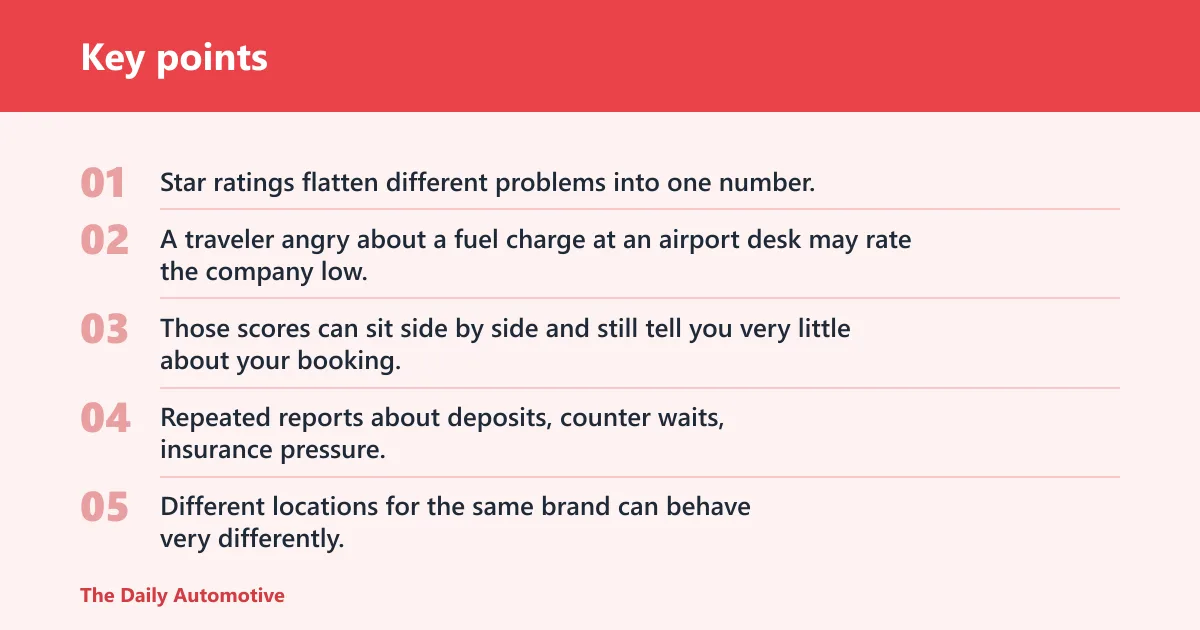
Star ratings flatten different problems into one number. A traveler angry about a fuel charge at an airport desk may rate the company low, while another traveler who booked early and never met a line may rate it high. Those scores can sit side by side and still tell you very little about your booking.
What matters more is the complaint pattern. Repeated reports about deposits, counter waits, insurance pressure, or damage claims matter more than a few scattered comments about “good service.” A rental company can have many reviews and still be a bad fit if the complaints match the risk in your trip.
Branch-level review patterns vs brand-wide ratings
Different locations for the same brand can behave very differently. Airport branches often face higher fees, more counter traffic, and more after-hours handoffs than neighborhood offices. If you are booking an airport car, branch reviews matter more than the corporate average.
Look for location names, terminal references, shuttle details, and pickup timestamps. If a review talks about a downtown office and your booking is at a terminal counter, treat that review as only partial evidence.
What matters more than the average score
Judge the review set by recency, complaint type, and booking proof. Recent reports can reveal a new fee policy, a merger-related service shift, or a seasonal staffing problem. A lower star score can still be acceptable if the complaints do not overlap with your own risks.
What makes a rental review trustworthy
A trustworthy rental review is recent, specific, and tied to a real booking situation. It should mention where the pickup happened, what went wrong or right, and which charges or rules came up. The strongest reviews usually name the counter, the date range, the vehicle class, or the return issue.
Recency and the last 90 days
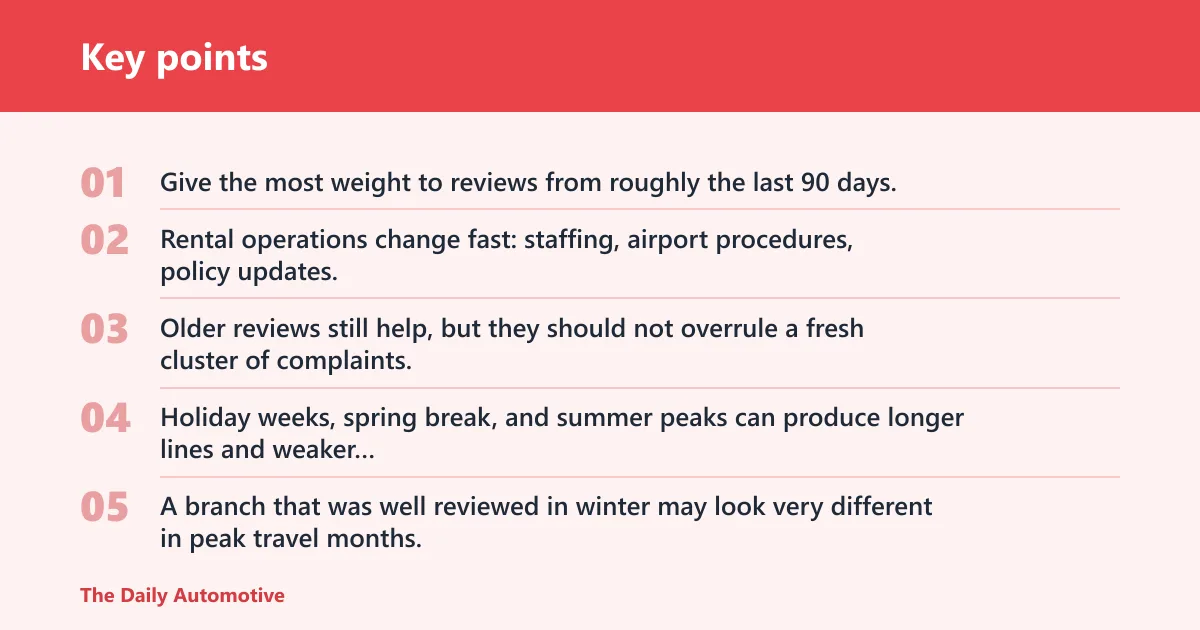
Give the most weight to reviews from roughly the last 90 days. Rental operations change fast: staffing, airport procedures, policy updates, and post-merger systems can alter the experience in a matter of weeks. Older reviews still help, but they should not overrule a fresh cluster of complaints.
Seasonality matters too. Holiday weeks, spring break, and summer peaks can produce longer lines and weaker service than the rest of the year. A branch that was well reviewed in winter may look very different in peak travel months.
Specific booking details that signal a real rental
Real reviews usually mention concrete facts that a fake or thin review often skips. Look for the vehicle class, the quoted rate, the deposit amount, the insurance pitch, the fuel policy, the mileage rule, or the drop-off location. The more specific the details, the more useful the review is for your booking.
Say your trip uses a one-way booking from an airport to a downtown office. Reviews that mention one-way fees, return-window rules, and after-hours drop boxes are far more useful than a five-word praise post that never mentions the route.
Location match and airport branch context
Branch context changes everything at airport locations. One counter may have smooth pickup lines while another has a long wait and a hard sell on add-ons. Reviews that name the airport terminal, shuttle process, or after-hours return lane carry more weight than a brand-wide score.
| Check | 0 points | 1 point | 2 points | Interpretation |
|---|---|---|---|---|
| Recency | Mostly older than 12 months | Mixed ages | Many reviews from the last 90 days | Fresh reviews deserve more weight |
| Volume | Very few reviews | Moderate volume | Large, steady volume over time | More volume helps, but only with balance |
| Specificity | Generic praise or vague complaints | Some details | Clear booking, fee, or counter details | Specific details are harder to fake |
| Location match | No branch, airport, or office context | Partial match | Exact location and pickup context | Branch-level fit matters most for rentals |
| Complaint repetition | Problems look random | Some repeated themes | Same issue repeats across multiple reviews | Repeated themes predict future trouble |
| Real booking details | No evidence of an actual rental | Some signs of a booking | Rate, date, fee, or return details present | More booking proof means more trust |
Score guide: 0-4 points means low trust, 5-8 points means cautious trust, and 9-12 points means higher trust. A high score still does not replace your own trip risk, but it gives you a better read than star ratings alone.
Where should you check reviews?
Check at least two or three sources, because each platform catches different problems. Google reviews often show volume and branch-specific comments. Trustpilot can show how a company responds to complaints. BBB can reveal complaint records, resolution history, and whether service issues repeat.
Google reviews: volume, recency, and spam signals
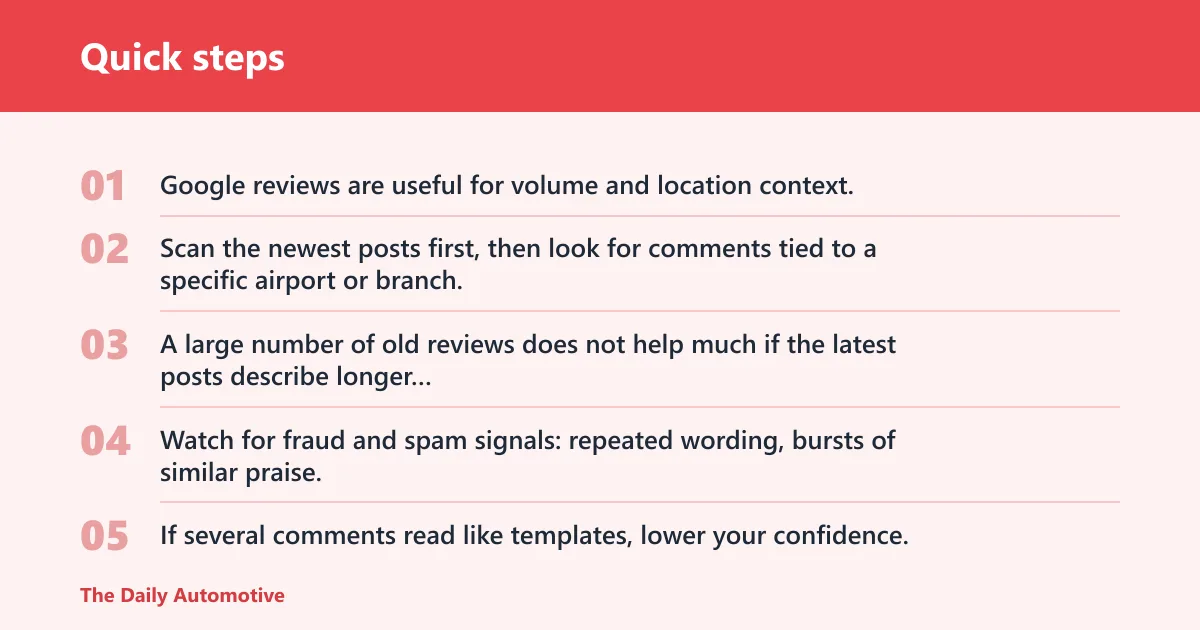
Google reviews are useful for volume and location context. Scan the newest posts first, then look for comments tied to a specific airport or branch. A large number of old reviews does not help much if the latest posts describe longer lines, new fees, or a new desk process.
Watch for fraud and spam signals: repeated wording, bursts of similar praise, reviews that never mention a rental date, and posts that sound detached from the branch. If several comments read like templates, lower your confidence.
Trustpilot: response behavior and authenticity clues
Trustpilot can help you see how a company handles complaints in public. Useful clues include whether the company replies, whether the reply addresses the actual issue, and whether the same complaint keeps returning after the response. Authenticity signals matter too, especially when many reviews use the same phrases or arrive in a short burst.
BBB: complaints, resolution history, and accreditation
BBB records are helpful for pattern recognition, not for a final verdict. Look at the complaint log, how often the company resolves issues, and whether similar problems repeat across the record. Accreditation status can add context, but it does not erase a pattern of unresolved service problems.
Which complaints matter most?
The most predictive complaints are the ones tied to money, timing, or damage claims. Hidden fees, insurance add-ons, airport surcharges, young driver fees, one-way fees, toll charges, deposits, fuel disputes, and return damage claims are far more useful than generic anger about “bad service.”
Hidden fees and add-ons
Read closely for charges that were not clear at booking. Insurance add-ons, airport surcharges, young driver fees, one-way fees, and toll packages can change the final price fast. If several reviews describe the same surprise charge, treat that pattern as a booking risk.
A common first-timer mistake is trusting a low base rate without checking the fee language. A $39 quote can become much more expensive after airport taxes, a deposit hold, and a possible under-25 surcharge.
Pickup delays, after-hours handling, and counter service
Pickup problems matter because they affect your whole trip. Reports about long lines, missing cars, slow shuttle service, or bad after-hours instructions are especially important for airport rentals. If your flight lands late, after-hours handoff details can matter more than the advertised daily rate.
Damage claims, fuel disputes, and deposit problems
Damage claims and fuel disputes are high-risk complaints because they can create charges after the trip. Read for words like “pre-rental photos,” “return inspection,” “fuel level,” and “mileage verified.” Reviews that mention unexplained damage claims or delayed deposit returns deserve attention.
How do airport rentals change the read?
Airport rentals often cost more and behave differently from city or neighborhood locations. Higher fees, shuttle transfers, busier counters, and later return windows can all change the experience. That means airport reviews should be judged by airport-specific comments, not by the brand average alone.
Fees that are more common at airports
Airport branches more often add surcharges tied to the location itself. Travelers also run into insurance pushback, deposit holds, and toll package pitches more often at busy counters. If reviews repeatedly mention extra charges at airports, treat that as a likely cost issue, not a one-off complaint.
Why the same brand can rate differently by location
The same brand can score well downtown and poorly at the airport because staffing, volume, and return logistics are different. One branch may have a quick pickup and clear paperwork, while another branch under the same name may run late and press add-ons. Branch reviews are the safer guide.
What travelers should expect at pickup and return
Before booking, check whether the branch offers clear pickup instructions, a documented return lane, and a late-arrival process. Review comments about mileage checks, fuel checks, and photo documentation are especially valuable because they point to how the branch handles disputes.
How do you spot fake or biased reviews?
Fake or biased reviews often leave a small set of signals. Look for generic praise, vague complaints, duplicate wording, sudden review bursts, and missing booking details. A real rental review usually contains at least one concrete fact about the car, desk, fee, or return.
Generic praise and vague complaints
“Great service” and “terrible company” are weak signals by themselves. They do not tell you what happened, where it happened, or whether the issue affects your booking. Reviews that stay vague across several comments should get less weight.
Review bursts, duplicates, and odd wording
When many reviews land close together and use nearly the same phrasing, the pattern deserves scrutiny. Duplicate wording, unnatural language, and oddly polished praise can point to paid or coordinated activity. That does not prove fraud every time, but it should lower confidence.
Missing details that real renters usually mention
Real renters often mention the car class, the desk process, the final charge, or the return inspection. If a review praises or attacks a company without any booking detail, treat it as weak evidence. Missing specifics are one of the fastest ways to spot a low-value review.
What about private-owner rentals and booking sites?
Private-owner rentals need a different reading method because the trust signal is tied to a person or host, not a large counter system. Booking sites and brokers also sit in the middle of the transaction, so their review set may reflect search, payment, and support issues rather than the actual car handoff.
Are private-owner reviews trustworthy?
Yes, but only if the reviews mention response time, vehicle condition, pickup clarity, and deposit handling. Private-owner ratings can be useful when they include photos, trip timing, and return notes. They are less useful when the comments stay general or only praise communication.
Is carrentals.com legit as a booking site?
As a comparison and booking site, carrentals.com should be judged as a middleman, not as the rental company itself. It may be legitimate for shopping and booking, but the actual pickup experience depends on the rental provider and location. Read both the broker terms and the renter comments before you book.
How to compare a broker, aggregator, and rental company
A broker controls the booking flow, an aggregator helps you compare offers, and the rental company handles the car, counter, and damage process. If a review complains about pricing accuracy or support, that may point to the broker. If it complains about pickup or fees at the desk, the rental company is the more likely problem.
How do you get good car rental reviews?
Good rental reviews usually come from clear expectations, clean pickup records, and fast follow-up when something goes wrong. For a company, that means accurate pricing, plain fee disclosure, and a smoother counter process. For a traveler, it means reading the same risk areas before booking so surprises are less likely.
Practical steps that improve the review outcome
- Confirm the full price, including insurance, airport surcharges, young driver fees, one-way fees, and toll charges.
- Choose the exact pickup branch, not just the brand name.
- Take pre-rental photos of the exterior, wheels, glass, and dashboard.
- Record fuel level and mileage before leaving the lot.
- Keep return photos and any desk paperwork.
- Check recent reviews from roughly the last 90 days before confirming.
If you already know your trip is late-night, one-way, or under-25, read for those exact issues first. A review about a smooth midday pickup does not help much if your flight lands after midnight.
Frequently asked questions
Can you trust car rental reviews?
Yes, if you weigh recent, location-specific reviews more than the star average. The best comments match your own risk: airport counter delays, hidden fees, deposits, fuel checks, or damage disputes. Older praise and broad complaints are much less useful than current, detailed reports.
What should I look for in rental car company reviews?
Focus on recency, volume, branch location, repeated complaints, and concrete booking details. The most useful reviews mention the exact fee, pickup process, return rule, or problem type. If the same issue repeats across several posts, take it seriously.
What signs show a car rental review is fake?
Watch for generic praise, vague criticism, duplicate wording, sudden review bursts, and missing booking details. Real renters usually mention the airport, branch, price, car class, deposit, or return process. Reviews without any of those details deserve less weight.
How do you tell if a car rental company has hidden fees?
Look for repeated complaints about insurance add-ons, airport surcharges, young driver fees, one-way fees, toll charges, and deposits. The strongest warning sign is repetition from different reviewers at the same branch or airport. One complaint may be noise; several with the same fee pattern are harder to ignore.
Which car rental review sites are most reliable?
No single site is enough on its own. Google reviews are useful for volume and branch detail, Trustpilot helps with response behavior and authenticity clues, and BBB can reveal complaint and resolution patterns. The safest read comes from comparing all three, then matching the pattern to your trip.
Is carrentals.com legit?
It can be legitimate as a comparison and booking site, but that does not guarantee the rental experience itself. Treat it as a broker or aggregator, then check the actual rental company and branch reviews separately. The important question is who handles the car, the fees, and the counter process.
Products related to this article
Sponsored / affiliate links. As an Amazon Associate I earn from qualifying purchases. I may earn additional commission from eligible campaigns.