Best Car Cargo Nets for Securing Loads (2026): We Compared
Choose a cargo net by the load and anchor layout first: fixed-hook nets fit small trunks, adjustable-hook nets fit mixed cargo, and UV-rated stretch nets work best for light, irregular loads with 4 to 8 anchor points. Bad fit lets bags slide, tip, or block rear visibility. This guide compares the best car cargo nets by fit, hardware, mesh, and the failure mode each one is meant to stop.
Quick comparison
| Product | Badge | Best for | Price | ||
|---|---|---|---|---|---|
 |
Amiss Cargo Net Stretchable Exterior Accessories,Amiss | Our pick | 35.4" x 15.8" · 4 Hooks · Nylon | $9.99
Price as of 21 Oct 2026
|
View |
 |
Heavy Duty Cargo Net for Pickup Truck Bed – 3′ x 4′Qumbeleize | Also great | 3′ x 4′ · 12 Clips · Latex Bungee | $13.99
Price as of 21 Oct 2026
|
View |
 |
WSSROGY 3′ x 4′ Cargo Net Stretches to 6′ x 8′, Heavy DutyWSSROGY | Upgrade pick | 3′ x 4′ · 14 Hooks · 4"x4" Mesh | $17.49
Price as of 21 Oct 2026
|
View |
 |
Car Rear Cargo Net with Good Elasticity&Tensile StrengthSSNNUU | Also great | 43.3" x 15.74" · D-Shapes · Polyester | $8.99
Price as of 21 Oct 2026
|
View |
The trade-off is coverage versus control. A tighter mesh and firmer hardware stop sagging and open gaps, but the same net can be harder to route cleanly across a trunk, SUV cargo area, or truck bed.
Start with the failure mode you need to stop. Then match the net’s stretch, anchor style, and mesh density to the cargo shape.
How we chose
We compared the listed specs and published product details against the job each net is meant to do. That means fit, hardware, mesh size, stretch range, and whether the net is better for light restraint or for more structured cargo control.
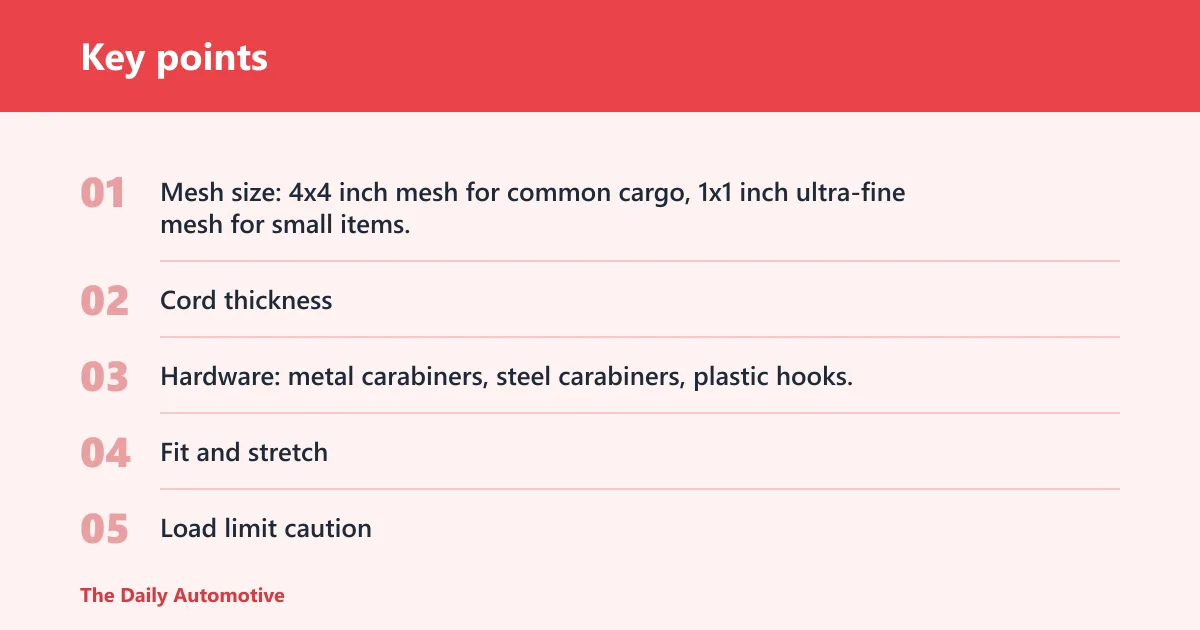
- Mesh size: 4×4 inch mesh for common cargo, 1×1 inch ultra-fine mesh for small items.
- Cord thickness: 5mm for light cargo, 10mm for heavier loads and better sag resistance.
- Hardware: metal carabiners, steel carabiners, plastic hooks, and adjustable clips were judged by likely hold quality and fit flexibility.
- Fit and stretch: sedan trunks, SUVs, truck beds, trailers, roof racks, and E-track compatible freight systems were separated because they fail differently.
- Load limit caution: these nets are for light to moderate cargo restraint, not a substitute for rigid tie-downs on very heavy or irregular loads.
| Vehicle / load scenario | Minimum mesh size | Cord thickness | Anchor type | Stretch range to look for | Do not use alone |
|---|---|---|---|---|---|
| Sedan trunk, groceries and carry-ons | 4×4 inch mesh | 5mm | Adjustable clips or metal carabiners | About 4×6 to 8×12 feet | Loose glass bottles, tool boxes, stacked boxes above the net line |
| Sedan trunk, small items and pet gear | 1×1 inch ultra-fine mesh | 5mm | Adjustable clips | About 4×6 to 8×12 feet | Sharp-edged cargo, loose hardware, any load that can crush the net |
| SUV cargo area, luggage and camping gear | 4×4 inch mesh | 5mm to 10mm | Steel carabiners or metal carabiners | About 4×6 to 10×15 feet | Coolers above seat-back height, moving boxes, irregular stacks |
| Truck bed, mulch bags and tools | 4×4 inch mesh | 10mm | Steel carabiners, adjustable clips, or truck-bed hooks | About 4×6 to 10×15 feet, or larger bed coverage where listed | Bulk mulch, loose debris, tall irregular piles, anything above sidewall height |
| Heavy or irregular loads | Not a mesh-only decision | 10mm minimum, plus rated tie-downs | Rigid tie-downs and rated anchor points | Depends on the tiedown system | Yes, always. Do not rely on a cargo net alone. |
Amiss cargo net: best for small trunks
The Amiss net is the compact pick for sedan trunks and smaller SUV cargo areas where you want a simple barrier for grocery bags, tote bags, and loose daily carry items. Its 35.4" x 15.8" size and four hooks point to a narrow-use fit rather than a broad bed-covering setup.
Based on the listed nylon construction, it should suit everyday trunk organization better than rough-duty hauling. The drawback is obvious: four hooks and a compact footprint leave less room for anchor spacing mistakes, so it is not the one to choose for deep loads, tall stacks, or a truck bed.
Qumbeleize truck bed net: best for pickup beds
The Qumbeleize net is the clearest truck-bed choice here because it stretches from 3′ x 4′ to 6′ x 8′ and uses 12 clips for attachment. That makes it better suited to spread-out bed cargo, such as tools, cooler loads, and boxed gear that need edge control more than a dense web.
Its published 4"x4" latex bungee mesh and heavy-duty clip count suggest good coverage for typical bed loads, and the stretch range gives it useful reach. The limit is that it still belongs in the light-to-moderate restraint category; loose mulch, irregular debris, or tall stacks still need tie-downs.
WSSROGY cargo net: best for flexible truck and roof use
The WSSROGY net is the most flexible of the group for mixed vehicle layouts because it stretches from 3′ x 4′ to 6′ x 8′ and is listed for pickup bed and roof rack use. The 5mm latex and nylon woven material gives it a lighter-duty feel than the 10mm options.
Its 4" x 4" mesh helps stop items from slipping through, while the 14 plastic hooks and 12 carabiners give you multiple ways to route it. The drawback is hardware quality trade-off: plastic hooks are fine for lighter duty, but they are not the first choice if you want the most durable anchor setup.
SSNNUU cargo net: best for SUV cargo areas
The SSNNUU net is a strong SUV cargo-area choice because its 43.3" x 15.74" shape is better aligned with a rear cargo opening than with a truck bed. The polyester build and dual installation methods also make it easier to adapt to standing or horizontal placement in the trunk.
That makes it useful for luggage, overlanding accessories, and smaller camping loads that move around on highway curves. The limit is that the dimensions are narrow enough that larger coolers or bulky boxes may outgrow it quickly, especially if you need to cover a wider hatch opening.
Which one should you buy?
Start with cargo shape, then the vehicle layout. A sedan trunk with groceries and day bags points to the Amiss net. A pickup bed points to the Qumbeleize net. An SUV cargo area points to the SSNNUU net. If you want one net for mixed light-duty use across a truck bed and roof rack, the WSSROGY net is the more flexible option.
For very small items, choose tighter mesh over bigger stretch. That is where 1×1 inch ultra-fine mesh matters. For heavier light-duty cargo, step up to 10mm cord and steel or metal carabiners, because thicker cords resist sag better and hold shape longer under repeated loading.
A common first-timer mistake is choosing a cargo net based only on span, only to find it leaves loose corners around bulky grocery bags in the trunk. Say your trunk is wide enough for the net but the anchor points sit too far apart from the cargo edge. The result is edge roll, then a gap under braking. In that case, a smaller, tighter net is usually better than a larger loose one.
Suppose you are carrying two suitcases and a duffel in an SUV. A 4×4 mesh net can keep the bags from shifting, but if the duffel is soft and small enough to pass through the openings, mesh density matters more than raw stretch. That is the case for choosing smaller mesh rather than more elastic mesh.
Choose Amiss if your priority is a small trunk barrier
Choose Amiss if you want a simple trunk organizer effect, light grocery restraint, or a compact net for a smaller hatch area. It is the better call when the cargo is low, the anchor points are close together, and the main risk is bags sliding forward.
Choose Qumbeleize if you need pickup-bed coverage
Choose Qumbeleize if you need broader bed coverage, more attachment points, and a net that is better aligned with truck-bed spacing. It is the stronger fit for tools, luggage, and camping gear that need to stay corralled across a wider surface.
Choose WSSROGY if you need flexible fit across layouts
Choose WSSROGY if you want one net that can move between a pickup bed and a roof rack, or if you need more mounting options. It fits best when the job is general cargo control and you value flexible attachment hardware over the stiffest possible hold.
Choose SSNNUU if your main job is SUV cargo control
Choose SSNNUU if your vehicle is an SUV and the load is mostly luggage, overlanding accessories, or soft-sided gear. Its shape suits the cargo area better than a bed-focused net, and the installation options make it easier to keep the net aligned.
What size cargo net do you need for your car or truck?
Measure trunk width, anchor spacing, and load height before you buy. A net can be the right length and still fail in use if the hooks sit at bad angles or the cargo sits higher than the net can cover. For most trunks, 4×4 inch mesh is enough; for small items, 1×1 inch mesh is the better call.
Trunk width and anchor spacing
Start by measuring the distance between usable anchor points, not just the widest part of the trunk opening. If the net has to stretch too far to reach the hooks, it loses tension and invites sagging. If the anchor points are too close, the net can bunch and create edge roll.
Load height and edge coverage
Low grocery bags are easier to restrain than stacked boxes or a cooler sitting upright. If cargo rises above the line where the net can lay flat, the net stops being a barrier and starts acting like a loose cover. That is the point where tie-down straps or rigid retention are a better choice.
When 4×4 mesh is enough
Use 4×4 mesh for groceries, luggage, camping gear, and tools that are too large to slip through the openings. It is the common middle ground: broad enough to cover mixed cargo, tight enough for normal loose items, and less fussy than ultra-fine mesh for everyday loading.
When 1×1 mesh is the better call
Choose 1×1 mesh when you are protecting small items from slipping through, such as pet gear, small soft bags, or loose accessories. The denser pattern matters more than stretch in that case. Smaller mesh also gives a better answer to the mesh gap failure mode.
Are metal carabiners better than plastic hooks on a cargo net?
For repeated loading, metal or steel carabiners are usually the better choice because they resist wear and accidental release better than plastic hooks. Plastic hooks can still work for light-duty trunks or short errands, but they are less reassuring when the net will be removed and reinstalled often.
Metal and steel carabiners for repeated loading
Metal carabiners are the better fit when you want a more durable connection at the anchor point. They help reduce hook slip, especially on rougher routes where the net is tugged repeatedly. The PAMAZY listing’s 10mm cord and 12 steel carabiners is a good example of a heavier-duty hardware package.
Plastic hooks for lighter duty use
Plastic hooks are acceptable for lighter loads, smaller trunks, and routine grocery duty. They are easier to live with when the net stays in one vehicle and the cargo is light. The trade-off is durability, especially if the hook needs to hold tension for long periods or against rough anchor edges.
Adjustable clips and where they help
Adjustable clips help when anchor spacing changes from one vehicle to another, or when you need to fine-tune how tightly the net pulls across the cargo area. They are useful in mixed-use setups, such as switching between an SUV and a truck bed. They do not replace strong anchors, but they do improve fit.
What hardware choice says about durability
Hardware choice is often a better durability clue than mesh color or marketing language. Steel and metal carabiners suggest repeated use and more secure attachment. Plastic hooks point to lighter duty. If the cargo is irregular, tall, or sharp-edged, hardware quality matters more than extra stretch.
Can a cargo net keep luggage from shifting on the highway?
Yes, for suitcases, duffels, and carry-ons, a cargo net can keep luggage from sliding across the floor or tipping into the back seat area. The key is enough tension and enough mesh coverage to stop the bags from moving into open space as speed changes, turns, and braking loads build.
Best fit for suitcases, duffels, and carry-ons
Luggage is one of the best uses for a cargo net because the load is usually soft, stackable, and lower risk than loose tools or building materials. A 4×4 mesh net is often enough for this role, especially in a trunk or SUV cargo area where the luggage already sits flat.
Why stretch range matters for highway use
Stretch range matters because a highway load needs steadier tension than a load on a short city trip. The TIRETEK range of 4’x6′ to 8’x12′ shows the kind of flexibility that can help in varied cargo areas, while the Migaven stretch up to 10’x15′ and the Suu66 stretch up to 15’x21′ show how some nets are built for broader coverage.
How mesh density affects smaller bags
Small luggage pieces and day bags can slip through loose mesh if the openings are too large. That is why mesh density matters as much as stretch. A 4×4 inch mesh is the common baseline, but 1×1 inch ultra-fine mesh is the smarter choice when the load includes small, soft, or oddly shaped items.
Picture a sedan trunk loaded with two grocery bags, a carton of eggs, and a soft tote. A loose, oversized net can let the tote rise into the gap between the net and the seat back. A tighter, better-fitted net reduces that gap and limits the chance of edge roll during braking.
What is the difference between a truck bed cargo net and a trunk cargo net?
A truck bed cargo net is built for wider spacing, more exposed anchor points, and rougher cargo shapes. A trunk cargo net is usually smaller, easier to tension across a confined space, and better suited to groceries, luggage, and daily carry items. The load failure modes are different, so the fit should be different too.
Truck bed use
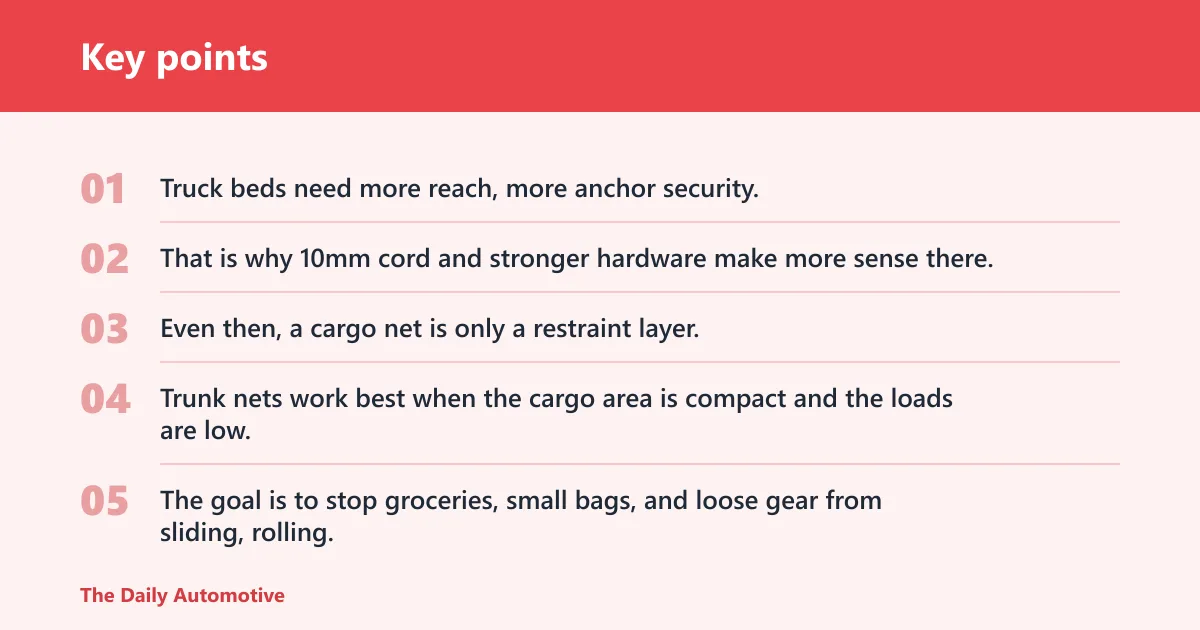
Truck beds need more reach, more anchor security, and more tolerance for irregular placement. That is why 10mm cord and stronger hardware make more sense there. Even then, a cargo net is only a restraint layer, not a substitute for rigid tie-downs on heavy or loose loads like mulch or tall tool stacks.
Trunk use
Trunk nets work best when the cargo area is compact and the loads are low. The goal is to stop groceries, small bags, and loose gear from sliding, rolling, or tipping into open space. Smaller nets often fit better because they create less slack and fewer anchor-angle problems.
Do cargo nets work for SUVs and trailers too?
Yes, but the use case changes. SUVs benefit from cargo nets for luggage, pet gear, and camping items, while trailers and E-track compatible freight systems need nets that are matched to the anchor system and the load rating. A generic elastic net is not enough for every trailer job.
SUV cargo areas
SUVs often need a mid-size net that bridges a wider cargo opening than a sedan trunk but does not require truck-bed coverage. The SSNNUU net fits this kind of use better than a bed-oriented net. The main goal is controlling motion without blocking access to the cargo floor or seatbacks.
Trailers and E-track systems
Trailers and E-track compatible freight systems are a different category. The anchor system matters as much as the mesh. HaulersHub notes an 800 lb capacity for E-track freight nets, which is the kind of system-level figure that matters more than hook count alone. Use the right rated setup there, not a generic trunk net.
How do I keep a cargo net tight enough for safety?
Keep the net tight by matching anchor spacing, using the shortest practical stretch, and rechecking the fit after the load is in place. A cargo net should lie against the cargo, not hover over it. If the mesh bows too far or the hooks sit at an angle, the setup is too loose.
Use the shortest practical stretch
Pick a stretch range that matches the vehicle layout instead of buying for maximum expansion. A net stretched near its limit loses shape and control. A better fit gives better sag resistance and reduces the chance of hook slip or edge roll as the cargo shifts.
Position the load before you tension the net
Load the cargo first, then tighten the net over the finished stack. If you tension the net before the cargo is settled, the first hard turn or brake application can change the geometry and leave slack where you did not want it. That is where small gaps become movement points.
Check for sag, slip, and gap
Sag shows up in the middle of the net. Hook slip shows up at the anchor points. Edge roll shows up where the net rides up off the cargo edge. Mesh gap shows up when a small item can move through the openings. Each problem needs a different fix, and a better fit is usually the first one.
Frequently asked questions
What mesh size is best for groceries and small items?
For groceries and normal loose items, 4×4 inch mesh is the practical baseline. If you are carrying small accessories, pet gear, or soft items that can slip through larger openings, 1×1 inch ultra-fine mesh is the better choice. Mesh density is what keeps small cargo from slipping through.
How much stretch should a cargo net have for heavy loads?
More stretch is not automatically better for heavy loads. A net like the TIRETEK range of 4’x6′ to 8’x12′ can fit more layouts, but heavy or irregular cargo still needs a rated tie-down system. For heavier light-duty restraint, thicker 10mm cord and stronger anchors are the better direction.
Products related to this article
Sponsored / affiliate links. As an Amazon Associate I earn from qualifying purchases. I may earn additional commission from eligible campaigns.