3 Best First Aid Kits for Cars (2026): We Compared
For most drivers, the best first aid kit for a car is the First Aid Only 298 Piece (FAO-442) because it balances organization, size, and refillability better than the typical glovebox kit. A weak kit wastes minutes on the shoulder, leaves minor cuts dirty, and forces you to improvise after a crash. This guide compares three real kits, shows what each handles well, and points out which injuries and trips each one fits best.
Quick comparison
| Product | Badge | Best for | Price | ||
|---|---|---|---|---|---|
 |
Mini First Aid Kit – 150 Piece Small Waterproof EVA HardVriexsd | Our pick | 150 piece · EVA case · red | $9.99
Price as of 18 Oct 2026
|
View |
 |
Adventure Medical Kits Smart Travel First Aid KitAdventure Medical Kits | Upgrade pick | Smart Travel · hospital-quality · multilingual | $74.99
Price as of 18 Oct 2026
|
View |
 |
American Red Cross Licensed Product, Deluxe All PurposeAmerican Red Cross | Also great | 299 piece · nylon case · Red Cross | $37.99
Price as of 18 Oct 2026
|
View |
The main trade-off is simple: piece count matters only when the kit stays organized, easy to reach, and stocked with the right items for vehicle injuries. For car use, the better question is whether the case survives heat, movement, and repeated opening without turning into a pile of loose wrappers.
Use this table as a quick filter, then read the product sections for storage fit, trauma readiness, and refill economics.
How we chose
These picks were compared on four things that matter in a car: contents, case type, storage fit, and how well the kit covers likely roadside injuries. The list also weighs refill availability, because a kit that can be restocked cheaply is often better than a larger one you replace after one incident.
ANSI/ISEA Z308.1 matters here as a baseline fill benchmark, not as a complete trauma standard. For harder use, the comparison also looks at whether a kit adds a tourniquet or CPR mask, and whether the packaging is sturdy enough to survive trunk duty.
First aid only 298 piece: best for most drivers
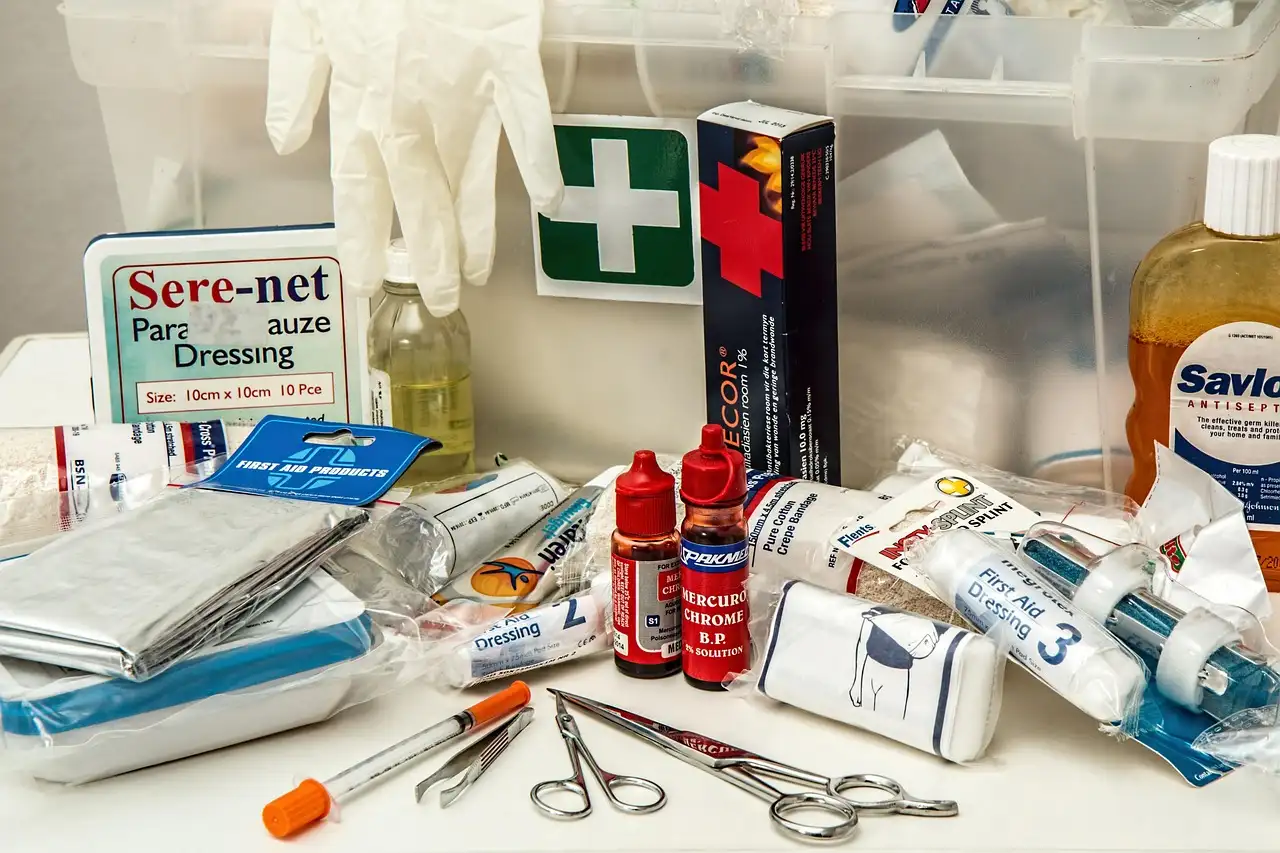
The First Aid Only 298 Piece kit is the best overall choice for most drivers because it combines a hard case, organized compartments, and refill packs in a size that still makes sense for everyday vehicle storage. It is also described as meeting ANSI/ISEA Z308.1 minimum fill requirements, which makes it a stronger baseline than a random bulk kit.
It fits best in a trunk organizer, cargo area, or under-seat space if your vehicle has room for a rigid case. The layout matters more than the number alone, because bandages, gauze, and wipes stay easier to find when they are separated instead of mixed in one pocket.
The weak point is that this is still a commuter-grade kit, not a trauma kit. It is built for cuts, scrapes, and common roadside cleanup, but it does not try to solve every serious bleeding scenario on its own.
What it includes
The key advantage is the organized hard case and refill-friendly design. That matters after one incident, because a depleted kit with no easy refill path becomes less useful fast. The 298-piece count is a useful signal only because the contents are spread into compartments instead of dumped into a soft pouch.
Pros
- Hard case helps protect supplies in a vehicle.
- Organized compartments make fast access easier.
- Refill packs can reduce long-term replacement cost.
- Good fit for everyday drivers who want a solid baseline kit.
Cons
- Not a full trauma kit.
- Hard case takes more space than a tiny glovebox pouch.
- It may still need add-ons for serious bleeding control.
M2 BASICS 350 piece: best for road trips
The M2 BASICS 350 Piece First Aid Kit is the better pick for road trips, family travel, and drivers who want more trauma-ready gear in the car. Its waterproof hard case, tourniquet, splint, trauma shears, emergency blanket, and CPR mask suggest it is more than a basic commuter kit.
It fits best in a trunk, hatch cargo area, or dedicated travel bag where size is less of a problem. That extra bulk is the price of carrying more serious supplies, and the added tools make more sense when passengers, remote roads, or long drives are part of the plan.
The drawback is that more gear also means more decisions. If you want a simple kit for glovebox storage, this is more than you need, and some drivers will never use the trauma items that make it worthwhile.
Pros: best equipped of the three
- Best equipped of the three for more serious emergencies.
- Waterproof hard case suits trunk storage.
- Tourniquet, splint, shears, blanket, and CPR mask add real emergency utility.
- Better match for road trips, camping, and passengers.
Cons: bulkier than a commuter kit
- Bulkier than a commuter kit.
- More than many drivers need for short city trips.
- Higher spec kit does not replace training or judgment.
DeftGet 163 piece: best for budget storage
The DeftGet 163 Piece First Aid Kit is the budget pick because it gives you a compact nylon bag that is easy to keep in a glovebox or small storage pocket. For drivers who want a low-cost car kit with basic coverage, it is the simplest way to keep bandages, gauze, and small supplies within reach.
It is most practical for glovebox storage, where a smaller soft bag has an advantage over a rigid case. That makes it a good fit for compact cars, minimalists, and drivers who want a kit that disappears into the cabin instead of taking up cargo space.
The weak point is durability and long-term organization. A soft bag is easier to stash, but it can be less protective than a hard case if the car sees heat, pressure, or rough storage conditions.
Pros: low-cost option
- Low-cost option for basic vehicle coverage.
- Fits glovebox storage well.
- Light, compact, and easy to move between vehicles.
- Good for minor cuts and quick cleanup items.
Cons: soft bag offers less protection
- Soft bag offers less protection than a hard case.
- Less suitable for rough storage or heat exposure.
- Not the best choice if you want trauma-focused gear.
Which car first aid kit fits your driving life?
The right kit depends on where you drive, where you store it, and what kind of incident you are trying to cover. A commuter kit should be easy to reach and simple to refill. A road-trip kit can be larger, and a family kit should give you more room for repeat use after a minor injury.
Which car first aid kit fits your driving life?
| Driver type | Storage location | Kit size | Trauma readiness | Refillability | Likely failure mode | Recommendation score |
|---|---|---|---|---|---|---|
| Daily commuter | Under seat or trunk | Medium hard case | Baseline only | Good with refill packs | Weak latch or bandage depletion | First Aid Only 298 Piece: 9/10 |
| Road-trip driver | Trunk or cargo area | Larger hard case | Highest of the three | Moderate | Bulky storage and overpacked case | M2 BASICS 350 Piece: 9/10 |
| Budget owner | Glovebox | Small soft bag | Low to moderate | Limited | Crushed packaging or dried-out items | DeftGet 163 Piece: 7/10 |
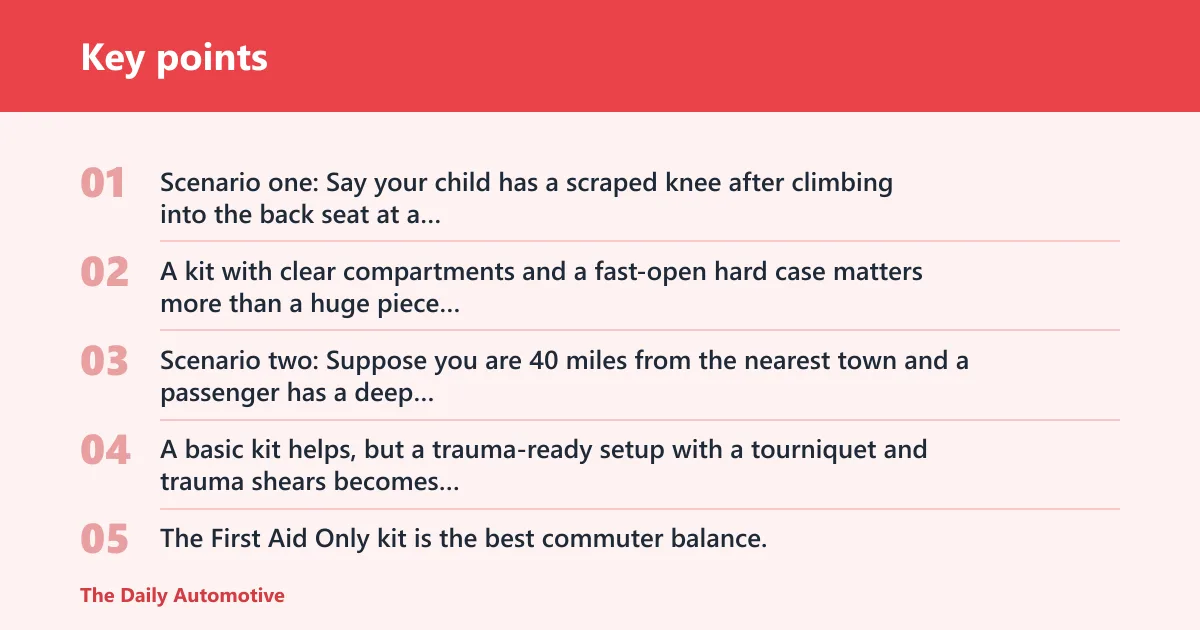
Scenario one: Say your child has a scraped knee after climbing into the back seat at a rest stop. A kit with clear compartments and a fast-open hard case matters more than a huge piece count, because you need gauze, antiseptic wipes, and bandages without digging through loose wrappers.
Scenario two: Suppose you are 40 miles from the nearest town and a passenger has a deep leg cut from broken cargo. A basic kit helps, but a trauma-ready setup with a tourniquet and trauma shears becomes far more relevant than a glovebox pouch filled only with adhesive strips.
Which kit handles which job best?
The First Aid Only kit is the best commuter balance. It gives you a solid baseline, organized access, and a refill path that makes sense after routine use. It is also the easiest choice when you want one kit to cover minor injuries without paying for trauma gear you may never touch.
The M2 BASICS kit is the better fit for long trips, family hauling, and drivers who travel far from quick help. Its tourniquet, splint, blanket, and CPR mask make it the most prepared for a serious roadside event among the three.
The DeftGet kit wins on storage convenience and price. If your main goal is keeping a useful kit in the glovebox, it is the cleanest fit. It just does not give you the same margin for harder use.
Replacement and refill guidance
Refill economics matter because one incident can wipe out a bandage stack fast. A kit with refill packs can be cheaper to restock than replace, especially if the case is still intact. That is one reason the First Aid Only kit rates so well for everyday drivers.
Watch for failure modes that are easy to miss: crushed packaging in a hot trunk, dried-out antiseptic wipes, weak latches that pop open, and bandage depletion after the first real cleanup. Those are the problems that make a kit look full but act empty.
For higher-risk driving, add a tourniquet and a CPR face shield or CPR mask if they are not already included. That is not a claim that every car needs trauma gear. It is a practical step for remote travel, frequent passengers, or longer distances from emergency care.
What should you keep in the car?
Keep a car kit that matches the space you actually have. A hard case is usually better for trunk or under-seat storage, while a soft bag is easier to fit in a glovebox or small cabin pocket. What matters most is fast access, intact packaging, and enough organization to find the right item quickly.
Hard case versus soft bag
Hard cases hold up better when the kit sits in a trunk, cargo area, or under-seat spot where other items can press on it. Soft bags are easier to stash and carry, but they are more vulnerable to crushing, moisture, and loose contents. For vehicle use, the case should match the storage location first.
Where each storage location works best
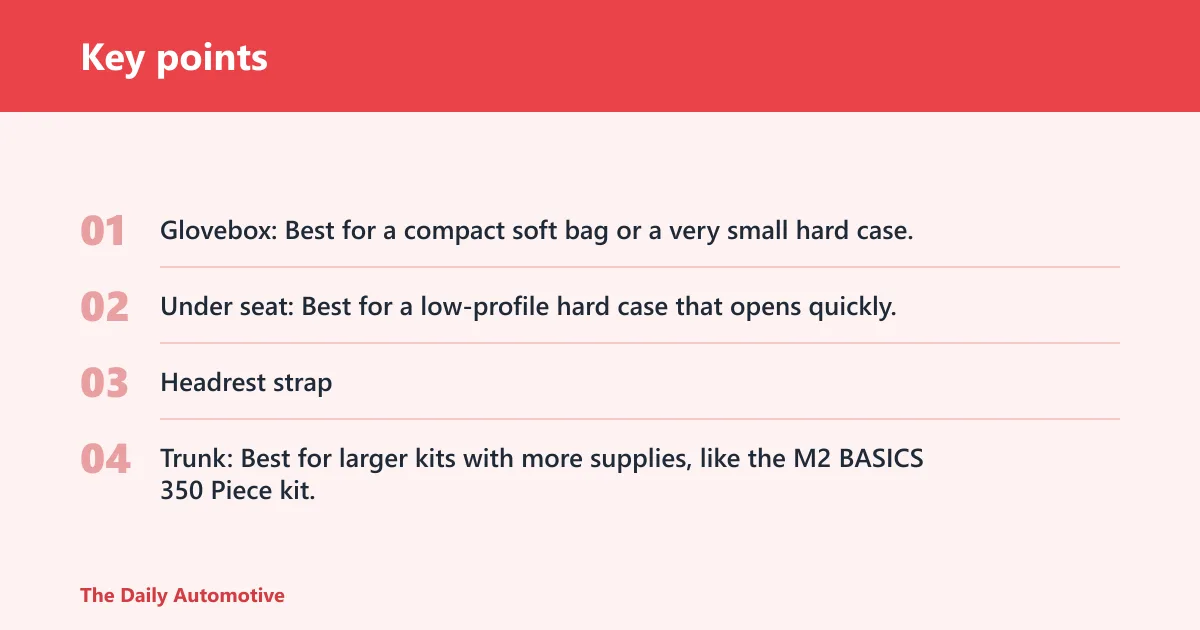
- Glovebox: Best for a compact soft bag or a very small hard case.
- Under seat: Best for a low-profile hard case that opens quickly.
- Headrest strap: Useful when a kit is built to hang in easy reach, like the Be Smart Get Prepared 106 Piece kit.
- Trunk: Best for larger kits with more supplies, like the M2 BASICS 350 Piece kit.
The Be Smart Get Prepared 106 Piece kit is a useful fit reference because its headrest strap makes placement simple. That matters when you want an accessible kit without giving up cabin space, especially in family vehicles.
Do you need a tourniquet in a car kit?
A tourniquet is not necessary for every driver, but it belongs in a more serious roadside kit. It is a trauma-focused item for heavy bleeding, and it is often absent from basic car kits. If your driving includes long distances, remote roads, or frequent passengers, it becomes a smart add-on.
Do you need a CPR mask?
A CPR face shield or CPR mask is worth having because it is included in some premium kits but not always bundled. It is a compact add-on that fits the gap between a basic bandage kit and a more complete emergency setup. For many drivers, that makes it a better buy than extra adhesive strips.
Choose First Aid Only if… / Choose M2 BASICS if… / Choose DeftGet if…
Choose First Aid Only 298 Piece if you want the best all-around car kit, you value organized compartments, and you like the option to restock instead of replacing the whole case after one incident. It is the most balanced choice for commuters and most families.
Choose M2 BASICS 350 Piece if you road trip often, carry passengers, want trauma items such as a tourniquet and splint, or keep the kit in a trunk where size is less of a problem. It is the strongest match for more serious preparedness.
Choose DeftGet 163 Piece if your main goal is a budget-friendly glovebox kit that covers the basics without taking up space. It is the easiest small-kit choice, but it is also the easiest one to outgrow.
There is one more useful reference point. Surviveware’s Small First Aid Kit, built from 600D nylon, is a good example of a durable off-road style bag when you want toughness over a rigid case. It is not one of the three compared picks here, but it shows what tougher storage looks like.
Frequently asked questions
What is the best first aid kit for a car?
For most drivers, the best first aid kit for a car is the First Aid Only 298 Piece kit. It offers a hard case, organized compartments, and refill packs, which makes it more practical than a bigger kit that is harder to store or restock. It is the best balance of size and usability.
How many pieces should a car first aid kit have?
Piece count is only a rough signal. A compact kit with the right items can be more useful than a larger one with filler supplies. For car use, look for enough bandages, gauze, gloves, antiseptic wipes, and cold pack coverage, then judge the layout, refill options, and case durability.
Should I get a hard case or soft bag first aid kit for my car?
Choose a hard case if the kit will live in the trunk, under a seat, or anywhere it might get crushed. Choose a soft bag if glovebox storage or compact cabin placement matters most. Hard cases usually protect contents better; soft bags usually win on small-space fit.
Do I need a tourniquet in a car first aid kit?
Not every driver needs one, but a tourniquet belongs in a more serious car kit for remote travel, road trips, or higher-risk driving. It is meant for major bleeding, not routine scrapes. If your kit lacks one and you want more trauma readiness, add a quality tourniquet separately.
What size first aid kit fits under a car seat?
A low-profile hard case or compact soft bag is usually the best under-seat fit. The goal is a kit that slides in, opens cleanly, and does not get crushed by seat tracks or loose cargo. A larger roadside kit is better kept in the trunk or cargo area.
Which car first aid kit is best for families?
The M2 BASICS 350 Piece kit is the strongest family choice here because it carries more supplies and adds trauma-focused items. For many families, that extra coverage matters more than having the smallest possible package. If you want a simpler everyday option, the First Aid Only kit is the balanced fallback.
Which first aid kit is best for road trips and camping?
The M2 BASICS 350 Piece kit is the best match for road trips and camping because it includes a tourniquet, splint, trauma shears, emergency blanket, and CPR mask. Those items make more sense when you are away from quick help and need a broader emergency kit in the vehicle.
Products related to this article
Sponsored / affiliate links. As an Amazon Associate I earn from qualifying purchases. I may earn additional commission from eligible campaigns.