How Much Does Car Finance Cost?
Car finance cost is the monthly payment plus interest and fees; for example, borrowing £10,000 over five years at around 10% APR can cost about £212 a month and roughly £2,750 in interest. Miss the rate or term, and you can pay far more than the car’s sticker price. This guide explains monthly repayments, total borrowing cost, fees, and how finance type changes what you actually pay.
Monthly repayments versus total cost
Car finance cost has three parts: the monthly repayment, the total interest and fees over the full agreement, and the ownership risk that comes from borrowing against a depreciating car. The car price is only the starting point. On HP-style deals, a small option to purchase fee can also sit at the end of the agreement.
Monthly repayment vs total payable
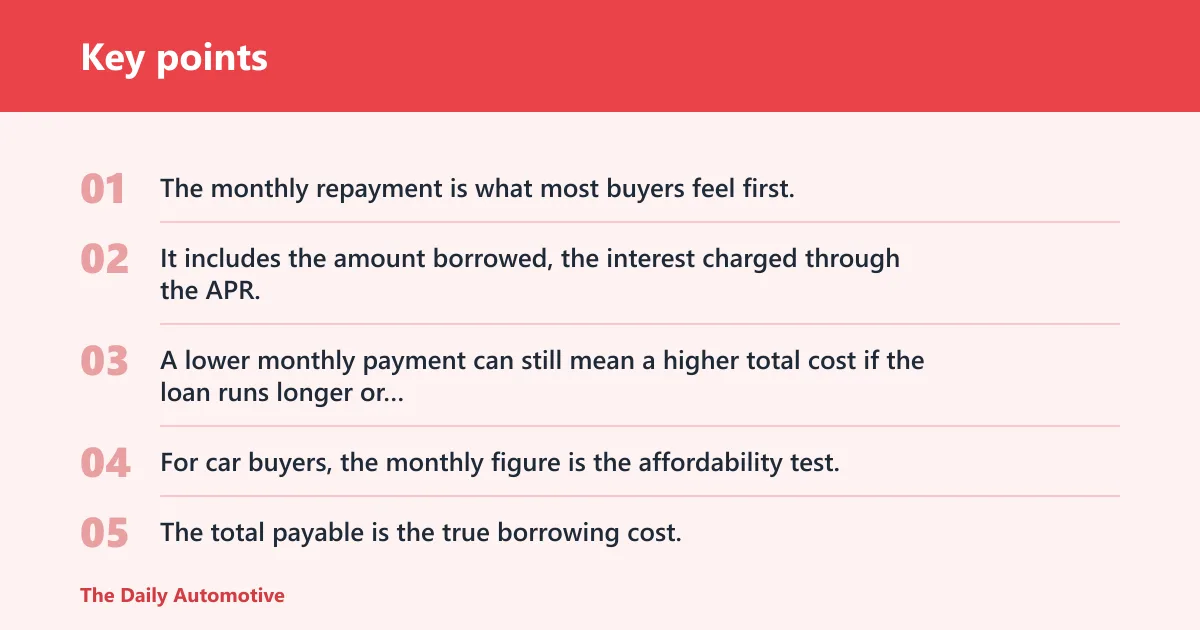
The monthly repayment is what most buyers feel first, because it leaves your bank account every month. The total payable is the bigger number. It includes the amount borrowed, the interest charged through the APR, and any agreement fees such as an option to purchase fee on some HP contracts.
That difference matters. A lower monthly payment can still mean a higher total cost if the loan runs longer or the APR is higher. For car buyers, the monthly figure is the affordability test. The total payable is the true borrowing cost.
Interest, fees, and the car price
Do not confuse finance cost with the car’s price. The car price is what the vehicle costs to buy. The total cost of credit is the interest plus fees paid over the agreement. Those two figures are separate, and the finance cost can materially exceed the amount you borrow.
Representative examples make that clear. Carmoola shows a £12,500 loan at 14.9% APR with 60 monthly payments of £290, total cost of credit of £4,900, an option to purchase fee of £1, and a total payable of £17,401. Car Finance 247 advertises rates from 8.9% APR, shows a representative 19.5% APR fixed rate, a sample loan of £12,000 over 5 years, a sample monthly payment of £304.38, and an option to purchase fee of £10.
Why the sticker price is not the full cost
Finance adds cost because you are paying to borrow. That extra charge is why paying cash is usually cheaper overall, even when the monthly hit of borrowing looks manageable. A finance quote that appears affordable can still be expensive once you add interest, fees, and the risk of owing more than the car is worth.
Say your budget leaves room for £320 a month. A longer term may bring the payment under that line, but the same car can end up costing more in total interest than a shorter loan. That is why the monthly figure should never be read on its own.
Car finance cost matrix
This matrix uses the same idea across six common setups so you can see how deposit, APR, and term length change the monthly payment, total interest, and likely buyer profile. The direction of change is the key point: bigger deposits and lower APRs usually reduce cost, while longer terms usually reduce the monthly payment but raise total interest.
| Scenario | Deposit | APR | Term | Monthly payment direction | Total interest direction | Likely buyer profile |
|---|---|---|---|---|---|---|
| 1 | Large | Lower | 36 months | Higher than a longer term, but still controlled | Lowest of the six | Buyer with strong credit and room to pay faster |
| 2 | Large | Lower | 72 months | Lower | Higher than Scenario 1 | Buyer who wants lower monthly outgoings and accepts more interest |
| 3 | Small | Lower | 36 months | Higher | Moderate | Buyer prioritising low total borrowing cost over cheap monthly payments |
| 4 | Small | Lower | 72 months | Lower | Higher | Buyer balancing cash flow against higher overall cost |
| 5 | Zero | Higher | 60 months | High | High | Buyer with limited cash up front and weaker credit pricing |
| 6 | Large | Higher | 60 months | Moderate | Still high, but less painful than Scenario 5 | Buyer with a thin profile who is trying to offset a weaker APR with cash up front |
How to read the cost changes
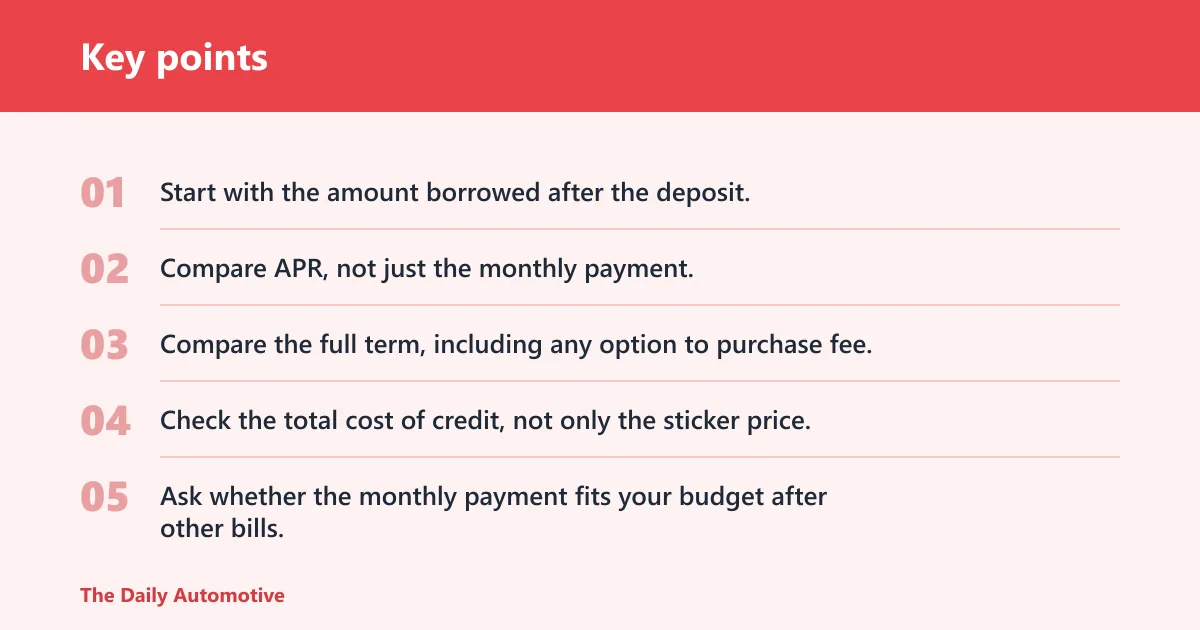
Read across each row, not just down the columns. A longer term can hide a higher total cost. A bigger deposit can offset some of that cost by reducing the amount borrowed. A lower APR helps both the monthly payment and the total payable.
- Start with the amount borrowed after the deposit.
- Compare APR, not just the monthly payment.
- Compare the full term, including any option to purchase fee.
- Check the total cost of credit, not only the sticker price.
- Ask whether the monthly payment fits your budget after other bills.
Who each scenario tends to suit
Scenario 1 tends to suit a buyer with the strongest affordability position: stable income, manageable outgoings, and a credit profile likely to get lower pricing. Scenario 5 is the riskier end of the scale because a zero deposit and a higher APR usually leave the borrower paying more for longer. Scenario 2 can suit someone who wants lower payments and can live with extra interest.
What makes car finance expensive?
Car finance gets expensive when the APR is high, the term is long, the deposit is small, or the lender sees more risk in your credit profile. APR is the headline borrowing rate. Credit score influences the rate offered, and lender risk pricing can move the number up or down before you ever see the final offer.
APR and credit score
APR matters because it sets the cost of borrowing. A higher score can get you a lower rate, while a weaker profile can push the APR up. That difference flows straight into the monthly payment and the total interest paid. Car Finance 247’s advertised rates from 8.9% APR sit below its representative 19.5% APR fixed rate, showing how wide the pricing gap can be.
That spread is why two buyers can be quoted very different costs for the same car. The lender is pricing risk, not the vehicle alone. If your credit profile is weaker, the same agreement can cost much more over the life of the loan.
Loan term length
Typical car finance agreements last between 1 and 6 years, and a common consumer range is 36 to 72 months. Longer loan terms lower monthly payments but can increase total interest paid. Shorter terms do the opposite: higher monthly outgoings, but a lower total borrowing bill. (Caranddriver)
That trade-off is often the biggest decision in the quote. A longer term can make the car look affordable on paper. It can also keep you paying interest long after the car has dropped in value.
Deposit size
A bigger upfront deposit reduces the amount borrowed and monthly repayments. It can also improve loan terms, because the lender is taking on less risk. A zero deposit deal usually means a larger loan and a more expensive financing bill, especially if the APR is not competitive.
Suppose two buyers want the same £18,000 car. One puts down £3,000. The other puts down nothing. The second buyer borrows more, pays more interest, and has less buffer if the car loses value quickly.
How much are car finance payments?
Car finance payments depend on the amount borrowed, the APR, and the term. The monthly repayment is the main affordability metric because it includes principal and interest. A smaller loan or lower APR cuts the payment, while a longer term spreads the cost out and lowers the monthly figure at the cost of extra interest.
How the monthly figure changes
There is no single answer to “how much are car finance payments?” because the number moves with three levers. Raise the deposit and the payment usually falls. Lower the APR and the payment usually falls. Stretch the term and the payment usually falls, but the total payable usually rises.
A practical comparison is simple: compare two quotes with the same loan amount, then change one variable at a time. If Quote A has a lower monthly payment but a longer term, check the total interest before choosing it. The cheapest month is not always the cheapest loan.
A simple way to compare two offers
Use this order: total payable, monthly payment, fees, then settlement rules. If two offers have similar monthly payments, the one with the lower total cost of credit is usually better. If one quote is cheaper per month but much more expensive overall, the lower payment may be a false bargain.
Most buyers should also check whether the quote is based on a representative APR or a rate they are actually likely to receive. The representative example is not a promise. It is a pricing signal.
How do HP and PCP change the cost?
HP and PCP change the cost in different ways. HP usually spreads the full price across the agreement and may include an option to purchase fee. PCP usually keeps the monthly payment lower by deferring part of the value into a balloon payment at the end, but mileage limits and end-of-term choices matter more.
HP and the option to purchase fee
On HP-style agreements, the option to purchase fee is a small final charge that becomes part of the total payable. Carmoola’s example includes a £1 option to purchase fee. Car Finance 247’s sample option to purchase fee is £10. Small as they are, these fees still belong in the full cost calculation.
PCP, balloon payments, and mileage limits
PCP usually reduces the monthly payment because you are not paying off the full value in the same way as a straight loan. That can make the car look more affordable. The catch is the balloon payment at the end, plus mileage limits and condition terms that can add cost if the car is returned with excess wear or excess miles.
A common first-timer mistake is to focus on the monthly figure and ignore the end-of-term bill. If you plan to keep the car, PCP can still work, but the final payment needs to fit your budget or be refinanced at more interest.
Which structure usually suits which buyer?
HP often suits buyers who want to own the car outright and prefer a straightforward path to ownership. PCP often suits buyers who want a lower monthly payment and may change cars more often. Neither is automatically cheaper. The better structure is the one that fits your cash flow, mileage, and exit plan.
Costs that catch buyers out
The biggest hidden cost risks are early settlement fees, negative equity, depreciation, and affordability strain. These do not always appear in the headline monthly payment, but they can change the real cost of the agreement quickly. That is especially true if you trade the car before the term ends.
Common mistakes and cost impact
| Mistake | Cost impact | Why it matters |
|---|---|---|
| Choosing a longer term than needed | Lower monthly payment, higher total interest | You pay for the convenience of a smaller monthly bill. |
| Putting down zero deposit | Higher amount borrowed and usually higher total cost | The lender finances more of the car and may price the deal accordingly. |
| Settling early without checking the fee | Extra settlement charge can raise the real cost | The lender may charge for ending the agreement before schedule. |
| Ignoring mileage on PCP | Excess mileage charges can add to the bill | The car’s agreed usage changes the end-of-term cost. |
| Overstretching the monthly budget | Higher risk of missed payments and financial stress | The agreement may fit the offer, but not your real outgoings. |
Negative equity and depreciation
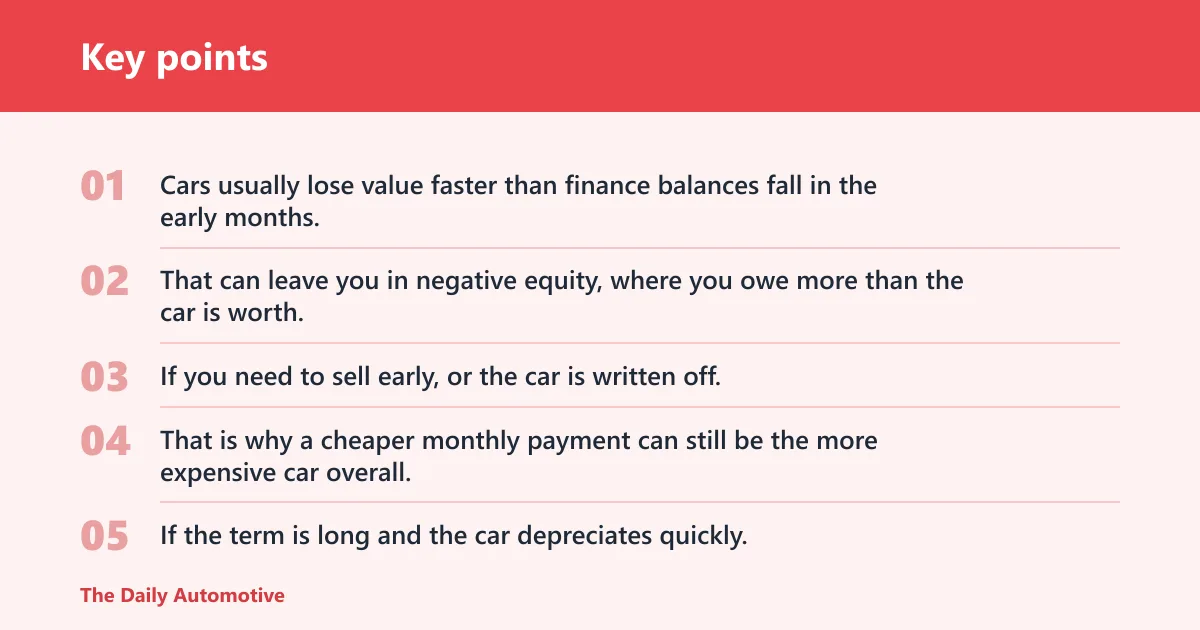
Cars usually lose value faster than finance balances fall in the early months. That can leave you in negative equity, where you owe more than the car is worth. If you need to sell early, or the car is written off, that gap can become your problem unless insurance or settlement terms cover it.
That is why a cheaper monthly payment can still be the more expensive car overall. If the term is long and the car depreciates quickly, the finance balance can stay high for longer than the car’s market value.
Affordability checks and budget strain
Lenders assess affordability using income, outgoings, disposable income, and credit profile. That check is not a formality. It is part of the approval decision. A deal can look affordable on paper and still fail the lender’s test if your other commitments leave too little room.
Do not treat approval as proof of comfort. A finance company can approve a loan that still feels tight once fuel, insurance, servicing, parking, and tax are added. The true test is whether the payment leaves enough room for the rest of car ownership.
Ways to lower the cost
The quickest ways to cut finance cost are simple: put down a bigger deposit, keep the term as short as your budget allows, and check every fee before signing. A better APR also helps, but that usually depends on your credit profile and the lender’s risk appetite.
Improve the deposit size
More cash up front means less to borrow. That lowers monthly repayments and can reduce the total interest charged. Even a modest deposit can make the agreement cleaner, because it reduces both the loan amount and the chance of starting in negative equity.
Shorten the term where affordable
Shorter terms usually cost less overall. The payment is higher, so this only works if the budget can carry it without stress. If the shorter term breaks your cash flow, the cheaper loan can become a bad choice in practice.
Check fees, settlement rules, and total payable before signing
Read the settlement rules before you commit. Check whether there is an option to purchase fee, an early settlement charge, or PCP mileage limits that could add to the final bill. The right comparison is the total payable, not the advertised payment alone.
One practical rule helps here: if the lender cannot show the total cost of credit clearly, stop and ask for it in writing before you proceed.
Frequently asked questions
How much are car finance rates?
Car finance rates vary by credit score, lender risk, loan term, and deposit. Advertised examples can range widely. Car Finance 247 advertises rates from 8.9% APR and also shows a representative 19.5% APR fixed rate, which illustrates how much the price can move between borrowers and offers.
How much car loan cost
Car loan cost is the amount you repay in total, including interest and any fees. It is separate from the car’s price.
Is car finance expensive?
Car finance can be expensive if the APR is high, the term is long, or the deposit is small. It is usually more expensive than paying cash because you are borrowing money. The deal can still be worth it if the monthly payment fits your budget and the total payable is acceptable.
How much is car finance interest rate?
There is no single rate. The APR depends on your credit profile, the lender, the deposit, and the term. Representative examples can be much higher or lower than advertised headline rates, so compare the actual APR offered to you, not only the marketing figure.
How much is car finance cost?
Car finance cost is the monthly repayment plus the total interest and fees over the agreement. It can include an option to purchase fee on some HP-style contracts. If you want the real figure, look at the total cost of credit and the total payable, not just the monthly payment.
Products related to this article
Sponsored / affiliate links. As an Amazon Associate I earn from qualifying purchases. I may earn additional commission from eligible campaigns.