Is It Better to Book a Car Rental Based on Reviews?
Yes, book a rental from reviews only after you filter for repeated complaints about fees, pickup delays, and policy enforcement. One bad pattern matters more than a high star average. Miss those signals, and you can pay extra charges, wait at the counter, or lose coverage over a rule you never saw. This guide shows which review details matter, which do not, and how to judge a company before you reserve.
How reviews reveal—and miss—key rental risks
Yes, but use reviews as a risk filter, not a booking rule. A strong average can hide airport-branch problems, fee surprises, or deposit disputes, while a mediocre score can still point to a usable location if the complaints are old, vague, or tied to a different branch.
What reviews are good at spotting
Reviews are useful when the same problem appears again and again: unexpected fees, long pickup waits, pressure to buy extras, deposit holds that were not explained, and cars that arrive dirty or damaged. Those patterns tell you more than generic praise about “great service.”
What reviews cannot tell you
Reviews do not replace the booking terms. They cannot reliably confirm free cancellation rules, mandatory coverage, young driver fees, one-way fees, license-holding requirements, or whether your car will be manual or automatic. Those details live in the booking flow and supplier terms, not in star ratings.
When price should outweigh rating
Price should matter more when the review gap is small and the cheaper option has clearer terms, a better pickup location, and a recent review record. A lower price is not safer by itself, but a transparent total can beat a slightly higher rating with messy fee reports.
Car rental review matrix
Use this matrix to score reviews before you book. It weighs the complaints that change the trip cost or the pickup experience most, and it gives more weight to recent, repeated reports than to one-off praise.
| Signal | Trust weight | What to look for | Booking call |
|---|---|---|---|
| Fee complaints | 5 | Hidden charges, airport surcharges, fuel-policy disputes, one-way fee surprises | Avoid if repeated and recent; otherwise consider |
| Pickup delays | 4 | Long queues, missing staff, slow check-in, closed counters | Consider if occasional; avoid if common at your branch |
| Deposit disputes | 5 | Unexpected holds, card problems, refusal to release deposit, unclear damage claims | Avoid when repeated |
| Vehicle-condition complaints | 4 | Dirty cars, warning lights, worn tires, body damage, wrong car class | Consider if isolated; avoid if common |
| Recentness | 5 | Reviews from the last few months, especially after ownership, fleet, or policy changes | Book only when recent patterns are stable |
How to score the mix
Start with the five signals above. If the worst complaints are about fees, deposits, or recent policy enforcement, treat the listing as risky even when the average score looks fine. If praise is old and complaints are current, trust the complaints.
What rental reviews actually reveal
The best reviews show where a rental can become more expensive or more frustrating than the headline price suggests. They are less useful for predicting one perfect car than for exposing recurring problems in billing, handoff speed, and the condition of the fleet at a specific branch.
Fee complaints and total cost surprises
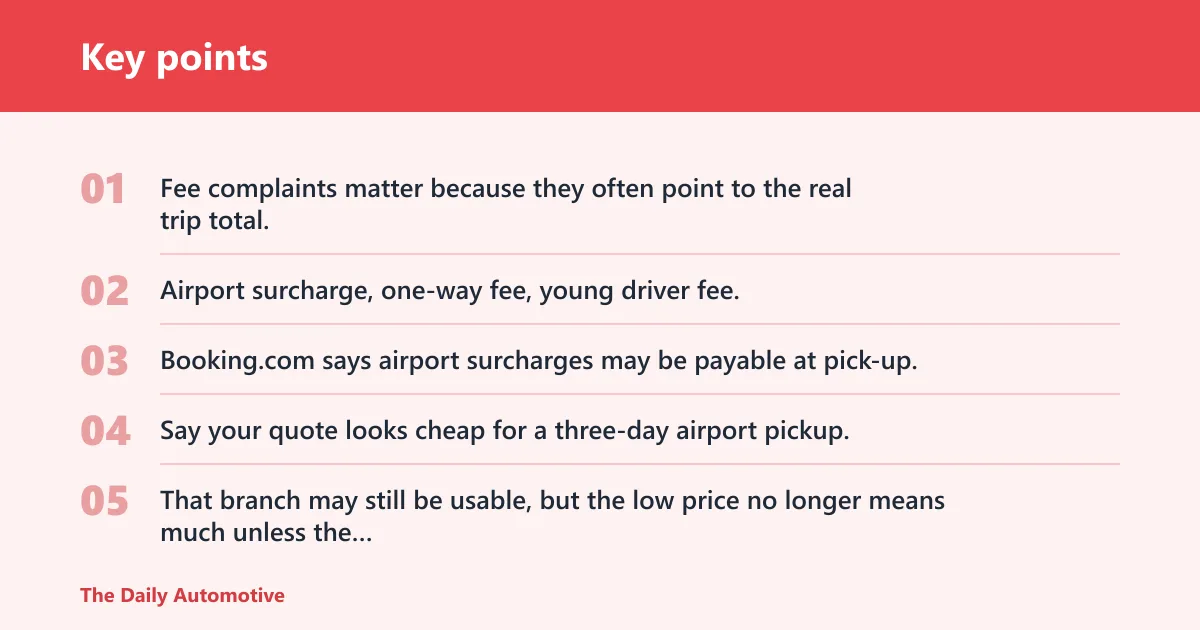
Fee complaints matter because they often point to the real trip total. Airport surcharge, one-way fee, young driver fee, and counter-sold extras can move the final bill far beyond the headline rate. Booking.com says airport surcharges may be payable at pick-up, and one-way rentals are usually possible but may cost an extra fee.
Say your quote looks cheap for a three-day airport pickup, but three recent reviews mention a surcharge charged at the desk. That branch may still be usable, but the low price no longer means much unless the payment page clearly shows the total.
Pickup delays and counter friction
Long waits matter because they can ruin the first hour of the trip. Reviews that mention slow counters, missing paperwork, or staff pushing add-ons are more useful than reviews that simply praise “friendly service.” If multiple recent customers report the same delay, expect the same experience.
Deposit disputes and policy enforcement
Deposit complaints are high-signal because they often reveal how strictly the branch enforces its rules. If reviews mention denied cards, surprise holds, damage claims, or extra charges for fuel or cleaning, treat those as warning signs. That risk is separate from a good star average.
Vehicle-condition complaints and fleet quality
Vehicle-condition reviews tell you whether the branch is turning over its fleet properly. Repeated reports of warning lights, poor cleaning, mismatched classes, or visible damage suggest weaker prep standards. A single complaint is noise; a pattern is a sign to keep shopping.
Location reviews matter most
Company-level ratings can mislead because car rental quality often changes by pickup point. An airport branch may have different staffing, fees, or stock than a city-center branch under the same brand, so the review location must match your booking location.
Airport branch versus city-center branch
Airport reviews matter most for airport pickups. Airport branch reviews may reflect shuttle delays, surcharge disputes, and long lines that may not appear in city-center feedback. City branches may have fewer airport fees and faster handoff, but they may also have different hours and car availability.
Why company ratings can mislead
Company-wide ratings blend many branches, so a strong overall score can hide a weak airport desk. The reverse is also true. A poor brand score may come from one bad location while your chosen branch performs better. Always read reviews tied to the exact pickup point.
How pickup location changes fee relevance
Pickup location changes the fee structure and the meaning of the reviews. Airport surcharges often show up there. City-center bookings may avoid that charge but create different tradeoffs, including limited hours or fewer automatic cars in markets where manual transmissions are common.
How reliable are reviews?
Reviews tend to be more reliable when they are numerous, recent, and tied to the same pickup location. Booking.com says it has 5 million+ reviews from real, verified customers, which is useful because a larger sample is harder to skew than a tiny set of perfect scores.
Verified ratings and review volume
Verified customer ratings matter more than anonymous comments because they reduce obvious spam. Review volume matters because one unhappy customer can distort a small sample. A branch with hundreds of recent ratings gives you a better read than a branch with a handful of glowing reviews.
Recentness and changed operations
Older praise can be stale if the branch changed ownership, fleet mix, or policy enforcement. A five-star review from last year may not reflect the current desk, current staff, or current fees. Give more weight to the newest pattern, especially at airport locations.
Suppose a city-center branch had great reviews six months ago, but recent comments mention faster charges at pickup and stricter deposit checks. The older praise is not useless, but the newer complaints should guide the booking decision because they better match today’s operation.
Spotting fake or biased reviews
Fake or biased reviews often sound vague, repetitive, or extreme without specifics. Trust comments that mention the fee, the desk process, the exact delay, or the condition of the car. Be cautious with reviews that are all praise or all anger and say nothing concrete about the rental.
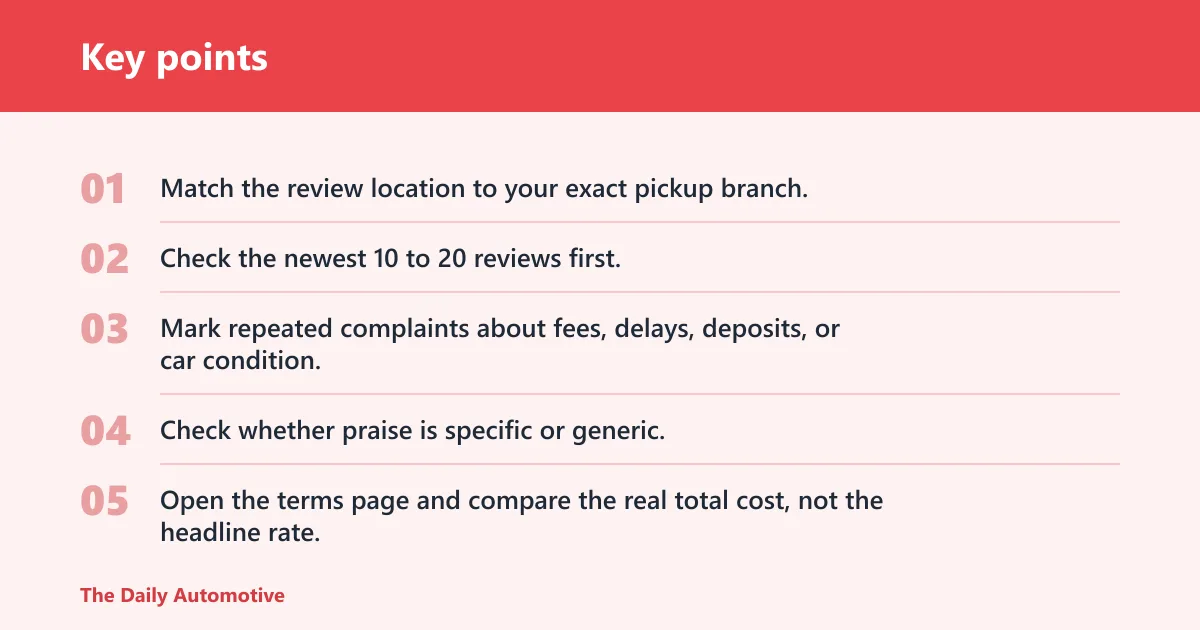
- Match the review location to your exact pickup branch.
- Check the newest 10 to 20 reviews first.
- Mark repeated complaints about fees, delays, deposits, or car condition.
- Check whether praise is specific or generic.
- Open the terms page and compare the real total cost, not the headline rate.
What the booking terms can hide
Reviews rarely list every rule that affects the bill or your eligibility. The booking terms decide whether you can cancel, what coverage is already included, and which extra charges can still appear at the counter. Read those terms before you trust the rating.
Free cancellation rules
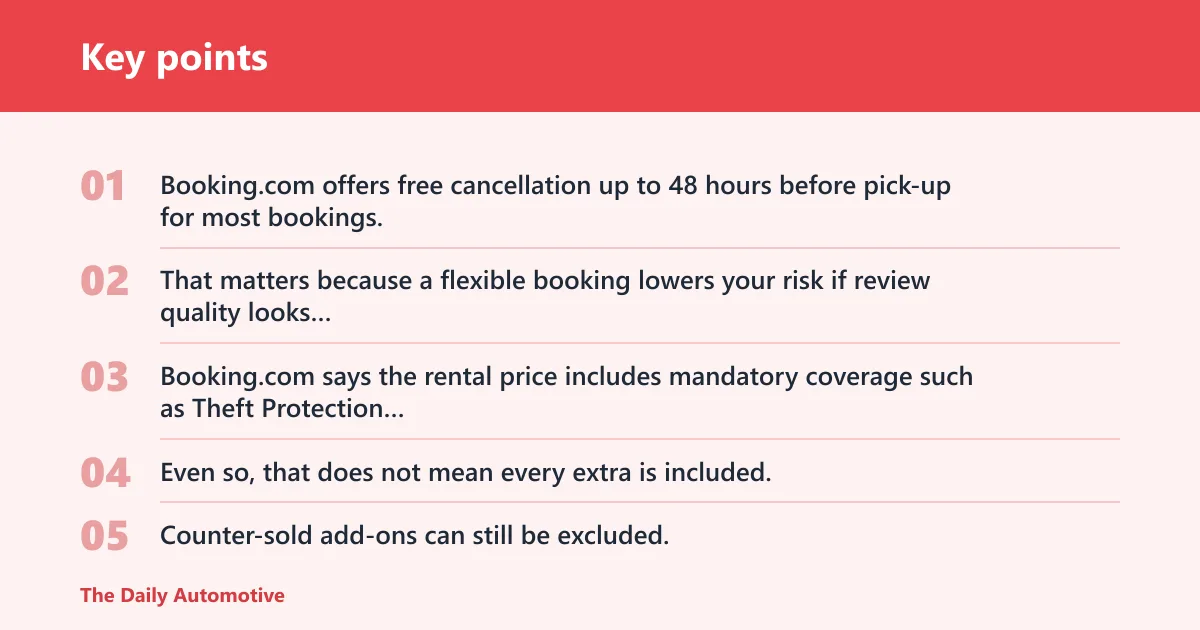
Booking.com offers free cancellation up to 48 hours before pick-up for most bookings, but supplier rules can differ. That matters because a flexible booking lowers your risk if review quality looks uncertain or if you want to keep shopping.
Mandatory coverage and included extras
Booking.com says the rental price includes mandatory coverage such as Theft Protection and Collision Damage Waiver. Even so, that does not mean every extra is included. Counter-sold add-ons can still be excluded, so check the payment page before assuming the price is complete.
Airport surcharges, one-way fees, and young driver fees
Booking.com says airport surcharges may be payable at pick-up, under-25 drivers may pay a young driver fee, and one-way rentals are usually possible but may cost an extra fee. Those charges often do not show up clearly in a quick review skim, which is why a low headline price can mislead.
License-holding periods and transmission type
Booking.com says some companies may require a driver’s license held for 36 months, most companies rent to drivers at least 21 years old, and manual cars are common in some countries while automatics are normal in others. These are eligibility and availability checks, not review topics, so confirm them before you book.
Can reviews beat a lower price?
Yes, when the cheaper rental comes with repeated complaints about fee surprises, pickup friction, or deposits. A slightly higher price can be worth it if the branch has recent, location-specific reviews that show clear billing and faster handoff. Clarity can save more than a discount.
When a cheap deal is still worth it
A cheap deal can still work when the reviews are recent, the complaints are minor, and the booking terms are clear. If the total cost is transparent on the payment page and the pickup location has a solid record, the lower price may be the better call.
When stronger reviews justify paying more
Pay more when the lower-priced option has repeated reports of deposits, surcharges, or long queues. Stronger reviews matter most when the trip has a tight schedule, when you are crossing a border, or when one-way and young driver fees can inflate the final bill.
How to compare total trip cost
Do not compare headline rates alone. Compare the base price, airport surcharge, one-way fee, young driver fee, mandatory coverage, and any likely counter extras. Booking.com says a full price breakdown is available on the Payment page, which is the right place to verify the total before paying.
Frequently asked questions
Should I book a car rental based on reviews?
Yes, but only after checking what the reviews actually complain about. Repeated fee disputes, pickup delays, and deposit problems matter more than a high star average. Use reviews to screen out risky branches, then confirm the total price and rental terms before booking.
How reliable are car rental reviews when choosing a company?
They are reliable when they are recent, verified, and tied to the same pickup location. Large review volume helps because it reduces the weight of one-off praise or anger. Old reviews, vague comments, and company-wide scores are less dependable than current branch-level feedback.
What should I look for in car rental reviews before booking?
Focus on fee complaints, pickup waits, deposit disputes, and vehicle condition, since these often affect total cost or the first hour at the desk. Those are the signals most likely to change your total cost or your first hour at the desk. Skip generic praise unless it is specific about fast pickup, clean cars, or clear billing.
Are star ratings or written reviews more useful for car rentals?
Written reviews are more useful because they explain why the rating is high or low. A star score can hide problems with airport surcharges, counter pressure, or policy enforcement. Short written complaints about specific charges or delays usually tell you more than the number alone.
How do I spot fake or biased car rental reviews?
Watch for repetitive language, extreme praise without details, or complaints that never mention a branch, fee, or pickup issue. Real reviews usually name a concrete problem, such as a delay, damage claim, or extra charge. A pattern of specific recent comments is more trustworthy.
What do reviews not tell you about car rental fees?
Reviews often miss airport surcharges, one-way fees, young driver fees, mandatory coverage details, and license rules. Booking.com says some of those charges can appear at pick-up or vary by supplier. Always check the payment page and the rental terms before relying on the review score.
Products related to this article
Sponsored / affiliate links. As an Amazon Associate I earn from qualifying purchases. I may earn additional commission from eligible campaigns.