How Much Does a Car Loan Cost?
A car loan costs the amount you borrow plus interest. On a typical 60-month loan at about 7% APR, $30,000 financed adds roughly $5,600 in interest. These examples assume no down payment, no trade-in, and no financed taxes or fees. Ignore rate or term, and the payment can look manageable while the total bill rises by thousands. This guide shows how principal, APR, and loan length change both your payment and your total cost.
Principal, APR, and term length
A car loan has three main cost parts: principal, interest, and term length. The principal is the amount financed, which can include the negotiated selling price plus taxes, title, license, and any lender or dealer charges you roll into the loan. APR sets the price of borrowing, and the term sets how long interest can build.
Principal: the amount you finance
Principal is the base balance you owe before interest. It is not limited to the sticker price. If you finance taxes, title, registration, documentation fees, or add-ons, those amounts raise the loan balance and the total interest you pay over time.
APR: the price of borrowing
APR, or annual percentage rate, is the yearly borrowing cost lenders use to price the loan. It matters because it drives total interest cost. A small APR shift can change total repayment by hundreds or even thousands of dollars on the same principal, especially over longer terms.
Term length: why months matter
Car loans are typically 24 to 84 months long, and most commonly run about five years, or 60 months. Shorter terms increase the monthly payment but shorten the interest period. Longer terms reduce the payment, then usually raise the total cost because interest keeps accruing for more months.
How much are car loan rates right now?
Car loan rates vary by credit tier, vehicle age, and lender. In the examples used in this article, new-car rates range from 4.41% for the best scores to 16.11% for the lowest. Used-car rates are higher, ranging from 6.29% to 21.62%, which means the same borrowed amount can cost much more on a used vehicle.
New-car rates by credit tier
New-car financing is usually cheaper than used-car financing. The best credit tiers can qualify for rates near the low end of the range, while weaker credit pushes the APR much higher. That gap matters because APR affects the full lifetime interest charge, not just the monthly bill.
Used-car rates by credit tier
Used-car loans usually price higher because the vehicle is older and the lender takes on more risk. That means a borrower can see a higher APR even with the same credit profile. The result is a larger share of each payment going to interest, especially in the first half of the loan.
Where a 670 credit score fits
FICO and VantageScore both use a 300 to 850 range, and Experian says around 670 is often considered the start of good credit. A score near that line can matter a lot. Better tiers usually bring better pricing, while weaker scores often face higher APRs and stricter loan terms.
Car loan cost comparison table
This comparison uses the same $30,000 loan amount so you can see how APR and term change the bill. The payment formula is an amortization formula, and most car loans accrue simple interest daily on the remaining balance. The table shows how a lower rate or shorter term changes monthly payment, total interest, and total repayment cost.
| Loan amount | APR | Term | Monthly payment | Total interest paid | Total repayment cost |
|---|---|---|---|---|---|
| $30,000 | 4.41% | 24 months | $1,307 | $1,368 | $31,368 |
| $30,000 | 4.41% | 60 months | $556 | $3,350 | $33,350 |
| $30,000 | 4.41% | 84 months | $415 | $4,809 | $34,809 |
| $30,000 | 7.00% | 24 months | $1,339 | $2,115 | $32,115 |
| $30,000 | 7.00% | 60 months | $594 | $5,634 | $35,634 |
| $30,000 | 7.00% | 84 months | $451 | $7,908 | $37,908 |
| $30,000 | 16.11% | 24 months | $1,467 | $5,205 | $35,205 |
| $30,000 | 16.11% | 60 months | $737 | $14,247 | $44,247 |
| $30,000 | 16.11% | 84 months | $605 | $20,589 | $50,589 |
| $30,000 | 6.29% | 60 months | $582 | $4,899 | $34,899 |
| $30,000 | 21.62% | 60 months | $817 | $18,997 | $48,997 |
The table shows the same loan amount at new-car and used-car rates. At 60 months, the difference between rates around 4.41% and 16.11% is more than $10,000 in total interest on $30,000. That is why APR belongs in the cost estimate from the start.
At 60 months, a rate around 6.29% adds about $4,900 in interest on $30,000, while a rate around 21.62% adds about $19,000. The payment also jumps from $582 to $817. Same loan amount. Very different bill.
How does loan term change the total cost?
Term length changes both the monthly payment and the total interest. A shorter loan raises the payment because the lender collects the balance faster, but it reduces the number of months interest can build. A longer loan lowers the payment and usually raises the total bill because the loan stays open longer.
Why shorter terms save interest
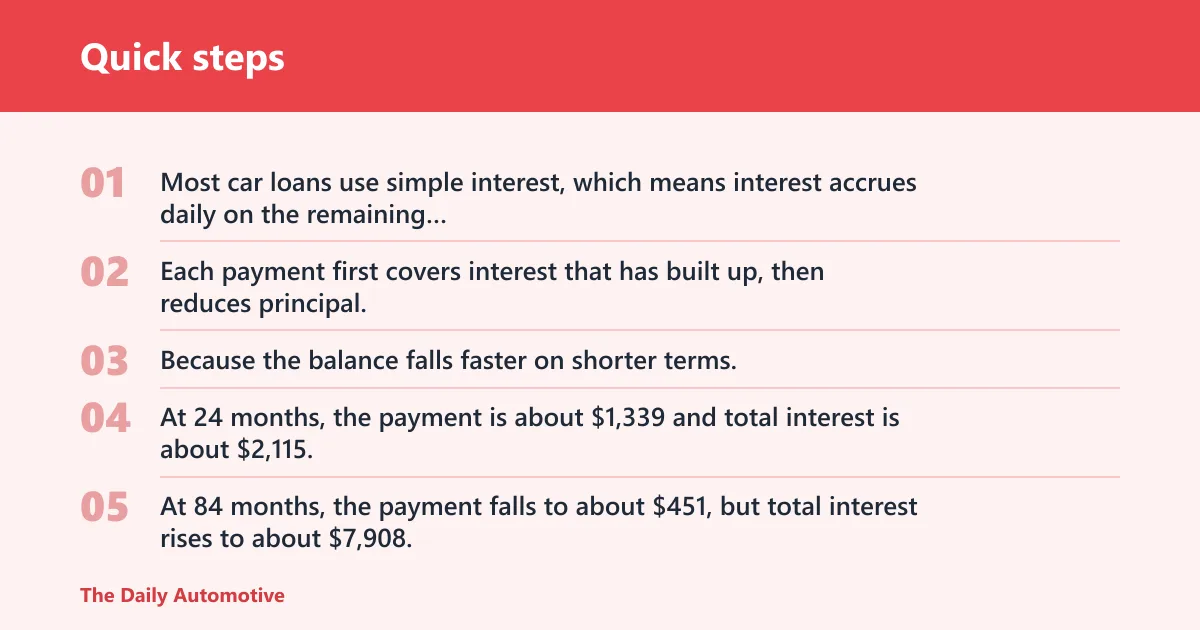
Most car loans use simple interest, which means interest accrues daily on the remaining balance. Each payment first covers interest that has built up, then reduces principal. Because the balance falls faster on shorter terms, less interest is charged over the life of the loan.
Suppose you finance $30,000 at 7% APR. At 24 months, the payment is about $1,339 and total interest is about $2,115. At 84 months, the payment falls to about $451, but total interest rises to about $7,908. The lower payment comes with a much larger interest bill.
Why longer terms lower payments
Longer terms spread the balance over more months, so the payment drops. That can help cash flow, especially if your budget is tight. But the loan stays alive longer, which means more months of interest charges and often a larger amount paid overall.
When a 60-month loan is the middle ground
Sixty months is the common benchmark because it often balances payment size and total cost better than 72 or 84 months. It is not automatically the cheapest option. It is simply a middle ground many shoppers use when they want manageable monthly payments without stretching the loan too far.
How credit score changes what you pay
Credit score is one of the biggest drivers of auto loan pricing. Around 670 is often treated as the start of good credit, and lenders use that kind of tiering to price risk. Better scores usually mean lower APR, while weaker scores usually mean higher APR and higher total interest.
Good credit versus bad credit pricing
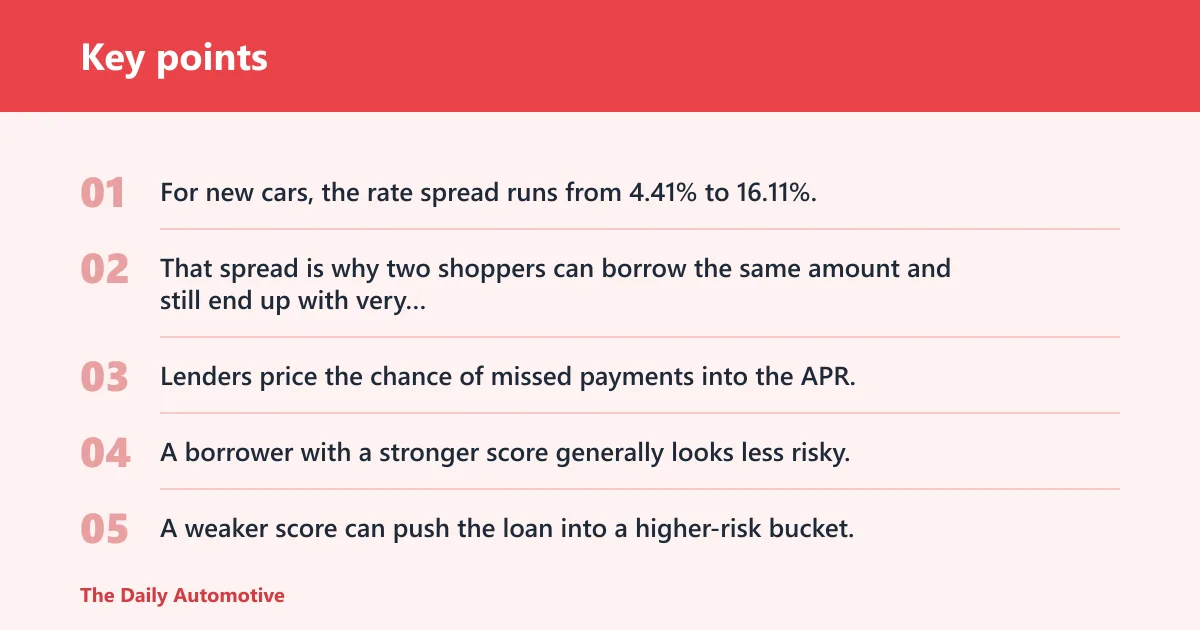
For new cars, the rate spread runs from 4.41% to 16.11%. For used cars, it runs from 6.29% to 21.62%. That spread is why two shoppers can borrow the same amount and still end up with very different monthly payments and total costs.
How lenders price risk
Lenders price the chance of missed payments into the APR. A borrower with a stronger score generally looks less risky, so the lender may offer a lower rate. A weaker score can push the loan into a higher-risk bucket, which raises interest cost across the full term.
Picture two shoppers each financing $30,000 for 60 months. One gets a 4.41% new-car rate and pays about $556 a month. The other gets a 16.11% used-car rate and pays about $737 a month. The second shopper pays much more, even though the borrowed amount is the same.
Why preapproval matters before you shop
Preapproval gives you a clearer rate and payment target before you choose a vehicle. It can also reveal how much principal you can support at a given monthly payment. That matters because taxes, title, fees, and optional add-ons can push the financed amount above the sticker price.
How to estimate what you can borrow
An affordability calculator can estimate borrowing capacity from rate, term, and monthly payment. Start with the payment you can actually support, then work backward to the loan amount. That keeps the decision grounded in your budget instead of a dealership payment pitch.
Using a payment or affordability calculator
Most payment calculators ask for principal, APR, and term. An affordability calculator does the reverse: it takes a target payment, rate, and term, then estimates the loan size you can carry. Use the same inputs across lender quotes so the comparison stays fair.
Matching the payment to your budget
Most experts say to spend no more than 10 percent of monthly take-home pay on a car payment, and a full car-ownership budget should stay at or below about 20 percent of take-home income. That leaves room for insurance, fuel, maintenance, and repair costs, which do not disappear once the loan is signed. (Caranddriver)
Keeping taxes and fees in the estimate
Do not treat the vehicle price as the full amount financed. Taxes, title, license, registration, and lender or dealer fees can increase the principal. If you leave them out, the estimated payment will be too low and the borrowing plan can fall apart at signing.
The cheapest loan structure is usually the one with the lowest APR and the shortest term you can comfortably afford. You can also reduce total cost by lowering the amount financed. None of those moves require stretching the loan just to make the monthly payment look smaller.
Compare lender offers before signing
Get quotes from banks, credit unions, and online lenders before you commit to dealership financing. APR differences matter because they change the total interest paid. Even a modest rate cut can save real money over a 60- or 84-month loan.
Raise the down payment if you can
A bigger down payment lowers principal, which lowers both the payment and the interest charge. It also gives you more room if taxes and fees push the out-the-door price higher than expected. A smaller loan is almost always cheaper than a larger one at the same rate.
Choose the shortest term you can comfortably afford
Choose the shortest term that still fits your budget. A 72- or 84-month loan can make the payment look easier, but the comparison table shows the tradeoff clearly: more months means more interest. If a shorter term is too tight, it may be better to buy less car.
Avoid rolling extras into the loan
Dealer add-ons are not mandatory just because they appear in the finance office. If you roll extras into the loan, you pay interest on them too. That raises the principal and increases the total repayment cost for the full term.
- Get preapproved before you shop.
- Ask for the out-the-door price, not just the sticker price.
- Compare APRs from at least two lenders.
- Use the shortest term you can afford without straining the budget.
- Keep the amount financed down by limiting add-ons and fees.
Frequently asked questions
How much does a car finance cost?
A car finance deal costs the principal you borrow plus interest over the loan term. On a $30,000 loan at about 7% APR for 60 months, total interest is roughly $5,600 and total repayment is roughly $35,600. Taxes, title, and fees can raise the borrowed amount before interest is applied.
How much are car loan rates?
Car loan rates depend on credit tier, vehicle type, and lender. New-car rates range from 4.41% to 16.11%, while used-car rates range from 6.29% to 21.62%. Better credit usually brings lower APR, which reduces the total interest paid over the life of the loan.
How much are used car loan rates?
Used-car loan rates range from 6.29% to 21.62% based on credit tier. That range is usually higher than new-car pricing, so the same loan amount can cost noticeably more. A 60-month, $30,000 loan at 6.29% costs about $4,899 in interest, while 21.62% costs about $18,997.
How much are new car loan rates?
New-car loan rates range from 4.41% for the best scores to 16.11% for the lowest. That spread changes monthly payment and total interest on the same loan amount. On a $30,000 loan for 60 months, the difference between those ends is more than $7,000 in total interest.
How much is the average car loan rate?
There is no single average rate that fits every borrower, because APR changes with credit score, loan term, and whether the car is new or used. A better way to shop is to compare the rate quoted for your credit tier against the new-car and used-car ranges before you sign.
How much does a car cost on finance?
The financed cost of a car is the amount borrowed plus interest, then plus any taxes and fees that were rolled into the loan. On the same principal, a shorter term lowers interest while a higher APR raises it. That is why two similar loans can have very different total costs.
Products related to this article
Sponsored / affiliate links. As an Amazon Associate I earn from qualifying purchases. I may earn additional commission from eligible campaigns.