Best Car Interior Cleaning Tools for Pet Hair: Picks
The best tool depends on your car’s surfaces and hair load: use a rubber bristle brush for light weekly cleanup, a motorized pet-hair tool or vacuum attachment for heavy shedding, and a crevice tool for seams. Miss that match, and hair packs into fabric, clogs mats, and eats time with repeat passes. I’ve seen this play out in cloth seats, vinyl trims, and cargo areas. This guide shows how to choose by seat material, shedding level, and cleaning frequency.
This guide is part of our Car cleaning and detailing guide series.
Best car interior cleaning tools for pet hair
The top pick for embedded hair in cloth seats is a rubber pet hair brush. For fast cleanup between trips, a lint roller or microfiber towel is quicker. For seams, mats, and crevices, pair compressed air with a pet-hair vacuum attachment and a narrow nozzle. Cloth needs a different plan than leather or vinyl.
That is the part many buyers miss. Chemical Guys says dog hair can cover an entire back seat in a single ride, and that fur embeds into seat seams and carpet fibers. It also notes that static cling can make fur stick to fabric, and that cloth, tweed, and textured fabric often hold fur more than leather or vinyl. I see the same pattern every time I clean a dog-hauler with deep pile fabric.
Top pick for embedded hair in cloth seats
A rubber pet hair brush is often a good first buy for cloth interiors with embedded fur. It lifts hair with static-electricity action, works on upholstery and carpet, and can be rinsed and reused. On textured cloth, it usually does the first real removal job better than a vacuum alone.
Top pick for fast cleanup between trips
A lint roller is often the quickest touch-up tool for loose surface hair. It is useful after a dog ride when the seats only need a quick reset. It is not a deep-clean solution, and it struggles once hair is pressed into textured fabric or packed into seams.
Top pick for seams, mats, and crevices
A pet-hair attachment nozzle with a rubber or silicone edge is the best targeted tool for seam work. Add compressed air or a blower for seat rails and under-mat gaps, then vacuum the loosened hair. That sequence reaches places where a brush alone cannot clean evenly.
According to Dog Hair Remover For Car – Chemical Guys — Chemical Guys sells 2 products in its dog-hair-removal collection.
Quick picks: the right tool by job
Use this section as a buying shortcut. The right stack changes with upholstery, hair load, and how often the car gets cleaned. A weekly pet commuter needs different gear from an occasional weekend traveler.
- Light shedding and quick touch-ups: lint roller, microfiber towel, and a small handheld vacuum.
- Moderate shedding in cloth interiors: rubber pet hair brush, vacuum with pet-hair attachment, and a microfiber finish pass.
- Heavy shedding and multi-pet vehicles: rubber brush, corded handheld vacuum, crevice nozzle, and compressed air or blower.
Light shedding and quick touch-ups
For a car that sees pets only occasionally, a lint roller and microfiber towel handle the loose top layer well. Add a small handheld vacuum if crumbs and grit ride along with the fur. This setup is fast, inexpensive, and easy to store in the cargo area.
Moderate shedding in cloth interiors
Cloth seats hold onto hair. For that reason, the rubber brush should lead, the vacuum should follow, and the towel should finish. This stack keeps you from wasting passes with the wrong tool, which is common when people start with suction alone.
Heavy shedding and multi-pet vehicles
Heavy shedding needs the full sequence: pre-loosen with air, lift with a rubber brush, vacuum with a pet-hair nozzle, then detail seams. If the car carries more than one animal, disposable rollers become expensive fast, so reusable tools usually make more sense.
What is the best car interior cleaning tool for pet hair?
The best single tool for most pet owners is a rubber pet hair brush, especially on cloth seats and carpet. It removes embedded hair that sits below the surface, while a vacuum then collects the loosened debris. For leather or vinyl, a wipe-down plus vacuum is usually enough.
Why one tool rarely handles every surface
Seats, seams, floor mats, and trim behave differently. A brush works on fibers. A nozzle reaches gaps. A roller catches loose top hair. A microfiber towel cleans the last fuzz and dander. No single tool covers all of that without leaving misses.
How hair load changes the answer
Light hair can be picked up with a roller or towel. Heavy hair tends to mat into cloth and cluster in corners, which is where a brush and vacuum pair starts to matter. When the back seat looks furred over after one ride, the work becomes removal, not dusting.
How cleanup frequency changes the buy
Weekly cleaning favors reusable tools because they cut cost over time. Occasional pet travel can justify a roller and compact vacuum. If the vehicle is cleaned after every trip, the priority should be speed and storage, not the biggest kit.
Rubber pet hair brush: best for embedded hair in cloth
A rubber pet hair brush is the primary removal tool for embedded hair in cloth interiors. Its edge creates a static-electricity lifting action that pulls fur out of fibers instead of only moving it around. It is safe for upholstery and carpet, reusable, and rinseable after use.
How the rubber edge lifts hair
The rubber surface grabs fur and rolls it into removable clumps. That makes it useful on cloth seats, carpet, and mats. It is especially helpful where the grain of the fabric holds hair close to the surface and a vacuum wand glides over it without much bite.
Where it beats a vacuum
It beats a vacuum when hair is anchored in fiber. Suction can pull loose debris, but embedded hair often needs a mechanical lift first. That is why professional detailers tend to brush first, then vacuum, instead of spending extra time chasing the same patch.
Where it fails on textured trim
On delicate or sharply textured trim, a rubber brush can smear hair into a corner if used too aggressively. It also slows down on large flat areas when the pile is short and the contamination is mostly loose surface hair. In those cases, a nozzle may be faster.
Which vacuum setup works best in cars?
The best vacuum setup is a handheld model with strong suction and a pet-hair attachment, especially if the car sees regular shedding. Corded units usually maintain power better for heavy cleanup, while cordless models win on speed and storage. Output matters: Chemical Guys lists its DetailVac with a 110w electric motor and 8.8 amps.
Corded vs cordless for pet hair
Corded vacuums suit deep sessions because they avoid battery fade and keep suction steadier. Cordless vacuums are better for quick resets and smaller cars, but they can run out of force during a long interior clean. If the job includes mats, seams, and cargo areas, corded usually holds up better.
What suction numbers matter
Shopping clues are motor output and electrical draw, not marketing language. A handheld vacuum with higher output and a pet-hair attachment is more likely to pull loosened fur from carpet and seams. Chemical Guys sells a corded handheld car vacuum cleaner under the DetailVac name, which gives a concrete example of the format to look for.
Which pet-hair nozzle to buy
Look for a rubber or silicone edge, an anti-clog design, and a shape that reaches deep fibers. That nozzle should be useful on seams and floor mats, where hair sits in grooves rather than on open panels. A narrow, clog-resistant head saves time on cleanup and emptying.
How do you get dog hair out of seams, mats, and crevices?
Start by moving the hair out of the gap, not straight to the vacuum. Compressed air or a blower works well for seat rails and under-mat gaps because it dislodges trapped hair. Then vacuum the loosened material and finish with a microfiber towel for any remaining fuzz.
Using compressed air or a blower first
Air tools are best for tight spots. They push hair from cracks, rails, and the edges under floor mats where a brush cannot reach cleanly. The downside is simple: air moves hair without removing it, so it should be a setup tool, not the final step.
Vacuuming seat rails and under-mat gaps
Once the hair is loosened, a crevice tool or pet-hair nozzle can capture it before it settles back into the carpet. This is where many cleanups fail. People vacuum first, the hair shifts deeper, and the remaining strands stay hidden in the gap.
Finishing with a microfiber towel
A microfiber towel is the final pass tool. Dry towels catch fine fuzz and dander; slightly damp towels can help gather the last loose strands on hard interior surfaces. It should not replace brushing or vacuuming, but it cleans the residue those tools leave behind.
Buyer’s decision matrix: pick by seat material and shedding level
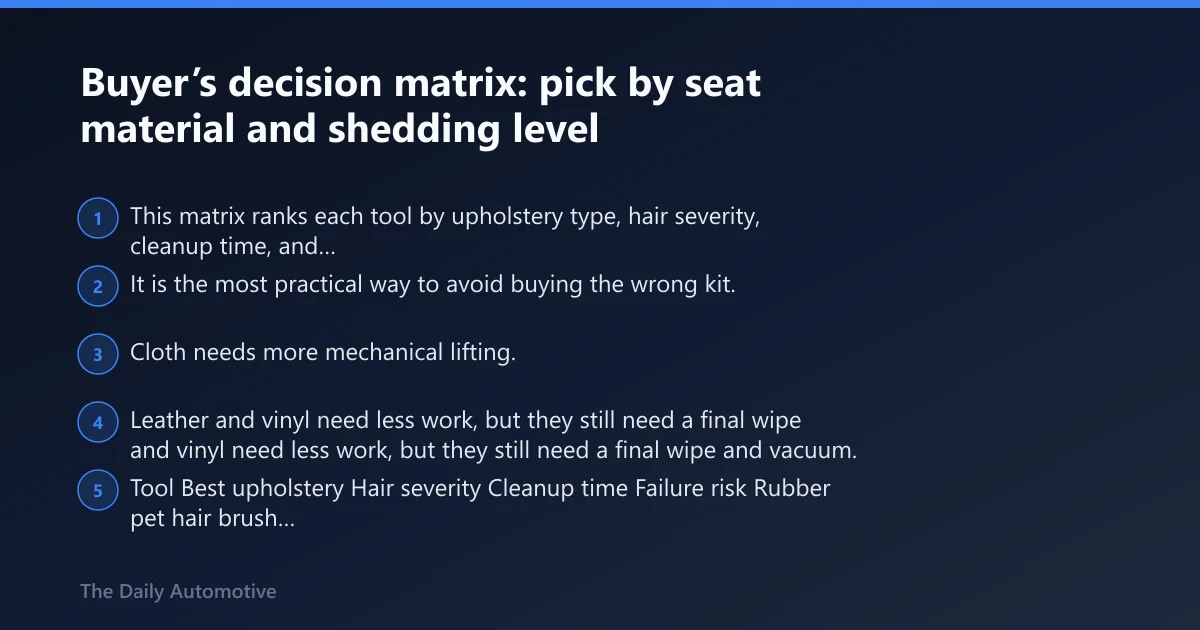
This matrix ranks each tool by upholstery type, hair severity, cleanup time, and likelihood of failure. It is the most practical way to avoid buying the wrong kit. Cloth needs more mechanical lifting. Leather and vinyl need less work, but they still need a final wipe and vacuum.
| Tool | Best upholstery | Hair severity | Cleanup time | Failure risk |
|---|---|---|---|---|
| Rubber pet hair brush | Cloth, carpet, mats | Moderate to heavy | Medium | Low on fabric, higher on glossy trim |
| Handheld car vacuum | Leather, vinyl, cloth after loosening | Light to heavy | Medium to long | Medium if hair is embedded or clogging the inlet |
| Pet hair attachment nozzle | Cloth seams, mats, carpet | Light to heavy | Medium | Low if anti-clog; higher on thick mats |
| Lint roller | Leather, vinyl, smooth cloth | Light | Fast | High on textured cloth and embedded hair |
| Microfiber towel | Leather, vinyl, trim, finishing cloth | Light residue | Fast | Medium if used as a primary remover |
| Compressed air or blower | Crevices, rails, under-mat gaps | All levels as a pre-step | Fast | High if used alone |
Cloth upholstery
Cloth, tweed, and textured fabric trap fur more than leather or vinyl. That means a rubber brush and pet-hair nozzle should be the main purchase. Vacuuming alone is slower and usually leaves the deepest strands behind.
Leather or vinyl seats
Leather and vinyl usually release fur more easily, so the workflow can be different. A wipe-down plus vacuum often clears the surface. The brush still helps in stitching and perforations, but the problem is usually residue, not embedded load.
Light, moderate, and heavy shedding
Light shedding can be handled with a roller, towel, and compact vacuum. Moderate shedding benefits from a brush-plus-vacuum stack. Heavy shedding needs a brush, a corded handheld vacuum, a pet-hair nozzle, and a crevice tool or blower for the gaps.
Weekly use versus occasional use
Weekly use often favors reusable tools because the cost per clean tends to drop over time. Occasional use can stay simpler, but the first cloth-interior cleanup usually takes longer than expected. If the dog rides often, buying the right sequence saves more time than buying a single “pet” gadget.
How to build the right tool stack for your car
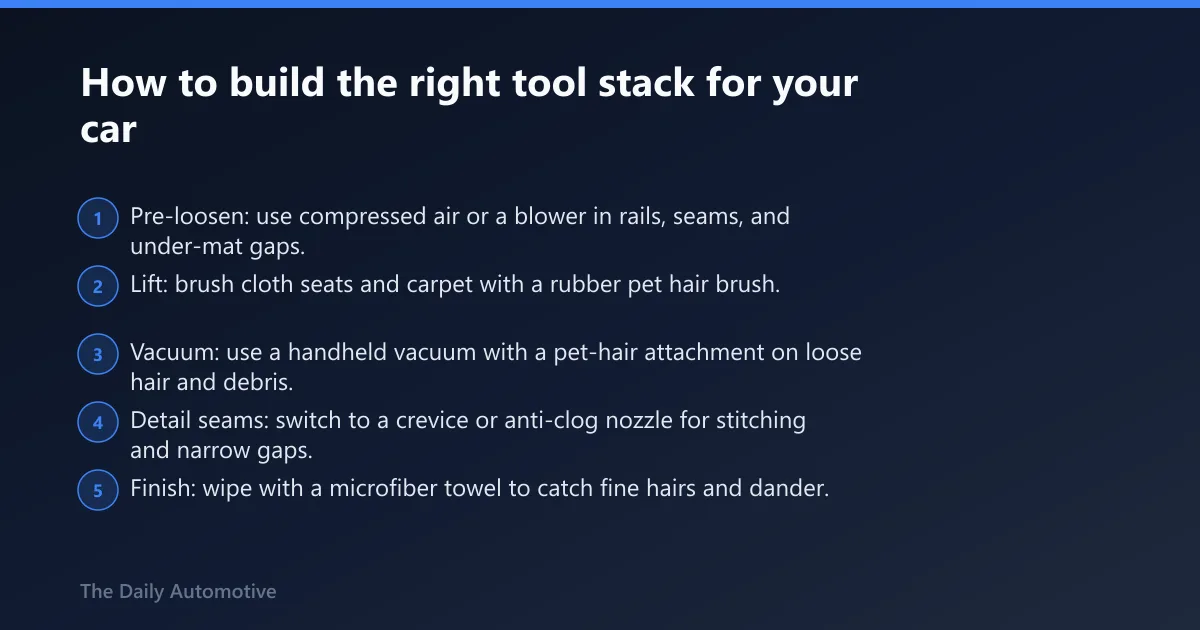
The right stack depends on how often the pet rides, how much it sheds, and whether the interior is cloth or leather. Start with the removal method that matches the surface, then add the vacuum and finish tools. The order matters: loosen, lift, vacuum, detail seams, finish wipe.
- Pre-loosen: use compressed air or a blower in rails, seams, and under-mat gaps.
- Lift: brush cloth seats and carpet with a rubber pet hair brush.
- Vacuum: use a handheld vacuum with a pet-hair attachment on loose hair and debris.
- Detail seams: switch to a crevice or anti-clog nozzle for stitching and narrow gaps.
- Finish: wipe with a microfiber towel to catch fine hairs and dander.
Light shedding stack
For light shedding, use a lint roller, microfiber towel, and compact vacuum. That gives enough speed for quick resets without overbuying tools. It is also the simplest stack to store in the car.
Moderate shedding stack
For moderate shedding, buy a rubber pet hair brush, a handheld vacuum with a pet-hair nozzle, and a microfiber towel. This is the most balanced setup for cloth seats and mixed use. It handles embedded hair without making the process too slow.
Heavy shedding stack
For heavy shedding, choose a rubber brush, a corded handheld vacuum, a pet-hair nozzle, and compressed air or a blower. This stack is the closest to what detailers use when the vehicle has been packed with fur after repeated rides.
Allergy-sensitive and multi-pet setups
Allergy-sensitive households should favor tools that collect rather than re-aerosolize hair: vacuum, microfiber, and careful seam cleaning. Multi-pet vehicles need reusable tools and easy-empty vacuums because disposable rollers become costly and time-consuming over repeated cleanups.
Maintenance, durability, and replacement frequency
Reusable rubber brushes last longer if they are rinsed after use and dried fully. Vacuum filters and bins need regular emptying, or suction drops and hair starts to recirculate. Rollers are the fastest disposable option, but they should be treated as a touch-up item, not a main system.
Detail King has a dedicated Pet Hair Removal category under Interior, and Chemical Guys sells 2 products in its dog-hair-removal collection. Chemical Guys also lists a Grubbie pet hair removal brush for stubborn embedded hair and fur, alongside the DetailVac corded handheld car vacuum cleaner. Those offerings match the same buying logic I use in the bay: brush, vacuum, and seam tool.
Frequently asked questions
Do rubber pet hair brushes work better than vacuums for dog hair?
Yes, on embedded hair in cloth they often do. A rubber brush loosens hair from the fibers, while a vacuum captures the debris after it has been lifted. For loose hair on leather or vinyl, a vacuum can be quicker, but it is rarely enough on textured cloth alone.
What tool removes pet hair from car seat seams?
A narrow pet-hair attachment nozzle works best, especially one with a rubber or silicone edge and anti-clog shape. For deeper seams, start with compressed air or a blower to push hair out of the gap, then vacuum the loosened strands before they settle back in.
How do you get dog hair out of cloth car seats?
Start with a rubber pet hair brush to lift embedded strands, then vacuum with a pet-hair attachment. Finish with a microfiber towel to catch fine fuzz and dander. Cloth traps hair more than leather or vinyl, so a single pass usually leaves too much behind.
Can a lint roller remove pet hair from a car?
Yes, but mainly for loose surface hair and quick touch-ups. It works best on smooth seats and light cleanup. It is weak on textured cloth, and it is not a deep-clean fix for embedded fur, seams, or floor mats.
What vacuum attachment is best for pet hair in cars?
The best attachment is a pet-hair nozzle with a rubber or silicone edge and an anti-clog design. It should reach into seams, mat edges, and carpet fibers without getting packed with fur. A crevice tool helps too, but the pet-hair nozzle is the better primary choice.
Products related to this article
Sponsored / affiliate links. As an Amazon Associate I earn from qualifying purchases. I may earn additional commission from eligible campaigns.