How Much Does It Cost to Clean Car Seats?
Cleaning car seats is often about $0-$30 for DIY spot cleaning, around $50-$150 per row for a detailer, and roughly $150-$300+ for deep extraction or stain removal. Skip it, and odors, residue, and set-in stains can drive the price up fast. This guide breaks costs down by cloth, leather, stain removal, and deep cleaning.
Seat cleaning cost matrix
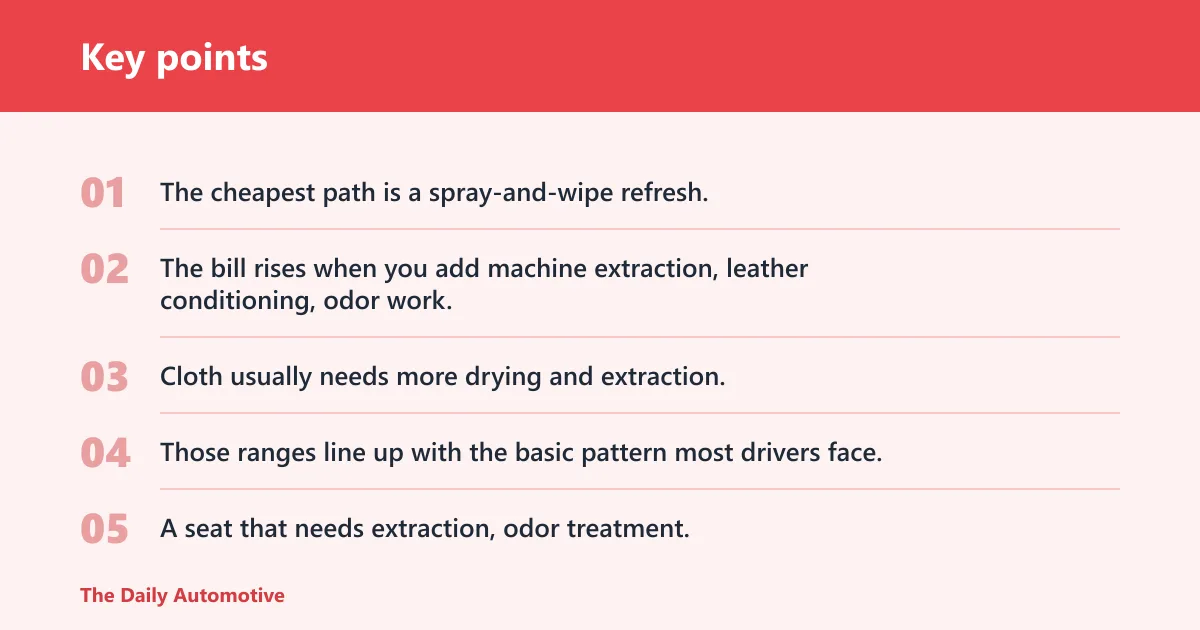


The cheapest path is a spray-and-wipe refresh. The bill rises when you add machine extraction, leather conditioning, odor work, or mobile labor. Seat material matters too. Cloth usually needs more drying and extraction, while leather needs gentler products and less water.
| Cleaning path | Seat material | Typical dirt level | Tools needed | Time required | Realistic cost range |
|---|---|---|---|---|---|
| DIY spray-and-wipe | Leather, light cloth touch-ups | Dust, fresh spills, light grime | DIY upholstery cleaner, stain remover spray, towels, soft brush | 30-90 minutes | $0-$25 |
| DIY deep clean without machine | Cloth, light leather spot work | Embedded dirt, older spots | Vacuum, cleaner, towels, soft brush, wet/dry vacuum | Half a day with drying time | $5-$30 |
| Machine-assisted deep clean | Cloth seats, some low-setting leather care | Heavy soil, odors, repeated spills | Portable upholstery extractor or steam cleaner, vacuum, cleaner | 2-4 hours plus drying | $15-$75 DIY; $100-$200 if rented or added by a pro |
| Professional detailer | Cloth and leather | Heavy staining, odor, pet hair, neglected seats | Pro extractor, steam, spot treatments, conditioning, drying tools | About half a DIY deep-clean day | $50-$150 per row; $150-$300+ for full deep work |
Those ranges line up with the basic pattern most drivers face. A quick interior refresh is cheap. A seat that needs extraction, odor treatment, or leather conditioning moves into a much higher bracket.
What drives the price?
Seat material, stain severity, method used, labor, and drying time do most of the work on the final bill. Add-ons like pet-hair removal, odor treatment, and mobile service can push a simple job into a pricier one fast.
Seat material
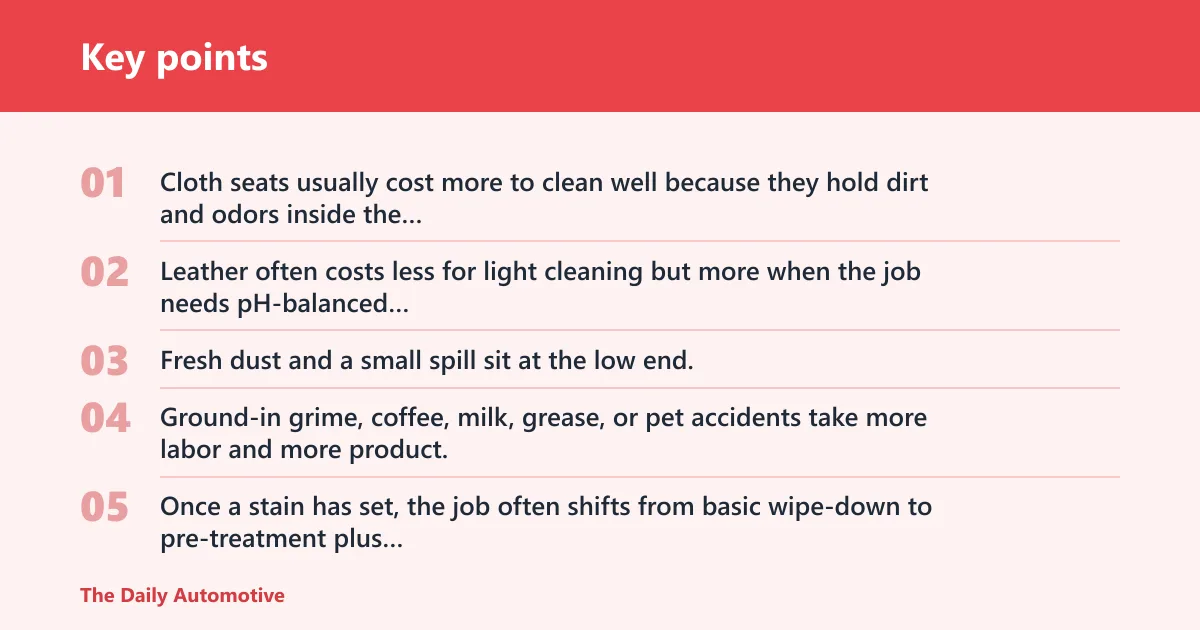
Cloth seats usually cost more to clean well because they hold dirt and odors inside the fibers. Leather often costs less for light cleaning but more when the job needs pH-balanced cleaner, conditioner, and careful drying. The wrong product can raise the repair bill.
Dirt level and stain severity
Fresh dust and a small spill sit at the low end. Ground-in grime, coffee, milk, grease, or pet accidents take more labor and more product. Once a stain has set, the job often shifts from basic wipe-down to pre-treatment plus extraction.
Tools, labor, and drying time
Basic DIY work uses a vacuum, soap and water, and optional leather conditioner, which The Drive lists as core tools. RCD Canada says vacuum first, then treat stains, then steam or extract for fabric. That order costs less than paying a detailer, but it takes time.
A basic car seat cleaning can take two to four hours, and the seat material changes that clock. A front cloth seat with a fresh spill may land near the low end, while a rear bench with soaked foam can stretch past that range once drying is added. The same source says a full DIY deep clean takes half a day with drying time, while a professional finishes in about half that time. The faster job costs more because labor is built into the price.
Add-ons and local pricing
Local labor rates change the quote. Mobile detailers often charge more because travel is built in. Pet-hair removal, odor treatment, and heavy stain work are common add-ons, and each one can shift a quote upward by a meaningful amount.
Say your front cloth seat has a coffee ring and a little grit from daily commuting. A basic spray-and-wipe job may stay near the low end. Add sour odor, sticky residue, and a wet seat that needs extra drying, and the same seat can move into deep-clean pricing.
How much does it cost to clean cloth seats?
Cloth seat cleaning usually starts with vacuuming, stain treatment, and extraction. Light upkeep can be nearly free if you already have the supplies. Deep cleaning with a portable upholstery extractor or pro service can move the price into the $50-$150 per row range.
Light maintenance and spot cleaning
For a light refresh, RCD Canada lists a DIY household cleaning path at $5 to $10, and a spray-and-wipe interior refresh at $15 to $25. That tier covers dust, fresh smudges, and small spots. A stain remover spray is the low-cost targeted buy for fabric upholstery.
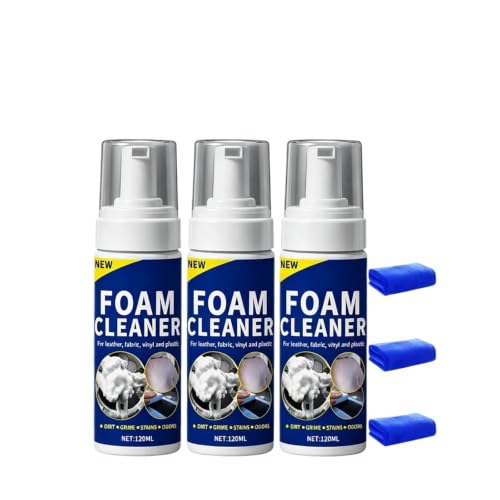
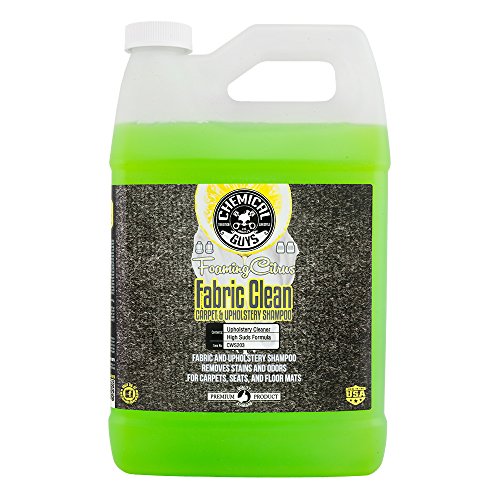
Walmart lists Armor All FRESH fx Power Foam at $5.97, Meguiar’s Carpet & Upholstery Cleaner at $6.57, and Chemical Guys Foaming Citrus Fabric Clean at $11.98. Those prices fit the cheap end of cloth-seat upkeep, not full extraction.
Deep cleaning and extraction
Cloth seats usually need more than blotting. A portable upholstery extractor sprays hot water and vacuums it back up, which is more effective than wiping alone for embedded dirt. If no extractor is available, a wet/dry vacuum can help pull out loosened moisture after pre-treatment.
The same source says most drivers should deep clean car seats every 3 to 6 months. That timing makes sense for cloth because odors and grime build up inside the fibers. A deep-clean session may also need extra drying time, which is part of the real cost.
Odor and stain add-ons
Odor removal and pet-hair pickup are common cloth-seat add-ons. They are not always expensive by themselves, but they add labor. If the seat smells musty after a spill, the cleaning quote can rise because the job is no longer just about visible dirt.
How much does it cost to clean leather seats?
Leather seat cleaning usually costs less than cloth for light work, but it can cost more when the seat needs careful conditioning or steam on a low setting. The safest low-cost path uses a pH-balanced cleaner, a microfiber towel, and conditioner after the surface dries.
Cleaner and conditioner pricing
Basic leather care often starts with a cleaner and conditioner rather than a heavy wet clean. The Drive lists optional leather conditioner among the core tools, and that matters because leather dries out faster than cloth. The product cost stays modest, but the process has to stay gentle.
The lowest-cost leather job is a wipe-down for dust, sunscreen film, and light grime. Once the seat needs conditioning, the price rises a little because you are buying a separate protection step, not only removing dirt.
Steam cleaning on a low setting
The same source says steam cleaning leather is safe on a low setting. That does not mean high heat is fine, and it does not mean every leather seat should be soaked with steam. Afterward, the seat should air dry for an hour, then receive conditioner if the finish needs it.
What raises the price on leather
Leather costs more when there are dye transfer marks, oily buildup, or dryness that needs repeated conditioning. If the seat is cracked, scratched through, or faded from heat and age, cleaning may not solve the problem. At that point, repair or replacement starts to make more sense.
DIY tools and product costs
DIY costs stay low because the tools are simple. The tradeoff is labor and drying time. If you already own a vacuum and microfiber towels, you can do a basic interior refresh for very little cash.
DIY upholstery cleaner and stain remover spray
A household DIY upholstery cleaner can be made with vinegar, baking soda, dish soap, and towels. That is the lowest-cost tier for light maintenance and spot cleaning, and it works without a machine. A stain remover spray is the usual retail shortcut when you want faster spot treatment.
Use it for small marks and fresh spills, not for soaked padding. Do not drench the seat. Too much liquid raises the chance of mildew and makes drying the real bottleneck.
Portable upholstery extractor and wet/dry vacuum
A portable upholstery extractor is the common tool for fabric deep cleaning. It sprays hot water and vacuums it back up, which beats blotting alone when dirt is inside the fibers. The same source lists a portable upholstery cleaner at $58.99, which gives a rough entry point for ownership.
A wet/dry vacuum is the workaround when an extractor is unavailable. It is not as focused as a true extractor, but it helps pull moisture after pre-treatment. That can save a cloth-seat job that would otherwise stay too wet for too long.
Steam cleaner and basic leather care products
Steam cleaning is often used as a pro-level deep-clean method for fabric, and on leather only at a low setting. The same source says to vacuum first, treat stains next, then steam or extract for fabric. On leather, follow with drying and conditioner.
Steam and leather need caution because heat and moisture can strip protection faster than cloth. Keep the setting low, keep the pass brief, and never treat steam as a universal fix.
When does cleaning stop being enough?
Cleaning stops being enough when stains stay visible after pre-treatment, odors remain after drying, or the fabric has worn through. At that point, reupholstery or replacement may cost less than repeated cleaning that never fully solves the issue.
Permanent staining and odor saturation
Some spills discolor the seat foam and cover layers, not just the surface. If a smell returns after the seats dry, that usually means liquid reached deeper than the outer fabric. Cleaning can reduce the symptom, but it may not remove the source.
Torn upholstery and worn padding
If the cover is torn or the padding has collapsed, a deep clean will not restore structure. In that case, the quote may shift from detailing to upholstery repair. That is a different job, with a different price and a different result.
Picture a rear cloth bench with a long milk spill, a sour smell, and a damp center seam. A detailer can still extract and dry it, but if the smell remains after drying and the fabric has started to separate, replacement becomes the cleaner financial move.
Frequently asked questions
How much does it cost to clean car upholstery?
Cloth seats usually cost more than a quick leather wipe-down because they need vacuuming, pre-treatment, and drying.
How much does it cost to deep clean car seats?
A deep clean usually costs $5-$30 DIY if you already have supplies, or roughly $100-$200 if a pro adds machine work to the job. The same source says a full DIY deep clean takes half a day with drying time, while a professional finishes in about half that time.
How much does it cost to steam clean car seats?
Steam cleaning commonly lands in the midrange because it is usually part of a deeper service, not a quick wipe. It is safer on cloth than on leather, and RCD Canada says leather should only be steam cleaned on a low setting. Expect higher labor if drying or conditioning is included.
How much does it cost to clean leather car seats?
Light leather cleaning can stay near the low end if you only need cleaner, towels, and conditioner. Costs rise when the seat needs careful steam work on a low setting or repeated conditioning. The main price driver is not water use; it is the extra care leather requires.
How much does it cost to clean cloth car seats?
Cloth seat cleaning can cost almost nothing for a basic DIY refresh, or $15-$25 for a spray-and-wipe interior refresh. Deep cleaning costs more because cloth holds dirt and odor inside the fibers, so vacuuming, stain treatment, and extraction take more time and more tools.
How much does it cost to remove stains from car seats?
Small spot treatment may cost only a few dollars if a stain remover spray does the job. Stubborn stains that need pre-treatment plus extraction often move into the $50-$150 per row range, especially if the spill has reached the foam or left a smell behind.
Products related to this article
Sponsored / affiliate links. As an Amazon Associate I earn from qualifying purchases. I may earn additional commission from eligible campaigns.