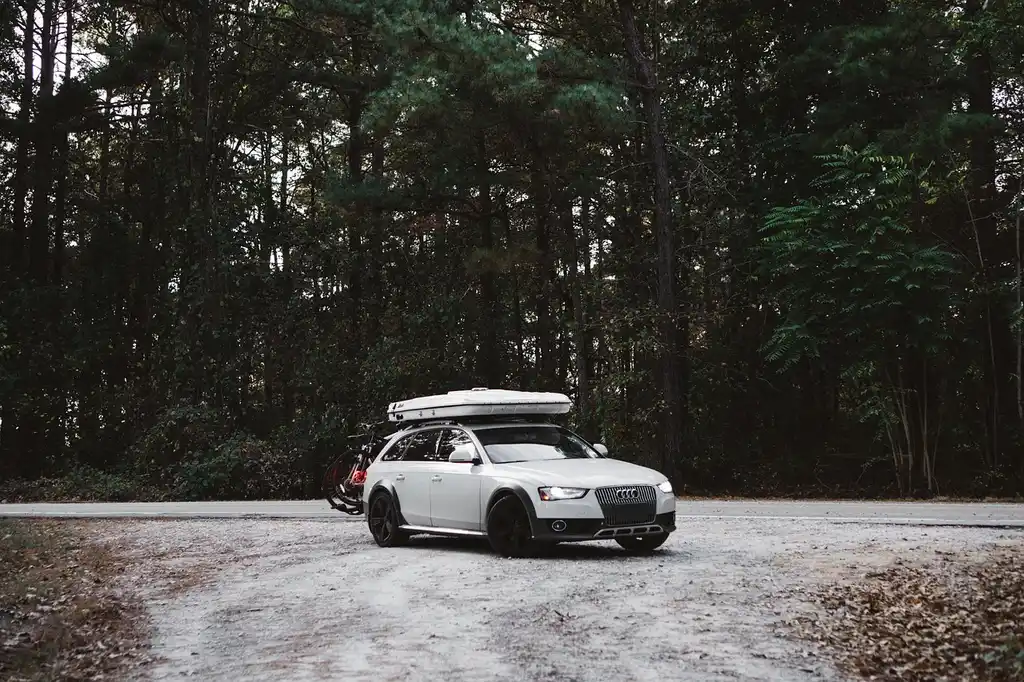
Best Car Roof Boxes for Storage: Top Picks
The best car roof box fits your roof load limit, opens without hitting your hatch, and clears your garage. For most drivers, about 400 to 500 liters is the practical range. Pick a bad match and you get wind noise, broken hinges, or a box that will not fit in the garage. This guide gives a fit-and-failure checklist, then compares waterproof and heavy-duty models for road trips, winter gear, and family cargo.
Kamei Husky 510: Best for bulky cargo


The Kamei Husky 510 leads this list for drivers who need maximum space without moving to a cargo trailer. It has a 510-litre capacity, a 75kg maximum loading capacity, opens from either side, and uses hydraulic struts for one-handed opening and closing. That mix makes loading easier when the box is full, but you still need to verify roof-bar spacing, hatch clearance, and garage height before buying.
Who it fits best
Choose it if you haul family luggage, bulky winter gear, or mixed cargo that does not pack neatly. A large box like this is usually better for SUVs, wagons, and taller crossovers than for compact hatchbacks, because the longer shell is easier to live with when the rear hatch opens high.
What to check before you buy
- Confirm the roof rack or crossbars can take a roof box mount.
- Check the vehicle manual for roof weight capacity and any dynamic limit.
- Measure hatch opening height and rear clearance with the box position marked out.
- Measure garage door height after adding the box to the car’s roofline.
- Match the box length to the cargo shape: skis, luggage, or long soft bags.
Quick picks by need
- Best for skis and winter gear: Kamei Husky 510, because it is long, large, and rated at 75kg.
- Best for family luggage: Thule Motion XT XXL, because it is positioned as a box for big families.
- Best for small cars and tight garages: Halfords 320l grey roof box, because its 320-litre size is easier to place and park around.
- Best low-profile option: Thule Force XT M, because it is positioned as the aerodynamic choice.
- Best premium choice: Thule Vector M, because it is positioned as the premium car roof box.
- Best budget-friendly compact box: Hapro Roady 350, because it has a 300-litre capacity and a 50kg maximum load.
Best for skis and winter gear
Long, medium-width boxes suit skis better than short, square boxes because ski bags need length more than height. A full-width box makes sense when you carry multiple pairs, poles, helmets, and boots together. If your skis fit only when angled, the box is too short or too narrow for repeat use.
Best for family luggage
For family travel, look for a large family box with enough volume for soft bags, coats, and awkward extras that do not fit neatly in a trunk. The Thule Motion XT XXL sits in that lane. Its value is not only litres on paper, it is the ability to take odd-shaped bags without forcing the lid.
Best for small cars and tight garages
For a hatchback or a car that already sits close to a garage door, a small boot supplement box or a medium-width box is often the safer choice. The Halfords 320l grey roof box and Hapro Roady 350 are smaller options that may reduce the chance of scraping the door or making the car too tall for daily parking.
Roof box fit matrix
This matrix is the fastest way to rule boxes in or out. Treat the fit check as pass or fail first, then compare features. Advertised litres matter, but only after the box can open, close, and fit your roof without blocking the hatch or the garage.
| Vehicle type | Roof-bar spread | Opening style | Usable load | Box length | Hatch clearance risk | Garage-clearance risk | Best use case | Pass/fail rule |
|---|---|---|---|---|---|---|---|---|
| Hatchback / compact car | Short to medium spread | Dual-side or easy one-hand opening | Up to 50kg | Short to medium | High if box sits far rearward | High if the car already sits tall | Boot supplement, weekend bags | Pass only if the hatch opens fully without contact and the garage door still clears the roofline. |
| SUV / wagon | Medium to wide spread | Single-side or dual-side | 50kg to 75kg | Medium to long | Medium | Medium | Family luggage, snow gear, mixed cargo | Pass if the box clears the rear hatch arc and the rack mounts sit within the box’s clamp range. |
| EV / taller vehicle | Medium to wide spread | Dual-side or hydraulic-strut assist | 50kg to 75kg | Medium to full-width | Medium to high | High | Road trips, long luggage, winter runs | Pass only if the added height still fits your garage and any charging canopy or parking barrier. |
| Wagon with long roof | Wide spread | Single-side or dual-side | 50kg to 75kg | Full-width | Low to medium | Medium | Skis, long bags, frequent travel | Pass if the box length stays clear of the tailgate when open. |
Use this rule: if the roof bars are too close together for the box clamp range, or the tailgate touches the open lid, stop. Do not buy on litre volume alone. A 510-litre box that misses the hatch is less useful than a 320-litre box that opens and closes cleanly every time.
Say your hatchback has a short roof and a steep rear hatch. A full-width box may sit too far back, so the tailgate catches the lid before it reaches its latch. In that case, a medium-width box with a shorter shell is the safer choice even if its litre number is lower.
Which roof box fits your vehicle?
Vehicle shape matters more than badge size. Hatchbacks need short shells and careful rear placement. SUVs and wagons can usually take longer boxes with better hatch clearance. EVs and other tall vehicles need extra attention because the added roof height can create garage problems even when the rack fit is correct.
Hatchbacks and compact cars
On smaller cars, the best roof box for storage is often a medium-width or small boot supplement box. Aim for lighter, shorter models and keep the load modest. If your box sits above the rear hatch opening, measure twice: the lid can clear the bars but still block the tailgate.
SUVs and wagons
SUVs and wagons usually suit full-width boxes better because the roofline and hatch geometry are friendlier to longer shells. These vehicles also handle family luggage and ski gear more naturally. Even so, the roof weight limit still matters, and the box should not overhang so far back that the hatch contacts it.
EVs and taller vehicles
EVs often have tall rooflines already, so garage clearance becomes a real failure point. A low-profile design helps here. It lowers the drag penalty a little and reduces the risk that a box turns a usable driveway into a parking problem.
Are single-side or dual-side boxes better?
Dual-side opening is usually easier, especially when the car is parked near a curb or in a narrow bay. Single-side opening can still be fine if you always load from the same side and have enough room to stand safely. Hinged end opening works best when the box is shorter and the cargo is simple.
Access on the curb side
Dual-side access is the practical winner when the passenger side is blocked by traffic or a wall. You can load from the safer side without reaching over the roof. That reduces awkward arm movement and helps you seat the lid correctly before the final lock turn.
Loading when parked in tight spaces
In a tight lot, the wrong opening style becomes a nuisance fast. A box that opens only from one side can force you into traffic or a fence line. Dual-side models and hydraulic struts are easier when the box is full and the lid wants to drop back down.
Hinged end opening versus side opening
Hinged end opening is less common for a reason: it can be less convenient when the cargo is deep. Side opening gives better reach into the box, while one-hand access matters when you are loading soft bags or icy ski gear. If the box is packed high, weak hinges or poor alignment can stop the lid from sealing cleanly.
Do roof boxes hurt fuel economy and noise?
Yes. Roof boxes add drag, increase wind noise, and usually reduce fuel economy. Popular Mechanics notes that a cargo box is enclosed and secure, but it also says roof boxes can hurt gas mileage and increase noise. Low-profile shapes help, yet any box on the roof changes the airflow around the car.
Drag from box shape and height
The taller and blunter the box, the more air it pushes. A long, low shell is usually quieter than a tall, square one. That is why aerodynamic models are often preferred for highway trips, even when the litre number is similar.
Wind noise at speed
Wind noise rises as speed rises. A box mounted too far forward, too far back, or off-center can whistle or drone more than a properly aligned one. Poor mounting can also make latches work loose over time, which is why a careful final check matters.
Low-profile designs that help
Low-profile designs help most when you already drive at highway speed or have a tall vehicle. The Thule Force XT M is positioned as the aerodynamic choice, which makes it a logical pick for drivers who care more about quiet and efficiency than about maximum height inside the box.
How to choose a roof box for your roof rack
Start with the rack, not the catalog photo. You need a roof rack or compatible mounting system, and the vehicle manual should confirm the roof weight capacity before anything goes on top. After that, choose box volume by cargo type, then check weather protection, security, and fit around the hatch and garage door.
Volume, length, and load rating
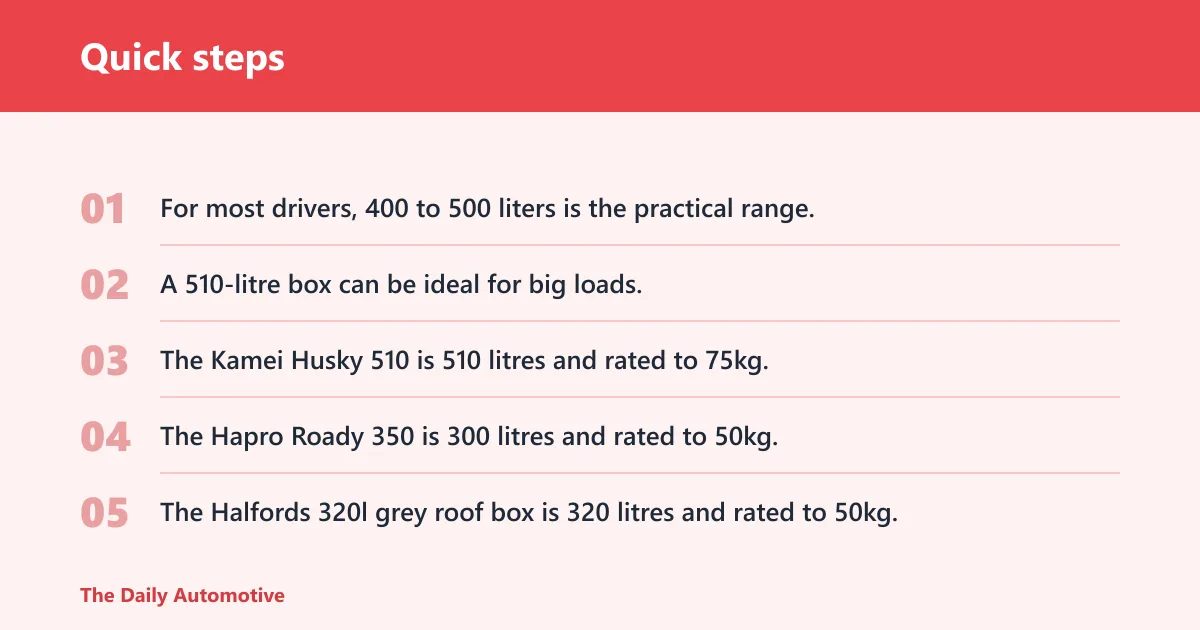
For most drivers, 400 to 500 liters is the practical range. The Kamei Husky 510 is 510 litres and rated to 75kg. The Halfords 320l grey roof box is 320 litres and rated to 50kg.
Do not treat litres as exact usable space. Wheel arches inside the box, lid curvature, and the shape of the cargo all reduce real packing room. Golf clubs need length. Ski bags need length. Family luggage needs depth and a lid that closes without forcing the seams.
Weather protection and security
Look for a waterproof or weather-resistant shell with sealed hard-shell construction if the box will live outside between trips. That protects all-weather storage better than a soft bag. For security, central locking, multi-point catches, and key retention until fully closed are worth having. If the key comes out before the lid is fully shut, the box can look latched when it is not.
Half-closed lids are a real failure case. They can misalign the latch, create water entry points, and weaken security because the shell is not fully seated. If one side sits high, stop and reopen the lid rather than forcing the lock.
Mounting, hatch clearance, and garage height
Mounting should be simple but not loose. Roof-bar attachment should feel secure, and installation effort should be realistic for the size of the box. The box will also add height, so garage clearance needs a fresh measurement after the box is installed. A few centimetres can decide whether the car still fits your parking space.
A common first-timer mistake is measuring the car alone, then buying the box later. Suppose the roof rack already leaves little room under a garage door. A medium box may fit the bars perfectly yet still turn every arrival into a slow, careful backup.
How big of a roof box do I need for skis or family luggage?
For skis, choose length first and volume second. For family luggage, choose volume first and length second. Ski travelers usually do better with a medium-width or full-width box long enough to keep the skis flat. Families usually need a large family box with enough room for soft suitcases and the odd-shaped items that fill a trunk fastest.
Small boot supplement box
This size is for overflow, not a full holiday. It works when you need extra room for coats, snacks, or a couple of small bags. It is the easiest style to live with on short cars and in low garages.
Medium-width box
A medium-width box is the best compromise for many drivers. It carries enough to matter, but it does not dominate the roof. It often suits compact SUVs, hatchbacks with careful hatch checks, and drivers who want a roof box only a few times a year.
Full-width box
Full-width boxes are the right call when you want to load around the shape of the car rather than fight it. They work well for skis, family luggage, and long soft bags. They are also more likely to cause hatch or garage issues, so the fit check matters more.
Large family box
Large family boxes are for dense trips and frequent use. The Thule Motion XT XXL sits in this category. It is the sort of box you buy when the trunk is already spoken for and the roof becomes part of the packing plan.
How much weight can a car roof box carry?
Most roof boxes have a box limit and the vehicle has a separate roof limit. The lower of those two numbers wins. The same source says to check the vehicle’s roof weight capacity before buying, which is the right starting point.
That load limit includes cargo weight, not just the box shell. Overpacking can strain the hinges, distort the lid, and make the latches hard to seat. If the box bows or the lid will not close without force, the load is too high or the cargo shape is wrong.
Frequently asked questions
What is the best car roof box for storage?
The best car roof box for storage is the one that fits your vehicle, cargo shape, and parking space before it fits your wish list. For many families, a 400 to 500-litre box is the best balance. The Kamei Husky 510 is the biggest listed here, while smaller models suit compact cars better.
Which roof box is most waterproof and secure?
A sealed hard-shell box with central locking, multi-point catches, and key retention until fully closed is the safer pick. No roof box should be treated as submersion-proof, but a weather-resistant shell with tight seals handles rain and road spray far better than a soft carrier.
Can I fit a roof box and a bike rack on the same roof?
Sometimes, yes, but only if the roof bars have enough spread and the box does not block the rack clamps or tailgate. On many cars, the roof box consumes the usable bar length. Measure the bar spacing and the accessory footprints before you assume both will fit.
Are single-side or dual-side opening roof boxes better?
Dual-side opening is usually easier because it lets you load from whichever side is clear. Single-side opening can work well if the car parks in the same orientation every time. Hydraulic struts and one-hand access make either style easier when the box is full.
What size roof box works for a small car boot?
For a small car, start with a small boot supplement box or a compact medium-width box. The goal is to add capacity without making hatch access or garage clearance unworkable. The Halfords 320l grey roof box and Hapro Roady 350 sit closer to that safer range.
How do I choose a roof box for my roof rack?
Match the box mounting system to the roof rack first, then check roof load capacity, hatch clearance, and garage height. After that, choose the size by cargo type. If the rack spread is too short or the tailgate touches the open lid, the box is the wrong fit.
Which roof boxes are easiest to open and close when full?
Boxes with dual-side access and hydraulic struts are usually easiest because they resist sudden lid drop and allow one-hand opening. The Kamei Husky 510 is a good example, since it opens from either side and uses hydraulic struts. That matters most when the box is packed near the lid line.
Products related to this article
Sponsored / affiliate links. As an Amazon Associate I earn from qualifying purchases. I may earn additional commission from eligible campaigns.
 Powerty Heavy Duty 100lb Weight Capacity Truck Clothes Hanger Bar,27.5'' to 64" Wrinkle Adjustable Metal Clothes Rod for Sedans, SUVs, Trucks Cars
 Car Roof Interior Cleaner Spray, Multi-Purpose Car Fabric Stain Remover, Deep Cleaning Dirt Grime Eliminator for Car Headliner, Seats, Carpets & Auto Upholstery (2PC)