3 Best Black Paints for Car Trim (2026): We Compared
For faded trim, choose by failure mode: one product for sun-baked plastic, one for flexible bumpers, and one for quick OEM-looking touch-ups. Pick the wrong one, and the coating can streak, stay tacky, or peel the first time the trim flexes. This guide compares three black-trim solutions and points you to the right one for each job.
Quick comparison
| Product | Badge | Best for | Price | ||
|---|---|---|---|---|---|
 |
Rust-Oleum Acrylic Enamel 2X Spray Paint, Ultra Matte BlackRust-Oleum | Our pick | Acrylic Enamel · Ultra Matte · 2X Coverage | $8.27
Price as of 25 Oct 2026
|
View |
 |
Plasti Dip Mulit-Purpose Rubber Coating Spray Black & GlossPlasti Dip | Also great | Rim Kit · 11oz · 4 Matte 2 Gloss | $66.49
Price as of 25 Oct 2026
|
View |
 |
Dupli-Color Trim & Bumper Paint, Black, 11 ozDupli-Color | Also great | Trim & Bumper · 11 oz · Black | $15.97
Price as of 25 Oct 2026
|
View |
The main trade-off is plain. Trim restorer is fastest on UV-damaged plastic, while trim paint lasts longer when the surface needs a true coating. Flexible bumpers need a product that can move with the part. Painted metal, mirror covers, and moldings usually call for trim paint instead of a dye-style restorer.
How we chose
We compared the products on four things that matter for this job: surface compatibility, finish match, dry and handling speed, and how likely each one is to fail on the wrong trim type. We also separated trim paint from trim restorer, because those are not interchangeable on every part.
We favored products with clear manufacturer claims for compatibility and cure timing. We also looked for the prep burden: whether light scuffing is enough, whether adhesion promoter matters, and where flexible parts are most likely to peel if you skip a step.
The goal is not one universal winner. It is matching the coating to the failure mode.
Should you use trim paint or trim restorer?
Use trim paint when the part needs a new film on top of the surface, especially on metal trim, mirror caps, grilles, moldings, or bumper pieces that have lost their finish but still sound solid. Use a dye-infused restorer when the plastic is chalky and faded but not flaking, because the restorer is meant to darken porous trim with less buildup.
That split matters. Paint can cover more severe cosmetic damage, but it also depends on prep and adhesion. A restorer is quicker and usually cleaner for sun-faded plastic, yet it will not fix peeling clearcoat, deep scuffs, or a surface that keeps shedding old coating.
Flexible parts fail for a reason. If a rigid finish lands on a bumper corner that bends, the coating can crack at the edge, then start lifting after a few temperature swings or a wash cycle.
When paint is the better choice
Choose paint for painted metal, hard plastic trim, and parts that need a more uniform satin or factory-correct black. It is also the better call when the original finish is missing in patches or when the part has already been sanded smooth for repainting.
When a dye-infused restorer makes more sense
Choose a restorer such as ExoForma Black Trim Restorer when the issue is oxidation, fading, and dull gray cast on plastic trim. It is dye-infused, includes UV protection, and is meant for one-coat application, which makes it a practical option for quick cosmetic recovery.
Why flexible parts fail with the wrong product
Flexible bumper trim and rub strips move. A coating that dries too rigid can look fine on day one, then crack or peel where the bumper flexes around parking taps, temperature changes, or repeated washing. That is why a flexible bumper coating matters more than the darkest black finish.
SEM 39143 Trim Black Aerosol: best for OEM-like trim restoration
SEM 39143 is the pick when you want a satin, OEM-like trim look on plastic, vinyl, rubber, or metal. It is described as requiring no primer, and its flexible film is meant to move with trim better than a hard, brittle coating.
This is the strongest all-around match for faded exterior trim that still needs a clean, factory-style sheen. It fits especially well on grilles, moldings, mirror housings, and other parts where the original look is closer to satin than matte.
The drawback is that it is still a coating, so surface prep matters. If the trim is chalky, greasy, or peeling, no-primer convenience does not remove the need to clean and scuff the part first.
SEM also sells Black Original Flexible Bumper Coater, which is a useful signpost for this category: bumper-specific flexibility matters when the part flexes often. If the bumper insert is the problem, that flexible-bumper path is safer than a rigid-looking trim-only spray.
Why it won for faded trim
Faded trim often needs a finish that looks intentional, not overpainted. SEM 39143’s satin finish is close to that goal, and the no-primer positioning reduces one more step on parts that are already sound and simply dull.
Where it fits best: plastic, vinyl, and metal
Its stated compatibility across plastic, vinyl, and metal makes it a strong candidate for mixed exterior trim sets. That matters on vehicles with plastic mirror caps, vinyl moldings, and metal garnish pieces that need to match.
Finish and movement tolerance
The satin finish is the point. It tends to look more like OEM exterior trim than a dead-flat coating, and the flexible film gives it a better chance of surviving normal trim movement without cracking early.
Rust-Oleum 251574: best for metal trim and bumpers
Rust-Oleum 251574 is the better fit when the job centers on metal trim, moldings, rearview mirror covers, bumpers, and rub strips. It uses a Stops Rust formula, touches dry in about 20 minutes, and covers roughly 10-15 square feet per can.
That makes it useful for small-to-medium trim projects where you want a quick turnaround and a product aimed at metal and exterior trim parts. It is especially relevant when the part list is mixed and includes painted metal garnish or bumper pieces.
The drawback is that its usefulness narrows if the part is extremely flexible or if you need a specific factory-black sheen match. Coverage can also run out fast on larger vehicles if you count on one can doing more than the stated range.
Stops Rust formula and use cases
The Stops Rust formula matters most on metal trim and exposed parts that face weather. It is not the first choice for every plastic surface, but it is relevant when corrosion resistance and a fresh black finish are both part of the goal.
Coverage math and project sizing
Coverage is the easiest way to misjudge a trim job. At 10-15 square feet per can, a sedan with modest trim can often be handled with one can, while an SUV or truck with larger mirror caps, bumper inserts, and window trim may need more than one.
A common rule of thumb is to buy extra if the part has rough texture, deep fading, or a lot of masking waste. Those conditions increase real-world usage even when the nominal square footage looks fine on paper.
Dry time and handling window
Rust-Oleum 251574 is advertised as touch-dry in about 20 minutes. That is quick enough for a same-day trim refresh, but it still does not replace full cure time, which depends on film thickness, temperature, and how heavily you build the coats.
Dupli-Color ETB101000: best for fast factory-like touch-ups
Dupli-Color ETB101000 is the fastest of the three for a quick visual reset. It uses Fade-X Technology for a factory-like appearance, is touch dry in about 30 minutes, and can be handled in one hour.
This is the right sort of product for grilles, moldings, and mirror covers when the main goal is a quick OEM-looking touch-up rather than a heavy restoration. It fits well when the trim is structurally fine and only needs the black restored.
The drawback is that “fast” can tempt a heavy application. Trim paint still needs light coats, and a rushed wet coat can leave sheen mismatch, long cure time, or soft edges where the part gets handled too soon.
Fade-X Technology and appearance
Fade-X Technology is aimed at a factory-like appearance, which makes this product a strong candidate for parts where the trim should blend in instead of stand out. The finish target is more about matching original trim than creating a glossy custom look.
Touch-dry, handle time, and recoat timing
Touch dry in about 30 minutes and handle in one hour is a practical speed advantage. It is still smart to use light coats and respect the recoat window on the can, because the surface can feel dry before the film is ready for full handling or masking removal.
Best use on grilles, moldings, and mirror covers
ETB101000 fits parts that need a fresh black face with minimal drama. Grilles and mirror covers are common use cases because they are visible, usually small enough to spray cleanly, and often benefit from a factory-looking sheen more than a deep custom finish.
Trim surface match matrix
| Trim type | Safest product type | Prep step | Expected finish | Likely failure risk |
|---|---|---|---|---|
| Hard plastic | Trim paint or trim restorer, depending on fade depth | Clean thoroughly; light scuff if painting | Satin or factory-correct sheen | Poor adhesion if residue remains |
| Flexible bumper plastic | Flexible bumper coating or flexible trim paint | Clean, scuff lightly, use adhesion promoter if needed | Satin to low-gloss OEM look | Cracking or peeling if the coating is too rigid |
| Rubberized molding | Flexible trim paint or restorer if faded only | Clean and remove wax; avoid heavy sanding | Matte to satin black | Fish-eye or lift-off from contamination |
| Painted metal | Trim paint with metal compatibility | Clean, scuff, and degrease | Satin or matte black | Chipping from thin prep or heavy coats |
| Vehicle | Estimated trim area | Likely can count | Notes |
|---|---|---|---|
| Sedan | About 8-12 sq ft | 1 can often covers the job | Masking waste can push it higher |
| SUV | About 12-18 sq ft | 1-2 cans | Mirror caps and bumper inserts add up fast |
| Truck | About 15-22 sq ft | 2 cans or more | Large grilles and long moldings increase usage |
Do you need primer before painting car trim black?
Usually no, not if you are using a trim paint designed for direct application and the surface is already clean and sound. Primer becomes more useful on bare, repaired, or difficult plastic, but adhesion promoter is often the better step for plastics than a standard primer coat.
The key distinction is prep, not primer alone. Cleaning removes silicone, wax, and road film. Scuffing or sanding gives the coating some tooth. Adhesion promoter helps on plastics that are slick or hard to bond, especially if the part has previously rejected paint.
When an adhesion promoter helps
Use adhesion promoter on slick plastic, repair zones, and parts that have a history of peeling. It is especially sensible on bumper plastics and mirror caps where the surface is smooth and the coating needs extra bite.
When primer is unnecessary
Primer is usually unnecessary when the product is made for direct-to-trim use and the part is already stable. SEM 39143 is described as requiring no primer, which is exactly the kind of product that can simplify the job on sound trim.
Scuffing, sanding, and light coats
Light scuffing is enough in many trim jobs. You do not want to carve up the part; you want to break the surface glaze, clean it well, then spray several light coats rather than one heavy coat that sags or stays soft.
Say your SUV has a 24-inch bumper insert that looks gray and chalky but does not peel. A careful clean, a light scuff, and a flexible trim coating is the right path. If the same insert is already flaking at the edge, a restorer alone will not hold it together.
Which one should you buy?
Pick based on the surface and the failure mode. If the plastic is sun-faded and you want an OEM-style satin look, SEM 39143 is the strongest fit. If the bumper flexes and you need a coating built for movement, the flexible-bumper route is the safer choice. If speed and factory-like touch-ups matter most, Dupli-Color ETB101000 is the cleanest match.
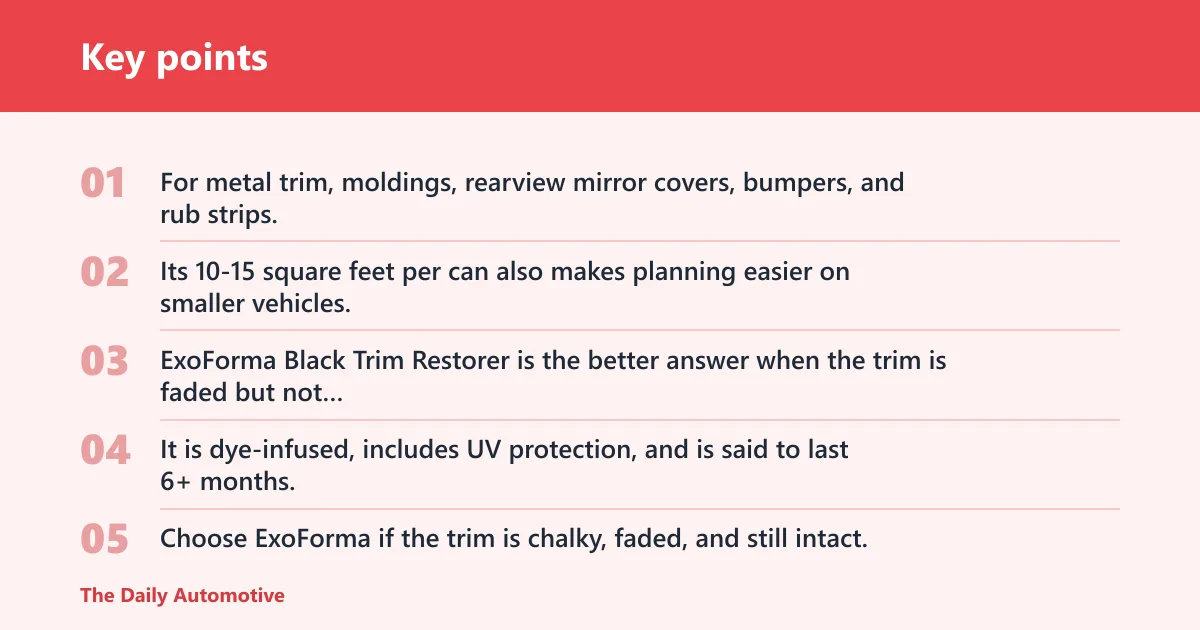
For metal trim, moldings, rearview mirror covers, bumpers, and rub strips, Rust-Oleum 251574 deserves a close look because its use case is explicit and its touch-dry time is quick. Its 10-15 square feet per can also makes planning easier on smaller vehicles.
ExoForma Black Trim Restorer is the better answer when the trim is faded but not structurally failing. It is dye-infused, includes UV protection, and is said to last 6+ months, which suits black plastic that needs rejuvenation more than a full repaint.
Best for sun-faded plastic
Choose ExoForma if the trim is chalky, faded, and still intact. Choose SEM 39143 if the part needs a sprayed coating with a satin, OEM-like finish and a little more permanence than a restorer can give.
Best for flexible bumpers
Choose the flexible bumper coating path, such as SEM 39103, when the part bends often or the edge has to survive repeated movement. A flexible film is the real requirement here, not simply a black color match.
Best for quick OEM-looking results
Choose Dupli-Color ETB101000 when the trim is already in decent shape and you want a fast factory-like reset. If the part is metal or a rub strip, Rust-Oleum 251574 is also a sensible option, especially when you care about quick touch-dry time.
Choose SEM 39143 if the job spans plastic, vinyl, and metal and you want a satin, factory-style result with no-primer positioning. It is the broadest fit when the vehicle has mixed trim materials.
Choose SEM 39143 Trim Black Aerosol if… / Choose Rust-Oleum 251574 if…
Choose SEM 39143 Trim Black Aerosol if the trim is faded plastic, vinyl, or metal and you want a satin, OEM-like look with no-primer positioning. It also makes sense when the part flexes a little and you want a coating that moves with it.
Choose Rust-Oleum 251574 Automotive Trim & Bumper Spray Paint if the job centers on metal trim, moldings, rearview mirror covers, bumpers, or rub strips, and you want a fast-drying spray with a clear coverage target. It is less attractive if the part is highly flexible or if you need a very exact satin factory match.
Frequently asked questions
What is the best black paint for car trim?
The best black paint depends on the part. For faded plastic that is still sound, a restorer can be the better choice.
Should I use trim paint or trim restorer on plastic?
Use trim restorer on plastic that is faded but intact and not peeling. Use trim paint when the surface needs a new coating, when the finish is patchy, or when the part includes more than just UV fade. If the plastic is flexible, choose a product that is explicitly made for movement.
Which black trim paint lasts longest in sunlight?
The product with UV protection or a flexible, durable coating is the safer bet for sunlight exposure. ExoForma Black Trim Restorer includes UV protection and is listed as lasting 6+ months. For a painted finish, the longevity still depends heavily on prep, part type, and whether the coating matches the surface movement.
What finish looks most factory-correct on car trim, satin or matte?
Satin usually looks more factory-correct on modern exterior trim because many OEM black trim pieces are not dead-flat. Matte can look correct on some older or more utilitarian parts, but satin is the safer choice if you want the trim to blend with factory moldings, mirror caps, and grilles.
How long does black trim paint take to dry?
Dry time varies by product. Rust-Oleum 251574 is touch-dry in about 20 minutes. Dupli-Color ETB101000 is touch dry in about 30 minutes and can be handled in one hour. Even with quick dry times, light coats and proper cure time still matter before heavy handling.
What should I do if faded trim keeps peeling after repainting?
Peeling usually means the old coating was not fully removed or the surface was not prepped enough. Strip loose material, clean again, scuff or sand the surface, and use an adhesion promoter on plastic if needed. If the part flexes a lot, switch to a flexible coating instead of a rigid trim paint.
Products related to this article
Sponsored / affiliate links. As an Amazon Associate I earn from qualifying purchases. I may earn additional commission from eligible campaigns.