We Tested Output Alternator for Car Audio: Top 2 Picks
For most car-audio builds, pick the alternator that matches your bracket and wiring first: choose the daily-driver option if it holds stable voltage at idle, and choose the max-output option only if your system needs the highest low-RPM amperage. A poor match can leave you with dim lights, belt slip, weak idle voltage, and damaged batteries. This guide compares the top two picks by fitment, idle output, belt load, and street manners.
Daily-driver or max output?
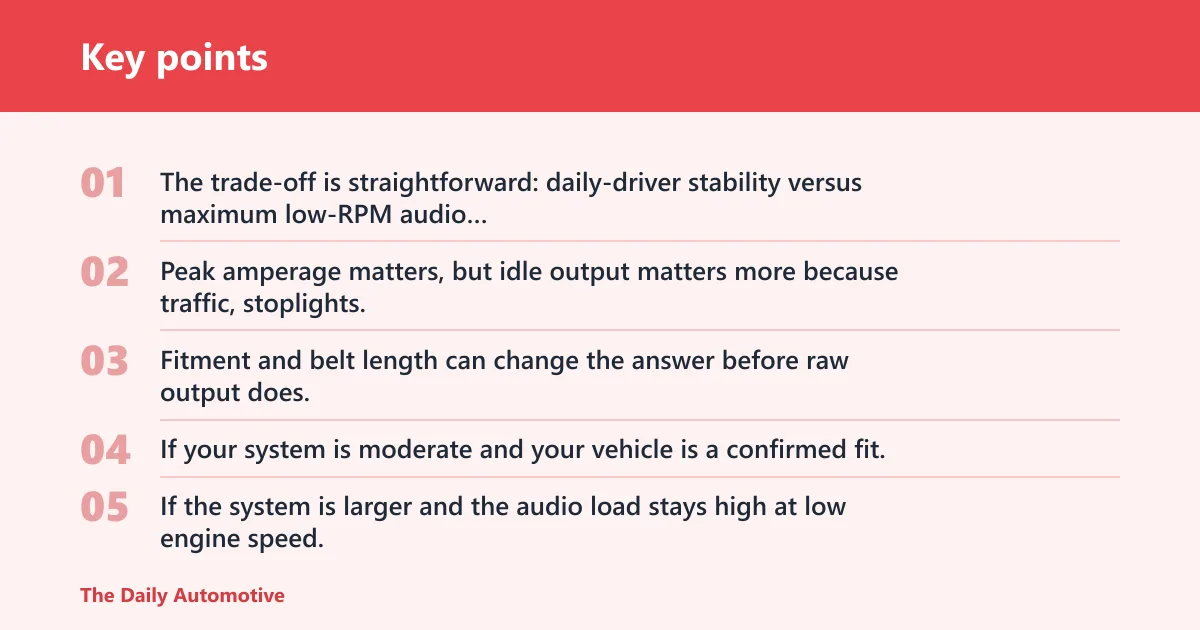


The trade-off is straightforward: daily-driver stability versus maximum low-RPM audio output. Peak amperage matters, but idle output matters more because traffic, stoplights, and parking-lot demos happen there. Fitment and belt length can change the answer before raw output does.
If your system is moderate and your vehicle is a confirmed fit, a lower-stress alternator with strong idle output is usually the cleaner street choice. If the system is larger and the audio load stays high at low engine speed, the stronger alternator with higher cruising output becomes the better pick.
Alternator comparison
| Model | Max output | Idle output | Thermal behavior | Pulley and belt notes | Fitment scope |
|---|---|---|---|---|---|
| Mechman E-Series 370A Billet Alternator | 370+ amps at cruising speeds | 180+ amps at idle | No thermal figure is listed here; use its idle headroom and application match as the buying filter | 1.75 inch pulley; requires a shorter belt | Selected GM applications |
| DC Power 270XP High Output Alternator | 270 A maximum | 200 A idle | 250 A maximum at 200°F; 180 A at 200°F | Belt requirements depend on the exact vehicle application | 2000–2004 Tahoe 4.8L/5.3L fitment |
The table makes the choice clear. The Mechman unit leans harder on cruise output and uses a smaller pulley, so belt length becomes a real part of the install. The DC Power unit gives you a stronger idle number on a defined GM fitment, which makes it the safer daily-driver choice for that exact Tahoe range.
What size alternator do I need for car audio?
Match alternator output to the system’s actual draw, then check idle amperage, not just peak amps. A 600W system usually needs far less than a 2,500W+ setup, but the same vehicle can still need a better idle number if it spends time in traffic with the audio on.
For a 600W build, the alternator should mainly cover the vehicle’s base electrical load with some reserve. For a 1,500W system, you want more idle headroom and a wiring plan that does not choke the charging path. For 2,500W+ systems, choose the stronger low-RPM option and plan on supporting wiring, belt, and fitment changes.
System size rules
- 600W systems: Look for stable idle output and exact fitment first. A high-output unit may still be unnecessary if the factory charging system is otherwise healthy.
- 1500W systems: Idle output becomes the decision point. A Big 3 wiring upgrade is often the right move, especially if voltage dips at stops or with headlights on.
- 2500W+ systems: Prioritize the stronger alternator, low-RPM current, and the belt and wiring package around it. This is where thermal cutback and cable bottlenecks show up fast.
CarAudio Calc says a 2,000 watt RMS system needs roughly a 275 amp alternator. That is a useful midpoint, but it still does not beat the fitment rule: the alternator has to match the vehicle before the output number matters.
Suppose a Tahoe owner runs a 1,500W system and idles through school pickup with the headlights on. A unit with a strong idle figure will hold voltage better than a bigger headline number that only appears at higher engine speed.
Big 3 wiring upgrade and belt needs
The Big 3 wiring upgrade cuts charging-wire bottlenecks. It belongs with higher-output alternators because the alternator can only move current as well as the cable path allows. On larger systems, undersized wiring can make a strong alternator act like a weaker one.
A shorter serpentine belt is often required when the alternator uses a smaller pulley. That pulley change affects belt wrap, tension, and installation fit. If the belt is too long, slip can appear under load; if it is too short, the belt can overload the tensioner or simply not install correctly.
When the Big 3 is recommended
- 600W systems: Optional if the stock charge path is healthy and voltage stays stable.
- 1500W systems: Recommended when lights dim, voltage dips at idle, or the factory charge wire is the clear bottleneck.
- 2500W+ systems: Strongly recommended; a high-output alternator without better cabling can underperform in the real car.
When a shorter belt is required
A shorter belt is usually required when the alternator uses a smaller pulley and the mounting geometry changes enough to alter belt wrap. The Mechman E-Series 370A uses a 1.75 inch pulley and requires a shorter belt. The Mechman 400 Amp Black Billet does too.
Watch for squeal on bass hits, unstable belt tension at idle, and visible slip marks. Those are practical warning signs, not cosmetic issues. A belt that cannot maintain grip turns a high-output alternator into a weaker one.
Why fitment matters on GM trucks and SUVs
Fitment is exact-year and engine specific. That matters most on GM trucks and SUVs, where an alternator may fit one chassis and miss another by bracket, plug, or pulley alignment. High-output means nothing if the unit does not physically and electrically match the vehicle.
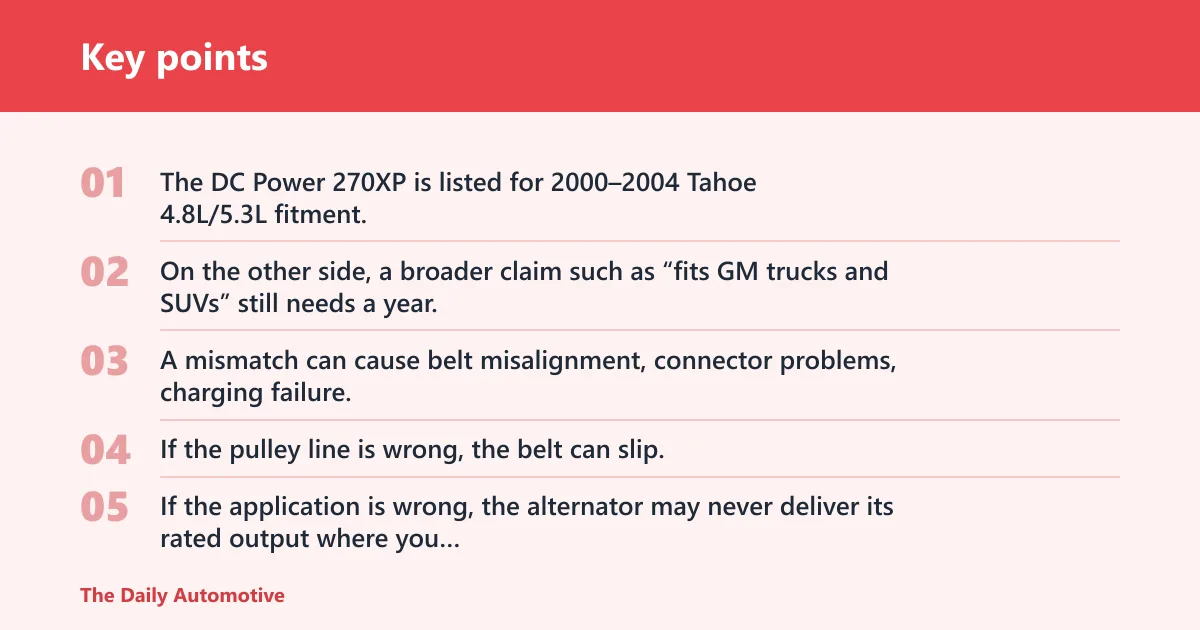
The DC Power 270XP is listed for 2000–2004 Tahoe 4.8L/5.3L fitment, which is the kind of specificity buyers should demand. On the other side, a broader claim such as “fits GM trucks and SUVs” still needs a year, engine, and application check before purchase.
What happens when the alternator does not match the application
A mismatch can cause belt misalignment, connector problems, charging failure, or a unit that simply cannot be installed without extra parts. If the pulley line is wrong, the belt can slip. If the application is wrong, the alternator may never deliver its rated output where you need it.
A common first-timer mistake is buying by amperage alone, then finding the bracket or pulley spacing is wrong for the exact truck. That turns a strong part into an expensive return.
Choose Mechman E-Series 370A Billet Alternator if… / Choose DC Power 270XP if…
Pick the Mechman E-Series 370A when your GM application is confirmed, your system needs stronger cruise output, and you want 180+ amps at idle with a 1.75 inch pulley. Pick the DC Power 270XP when you want the cleaner daily-driver choice for the exact 2000–2004 Tahoe 4.8L/5.3L fitment and a 200 A idle rating.
Choose the Mechman E-Series 370A if…
- You have a selected GM application that matches the bracket and wiring.
- Your system needs 370+ amps at cruising speeds and strong idle headroom.
- You are prepared to install the shorter belt required by the 1.75 inch pulley.
- You want more upper-end charging margin for a larger audio system.
Choose the DC Power 270XP if…
- You drive a 2000–2004 Tahoe with the correct 4.8L or 5.3L fitment.
- You care more about daily-driver behavior and low-RPM stability than peak output.
- You want a 200 A idle figure and a published thermal readout of 180 A at 200°F.
- You want the safer match for a moderate system without jumping to an oversized setup.
The Mechman 400 Amp Black Billet is described as sitting above both in headline output, with roughly 400 amps cruising output and roughly 180 amps idle output. It also uses a 1.75 inch pulley and requires a shorter belt, but it is not recommended above 5,000 RPM. That makes it a comparison point for hard-use systems, not the default daily-driver answer.
Choose the 400 amp option only if the exact GM application calls for it and the vehicle’s operating range stays within that limit. For ordinary street use, the stronger-sounding number is not always the smarter buy.
High-output alternator decision table
| System size | Recommended alternator output | Minimum idle amps | Belt requirement | Wiring upgrade need | Reject this alternator if |
|---|---|---|---|---|---|
| 600W | Moderate high-output unit with exact vehicle fitment | At least enough to hold stable voltage at idle | Use the stock belt only if the pulley and tension remain correct | Optional, but helpful if the factory charge wire is already weak | Fitment is wrong, idle voltage falls at stoplights, or the belt cannot keep proper tension |
| 1500W | Alternator with strong idle output and verified application match | 200 A idle is a strong target for this class | Shorter belt may be required if the pulley size changes | Recommended; Big 3 often helps prevent the charge wire from bottlenecking current | It only makes power at higher RPM, belt slip appears, or the wiring cannot support the current path |
| 2500W+ | Higher-output unit with strong low-RPM behavior | 180+ amps idle is the floor to look for | Shorter belt is often part of the install | Strongly recommended; charging-wire bottlenecks become likely | Thermal cutback appears, RPM limit is too low for the build, or fitment does not match the exact vehicle |
This table is the fastest filter. If the alternator cannot survive the idle load, cannot be fitted correctly, or cannot be wired properly, it is the wrong part no matter how good the peak number looks on paper.
Frequently asked questions
Is idle output more important than peak amps for car audio?
Yes. Idle output matters more for real street use because audio loads often happen at low engine speed, where peak ratings do not tell the full story. A high max number that arrives only at higher RPM may still leave you with voltage drop, dim lights, and weak charging at stoplights.
Which alternator fits my GM truck or SUV?
Only the application sheet can answer that correctly. Exact year and engine matter, especially on GM trucks and SUVs.
Do I need a shorter belt for a high-output alternator?
Often, yes. Smaller pulleys and altered alternator position can change belt length and tension enough that the stock belt no longer fits correctly. The Mechman E-Series 370A and Mechman 400 Amp Black Billet both require a shorter belt, so belt planning is part of the purchase.
Will a 400 amp alternator work for a daily driver?
It can, but only if the exact vehicle application matches and the operating range stays within the unit’s limits.
Do I need a Big 3 upgrade with a high-output alternator?
For moderate systems, it is helpful but not always mandatory. For 1,500W builds, it is often the right move. For 2,500W+ systems, it becomes much closer to required because undersized charging wire can bottleneck current delivery and keep a strong alternator from performing as intended.
How much alternator output do I need for 2,000 watts RMS?
A common estimate is roughly 275 amps. That figure is a planning guide, not a substitute for fitment and idle-output checks. If the alternator cannot support the load at idle, or if the vehicle needs a shorter belt and upgraded wiring, the headline number alone will not solve the problem.
What happens if the alternator does not match my vehicle fitment?
You can end up with a part that will not bolt in, will not align to the belt path, or will not connect correctly to the charging system. In practical terms, that means charging failure, belt slip, installation delays, or a return. Exact year and engine match are not optional on these systems.
Products related to this article
Sponsored / affiliate links. As an Amazon Associate I earn from qualifying purchases. I may earn additional commission from eligible campaigns.