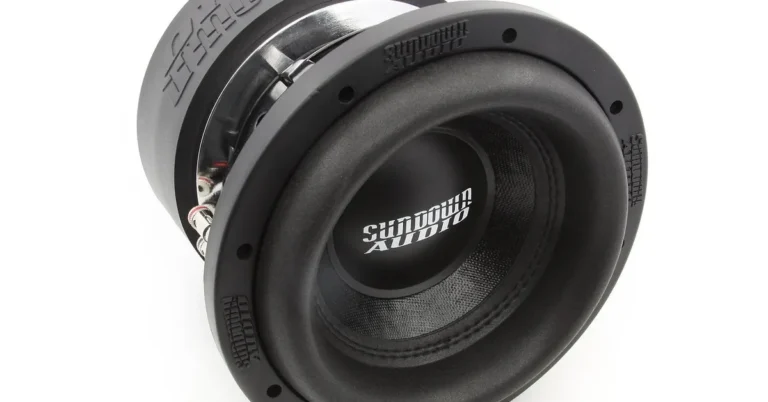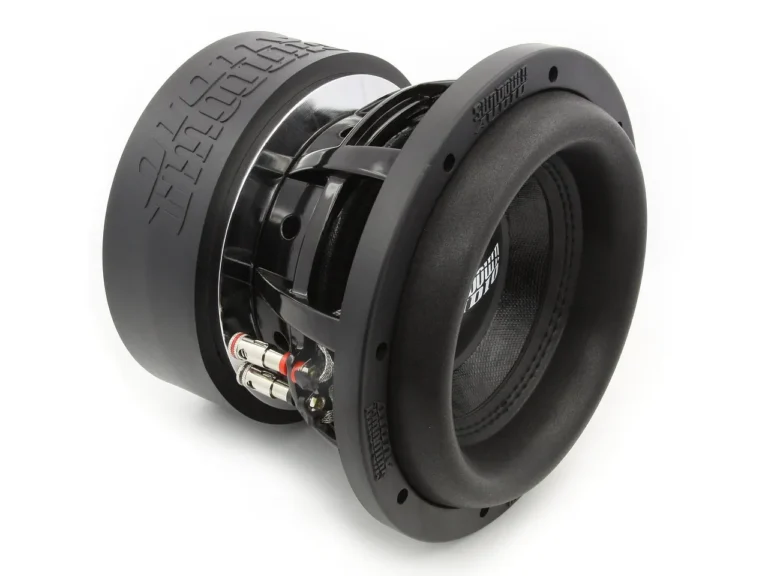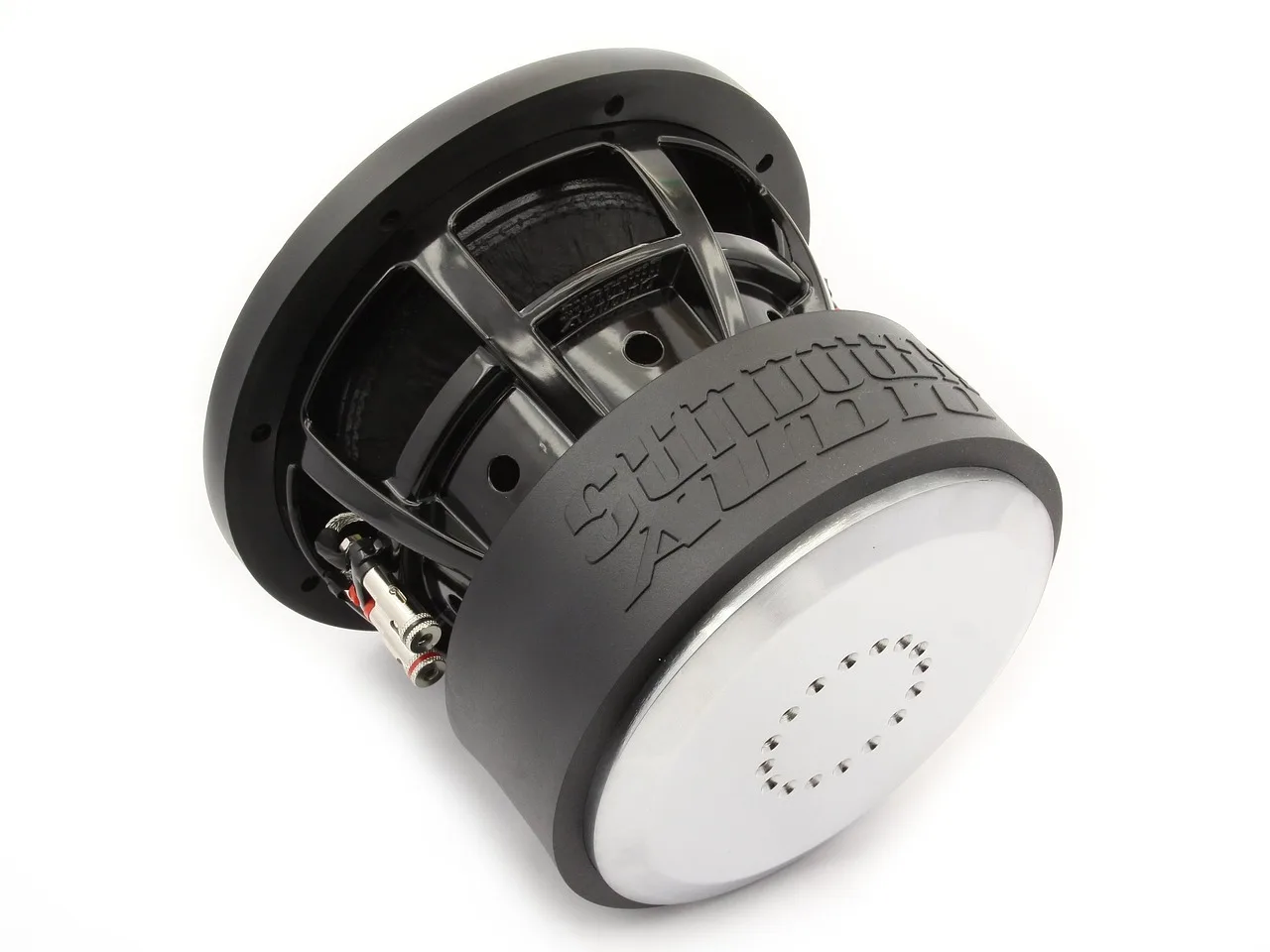
Best Car Subwoofer for Small Cars: FOLTUSYMY
For a small car, choose an under-seat powered subwoofer that fits the seat clearance and delivers about 100 to 150 watts RMS. Bigger numbers on the box matter less than real RMS output and enclosure depth. Buy the wrong size or ignore fitment, and you get blocked seat travel, rattles, weak bass, or a return. This guide compares compact under-seat options, explains clearance and power matching, and shows how to pick one that works in a small cabin.
FOLTUSYMY is the top pick for small cars


For many small-car buyers, a practical starting point is the FOLTUSYMY 10-inch 1200W car subwoofer because it pairs a compact under-seat format with a built-in amplifier and high/low level input options. The number on the box is not the decision-maker. Fitment, input compatibility, and reasonable power draw are.
Why this guide starts with fitment, not peak wattage
Small cabins make bad bass choices obvious. If the enclosure is too tall, the seat will not return to position. If the power is oversized for the cabin, bass turns thick and boomy instead of controlled. If the wiring is weak, you may hear hiss, whine, or clipping long before you run out of claimed wattage.
Under-seat powered subwoofers solve one problem very well: they use low-space installation with an integrated amplifier. That makes them practical for small sedans and hatchbacks where a full box would eat cargo room.
Quick picks
- Best overall small-car pick: FOLTUSYMY 10-inch 1200W car subwoofer, if your front-seat clearance can handle a slim powered unit and you want high/low level input flexibility.
- Best budget-minded compact pick: FOLTUSYMY 10-inch 800W powered car subwoofer, if you want a smaller-power target and a built-in amplifier with simpler tuning.
- Best slim under-seat option: 800W Slim Under Seat Powered Car Subwoofer Kit, if under-seat height is tight and you want the slimmest layout among the listed options.
Small car subwoofer fitment checklist
Fitment comes first because a compact car cannot absorb a bad install. Check seat rail height, floor hump shape, and rear-seat legroom before you buy. Then match the subwoofer height and wiring plan to that space. A low-profile model can still fail if the connector plugs face the wrong direction.
| Vehicle class | Vehicle seat clearance | Preferred subwoofer height | RMS target | Input type needed | Fuse rating | Likely tradeoff | Pass/fail recommendation |
|---|---|---|---|---|---|---|---|
| Small sedan | About 3.0 to 4.5 in under the front seat | 2.5 to 3.0 in | 100 to 150W RMS | High/low level input | 20A to 30A, matched to maker spec | Bass depth | Pass if seat travel stays clear |
| Hatchback | About 3.5 to 5.0 in under the front seat | 2.5 to 3.5 in | 100 to 150W RMS | High/low level input | 20A to 30A, matched to maker spec | Trunk space | Pass for most front-seat installs |
| Compact SUV | About 4.5 to 6.0 in under the front seat | 3.0 to 4.0 in | 150 to 200W RMS | High/low level input | 25A to 40A, matched to maker spec | Install complexity | Pass if the seat frame allows cable routing |
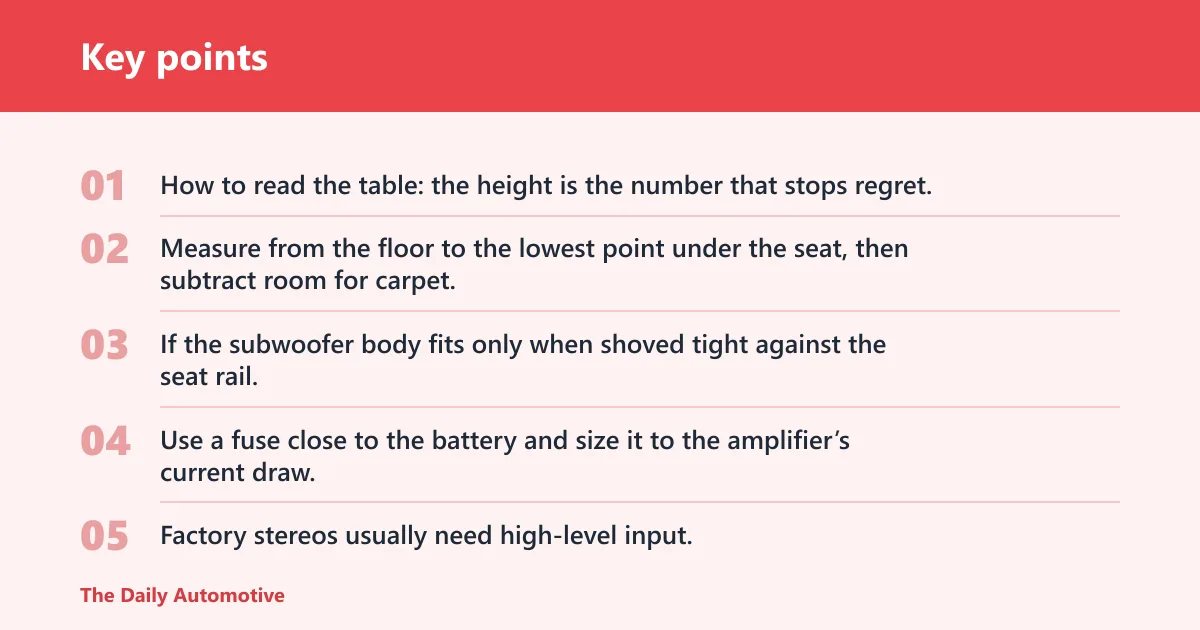
How to read the table: the height is the number that stops regret. Measure from the floor to the lowest point under the seat, then subtract room for carpet, plugs, and airflow. If the subwoofer body fits only when shoved tight against the seat rail, that is not a fit.
Fuse, input type, and install tradeoff notes
Use a fuse close to the battery and size it to the amplifier’s current draw, not to a marketing claim. Factory stereos usually need high-level input. Aftermarket head units often support RCA low-level input, and many active subwoofers accept both.
Ground quality matters more in small cars because the cabin is short and wiring runs are easy to overlook. A clean chassis ground, solid crimping, and the right wire gauge reduce alternator whine and voltage drop. If the sub hums when the engine revs, check the ground before blaming the enclosure.
FOLTUSYMY 10-inch 1200W car subwoofer
The FOLTUSYMY model is described as a 10-inch 1200W car subwoofer, and it is listed as a 2025 upgraded slim under-seat powered car subwoofer. It includes a built-in amplifier, high/low level input options, and a blue LED light. Those features matter more than the headline wattage for a small cabin.
Built-in amplifier and input options
A built-in amplifier makes this an active subwoofer, so you do not need a separate amp or extra rack space in a compact car. The high/low level input options let you connect to factory or aftermarket stereos. That keeps the install simple and avoids extra boxes in the cabin.
For a driver with a stock radio and limited trim space, that matters. You can usually tap speaker-level signal without replacing the head unit, then use the amp controls to trim bass for the cabin.
Blue LED light and what it changes
The blue LED light is cosmetic. It does not change output, extension, or cone control. If you like the look, fine. If you need quieter operation, focus on the enclosure height, the gain setting, and the wiring instead.
Best fit case for this model
This model makes the most sense when you want a single compact unit, the seat clearance is measured rather than guessed, and you want enough output for everyday bass without giving up the front passenger footwell. In a small sedan, that is often the right balance.
FOLTUSYMY 10-inch 800W powered car subwoofer
The FOLTUSYMY 800W version is also a 10-inch powered car subwoofer and is listed as a 2024 slim under-seat car subwoofer. It also has a built-in amplifier, high/low level input, and a blue LED ambient light. It is the softer-power option when the cabin is small and the goal is controlled bass, not shake.
800W output for smaller cabins
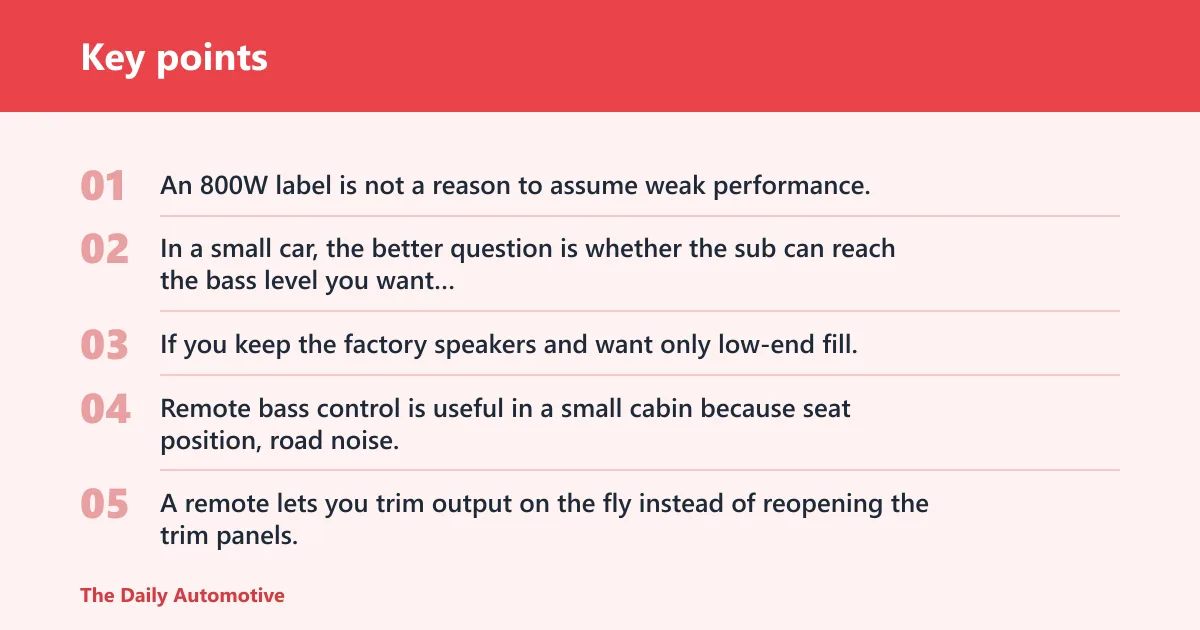
An 800W label is not a reason to assume weak performance, and it is not a reason to expect chest-thump from a tiny enclosure either. In a small car, the better question is whether the sub can reach the bass level you want without distortion at the volume you actually use.
If you keep the factory speakers and want only low-end fill, this type of power level can be a better match than a larger claim that tempts bad gain settings.
Blue LED ambient light and remote tuning
Remote bass control is useful in a small cabin because seat position, road noise, and passenger count change the bass balance. A remote lets you trim output on the fly instead of reopening the trim panels. That is practical tuning, not a luxury feature.
The blue LED ambient light remains cosmetic. It may help you confirm that the unit is powered, but it does not fix poor integration or rattles.
When this model makes more sense than the 1200W version
Choose the 800W version if your seat clearance is tighter, your listening level is moderate, or your factory alternator and wiring budget are modest. It is often the safer pick for a car where the sub has to live under the seat and disappear.
800W slim under-seat powered car subwoofer kit
The 800W Slim Under Seat Powered Car Subwoofer Kit is listed as an 800W slim under-seat powered car subwoofer kit. It includes colorful LED lights, a built-in amplifier, and high/low level input. The slim format is the main selling point, not the lights.
Slim design and under-seat clearance
When clearance is tight, the slimmer cabinet can matter more than another claimed power number. A sub that fits flat under the seat and leaves room for wiring is easier to live with than a taller unit that forces the seat into a fixed position.
This type of kit is useful in hatchbacks with short rear cargo areas or compact sedans where the front seats sit low. It trades some bass depth for easier placement.
Colorful LED lights and sound tradeoffs
Colorful LEDs are mostly cosmetic. They do not improve sound quality, and they can be a distraction in a dark cabin. If the choice comes down to a cleaner install or more lights, pick the cleaner install.
Who should pick a slim kit over a larger unit?
A slim kit suits the buyer who wants easy fitment first and bass second. If you listen at moderate volume and care more about keeping the cabin usable, the slimmer cabinet often wins. If you want deeper low-end extension, you will usually need more enclosure volume than an under-seat space allows.
What size subwoofer is best for a compact car?
For a compact car, a 10-inch under-seat powered subwoofer is often the practical size because it balances output and fitment better than a larger box. Smaller options can fit more easily, but they usually give up low-end depth. Bigger claims mean little if the cabinet cannot breathe under the seat.
10-inch versus smaller compact options
A 10-inch driver can move more air than many smaller compact units, which helps in a cabin that needs low-frequency fill without a full trunk box. The downside is depth. A 10-inch unit still needs room for the motor structure, amplifier housing, and connector clearance.
Say your hatchback has 3.5 inches under the passenger seat but the battery cable plug points rearward. A short body with awkward connectors can fail the fit test even if the driver size sounds right on paper.
Cabin size and bass depth tradeoffs
Small cabins can make modest subwoofers sound fuller than they do in larger vehicles, but that does not erase physics. A sealed under-seat model usually gives tighter bass and easier placement. A ported design often wants more space than a small car can spare.
Why enclosure size matters more than headline power
Headlines like 1200W or 800W do not tell you how much low-frequency air the enclosure can move cleanly. In a compact car, a modest RMS rating in the right cabinet often sounds better than a huge peak figure stuffed into a cramped spot.
Do you need a built-in amplifier?
Yes, in most compact-car installs, a built-in amplifier is the cleaner choice because it combines the amp and subwoofer in one enclosure. That cuts component count and keeps the install small. It also makes wiring shorter and easier to route in a tight cabin.
Active subwoofer basics
The Czech retailer describes active subwoofers as having an integrated amplifier and says they are suitable for installation under a seat. That is the key advantage for small cars: one box, fewer parts, and less demand for installation space.
Passive boxes can work, but they need an external amp, more wire, and more room. That is fine in a larger vehicle. In a compact cabin, it is often a poor use of space.
Factory stereo and aftermarket stereo compatibility
High/low level input helps both factory and aftermarket stereos because it lets the sub take signal from speaker-level or RCA-level sources. That reduces the chance you need a head-unit swap just to add bass. It also gives you more install options when the factory radio is staying put.
A common first-timer mistake is buying an under-seat sub with only one input path, then discovering the car has no easy low-level output. The result is extra adapters, more cost, and more noise risk.
When an integrated amplifier simplifies installation
If you want a sub that can be installed without a separate amp rack, an integrated amplifier is the simple answer. It trims install time, helps protect trunk room, and keeps wiring shorter. That matters most in a small car where every inch counts.
Will an under-seat subwoofer fit in a small car?
Often yes, but not automatically. Under-seat powered subwoofers are built for low-space installation, yet small-car fitment still depends on seat rail height, floor shape, and connector direction. A car with shallow clearance may accept one model and reject another with the same claimed size.
Small sedan, hatchback, and compact SUV fitment
Small sedans usually have the tightest front-seat clearance. Hatchbacks often give a little more room, while compact SUVs usually offer the most under-seat height of the three. Even so, rear-seat travel, seat motors, and underfloor ducts can change the result.
Seat rail, floor pan, and rear-seat clearance checks
Measure the lowest point under the front seat and compare it with the subwoofer height, then add room for the plug and cable bend. Check that the seat can move through its full range. If the sub touches the rail when the seat slides back, it is not a fit.
Picture a compact SUV with plenty of cabin height but a seat rail that dips near the rear mount. The sub may fit at the front edge and fail at the back edge. That is why one measurement is never enough.
When the trunk space is the better option
If the front-seat area is too tight or the wiring route would cross a moving rail, a trunk-mounted sealed sub may be smarter. It takes more cargo room, but it gives you more enclosure volume and fewer clearance surprises. That tradeoff often suits drivers who carry gear but do not want a seat-lift compromise.
How much power do I need in a car subwoofer for bass?
For small cars, about 100 to 150 watts RMS is a sensible target for an under-seat subwoofer, and some compact SUVs may support a bit more. RMS matters because it reflects sustained output. Peak wattage is a marketing number, not a planning number.
RMS target versus peak wattage marketing
Peak numbers can look impressive and still tell you almost nothing about daily use. A 1200W claim does not mean the unit needs 1200W of continuous power, and it does not mean the amplifier can feed that all day. Use RMS to compare real output.
How to avoid distortion in a small cabin
Small cabins magnify bad gain settings. If the sub is overdriven, bass becomes muddy fast and rattles appear in door cards, mirrors, and the rear deck. Set gain conservatively, listen for clipping, and reduce bass boost before you chase more power.
What is the difference between active and powered car subwoofers?
In shopping language, active and powered are often used to mean the same thing: a subwoofer with an integrated amplifier. That is the type that works well under a seat or in a compact trunk because it cuts component count and keeps the install smaller.
Remote bass control and sound tuning
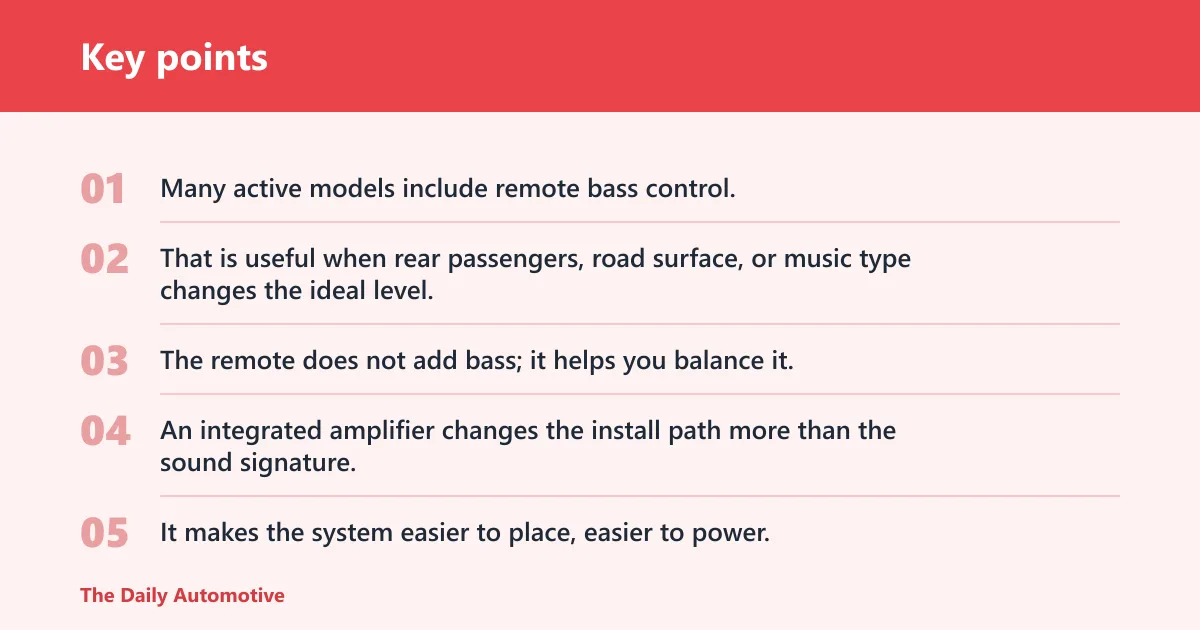
Many active models include remote bass control, which helps you tune bass for cabin size without reaching under the seat. That is useful when rear passengers, road surface, or music type changes the ideal level. The remote does not add bass; it helps you balance it.
What the built-in amplifier changes
An integrated amplifier changes the install path more than the sound signature. It makes the system easier to place, easier to power, and easier to integrate with factory audio. It also limits component matching errors, which is a real advantage in a small car.
Frequently asked questions
What is the best subwoofer for a small car?
The best choice is usually an under-seat powered subwoofer that matches your clearance and sits near the 100 to 150 watts RMS range. The FOLTUSYMY 10-inch 1200W unit is the stronger all-around fit if the seat height allows it and you want built-in amplification with both input types.
Do I need a built-in amplifier for a car subwoofer?
Not always, but it is usually the better choice for a compact car. A built-in amplifier turns the sub into an active unit, which reduces extra wiring and frees up space. It also makes installation simpler when you want to keep the factory stereo.
Can I install a powered subwoofer without changing my car stereo?
Yes. A powered subwoofer with high/low level input can often connect to the factory stereo through speaker-level wiring. That is one of the main reasons these units work well in small cars. You keep the stock head unit and add bass with minimal disruption.
Are LED lights on a car subwoofer useful or just cosmetic?
They are mostly cosmetic. Blue LED light or colorful LED lights can help you confirm power and add visual flair, but they do not affect sound quality, bass depth, or distortion. If fitment is tight, lighting should never outweigh height, input type, or wiring quality.
Products related to this article
Sponsored / affiliate links. As an Amazon Associate I earn from qualifying purchases. I may earn additional commission from eligible campaigns.