Armor All Interior Cleaner Review
Armor All Interior Cleaner works best on hard interior plastics, vinyl, and some fabric touch-ups; use a leather-specific cleaner on leather and a dedicated carpet or upholstery cleaner on cloth and carpet. Use the wrong formula and you can leave residue, dull finishes, or dry out sensitive surfaces. This guide sorts Armor All’s interior formats by material, then notes where each one falls short versus dedicated cleaners.
Match Armor All products to your surface type
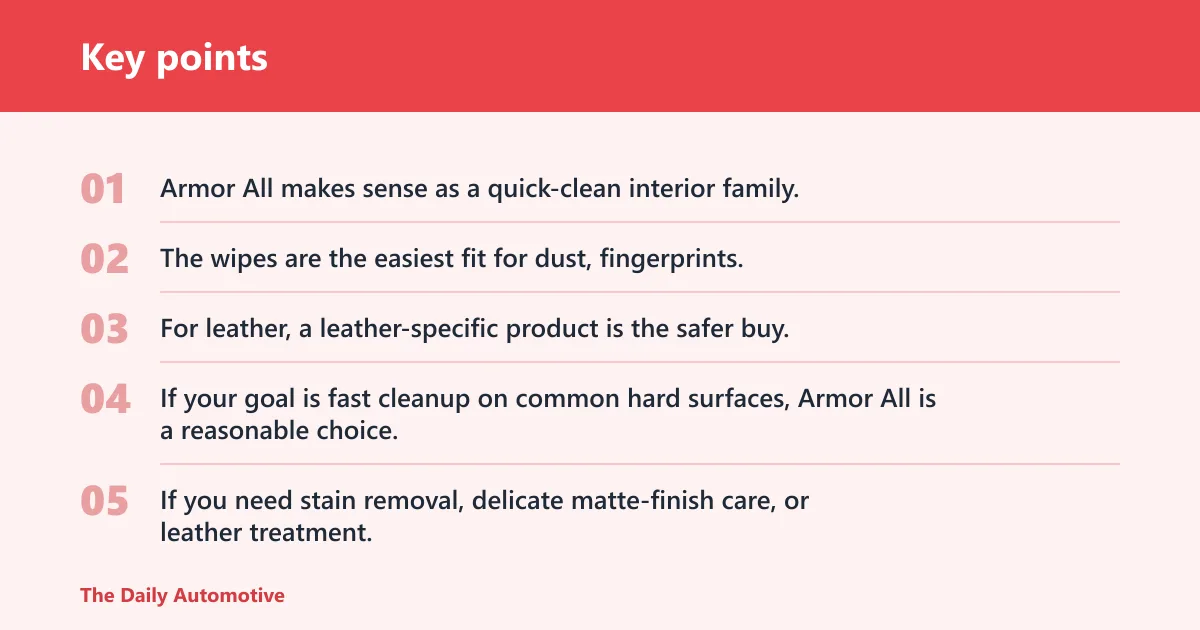


Armor All makes sense as a quick-clean interior family, not a single product for every cabin surface. The wipes are the easiest fit for dust, fingerprints, and light dirt on dashboards and trim, while the foam cleaner belongs on carpet and upholstery. For leather, a leather-specific product is the safer buy.
If your goal is fast cleanup on common hard surfaces, Armor All is a reasonable choice. If you need stain removal, delicate matte-finish care, or leather treatment, a dedicated cleaner is usually the better call because the wrong formula can leave residue or change the look of the surface.
Bottom line for quick dust and dirt cleanup
Armor All Car Interior Cleaner Wipes fit quick cleanup best. AutoMaximizer lists them as a 25-count product, and the wipe format is easy to keep in the car for dashboards, trim, and other hard interior plastics where loose dust and road grime are the main problem.
That matches the broad buyer consensus that makes these wipes a frequent first pick for light cleanup. CNET also names them the best interior cleaner wipes and describes them as a classic choice that does a good job.
Where the family falls short versus dedicated cleaners
The limits show up when the mess is stuck in place instead of sitting on the surface. Cloth upholstery, carpet, floor mats, and stained seats usually need more cleaning power than a wipe can deliver, and leather deserves a formula made for that material.
CNET also notes that some interior cleaners are not suited to every type of upholstery, and recommends testing cleaner on cloth before full use. That warning matters here because Armor All’s interior lineup includes several products with different target surfaces.
First-buy recommendation by surface type
For dashboards, plastic trim, and quick dust removal, start with the wipes. For carpet and cloth seats with stains, start with the foam cleaner. For leather seats, choose a leather-specific cleaner rather than assuming the general interior product will be safe.
Pros and cons
Pros
- Portable wipe format for quick cleanup in the car.
- Good fit for dust and light dirt on dashboards and trim.
- Foam cleaner gives you a deeper option for fabric and upholstery.
- The line covers several common interior materials instead of forcing one format onto every job.
Cons
- Wrong-product use can leave residue or change the finish.
- Wipes are limited on stains, set-in grime, and seams.
- Foam cleaner can over-wet fabric if you spray too much.
- Leather, matte plastics, and sensitive trim still call for spot testing.
Armor All interior use-case matrix
This matrix separates quick cleanup from stain work. It also shows where spot testing matters most, because surface finish and residue control are often the real deciding factors.
| Armor All interior product | Best surface fit | Expected cleaning strength | Residue risk | Spot test essential? |
|---|---|---|---|---|
| Car Interior Cleaner Wipes, 25-count | Dashboard, plastic trim, vents, quick touch-ups on vinyl | Light to moderate for dust, dirt, and surface oils | Low to moderate if overused or left to dry on glossy trim | Yes on matte, soft-touch, or unfamiliar finishes |
| 19139 Power Foam Carpet & Upholstery Cleaner, 22 ounces | Cloth upholstery, carpet, floor mats, seats | Moderate to stronger on stains and embedded grime | Moderate if fabric is saturated or not fully wiped out | Yes on colored fabric, seams, and delicate upholstery |
| Leather wipes | Leather seats and leather-trimmed contact surfaces | Light cleaning and maintenance | Low to moderate depending on coating and finish | Yes on coated or matte leather |
| Air freshening protectant | Hard interior plastics and trim where a scent or protectant is desired | Low for cleaning; more of a finishing product than a cleaner | Moderate if used on touchpoints or glossy surfaces | Yes on screens, matte trim, and sensitive plastics |
| Vent cleaner | Vents and narrow gaps | Light for dust in tight spaces | Low if applied carefully, higher if sprayed too heavily | Yes before use near electronics or delicate trim |
Wipes versus foam cleaner by surface
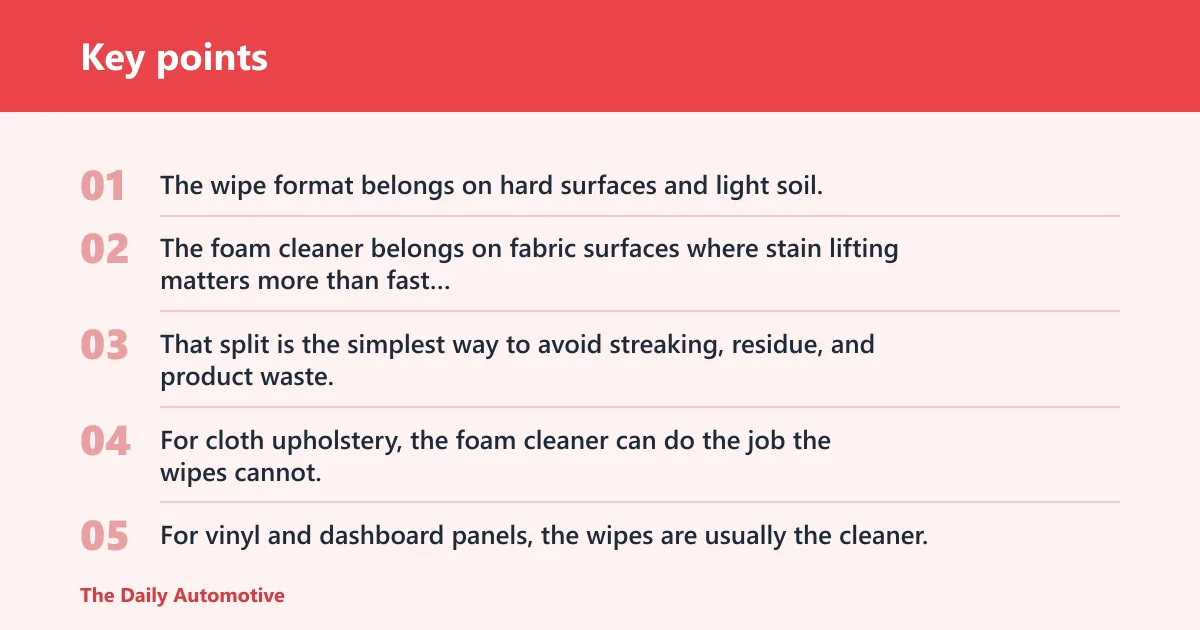
The wipe format belongs on hard surfaces and light soil. The foam cleaner belongs on fabric surfaces where stain lifting matters more than fast dust removal. That split is the simplest way to avoid streaking, residue, and product waste.
For cloth upholstery, the foam cleaner can do the job the wipes cannot. For vinyl and dashboard panels, the wipes are usually the cleaner, faster choice because you can control where the product lands.
Cleaning strength versus residue risk
Dust is easy. Oils and embedded dirt are harder. Stains are harder still. Armor All’s wipe format handles the first two well on the right surface, while the foam cleaner is the better match when the problem has moved into fibers.
Residue risk rises when you use too much product, work on a textured surface, or skip the final wipe. That is why the same product can look fine on one dashboard and leave a film on another.
When spot testing is essential
Spot testing matters on cloth, leather, matte plastics, soft-touch panels, and any interior surface with an unfamiliar sheen. CNET’s guidance to test cleaner on cloth before full use is the right model here, and it applies even more when the material is coated or aged.
Say your sedan is around 10 years old and has matte door-panel trim and a glossy center stack. The wipe may look fine on the center stack, then leave a haze on the matte plastic if you do not test first. The same cleaner, two different finishes, two different outcomes.
Safe use is mostly about restraint. Use the smallest amount that gets the job done, keep product off surfaces it was not made for, and stop as soon as the residue is gone.
- Pick the product that matches the surface: wipes for hard trim, foam for fabric, leather wipes for leather.
- Test in a hidden area before full application, especially on cloth, leather, matte plastics, or soft-touch panels.
- Apply a small amount first instead of soaking the surface.
- Wipe away loosened dirt before it dries back into the finish.
- On fabric, avoid over-wetting seams and edges where liquid can collect.
- On leather and matte plastics, inspect for streaking or change in sheen after the first pass.
How to avoid over-wetting seams and fabric
Do not spray directly into stitching, perforations, or deep seat seams unless the product is meant for that job and the instructions support it. Oversaturation is how a small cleanup turns into a longer drying issue or a visible ring.
Residue control and wipe-off timing
Wipe off soon after application, especially on glossy trim and leather. The longer a cleaner sits, the more likely it is to leave a film or catch dust again. That is especially true on surfaces that already have a factory sheen.
Is Armor All bad for your interior?
No, not when you match the formula to the material. Armor All becomes a problem when the wrong product goes onto the wrong surface, or when too much cleaner is left behind. That is when you get streaking, residue, dulling, or a surface that feels slick instead of clean.
What can go wrong on the wrong surface?
Leather can look overly shiny or feel coated if you use the wrong interior cleaner. Cloth can hold excess moisture in seams, which can leave rings or a longer dry time. Matte plastics can haze if the product is not wiped off fully.
A common first-timer mistake is treating a cloth seat cushion like a dashboard. Suppose a small coffee spill dries into a seat seam. A wipe may clean the visible top layer, but the seam can still hold residue unless you use a fabric cleaner and blot carefully.
When the product is a reasonable choice
Armor All is reasonable for routine dust removal, light dirt, and quick refreshes on common hard surfaces. It is also a sensible travel kit item because the wipes are easy to keep in a glovebox and use without a bottle or microfiber stack.
Materials that need extra caution
Leather, matte plastics, coated trim, and cloth with mixed fiber content deserve the most caution. If the surface is delicate, dark, or expensive to replace, spot test first and use the smallest amount needed.
Does Armor All clean leather?
Some Armor All leather products are meant for leather, but the general interior cleaner is not the right default for leather seats. Leather is one of the places where product choice matters most, because coated, perforated, or matte finishes can react differently to cleaning residue.
Leather seats and leather wipes guidance
The same source lists Armor All Leather Beeswax Wipes as a separate leather product, which is the right signal to pay attention to. If you are cleaning leather, a product labeled for leather is the safer starting point than a general dashboard wipe.
For light maintenance, leather wipes can work on surface dust and finger oils. For grime in bolsters, perforations, or seat seams, a dedicated leather cleaner is the better option because you need controlled cleaning and less residue.
Why a dedicated leather cleaner may be better
CNET’s leather-specific category exists for a reason, and its leather pick is Carfidant Ultimate Leather Cleaner. That separation reflects a basic practical rule: leather needs its own cleaner when the goal is cleaning, conditioning, or preserving the original finish.
Use a leather-specific product if the seat is visibly soiled, has body oils on the bolster, or has a finish that can show streaking. General interior cleaner is too broad a tool for that job.
Finish and residue concerns on coated leather
Coated leather can tolerate some cleaners, but it is also one of the easiest places to notice leftover film. If the surface feels slippery after wiping, the product was too heavy or the finish needed a gentler formula.
Which Armor All product should you buy?
Pick the product by surface, not by brand name. The family covers quick dusting, fabric cleaning, leather care, and narrow-gap dusting, but each format fits a different job.
Armor All Car Interior Cleaner Wipes for dashboards and trim
Choose the 25-count wipes for dashboards, plastic trim, and light cleanup in the cabin. They are the best fit when you want portability, quick use, and easy control over where the cleaner lands.
Armor All 19139 power foam carpet & upholstery cleaner for fabric stains
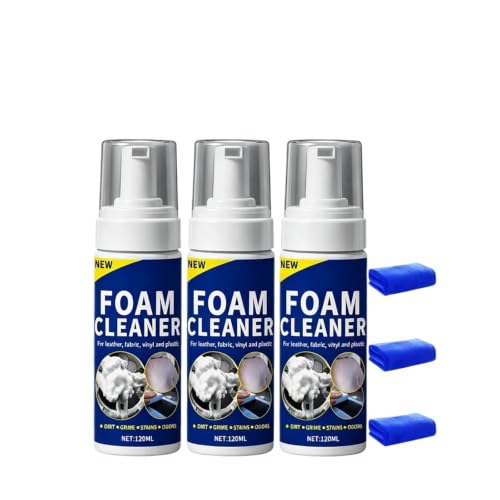
Choose the 22-ounce foam cleaner for cloth upholstery, carpet, and floor mats. The spray-and-wipe format makes more sense when the mess is set into fibers and you need stain lifting, not just a surface pass.
Leather wipes for leather seats
Choose the leather wipes when you need a leather-specific formula for quick maintenance. They are not a substitute for a strong fabric cleaner, but they are closer to the right tool for leather than the general interior wipe.
Air freshening protectant for finishing, not heavy cleaning
Choose the air freshening protectant when the goal is more about finish and scent than cleaning power. Do not expect it to solve dirt, oils, or stains on its own.
Vent cleaner for narrow spaces
Choose the vent cleaner for tight openings where dust collects and wipes cannot reach. Use it carefully, because vents sit near controls and electronic parts that do not benefit from heavy spray.
Who it’s for
Armor All is for DIY drivers who want a simple interior kit for dust, fingerprints, and routine cleanup across common cabin surfaces. It is less suitable for owners dealing with delicate leather, heavily soiled fabric, or interiors where finish change would be a deal-breaker.
If you mostly need a wipe for quick cleanup, this family makes sense. If you need one product to handle every material in the cabin, that is where dedicated leather and upholstery cleaners start making more sense.
Frequently asked questions
Is Armor All bad for interior?
No, but it can be bad for a specific surface if you use the wrong formula. The interior line works best when you match wipes, foam, or leather products to the material. The main risk is residue or finish change from poor product-to-surface matching.
Does Armor All hurt your interior?
It can, if you use a product on the wrong material or leave too much behind. Cloth can be over-wet, leather can look coated, and matte plastics can haze. Used correctly, on the right surface, it is a reasonable cleaning option.
How well do Armor All interior cleaner wipes work on dust and dirt?
They are best for light dust, fingerprints, and surface dirt on dashboards and trim. That is exactly where the wipe format makes sense. They are less effective on embedded grime, stains, or textured fabric because the material holds onto contamination.
Which Armor All interior product is best for seats, carpet, or dashboards?
Use the 25-count wipes for dashboards and trim, and the 22-ounce Power Foam Carpet & Upholstery Cleaner for seats, carpet, and floor mats. Leather seats should get the leather-specific product instead of the general wipe or foam cleaner.
What’s the difference between Armor All car cleaning wipes and carpet & upholstery cleaner?
The wipes are for quick surface cleaning on hard interior materials, while the foam cleaner is built for fabric and upholstery stain work. One is better for convenience and dust control. The other is better for deeper cleaning on cloth and carpet.
Products related to this article
Sponsored / affiliate links. As an Amazon Associate I earn from qualifying purchases. I may earn additional commission from eligible campaigns.