4 Best Car Audio Subwoofers for Bass in 2026: We Compared
The best car audio subwoofer is the one that fits your space, amp, and listening goal: sealed for tight bass, ported for more output, powered for the easiest install, and vehicle-specific for the cleanest fit. Choose the wrong path and you give up cargo room, stress the amplifier, or end up with boomy bass and thin front-stage sound. This guide compares four real subwoofer paths by fitment, power needs, enclosure type, and install difficulty.
Quick comparison
| Product | Badge | Best for | Price | ||
|---|---|---|---|---|---|
 |
12-Inch Sealed 4-Ohm Subwoofer by JL AudioJL AUDIO | Our pick | 12-inch · 4-ohm · JL Audio | $929.99
Price as of 22 Oct 2026
|
View |
 |
KICKER 50DCWC122 Dual CompC 12-inch Subwoofers in VentedKICKER | Also great | 12-inch · 2-ohm · KICKER | $399.99
Price as of 22 Oct 2026
|
View |
 |
PIONEER D-Series TS-D10D4 10" Subwoofer 1300W Max | Dual 4PIONEER | Budget pick | 10-inch · Pioneer · D-Series | $159.99
Price as of 22 Oct 2026
|
View |
 |
Rockford Fosgate P3SD4-10 Punch P3S 4-Ohm DVC Shallow 10"Rockford Fosgate | Also great | 10-inch · 4-ohm · Rockford Fosgate | $229.99
Price as of 22 Oct 2026
|
View |
The split is plain. Component systems give you the most control and the most install work, while powered and shallow options cut space demands. For trucks, small cars, and daily drivers, fitment often matters more than raw wattage.
How we chose
The picks are sorted by install constraint first, then by listening goal. That means enclosure type, amp demand, vehicle space, and impedance matter before cone size does.
We also looked at long-term system cost. A cheap driver can turn expensive once you add an amp, a box, wiring, and possible tuning fixes for the factory head unit.
Finally, each path is judged by who should avoid it. That matters because a strong spec sheet can still be the wrong answer for a truck with no cargo room or a daily driver that needs quiet, controlled bass.
Jl audio w7ae: best for high-end component builds
The JL Audio W7AE line is the pick for a serious component build where enclosure design and amplifier matching are part of the plan, not afterthoughts. It is offered in 8-inch, 10-inch, 12-inch, and 13.5-inch sizes, with size-dependent RMS power from 500 to 1500 watts.
That range makes it easier to scale the system around the car, not the other way around. The W7AE also supports sealed or ported enclosure use, so you can choose tighter transient response or more output depending on cabin size and music.
The drawback is cost and complexity. You need the sub, the box, the amp, and enough install space to do it properly, so this is not the clean answer for a simple factory-upgrade job.
Use this path when you want the most control over system tuning and are willing to pay for the rest of the build around it.
Hertz mille pro shallow: best for tight spaces
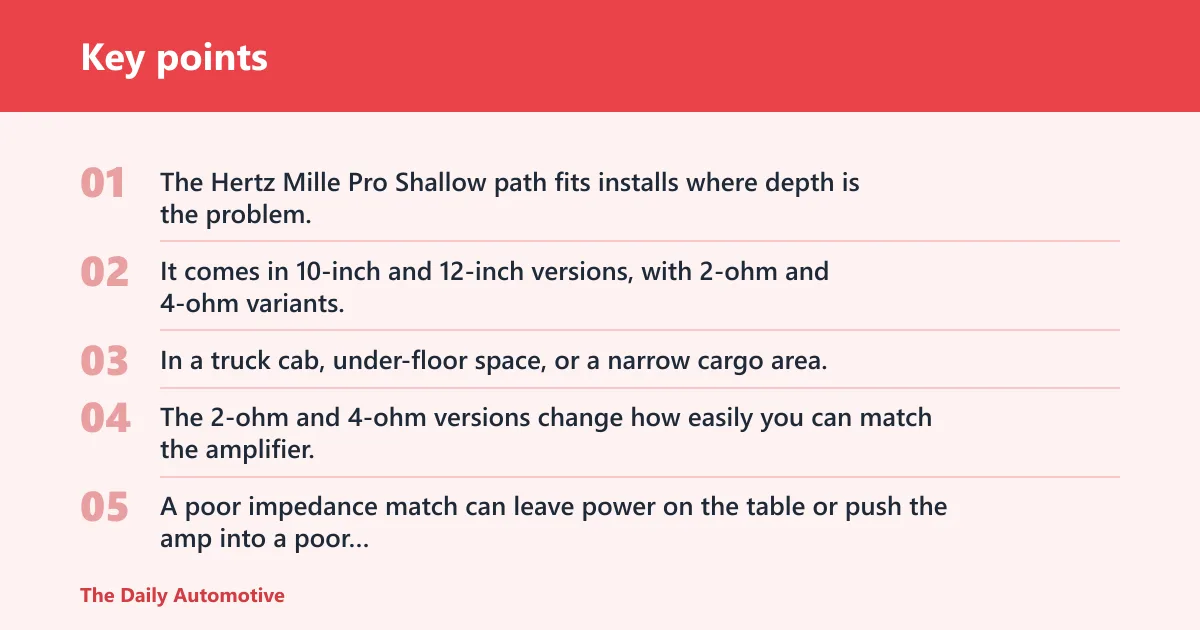
The Hertz Mille Pro Shallow path fits installs where depth is the problem, not just total volume. It comes in 10-inch and 12-inch versions, with 2-ohm and 4-ohm variants, and it is paired with a compact sealed box around 0.4 to 0.5 cubic feet.
That compact sealed enclosure is the key. In a truck cab, under-floor space, or a narrow cargo area, the smaller box makes the difference between a real sub install and no install at all.
The 2-ohm and 4-ohm versions change how easily you can match the amplifier. A poor impedance match can leave power on the table or push the amp into a poor operating range, so the wiring plan matters before purchase.
The drawback is simple: shallow designs trade some enclosure flexibility for fitment. If you have room for a deeper sub and a properly sized box, a standard design may give you more options.
Jl audio acp110lg-tw1: best powered compact setup
The JL Audio ACP110LG-TW1 suits drivers who want bass without building a full system around a separate amp and box. It uses a 10-inch driver with a built-in Class-D amplifier rated at about 400 watts, inside a ported MDF enclosure measuring approximately 21×13.5×6.6 inches.
That makes it a strong match for daily driving where you want a clean, contained install and fewer parts to buy. The enclosure is still a real box, so it needs more room than an under-seat unit, but less planning than a separate component setup.
The drawback is flexibility. A powered enclosure gives you an integrated package, but you cannot tune each piece as freely as you can with a separate sub and amplifier.
This is a good fit when you want a straightforward upgrade and are willing to accept the factory-style limits of a packaged solution.
Infinity kappa 123wdssi: best free-air option
The Infinity Kappa 123WDSSI is a free-air option for vehicles that cannot spare room for a traditional box. It is a 12-inch infinite-baffle subwoofer shown at 500 watts, with about 250–350 watts suggested for free-air use.
Free-air can work well when the rear deck or panel layout can isolate the front and rear wave of the driver. That makes it useful in certain sedans and custom installs where enclosure depth is the main obstacle.
The drawback is that free-air is less forgiving than sealed or ported boxes. If the mounting surface leaks, flexes, or is poorly sealed, bass drops off quickly and the whole install can sound thin.
This option should be reserved for vehicles and panels built for it. If you can fit a proper enclosure, that is usually the safer buy.
Which one should you buy?
If you want the best daily driver balance, start with a powered enclosure such as the JL Audio ACP110LG-TW1. It cuts the parts count and still gives you a real subwoofer upgrade without a full custom build.
If you are building for the strongest result and have room for a proper box and amp, the JL Audio W7AE is the higher-end component path. It is the most flexible choice, but the rest of the system needs to match it.
If your vehicle is short on depth, the Hertz Mille Pro Shallow is the smart answer. If you need the simplest package, the powered JL option is easier to plan around than a separate driver, amp, and enclosure.
For trucks with limited space, shallow-mount and under-seat formats usually make more sense than a large box. A common first-timer mistake is buying a big dual-12 package because the spec sheet looks strong, then discovering the enclosure fills the cargo area and still needs amplifier space.
For budget-minded buyers, the KICKER dual 12 package can make sense if you already have room for a vented box and want a loaded enclosure. If you need to keep cost down across the full build, factor in wiring, fuse protection, and any amp you still have to buy.
Subwoofer decision matrix
| Type | Vehicle space | Preferred music | Amp requirement | Enclosure size | Expected output | Install complexity | Who should avoid it | Common mistake |
|---|---|---|---|---|---|---|---|---|
| Component | Medium to large cargo area or custom space | Critical listening, mixed genres, tuned daily use | External amp required; power must match RMS and impedance | Sealed or ported, often larger than powered options | Highest ceiling when the box and amp are right | High | Drivers who want plug-and-play or minimal wiring | Buying by peak watt claims and ignoring box volume |
| Shallow-mount | Small trunks, trucks, under-floor spaces | Daily bass with limited depth | External amp required; impedance choice matters | Compact sealed box, often around 0.4 to 0.5 ft³ for some models | Moderate to strong, depending on enclosure and power | Medium | Users chasing the biggest possible output per dollar | Using a box that is too small or too shallow for the driver |
| Powered | Compact trunks, hatchbacks, and some SUVs | Daily listening, quick bass upgrade, factory-system add-on | Built-in amplifier; needs power, ground, and signal input | Integrated enclosure, usually compact to medium size | Moderate; enough for many daily systems | Low to medium | Users who want maximum tuning control or huge output | Forgetting that the built-in amp still needs a clean signal and proper gain setting |
| Free-air | Vehicles with a proper rear deck or partition | Clean bass when box space is scarce | External amp required; free-air power range must be respected | No box, but the mounting surface must be rigid and sealed | Moderate; depends heavily on installation quality | Medium to high | Anyone without a solid mounting panel and proper isolation | Assuming “no box” means “no requirements” |
What is the best car subwoofer for daily driving?
The best daily-driving subwoofer is usually a powered enclosure or a well-sized sealed component system. Daily use asks for controlled bass, reasonable cabin fill, and low hassle, not the most extreme output possible. If your cargo room is limited, a compact powered unit is often the better buy.
Daily listening usually benefits from sound that stays balanced at lower volumes. Sealed boxes and powered enclosures tend to behave better in that role than a large ported setup that may sound heavy in a small cabin.
Is a sealed or ported subwoofer box better?
Sealed boxes are usually better when you want compact size, tighter bass, and easier placement. Ported boxes are better when you want more output from the same driver and can spare more room. The wrong choice usually shows up as weak bass from too-small volume or excessive boom from a box that was never meant for the car.
For truck cabs and smaller trunks, sealed often makes more sense. For larger SUVs or vehicles with real cargo room, ported can be the better fit if the enclosure is built to the driver’s needs.
How much RMS power do I need for a car subwoofer?
You should match the amplifier to the subwoofer’s RMS range, not its peak rating. A sub rated for 500 watts RMS does not need a 1000-watt amp just because the box says 1000 on the label. Bad matches usually cause clipping, heat, or underused hardware.
As a basic rule, choose an amp that can deliver the sub’s RMS rating at the final wiring impedance. If the load changes from 2 ohms to 4 ohms, the power available changes too, so the wiring plan belongs in the buying step.
Can I install a subwoofer with a factory head unit?
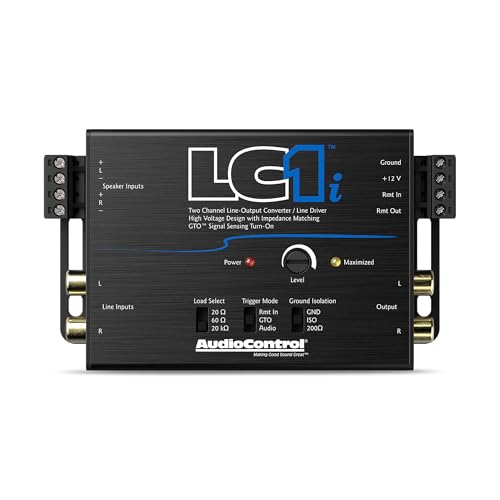
Yes, in many vehicles you can. The difference is signal input: a powered sub or external amp may need a line output converter, high-level input, or another factory-signal solution. If the signal is noisy or poorly integrated, the sub can sound weak even when the hardware is fine.
Factory head units are common in new trucks and SUVs, so signal compatibility matters as much as speaker size. Plan for power, ground, and turn-on wiring before you buy the subwoofer itself.
What size subwoofer is best for my car?
The best size depends on space and the kind of bass you want. An 8-inch can fit tighter builds and still add useful low end. A 10-inch is often the middle ground. A 12-inch usually needs more room and can move more air, while larger drivers need even more enclosure space.
For small cars, 8-inch and 10-inch options are easier to package. For SUVs and larger sedans, 12-inch and larger drivers make sense if you can support the enclosure size and amp demand.
What is a shallow mount subwoofer used for?
A shallow-mount subwoofer is used when depth behind the mounting surface is limited. That makes it a common answer for trucks, slim trunks, and under-seat or low-profile builds. It is not about chasing the largest box; it is about fitting real bass into a tight cavity.
The tradeoff is that shallow designs can be more sensitive to box volume and amplifier matching. If the enclosure is too small, or the impedance does not suit the amp, output suffers fast.
Are free air subwoofers worth it?
Free-air subwoofers are worth it when the vehicle is built for them and box space is genuinely unavailable. They are not a shortcut. You still need a rigid mounting surface, a sealed partition, and a proper power match to get useful bass.
For the right sedan rear deck or custom partition, free-air can be practical. For most other builds, a sealed or powered enclosure is a safer and more predictable choice.
What is the best subwoofer for a truck with limited space?
The best truck subwoofer for limited space is usually a shallow-mount or under-seat powered unit. Trucks often punish deep enclosures more than they punish cone size, so fitment and enclosure depth come first. A compact sealed design can be the difference between a usable cab and a box that gets in the way.
If you want the least hassle, a powered under-seat option is the simplest place to start. If you want more control and have a little more depth to work with, a shallow-mount component sub in a compact sealed box is the stronger long-term answer.
Frequently asked questions
Should I buy a powered subwoofer or a component subwoofer?
Buy a powered subwoofer if you want the easiest install and a smaller parts list. Buy a component subwoofer if you want more tuning freedom, better amp matching, or a stronger upgrade path. The component route costs more once you add the amp and enclosure.
Products related to this article
Sponsored / affiliate links. As an Amazon Associate I earn from qualifying purchases. I may earn additional commission from eligible campaigns.