Best Dash Cams for Security (2026): Based on Specs and Reviews
The best dash cams for security are 4K models with buffered parking mode, plus a 360-degree camera if you need cabin and side-window coverage. Miss that match, and you may get unusable plates, no impact footage, or no evidence when a parked car is hit. This guide compares the top security-focused picks and maps each one to parking lots, street parking, and commute-only protection.
Quick comparison
The table below is the fastest way to match threat type to camera type. It puts evidence quality ahead of headline resolution, because a clear plate, a locked event file, and reliable parking power matter more than a spec sheet alone.
| Product | Badge | Best for | Price | ||
|---|---|---|---|---|---|
 |
Orderich 360°Dash Cam Front and Rear Inside Left Right, 4Orderich | Our pick | 360° · 4CH · FHD | $41.99
Price as of 16 Oct 2026
|
View |
 |
Affver 4K+2.5K Dash Cam Front and Rear, Built-in 5G WiFi 6Affver | Budget pick | 4K · 2CH · 5G | $76.49
Price as of 16 Oct 2026
|
View |
 |
ROVE R2-4K Dual Dash Cam Front and Rear, STARVIS 2 Sensor,ROVE | Upgrade pick | 4K · 2CH · STARVIS | $149.99
Price as of 16 Oct 2026
|
View |
How we chose
We compared the listed cameras on four security filters: front plate capture, parked-car coverage, night-image hardware, and parking power requirements. We also weighed storage burden, installation complexity, and whether the camera’s coverage matches common threat scenarios like side-swipes, break-ins, and rear-window hits.
That matters because a 4K front camera can still miss a side impact, while a 360-degree setup can record more of the cabin without always giving better exterior detail. For security buyers, the right choice is the one that fits where the car sits and how long it sits there.
Top pick for street parking
ROVE R2-4K Dual Dash Cam is the best street-parking pick in this group because its front STARVIS 2 sensor, rear camera, and 24-hour parking mode give the strongest balance of night evidence and parked-car coverage. If your car spends long hours on the curb, that mix usually beats a front-only 4K camera with no rear witness.
Top pick for apartment parking
Orderich 360° Dash Cam is the best apartment-parking pick because its four-channel 360-degree layout watches more of the vehicle’s surroundings and cabin than a standard dual-channel setup. That broader view helps when a hit comes from a side angle or when you want more context around who approached the car.
Top pick for commute-only drivers
Affver 4K+2.5K Dash Cam is the best commute-only pick because it gives you true front-and-rear coverage, a 64GB card in the box, and a lower entry price than the ROVE model. If you mostly want evidence for moving incidents and occasional parking notes, it covers the basics without pushing storage costs too hard.
Quick picks
- Best overall for security: ROVE R2-4K Dual Dash Cam
- Best for full surround coverage: Orderich 360° Dash Cam
- Best value front-and-rear option: Affver 4K+2.5K Dash Cam
- Best for parking lots and curbside risk: ROVE R2-4K Dual Dash Cam
- Best for simple budget coverage: Orderich 360° Dash Cam
Dash cam security table
| Model | Best threat scenario | Recording mode | Power requirement | Storage burden | Night-performance priority | Install complexity |
|---|---|---|---|---|---|---|
| ROVE R2-4K Dual Dash Cam | Street parking, rear-end hits, license-plate capture at speed | Front + rear, 24-hour parking mode, event locking | Best with hardwire kit for parking mode | High; 4K front files and rear clips fill cards faster | High; STARVIS 2 sensor favors low-light detail | Moderate; dual cable routing plus parking power |
| Affver 4K+2.5K Dash Cam | Commutes, parking-lot bumps, rear-window incidents | Front + rear, loop recording, 24H parking mode | Hardwire kit needed for parking surveillance | High; 4K front plus 2.5K rear creates large files | Moderate to high; front 4K helps if light is adequate | Moderate; dual-camera installation and power setup |
| Orderich 360° Dash Cam | Apartment parking, side-window hits, cabin context after an event | Four-channel 360-degree coverage, motion detection, parking mode | Hardwire kit or battery pack for parked surveillance | High; four channels create the heaviest card load here | Moderate; IR helps inside, but exterior plate detail is less focused | High; multiple cameras and more wiring |
Do you need 4K or 360 coverage for your car?
Choose 4K if your main goal is plate readability from the front and you want the cleanest image on the road. Choose 360-degree coverage if your risk is side impacts, break-ins near the cabin, or parking damage from angles a front camera cannot see. Many drivers need both coverage and detail, which is why dual-channel remains the middle ground.
4K front cameras and license plates
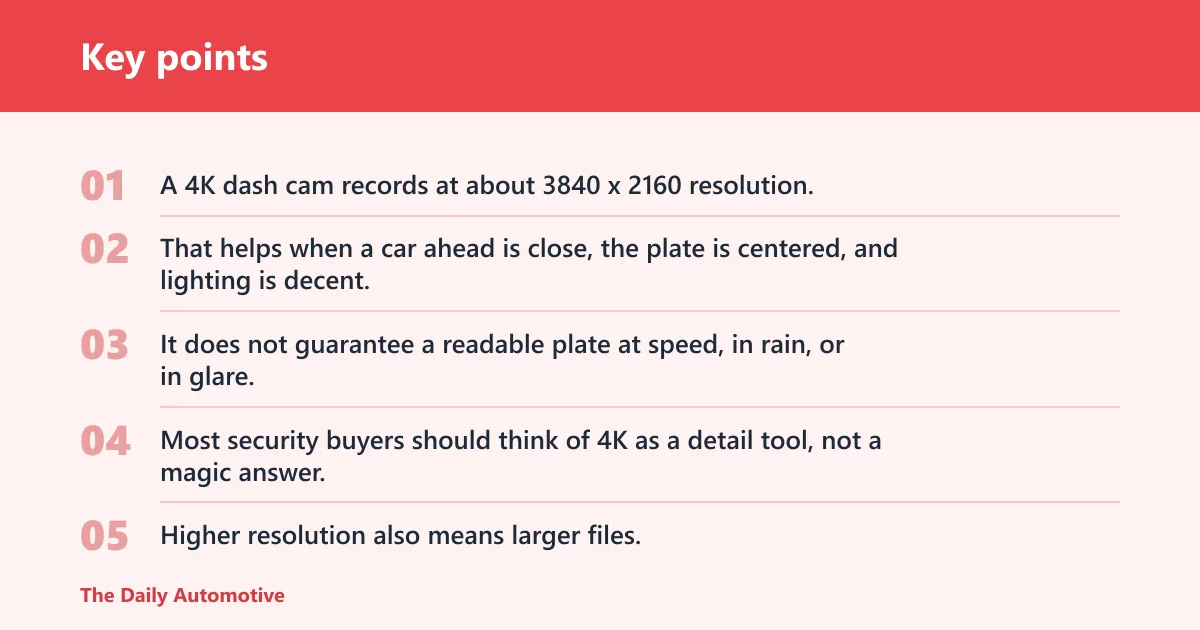
A 4K dash cam records at about 3840 x 2160 resolution, which gives the front camera more pixels to work with than 1080p. That helps when a car ahead is close, the plate is centered, and lighting is decent. It does not guarantee a readable plate at speed, in rain, or in glare.
Most security buyers should think of 4K as a detail tool, not a magic answer. Higher resolution also means larger files, which raises storage demands and shortens how long footage stays on the card before loop recording overwrites it. HDR or WDR matters because it helps preserve detail in bright sky and dark shadows, especially at dawn, dusk, and in headlight glare.
360-degree coverage and blind spots
A 360-degree dash cam reduces blind spots by adding views to the left, right, and often the cabin or full surroundings. That can be better for parked-car security when the threat comes from a side door, a passerby, or a nearby vehicle backing in.
The tradeoff is that 360-degree coverage does not always equal better exterior evidence. Interior-facing or all-around views may catch more context but less plate detail than a focused front 4K camera. Installation is also more complex because more channels mean more cable runs, more mounting decisions, and more storage pressure.
When dual-channel is the better middle ground
Dual-channel dash cams record front and rear, which is enough for many security cases. They can capture a rear-window hit, a tailgater, or a break-in attempt at the back of the car without the extra wiring and storage load of a 360-degree system.
Suppose you park on a city street where most damage comes from passing traffic and rear contacts. A dual-channel camera is usually the smarter choice than a front-only 4K model, because it adds rear evidence without the cost and setup burden of four channels.
Best 4K dash cam: front-camera security
The best 4K security setup is a front camera with strong low-light hardware, buffered parking mode, and enough storage to keep event files until you can review them. Among the listed models, the ROVE R2-4K Dual Dash Cam is the strongest fit because its STARVIS 2 sensor and dual-channel layout support better night evidence than a basic front-only unit.
Night performance and sensor choice
For night security, the sensor often matters as much as the resolution. Sony STARVIS or STARVIS 2 hardware is designed for low-light capture and better dynamic range, which helps when headlights hit a dark road or a parking lot has mixed lighting.
A 4K camera without good low-light tuning can still produce smeared plates or blown-out highlights. HDR or WDR helps balance those scenes. If the front camera is your main evidence source, sensor quality should rank above a raw pixel count.
Storage needs for 4K recording
4K files are large. A common rule of thumb is that a 4K front camera can use roughly 4 GB to 8 GB per hour, depending on bitrate, codec, motion, and whether the rear channel is also recording. Add rear video, and card space disappears faster.
For security use, a microSD endurance card matters more than a bargain card. Look for high write endurance, at least 128GB if your camera supports it, and compatibility with loop recording. In 24/7 use, cheap cards wear out faster, which can leave you with gaps exactly when you need the file.
When 4K matters most
4K matters most when the front view is close, the target is near the center of frame, and you need fine detail like a plate, bumper mark, or badge. It matters less for wide-area surveillance, where coverage and parking triggers are more important than pixel count.
A common first-timer mistake is buying 4K for highway footage and then discovering the parked-car problem is actually from the side. In that case, a better parking mode and rear coverage will do more for evidence quality than a sharper front file.
Best 360-degree dash cam: all-around coverage
The best 360-degree option here is the Orderich 360° Dash Cam because its four-channel design gives the widest coverage of the three listed products. It is the better choice when your security concern is not only the road ahead, but also the cabin, side windows, and nearby activity around the parked car.
Parked-car use cases
360-degree coverage helps when a vehicle sits in a shared lot, garage, or apartment space where the threat can come from any side. Motion detection can capture approach activity, while impact triggers can lock an event if the car is bumped or struck.
That said, parked-car security still depends on power. A 360-degree camera with no hardwire kit or battery pack may lose parking mode when the car is off. Heat, long idle periods, and voltage drop can also interrupt recording if the setup is not done correctly.
Interior coverage versus exterior security
Do not confuse full-cabin coverage with exterior security. Interior views are useful for context, rideshare protection, or showing what happened inside the vehicle, but they do not automatically read license plates better than a front-facing camera.
The value is context. If a side window is smashed or someone leans into the cabin, a 360-degree camera is more likely to record the event from somewhere in the vehicle’s field of view than a front-only unit. For pure plate capture, a focused front 4K camera still has the edge.
Installation complexity to expect
More coverage usually means more installation work. A four-channel system can require more cable routing, more careful mount placement, and more attention to storage settings because every extra view adds to file size and card wear.
That makes it a stronger security tool, but not a simpler one. If you want the widest possible evidence net and are willing to accept more setup work, the tradeoff can be worthwhile. If you want fast installation, dual-channel is easier.
How parking mode works
Parking mode records when the car is off, usually through motion detection, impact detection, or time-lapse. For security use, it is one of the most important features because many vandalism and hit-and-run events happen when the vehicle is unattended.
Motion detection versus impact triggers
Motion detection starts recording when the camera sees movement. Impact or G-sensor triggers lock footage when the car is hit or jolted. The best parking setups use both, because motion can catch an approach and the impact sensor can preserve the actual contact.
False triggers are real. Heavy rain, passing trucks, slamming doors nearby, and vibration can wake the camera too often, fill the card, and drain the battery. Sensitivity settings need to be adjusted so the unit records the right events without logging every minor shake.
Hardwire kits, battery packs, and voltage cutoff
A hardwire kit is the usual path to parking mode. It connects through a fused circuit, allows the camera to run when the car is off, and usually includes a low-voltage cutoff so the vehicle battery does not get drained too far.
A battery pack is another option when you want parked surveillance without leaning on the starter battery. Either way, the system should have voltage protection. If that cutoff is set too low, the dash cam can leave the car with a weak battery after a long overnight session.
Time-lapse versus buffered recording
Time-lapse captures frames at intervals, which saves space but can miss the exact moment a person approaches or a vehicle makes contact. Buffered recording keeps a short rolling clip in memory and saves footage from just before the trigger, which is better for theft and hit-and-run evidence.
For security buyers, buffered recording is usually the better answer. It gives context before impact, not just the impact itself. Time-lapse is easier on storage, but it is weaker when you need a clear sequence of events.
How to choose the right security setup
The right choice depends on where the car sits, how long it sits there, and what kind of threat is most likely. Street parking calls for rear coverage and strong low-light performance. Apartment parking often benefits from wider coverage and better motion logic. Commute-only drivers can get by with simpler front-and-rear recording.
Street parking
Street parking favors a dual-channel or 360-degree setup with parking mode enabled. The likely risks are scrape damage, close passes, and rear contacts. If the street is dark, a STARVIS-class sensor matters because night plate capture is otherwise weak.
Apartment parking
Apartment parking often means more side-angle risk and more foot traffic. A 360-degree camera can help if you want broad scene coverage, but it also needs more wiring and better storage planning. If installation simplicity matters, a dual-channel camera with buffered parking mode is the safer compromise.
Commute-only driving
Commute-only drivers can focus more on front detail and rear incident capture than on 24/7 monitoring. The Affver 4K+2.5K makes sense here because it covers daily driving without making the setup overly expensive or complex. If parking security is not a major concern, front-rear coverage is usually enough.
Storage and endurance cards
High-resolution security cameras stress cards fast. Choose a microSD endurance card, not a general-purpose card, and match capacity to your parking habit. A 128GB card is the practical floor for many dual-channel setups, while 256GB makes more sense if you expect long parking sessions or four-channel recording.
If the camera runs all day and all night, loop recording will overwrite the oldest files. That is normal, but it also means the card has to survive constant writes. Endurance cards are built for that job; standard cards are not.
Picture a driver who parks under a dim apartment light and comes back to a scraped rear door. A front-only 4K camera may show the street ahead but miss the contact entirely. A dual-channel or 360-degree setup is more likely to keep the hit in frame and lock the file through the G-sensor.
Which one should you buy?
Buy the ROVE R2-4K Dual Dash Cam if your budget allows one strong all-around security pick and you care most about night detail, front plate capture, and rear-window evidence. Buy the Orderich 360° Dash Cam if your car faces side-angle risk or you want the broadest parked-car view. Buy the Affver 4K+2.5K Dash Cam if you want front-and-rear security at the lowest practical cost of the three.
If your budget is tight, start with the Affver and add a proper high-endurance card and hardwire kit later. If your car lives on the street, spend on parking mode before spending on more pixels. If your car is garage-kept and you mainly want moving evidence, dual-channel is usually the best value.
Frequently asked questions
What is the best dash cam for security and parking protection?
The strongest security choice here is the ROVE R2-4K Dual Dash Cam because it combines STARVIS 2 low-light hardware, front and rear coverage, and 24-hour parking mode. That mix is better for hit-and-run evidence than a front-only 4K camera with no parked-car power plan.
Do I need 4K or 360-degree coverage for my car?
If your main concern is reading front plates, 4K is usually the better starting point. If your concern is side impacts, vandalism, or cabin context while parked, 360-degree coverage is more useful. Many drivers get the best balance from dual-channel rather than choosing one extreme.
Which dash cams record while the car is parked?
Any camera with parking mode can record while the car is parked, but it normally needs a hardwire kit or battery pack to stay on after shutdown. Motion detection, impact triggers, and buffered recording are the features that make the footage useful instead of random.
What features matter most for theft and hit-and-run evidence?
Look for buffered parking mode, a dependable G-sensor, strong low-light performance, and enough storage to hold event clips. Rear coverage matters for hits from behind, while 360-degree coverage helps when the incident comes from the side or near the cabin.
Is a front-only dash cam enough for security?
It can be enough for simple commuting evidence, but it is weak for parking security. A front-only unit may miss a rear impact, side swipe, or door-ding entirely. For security-focused buyers, dual-channel or wider coverage is the safer choice.
How much storage do I need for a 4K dash cam?
Exact runtime depends on bitrate, whether the rear channel is on, and how often the camera triggers events.
Are 360-degree dash cams better than dual-channel dash cams?
Not always. A 360-degree camera gives wider coverage and more context, but dual-channel cameras are simpler, cheaper to install, and often better at keeping file sizes and power needs under control. For many drivers, dual-channel is the better security value.
What should I look for in a dash cam with night vision?
Look for a STARVIS or STARVIS 2 sensor, HDR or WDR support, and a camera that handles headlight glare without crushing dark detail. Night vision on a spec sheet means little if the plate is still unreadable in low light or the image blows out under streetlamps.
Products related to this article
Sponsored / affiliate links. As an Amazon Associate I earn from qualifying purchases. I may earn additional commission from eligible campaigns.