Best Car Camping Mattresses (2 Real Picks Compared)
For most car campers, the best choice is one of two mattresses: a thick foam self-inflating pad for comfort, or a packable air mattress for small storage. Choose comfort first if you sleep in the vehicle often, packability first if space is tight. Pick wrong and you either lose sleep on a thin bed or waste cargo room on bulky gear. This guide compares both by comfort, packed size, setup hassle, cold-weather use, and fit in SUVs, trucks, and hatchbacks.
Quick comparison
| Product | Badge | Best for | Price | ||
|---|---|---|---|---|---|
 |
Memory Foam Camping Mattress – 3.5-Inch Thick Sleeping PadWakeman | Our pick | 3.5" thick · Dual-layer · Gray | $81.52
Price as of 19 Oct 2026
|
View |
 |
OGERY 3.15" Memory Foam Sleeping Pad, Self-Inflating withOGERY | Upgrade pick | 3.15" thick · Electric pump · 4-Season | $56.98
Price as of 19 Oct 2026
|
View |
The split is simple. Air mattresses usually win on plush feel and thicker cushioning. Self-inflating mattresses usually win on smaller packed volume, faster setup, and better shoulder-season warmth.
The right answer depends on where the mattress has to live between trips, and how often you want to inflate, deflate, and re-pack it.
How we chose
These two picks were compared on the details that matter in vehicle camping: comfort, packed size, inflation method, weight capacity, and fit in real cargo areas. We also looked at failure modes, including puncture risk, valve leakage, and overnight pressure loss.
For cold-weather use, R-value and insulation matter. For small vehicles, packed volume and the mattress’s rolled or folded shape matter just as much as the sleep surface itself.
Both products below are from the provided list. The goal here is not to crown a universal winner. It is to match the mattress type to the problem you need solved.
Wakeman memory foam camping mattress: best for comfort
This is the better fit if sleep comfort matters more than cargo-room efficiency. Based on the manufacturer’s specs and published product details, it uses gel-infused memory foam plus high-density support foam, with a 3.5-inch thickness that should feel closer to a real bed than a thin camping pad.
It is aimed at people who want a softer sleeping surface for a vehicle, tent, cot, or sleepover setup. The water-resistant cover and grippy bottom help it stay put, and the roll-up format with hook-and-loop straps makes it easier to handle than loose foam.
The trade-off is size. A foam mattress of this type usually takes more storage space than a deflated air mattress, and it will not compress into a tiny bundle. If your hatchback cargo area is already crowded, that can matter more than the extra comfort.
OGERY 3.15-inch self-inflating mattress: best for packability
This is the better fit if you want a car camping mattress that packs smaller and sets up with less effort. The published details point to an integrated electric pump, adjustable air pressure, and an insulated foam core, which makes it a more efficient choice for tight storage and faster camp setup.
It is a stronger match for shoulder-season trips and for campers who want a balance between mattress feel and packed volume. The built-in pillow also cuts one extra item from your kit, which helps when cargo space is limited.
The drawback is the same one shared by most air-supported designs: more moving parts. Even with foam inside, the valve system, electric pump, and air chambers add failure points, and you still need to watch for pressure loss from temperature swings or a small leak.
Mattress decision table
| Decision factor | Wakeman memory foam mattress | OGERY self-inflating mattress |
|---|---|---|
| Comfort | High; 3.5-inch foam build suits side sleepers best | Moderate to high; adjustable firmness helps, but it still feels more air-supported |
| Pack size | Bulkier when rolled | Smaller when packed; better for limited cargo room |
| Setup time | Fast to unroll, no pump needed | Fast with built-in electric pump, but still needs inflation and valve handling |
| Cold-weather warmth | Good insulation from foam mass | Better shoulder-season value if the insulated core and air chamber are used well |
| Puncture risk | Low; no air chamber to puncture | Higher; valve leaks and air loss are real failure modes |
| Vehicle-fit confidence | Higher in larger cargo areas; bulk is the main issue | Higher in smaller SUVs, hatchbacks, and tighter storage spaces |
Decision rule: choose the foam mattress if you are a side sleeper, want fewer leak worries, and have space to store a bulkier roll. Choose the self-inflating mattress if the car is small, cargo room matters, or you want a lower-effort setup with better packability.
What is the best car camping mattress for comfort and packability?
The best car camping mattress for comfort is usually a thicker foam or self-inflating model, while the best for packability is usually a self-inflating or air-based design that packs smaller. If you want one mattress to solve both problems, expect a compromise: more comfort means more bulk, and less bulk usually means less cushion.
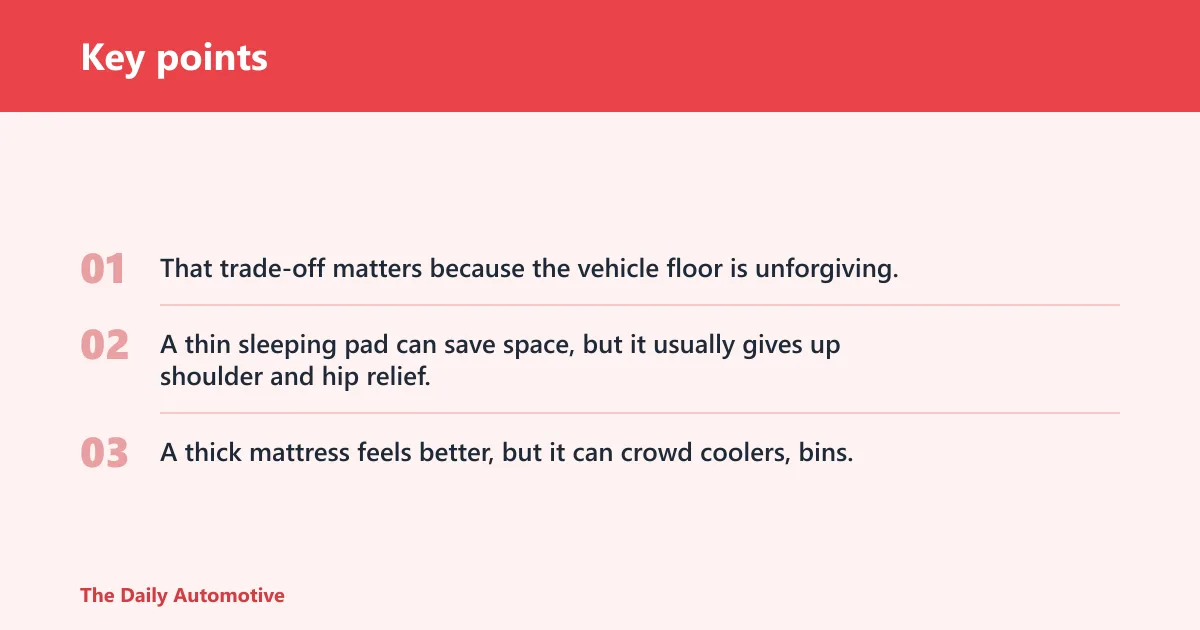
That trade-off matters because the vehicle floor is unforgiving. A thin sleeping pad can save space, but it usually gives up shoulder and hip relief. A thick mattress feels better, but it can crowd coolers, bins, and sleep gear in a small SUV or hatchback.
Do I need a 2-inch, 3-inch, or 4-inch car camping mattress?
Use 2 inches only if pack size is the main goal and you sleep mostly on your back or on short trips. Three inches is the common middle ground for solo campers. Four inches is better for side sleepers, heavier sleepers, or anyone who wants more cushion over the vehicle floor and wheel wells.
Thickness is only part of the decision. A 4-inch mattress that barely fits your cargo area is not a better buy than a 3-inch model that fits cleanly and stays flatter along the edges. For car camping, usable dimensions matter as much as the labeled thickness.
Thickness and sleeping position
Side sleepers usually need more thickness because hips and shoulders sink deeper. Back sleepers can get by with less. Stomach sleepers often prefer a firmer, lower-profile feel, especially in a vehicle where extra loft can create instability.
Say your hatchback gives you just enough length for a folded mattress but not much height when the rear seats are down. In that case, a 3-inch self-inflating mattress may fit where a 4-inch foam mattress will not, even though the thicker option sounds better on paper.
Which is better for car camping: self-inflating or air mattress?
For most buyers, self-inflating mattresses are the safer all-around choice because they balance comfort, insulation, and packability. Pure air mattresses can feel plush, but they are more vulnerable to punctures, pressure loss, and pump hassle. If warmth and storage matter, self-inflating usually wins; if softness matters most, air usually wins.
Foam core and valve basics
A self-inflating mattress uses a foam core that expands when the valve opens, then takes in air to reach full thickness. That foam adds structure and insulation, so the bed feels less hollow and handles colder nights better than a plain air chamber. The valve system also affects setup speed and how easy it is to fine-tune firmness.
Air mattresses and failure modes
An air mattress gives you more plush cushioning for less stored bulk, but it brings puncture risk, seam issues, and overnight pressure loss. Temperature drops can make the bed feel softer by morning, even without a leak, because air contracts in cold weather. That is why fit, inflation, and repair kit access all matter.
Will a car camping mattress fit in my SUV, truck, or hatchback?
Fit depends on three measurements: cargo-area length, cargo-area width between wheel wells, and usable height with the seats folded. A mattress can be “the right size” on paper and still be awkward in a vehicle if the wheel-well spacing is narrow or the rear opening is short.
Check the mattress dimensions against the usable sleep length, not just the full cargo length. A mattress that is too long may bend at the tailgate or press against the front seats. A mattress that is too wide may ride up over the wheel wells and reduce comfort.
How to measure fit
- Measure the flat sleeping length from the hatch to the front obstacle, usually the front seats or folded seatbacks.
- Measure the narrowest width between wheel wells.
- Measure the vertical clearance if you plan to sleep under a shelf, platform, or cargo cover.
- Compare those numbers with the mattress dimensions, including thickness when packed and when inflated or expanded.
Picture a small SUV with 72 inches of usable length but only 40 inches between wheel wells. A wide two-person mattress may seem fine until the side bolsters ride up on the wheel arches. In that case, a narrower solo mattress can sleep better even if it looks less generous on a product page.
How do I keep a car camping mattress from deflating overnight?
Start with the valve and seam checks, then account for temperature. Most overnight softening comes from a small leak, a loose valve, or cooling air inside the mattress. If the mattress is air-based, topping it off before bed and keeping it out of sharp temperature swings helps. A repair kit matters because tiny punctures and seam pinholes are common failure points.
For self-inflating mattresses, the foam core reduces the effect of small pressure changes, but the valve still needs to close fully. Lay the mattress on a clean surface, keep it away from cargo edges, and avoid overinflating to the point that seams are stressed.
Repair kit and field fixes
A repair kit is not optional if you rely on an air mattress. Patches and adhesive help with small holes, and they can also slow a valve-related issue long enough to finish a trip. For seam failure, the fix is usually limited in the field, so prevention matters more than rescue.
What mattress size works best for solo car camping vs two people?
Solo campers usually do best with a mattress that matches one sleeping position cleanly, leaves room for bags, and does not crowd the cargo area. Two people need enough width to avoid shoulder overlap and enough length to keep feet from hitting the hatch or front seats. In small vehicles, two separate pads can be smarter than one oversized mattress.
For solo use, a narrower mattress often fits better and packs smaller. For two people, width is the more common limit, not thickness. If the vehicle is a truck bed or large SUV cargo area, a wider sleep surface becomes more realistic, but only if the mattress can still lie flat.
Solo versus two-person setups
Solo campers who sleep on their side should lean toward a 3-inch or thicker mattress with enough width to roll without slipping off the edge. Two-person setups work best when both sleepers can stay inside the mattress boundary without fighting for the center seam or compressing the edges into wheel wells.
Car camping mattress comparison matrix
This matrix turns the decision into a quick scorecard. Use it to match the mattress type to the problem you are trying to solve, not to chase a perfect score in every column.
| Criterion | Foam self-inflating mattress | Air mattress |
|---|---|---|
| Comfort | 4/5 | 5/5 |
| Pack size | 3/5 | 5/5 |
| Setup time | 4/5 | 3/5 |
| Cold-weather warmth | 4/5 | 2/5 |
| Puncture risk | 4/5 | 2/5 |
| Vehicle-fit confidence | 4/5 | 3/5 |
Short decision rule: side sleepers should start with the foam self-inflating option. Solo campers in small SUVs should favor packability first. Two-person setups need to measure width before anything else, because a mattress that is too wide is a worse fit than one that is a little firmer.
Choose the Wakeman memory foam mattress if… / Choose the OGERY self-inflating mattress if…
Choose the Wakeman if your priority is a softer sleep surface, less leak anxiety, and a mattress that behaves more like a bed than an air chamber. It is the better call if your vehicle has enough cargo room to spare and you do not mind a bulkier roll between trips.
Choose the OGERY if your cargo space is tight, you want built-in inflation, or you need a mattress that packs smaller for frequent travel. It is also the smarter pick for shoulder-season camping, where insulation and controlled firmness matter more than maximum plushness.
A common first-timer mistake is assuming the thickest mattress is automatically the best choice for sleeping in a compact SUV. A 4-inch mattress can still disappoint if it does not fit the cargo area cleanly, while a 3-inch self-inflating model can sleep better in a tight hatchback because it leaves room for the rest of the kit.
Frequently asked questions
Can I use a sleeping pad instead of a car camping mattress?
Yes, if you want the lightest, lowest-profile option and can live with less comfort. A sleeping pad is easier to store and carry, but it usually gives up width, thickness, and cushioning. For long trips or side sleeping, a mattress is usually the better sleep surface.
How much should I spend on a good car camping mattress?
Price should track the type and the features you need, not just the brand name. Spend more for better insulation, a better valve system, or a thicker comfort layer. If you only need occasional use, a simpler mattress can make sense, as long as it fits the vehicle and sleeping position.
What features matter most in a car camping mattress for side sleepers?
Side sleepers should prioritize thickness, edge support, and enough width to avoid rolling off. Three inches is a common starting point, but many side sleepers prefer more. A stable surface matters more than a tiny packed size, because hip and shoulder pressure will wake you up faster than a larger roll will.
How do I choose a mattress for cold-weather car camping?
Look for insulation, not just thickness. R-value is the insulation rating that matters for shoulder-season and cold-weather camping, and it is more useful than thickness alone when comparing sleep systems. A self-inflating mattress with foam insulation is usually the better choice when temperatures drop.
Products related to this article
Sponsored / affiliate links. As an Amazon Associate I earn from qualifying purchases. I may earn additional commission from eligible campaigns.